A Rivalry Between Two Giants:
Dr. Grant B. Bitter and Dr. Robert G. Sanderson in Deaf Education in Utah
Written & Compiled by Jodi Christel Becker
Published in 2015
Updated in 2026
Published in 2015
Updated in 2026
Author's Note
Through my father-in-law, Kenneth "Ken" L. Kinner, a 1954 graduate of the Utah School for the Deaf and the father of two Deaf children, Duane and Deanne, I learned about the life and legacy of Dr. Grant B. Bitter. Dr. Bitter was a prominent advocate of oral and mainstream education for Deaf children, and his significant influence on Deaf education in Utah captured my attention, largely through Ken's vivid stories and personal insights.
Dr. Bitter's educational philosophies helped shape Deaf education in Utah for decades. His work during the 1960s contributed to the expansion of mainstream educational opportunities for Deaf students, earning him recognition as the "Father of Mainstreaming" in Utah Deaf education.
Without Ken's invaluable recollections of Dr. Bitter's work, as well as those of his counterpart, Dr. Robert G. Sanderson, a respected Deaf leader who advocated for sign language, language access, and state schools for the deaf, I would not have been able to explore and document this important chapter of Utah Deaf history.
This webpage examines Dr. Bitter's career, educational philosophy, and lasting influence on Deaf education in Utah. It also explores his well-known rivalry with Dr. Sanderson, whose differing views on language and education shaped many of the discussions surrounding Deaf education during the latter half of the 20th century.
I also encourage you to visit the "The History of Deaf Education in Utah" webpage, which provides a broader examination of the evolution of Deaf education in the state. That page also includes a collection of Dr. Bitter's videos and additional historical resources that help place his contributions within the larger context of Utah Deaf history.
Thank you for your interest in this topic.
Enjoy!
Jodi Christel Becker

Dr. Grant B. Bitter. Source: The Utah Eagle, October 1962
Dr. Grant B. Bitter's Influence
on Deaf Education in Utah
For many decades, Deaf students from across Utah attended the Utah School for the Deaf in Ogden, Utah, where they lived, learned, and socialized with one another. Beginning in the 1960s, however, Deaf education in Utah shifted significantly under the leadership of Dr. Grant B. Bitter, a prominent advocate of oral and mainstream education. Because of his extensive efforts to place Deaf students in neighborhood public schools rather than residential schools for the deaf, Grant became widely known as the "Father of Mainstreaming" in Utah.
This movement stood in sharp contrast to the earlier vision of Dr. Martha Hughes Cannon, a member of the Board of Trustees of the Utah School for the Deaf and the Blind and the first female state senator in the United States. In 1896, Martha sponsored legislation requiring the education of Deaf, blind, and mute children in Utah. Her efforts helped establish the Utah School for the Deaf and the Blind as the state's primary educational institution for Deaf and blind students (Martha Hughes Cannon, Wikipedia, April 20, 2024). She believed Deaf children deserved access to a comprehensive education in an environment that accommodated their communication needs and fostered a strong sense of community.
By contrast, Grant strongly believed Deaf children should learn spoken language and, whenever possible, attend local public schools alongside hearing peers. His advocacy helped gradually expand mainstream educational opportunities throughout Utah. These changes mirrored broader national trends and gained additional momentum following the passage of Public Law 94-142 in 1975, now known as the Individuals with Disabilities Education Act (IDEA). The law guaranteed students with disabilities access to a free and appropriate public education in the least restrictive environment and significantly influenced educational practices across the United States.

Martha Hughes Cannon. Source: Utah State Historical Society, Deseret News Archives
Grant's commitment to Deaf education was deeply personal. His daughter, Colleen, was born deaf in 1954, and her experiences profoundly influenced his educational philosophy. During his professional training at the Lexington School for the Deaf, Grant became troubled by the practice of separating young Deaf children from their families for extended periods. These experiences strengthened his belief that Deaf children should remain at home and, whenever possible, be educated within their local communities (Bluhm, 1987).
Grant had an extensive career in teaching and curriculum development. He began his professional career in the Extension Division of the Utah School for the Deaf in Salt Lake City, where he served as a teacher and curriculum coordinator. His dedication to Deaf education eventually led him to the University of Utah, where he became a professor and director of the Teacher Training Program within the Department of Special Education. In 1968, he was appointed director and professor of the program, where he focused primarily on oral education and the preparation of future teachers of Deaf and hard-of-hearing students. He remained in this position until 1987, one year after the program closed. Grant also served as coordinator of the Deaf Seminary Program for The Church of Jesus Christ of Latter-day Saints in Utah (Bitter, March 15, 1985; Bitter, October 22, 1986; Bluhm, March 17, 1987; "Obituary: Grant Bunderson Bitter," Deseret News, July 2, 2000).
Grant had an extensive career in teaching and curriculum development. He began his professional career in the Extension Division of the Utah School for the Deaf in Salt Lake City, where he served as a teacher and curriculum coordinator. His dedication to Deaf education eventually led him to the University of Utah, where he became a professor and director of the Teacher Training Program within the Department of Special Education. In 1968, he was appointed director and professor of the program, where he focused primarily on oral education and the preparation of future teachers of Deaf and hard-of-hearing students. He remained in this position until 1987, one year after the program closed. Grant also served as coordinator of the Deaf Seminary Program for The Church of Jesus Christ of Latter-day Saints in Utah (Bitter, March 15, 1985; Bitter, October 22, 1986; Bluhm, March 17, 1987; "Obituary: Grant Bunderson Bitter," Deseret News, July 2, 2000).

Colleen Bitter Addie. Source: The Salt Lake Tribune Obituary, July 24, 2003
Throughout his career, Grant remained firmly committed to oralism, the philosophy that Deaf individuals should learn to communicate through speech and speechreading. His commitment to this approach extended beyond the classroom. In 1970, he founded the Oral Deaf Association of Utah (ODAU), reflecting his belief that oral education offered Deaf individuals the best opportunity for integration into the wider hearing society. In 1981, he established the Utah Registry of Oral Interpreters and later served as chair of the Utah Chapter of the Alexander Graham Bell Association. Through these organizations, Grant promoted oral education and advocated for the interests of oral Deaf individuals and their families (Bitter, March 15, 1985; Bitter, October 22, 1986).

'New Curriculum Coordinator for the Extension Division.' Source: The UAD Bulletin, Summer 1969
Grant was also an influential lobbyist at Utah's Capitol, where he worked closely with legislators and policymakers on issues related to Deaf education. He consistently emphasized the importance of preparing Deaf and hard-of-hearing individuals to function successfully in an English-speaking environment. Grant believed that teaching spoken language skills was essential for helping Deaf people achieve successful integration into the hearing world and what he considered a "normal" life. His influence on Deaf education in Utah during the 20th century was comparable to that of Alexander Graham Bell, whose advocacy for oralism profoundly shaped Deaf education in the United States during the 19th century. Like Alexander, Grant viewed speech as the primary pathway to integration within mainstream society (Baldwin, 1990).
Grant's influence extended far beyond Utah. His numerous presentations, workshops, and public appearances demonstrated his commitment to advancing oral Deaf education nationwide. He conducted workshops for oral interpreters at institutions such as the University of Cincinnati and the University of Utah. From 1974 to 1978, he held leadership positions within the Alexander Graham Bell Association for the Deaf, serving as chair of its Governmental Relations Committee and leading the International Parents' Organization. These roles allowed him to promote oral education on both national and international levels. He also worked closely with Utah's congressional delegation, including Senator Orrin G. Hatch, then chair of the Senate Labor and Human Resources Committee, to advocate for legislation and policies supporting oral educational approaches (Bitter, March 15, 1985; Bitter, October 22, 1986).
Grant's influence extended far beyond Utah. His numerous presentations, workshops, and public appearances demonstrated his commitment to advancing oral Deaf education nationwide. He conducted workshops for oral interpreters at institutions such as the University of Cincinnati and the University of Utah. From 1974 to 1978, he held leadership positions within the Alexander Graham Bell Association for the Deaf, serving as chair of its Governmental Relations Committee and leading the International Parents' Organization. These roles allowed him to promote oral education on both national and international levels. He also worked closely with Utah's congressional delegation, including Senator Orrin G. Hatch, then chair of the Senate Labor and Human Resources Committee, to advocate for legislation and policies supporting oral educational approaches (Bitter, March 15, 1985; Bitter, October 22, 1986).

Alexander Graham Bell. Source: Wikipedia
In the 1970s, Stephen C. Baldwin, a Deaf educator and Curriculum Coordinator of the Total Communication Division at the Utah School for the Deaf, reflected on Grant's influence. Stephen described Grant as one of the nation's strongest advocates of oral education and characterized him as a "hard-core oralist." He further noted that few individuals worked as tirelessly to promote oral and mainstream educational approaches (Baldwin, 1990).
According to Stephen, Grant believed that sign language limited the development of speech and listening skills. He argued that oral education would better prepare Deaf individuals to participate in mainstream society. As a result, he favored programs that emphasized spoken language and supported policies that reduced reliance on sign language in residential educational settings (Baldwin, 1990).
As a parent of nine children, Grant's personal experiences influenced his professional work and his commitment to educational advocacy. Throughout his career, he produced numerous publications, audiovisual presentations, and videotape resources promoting oral Deaf education. His scholarship focused on helping Deaf and hard-of-hearing individuals develop spoken communication skills and navigate educational and social environments. This work culminated in the publication of The Hearing Impaired: New Perspectives in Educational and Social Management in 1987, a significant contribution reflecting his lifelong commitment to the oral approach in Deaf education.
Grant remained one of the most influential and controversial figures in Utah Deaf education. Supporters praised his dedication to expanding opportunities for Deaf and hard-of-hearing individuals through oral education, while critics challenged his opposition to sign language and bilingual approaches. Regardless of these differing perspectives, his advocacy, leadership, and educational initiatives played a significant role in shaping Deaf education policy and practice in Utah during the latter half of the 20th century.

Dr. Stephen C. Baldwin.
Source: The Utah Eagle, April 1975
A Philosophical Divide
The debate between Grant Bitter and supporters of residential Deaf education reflected a much larger philosophical disagreement within the Deaf community.
Grant believed Deaf students would benefit most from learning spoken language and attending neighborhood schools. In contrast, many Deaf community leaders believed Deaf children should have access to sign language and opportunities to interact with other Deaf students in a culturally and linguistically accessible environment.
Among the most prominent advocates of sign language and residential Deaf education was Dr. Robert G. "Bob" Sanderson. Having become deaf at age 11, Bob strongly supported educational programs that preserved sign language and Deaf culture. Through his leadership in the Utah Association for the Deaf (UAD), he worked to ensure that Deaf children had access to sign-language-based educational opportunities. Grant's promotion of oral communication and mainstream education also sparked a longstanding conflict with the UAD (Becker, 2026).
The rivalry between these two giant figures—Grant Bitter and Bob Sanderson—stemmed from their ongoing disagreement over the use of oral and sign language approaches in Utah's Deaf education system. This conflict was not merely a matter of personal preference; it represented a fundamental disagreement over the most effective methods for educating Deaf children. Each side sought to influence policy and practice in a rapidly changing educational landscape, like a chess match, which heightened tensions. As the conflict intensified, both groups rallied supporters to advocate for their views and influence public opinion and policymakers (Becker, 2026). The outcome of this debate would help shape the future of Deaf education in Utah and influence similar discussions across the nation.
Over time, the differences between Grant and Bob became one of the most influential debates in Utah Deaf history. Their disagreement centered not only on communication methods but also on broader questions involving language, identity, culture, educational access, and the best way to prepare Deaf children for adulthood.

Dr. Robert G. Sanderson. Photo courtesy of Gallaudet University Archives
Understanding ASL and
Listening and Spoken Language
To better understand this controversy, it is important to recognize that American Sign Language (ASL) and Listening and Spoken Language (LSL) represent different approaches to communication and education.
ASL provides Deaf individuals with direct visual access to language and supports identity development, cognitive growth, and participation in Deaf culture. However, because relatively few hearing people know ASL, Deaf individuals may encounter communication barriers in everyday settings and often rely on interpreters for full access.
LSL focuses on developing listening and spoken communication skills. This approach can support participation in spoken-language environments and neighborhood schools. However, its success often depends on early intervention, consistent therapy, advanced hearing technology, and ongoing support. Listening and lipreading can also be physically and mentally demanding. When spoken-language approaches do not provide full language access and sign language is not introduced, children may be at risk of language deprivation.
Today, many families view ASL and LSL as complementary rather than competing approaches and often combine elements of both to meet the individual needs of their children (Becker, 2026).

Dr. Grant B. Bitter. Source: Deseret News, March 18, 1974
Conflict Between Oral and Sign-Language Advocates
Grant Bitter helped shape policies that favored oral and mainstream educational approaches in Utah. During his graduate training, he was troubled by seeing Deaf children attend residential schools and live away from their families. This experience reinforced his belief in mainstreaming and local educational placement (Bluhm, March 17, 1987).
In contrast, Bob, supported by the UAD, actively participated in ongoing debates regarding sign language and oral communication. He and the UAD emphasized the importance of accessible sign-language education at the Utah School for the Deaf. The disagreement became increasingly heated and played out through oral demonstration panels, picket protests, committee meetings, board discussions, and legislative hearings (Bluhm, March 17, 1987).
During the intense controversy over oral versus sign language education, Grant formally demanded the termination of Bob Sanderson and Dr. Jay J. Campbell, both respected advocates for sign language, at a meeting of the USBE. He argued that their actions were obstructing his mission to promote oral and mainstream education. Moreover, he requested the resignation of Della L. Loveridge, a Utah legislator and the respected chairperson of the committee. He criticized her decision to invite representatives from the UAD, including Bob, viewing this invitation as a deviation from the committee's purpose and focus (Bluhm, March 17, 1987).
Grant's objections extended beyond committee proceedings. He also criticized Beth Ann Stewart Campbell's televised news interpretations in American Sign Language, claiming they conflicted with his oral educational philosophy and urging that the interpreted news segment be discontinued. Furthermore, he called for Bob's dismissal from his position with the Utah State Office of Rehabilitation because Bob had assigned Beth Ann to provide the interpreted broadcasts (Robert G. Sanderson, personal communication, October 21, 2006; Stewart, DSDHH Newsletter, April 2012).
Lasting Impact
The UAD, led by Bob, played a vital role in raising concerns about oral education and mainstreaming policies, while Grant continued to advocate for those approaches. As a representative of the Deaf community, Bob provided significant insight into the challenges Deaf individuals faced in Utah.
Because most Deaf children are born to hearing parents, advocates such as Grant often held considerable influence in shaping educational policy. With support from parents who favored oral education, Grant successfully promoted oral and mainstream programs throughout Utah. Despite the substantial influence of Grant and other oralists, the UAD and its supporters remained steadfast in advocating for sign language, communication access, and the rights of Deaf children.
Their efforts helped preserve educational options for Deaf students and contributed to continuing discussions about language, identity, educational choice, accessibility, and Deaf culture. The debate between oralism and sign-language education remains one of the most significant chapters in Utah Deaf history. Understanding both perspectives provides valuable insight into the evolution of Deaf education and the ongoing efforts to ensure that Deaf children have meaningful access to language, education, and opportunity.

Dr. Grant B. Bitter, Source: The Utah Eagle, October 1967
The Introduction of the Dual-Track Program
In the fall of 1962, Utah's Deaf community was surprised by major educational reforms at the Utah School for the Deaf with the implementation of the dual-track program, commonly known as the "Y" system. The new policy profoundly affected the education of Deaf children and quickly became one of the most controversial developments in Utah Deaf history.
The Utah Association of the Deaf (UAD), which supported sign language and residential Deaf education, was unaware that the Utah Council for the Deaf had played a major role in promoting the change. The council advocated for speech-based instruction and successfully pushed for its implementation at the Utah School for the Deaf in Ogden (The UAD Bulletin, Fall-Winter 1962). It is believed that Grant was a member of this council.
The dual-track program established two separate educational pathways: an oral department and a simultaneous communication department, which was later replaced by a combined communication system. Under the policy, however, all Deaf children were initially required to enroll in the oral department, regardless of their individual communication needs (The Utah Eagle, February 1968; Gannon, 1981). On June 14, 1962, the Utah State Board of Education approved the plan with the support of the Special Study Committee on Deaf Education (The Ogden Standard-Examiner, June 14, 1962; Wight, The Ogden Standard-Examiner, October 19, 1970). After an initial placement period, students could transfer to either the oral or sign language track (Smiley, The Salt Lake Tribune, June 14, 1962; The Ogden Standard-Examiner, June 14, 1962).
Newly appointed superintendent Robert W. Tegeder accepted recommendations from parents who favored oral education and initiated significant changes within the school system (The UAD Bulletin, Fall-Winter 1962; Bluhm, March 17, 1987). These reforms affected not only Deaf children but also their families and the broader Utah Deaf community.

Robert W. Tegeder. Source: The Utah Eagle, October 1959
The "Y" System
The "Y" system imposed significant restrictions on students and their families by separating instruction into two distinct educational tracks. The oral department emphasized speech, lipreading, amplified sound, and reading, while the simultaneous communication department utilized signs, the manual alphabet, speech, and reading (The Utah Eagle, February 1968).
Under this policy, all Deaf children were initially required to enroll in the oral department for the first six years of their education. At the end of that period, a committee evaluated each student's progress and determined whether the student would remain in the oral department or transfer to the simultaneous communication department (The Utah Eagle, February 1968).
Because the oral department served as the default placement, many Deaf community members believed the system favored oral education over sign language. Parents and students had little choice in educational placement until approximately the 6th or 7th grade, when students could continue in the oral department or transfer to the simultaneous communication department (The Utah Eagle, February 1968; Dr. Grant B. Bitter's Paper, 1970s; Deanne Kinner Montgomery, personal communication with the author, May 4, 2024).
Students who transferred from the oral department to the signing program were often labeled "oral failures," a term that created stigma and frustration for many families (The UAD Bulletin, Spring 1965).
Historical sources differ slightly regarding the age or grade level at which students became eligible to transfer. The First Reunion of the Utah School for the Deaf Alumni Program Book (1976) indicates that students generally transferred between the ages of 10 and 12, while The Utah Eagle (February 1968) stated that students remained in the oral department for their first six years of schooling. For this reason, it is most accurate to describe transfer eligibility as occurring around the 6th or 7th grade, depending on each student's individual educational progress.
Changes to the School Environment
The implementation of the dual-track program required major organizational changes at the Utah School for the Deaf. Additional oral teachers were hired, and speech became the primary mode of instruction for younger students. All elementary-aged students entered the oral department, and only those who experienced difficulty progressing within that program were transferred to the simultaneous communication department.
School administrators believed that oral language skills should be developed first and that sign language should play a secondary role in the educational process. As a result, the school's culture and instructional environment changed dramatically. The increased emphasis on oral education altered daily classroom experiences, staffing patterns, and communication practices throughout the campus (The Utah Eagle, February 1968; Deanne Kinner Montgomery, personal communication with the author, May 4, 2024).
The dual-track program also influenced teacher preparation. Training increasingly emphasized oral methods rather than sign language, and school administrators promoted what they described as a "pure oral mindset" among educators. In 1968, the Utah School for the Deaf was one of the few residential schools in the nation to provide a completely oral elementary program (The Utah Eagle, February 1968). By 1973, school officials promoted the dual-track system as unique because it offered both oral and simultaneous communication options within the same institution (Laflamme, The Ogden Standard-Examiner, September 5, 1973).
Segregation on Campus
Following approval of the dual-track program on June 14, 1962, the Ogden campus underwent dramatic physical changes during the summer break (The Ogden Standard-Examiner, June 14, 1962).
The residential campus was divided into separate oral and simultaneous communication departments. Each department maintained its own classrooms, dormitories, dining facilities, recess schedules, and extracurricular activities. Interaction between students in the two programs was discouraged or prohibited in an effort to maintain separate communication environments (The Utah Eagle, February 1968; Wight, The Ogden Standard-Examiner, October 19, 1970).
Athletics provided one of the few exceptions. Because there were not enough students in either department to support separate sports programs, athletic teams combined students from both tracks. Coaches representing both communication approaches worked together to communicate with their respective athletes (The Utah Eagle, February 1968).
This unique arrangement illustrated the practical difficulties and social tensions created by the dual-track system.
Student Reactions to the Dual-Track Program
During the 1962-63 school year, significant changes were implemented at the Utah School for the Deaf without prior notice to Deaf students. When students arrived on campus in August 1962, many were shocked to discover the new policies and divisions within the school. The changes generated considerable frustration among older students and led to disagreements among veteran teachers, administrators, and members of the Utah Deaf community (Diane Quinn Williams, personal communication with the author, 2007).
Barbara Schell Bass, a longtime Deaf teacher at the Utah School for the Deaf, later recalled that the physical and educational separation of students had painful consequences. According to Barbara, philosophical disagreements strained friendships among teachers, classmates became socially divided, and administrators struggled to balance competing loyalties (Bass, 1982).
Barbara Schell Bass, a longtime Deaf teacher at the Utah School for the Deaf, later recalled that the physical and educational separation of students had painful consequences. According to Barbara, philosophical disagreements strained friendships among teachers, classmates became socially divided, and administrators struggled to balance competing loyalties (Bass, 1982).
The 1962 Student Protest
The student protests of 1962 and 1969 were fueled by dissatisfaction with the dual-track program's "Y" segregation system, the separation of oral and signing students, and the administration's perceived dismissal of student concerns (Ogden Standard-Examiner, September 14, 1962; Ogden Standard-Examiner, September 15, 1962; Manuelita "Nellie" Sausedo, personal communication with the author, 2007; Ronald C. Burdett, personal communication with the author, 2007; Celia May Laramie Baldwin, e-mail message to Jodi Christel Becker, April 1, 2024).
Following the 1962 protest against social segregation on the Ogden residential campus, Dr. Grant B. Bitter and other supporters of oral education suspected that the Utah Association for the Deaf had organized the student strike. The Utah State Board of Education investigated the allegations but found no evidence connecting the students' actions to the Utah Association for the Deaf (Sanderson, The UAD Bulletin, Summer 1963; Kenneth L. Kinner, personal communication with the author, May 14, 2011).
Students in the simultaneous communication department organized their own demonstrations in response to the segregation policies. Their actions reflected growing frustration with restrictions that limited interactions between oral and signing students.
Dr. Robert G. Sanderson, who served as president of the Utah Association for the Deaf from 1960 to 1963, denied any involvement in the strike. He maintained that the protest was a spontaneous response by students who felt that conditions at the Utah School for the Deaf had become intolerable (Sanderson, The UAD Bulletin, Summer 1963).
In its Fall-Winter 1962 issue of the UAD Bulletin, the Utah Association of the Deaf expressed support for testing the dual-track program in the classroom. However, the organization strongly opposed complete social isolation, interference with religious activities, damage to the athletic program, and pressure placed on oral students to comply with the "no signing" policy (UAD Bulletin, Fall-Winter 1962, p. 2).
For many members of Utah's Deaf community, the implementation of the dual-track program marked one of the most controversial chapters in the history of Deaf education in Utah.
The 1969 Walkout
The 1969 walkout represented another significant act of student resistance and echoed the concerns raised during the 1962 protest (Dale R. Cook, Paul Arthur, and Linda Snodgrass James, personal communication with the author, May 29, 2011). Although students did not achieve all of their goals, they continued seeking ways to express dissatisfaction with the continuing social segregation imposed by the "Y" system.
Some signing students deliberately crossed into hallways designated for oral students, while others entered areas reserved for the simultaneous communication department. These actions violated school rules that designated certain spaces as off-limits in an effort to maintain what administrators viewed as separate communication environments. Some students openly challenged oral teachers, accusing them of exercising excessive control and authority over Deaf students (Raymond Monson, e-mail message to Jodi Christel Becker, November 9, 2010).
For nearly a decade, the Utah Association for the Deaf and the Parent-Teacher-Student Association worked together to oppose the "Y" system. Supported by parents who favored sign language, these organizations continually challenged the dual-track system despite repeated setbacks and opposition.
Creation of the Two-Track Program
Faced with continuing controversy, Superintendent Robert W. Tegeder sought assistance from Dr. Jay J. Campbell, Deputy Superintendent of the Utah State Office of Education and a strong ally of Utah's Deaf community. Concerned about the welfare of Deaf children and the growing conflict surrounding the "Y" system, Jay worked to develop a new educational framework intended to replace the segregated structure then in place (First Reunion of the Utah School for the Deaf Alumni, 1976; Campbell, 1977; Dr. Jay J. Campbell, personal communication with the author, July 1, 2007).

Dr. Jay J. Campbell. Source: UAD Bulletin, June 1973
Ned C. Wheeler, a 1933 graduate of the Utah School for the Deaf and chair of the USDB Governor's Advisory Council, played a significant role in the effort to reform the existing system. Influenced by Jay's proposals, the student protests of 1962 and 1969, and ongoing opposition from the Parent-Teacher-Student Association, Ned proposed a revised two-track system that would provide parents with educational choices.

Ned C. Wheeler. Photo courtesy of Edith Deininger Wheeler
On December 28, 1970, the Utah State Board of Education approved a new policy that eliminated the "Y" system. The new policy allowed parents to choose between oral and total communication approaches for Deaf children between the ages of 2½ and 21 (Kenneth L. Kinner, personal communication with the author, May 14, 2011; Recommendations on Policy for the Utah School for the Deaf, 1970; Deseret News, December 29, 1970).
However, while supervising the Utah School for the Deaf, Jay observed that many parents were not fully informed about the educational and communication options available to their Deaf children (Campbell, 1977). Although the Utah State Board of Education adopted policies in 1970, 1977, and 1998, the Utah School for the Deaf's Communication Guidelines did not consistently provide parents with a broad range of educational choices. As a result, placement practices were often influenced by a prevailing oral bias, limiting informed decision-making by families.
On April 14, 1977, Jay presented a comprehensive 202-page study of the Utah School for the Deaf to the Utah State Board of Education. His report proposed improvements to the school's educational system through more equitable evaluation and placement procedures. Grant, then a professor at the University of Utah, strongly opposed Jay's findings. He argued that the report contained inaccuracies and drew unsupported conclusions regarding the University of Utah's Oral Teacher Training Program and Deaf education programs throughout the state (G.B. Bitter, March 6, 1978).
The presentation generated intense debate. More than 300 parents attended the meeting, many of whom supported the oral method and applauded Dr. Bitter and Peter Viahos, an Ogden attorney and father of a Deaf daughter, as they presented arguments against Jay's recommendations (The Ogden Standard-Examiner, April 15, 1977).
A group of parents aligned with Grant petitioned the Utah State Board of Education to suspend Jay's study, arguing that its findings were inconclusive. Dissatisfied with his conclusions, they also called for his dismissal (Dr. Jay J. Campbell, personal communication with the author, July 1, 2007). The meeting drew approximately 300 parents and between 50 and 60 Deaf community members, including Ned C. Wheeler, W. David Mortensen, Lloyd L. Perkins, Dennis R. Platt, and Kenneth L. Kinner.
As a spokesperson for oral advocates, Grant presented Jay's supervisor, Dr. Walter D. Talbot, State Superintendent of Public Instruction, with three proposed courses of action:
Dr. Talbot's response intensified tensions within the meeting. Members of the Deaf community strongly opposed the State Board's decision to reassign Jay within the Utah State Office of Education. Their dissatisfaction was evident as they expressed their frustration by stomping on the floor in protest. In his 1987 oral history interview, Grant described the atmosphere as highly emotional and chaotic, stating that he considered leaving the room. Concerned about the escalating conflict, Dr. Talbot ultimately asked Deaf community members to leave the meeting (Bluhm, March 17, 1987). Accounts of the incident vary, and differing interpretations of what occurred remain a subject of disagreement.
However, while supervising the Utah School for the Deaf, Jay observed that many parents were not fully informed about the educational and communication options available to their Deaf children (Campbell, 1977). Although the Utah State Board of Education adopted policies in 1970, 1977, and 1998, the Utah School for the Deaf's Communication Guidelines did not consistently provide parents with a broad range of educational choices. As a result, placement practices were often influenced by a prevailing oral bias, limiting informed decision-making by families.
On April 14, 1977, Jay presented a comprehensive 202-page study of the Utah School for the Deaf to the Utah State Board of Education. His report proposed improvements to the school's educational system through more equitable evaluation and placement procedures. Grant, then a professor at the University of Utah, strongly opposed Jay's findings. He argued that the report contained inaccuracies and drew unsupported conclusions regarding the University of Utah's Oral Teacher Training Program and Deaf education programs throughout the state (G.B. Bitter, March 6, 1978).
The presentation generated intense debate. More than 300 parents attended the meeting, many of whom supported the oral method and applauded Dr. Bitter and Peter Viahos, an Ogden attorney and father of a Deaf daughter, as they presented arguments against Jay's recommendations (The Ogden Standard-Examiner, April 15, 1977).
A group of parents aligned with Grant petitioned the Utah State Board of Education to suspend Jay's study, arguing that its findings were inconclusive. Dissatisfied with his conclusions, they also called for his dismissal (Dr. Jay J. Campbell, personal communication with the author, July 1, 2007). The meeting drew approximately 300 parents and between 50 and 60 Deaf community members, including Ned C. Wheeler, W. David Mortensen, Lloyd L. Perkins, Dennis R. Platt, and Kenneth L. Kinner.
As a spokesperson for oral advocates, Grant presented Jay's supervisor, Dr. Walter D. Talbot, State Superintendent of Public Instruction, with three proposed courses of action:
- Remove Dr. Campbell from his position;
- Reassign him to another position; or
- Request a grand jury investigation into allegations that oral Deaf individuals had been intimidated by certain state programs (Bluhm, March 17, 1987).
Dr. Talbot's response intensified tensions within the meeting. Members of the Deaf community strongly opposed the State Board's decision to reassign Jay within the Utah State Office of Education. Their dissatisfaction was evident as they expressed their frustration by stomping on the floor in protest. In his 1987 oral history interview, Grant described the atmosphere as highly emotional and chaotic, stating that he considered leaving the room. Concerned about the escalating conflict, Dr. Talbot ultimately asked Deaf community members to leave the meeting (Bluhm, March 17, 1987). Accounts of the incident vary, and differing interpretations of what occurred remain a subject of disagreement.

Dr. Walter D. Talbot. Source: The Utah Eagle, April 1970
Although the Utah State Board of Education accepted Jay's report and supporting documentation, it rejected all of his recommendations despite the report's inclusion of data from independent researchers (The Ogden Standard-Examiner, April 15, 1977). As a result, Jay's proposed reforms, including a two-year study designed to improve educational assessment and placement procedures, were never implemented. According to Jay, the plan was effectively shelved and eventually forgotten (Dr. Jay J. Campbell, personal communication with the author, July 1, 2007).
The legacy of the "Y" system and the oral bias embedded within the dual-track program continued to influence parental choice and educational placement for many years. During the 1970s, Jay sought to provide parents with more balanced information through the Parent Infant Program Orientation. Grant opposed these efforts, arguing that total communication lacked a meaningful relationship between sign language and spoken language and characterizing it primarily as a gestural system. He also questioned the validity of the research supporting total communication (Campbell, 1977; Cummins, The Salt Lake Tribune, August 20, 1977; Bluhm, March 17, 1987).
For many years, the Parent Infant Program at the Utah School for the Deaf strongly favored oral approaches and did not consistently provide balanced information about the full range of educational and communication options available to Deaf children. The Utah Deaf Education Core Group, a leading advocate for ASL-English bilingual education, criticized this imbalance and called for parents to receive objective and comprehensive information.
In 2010, Superintendent Steven W. Noyce of the Utah Schools for the Deaf and the Blind developed a revised Parent Infant Program Orientation intended to provide parents with more balanced information. Noyce, a longtime educator, school director, oral advocate, and former student of Dr. Bitter, sought to ensure that families understood the available educational options. Nevertheless, many parents still faced what some viewed as an "either-or" decision between ASL-English bilingual education, which replaced total communication, and Listening and Spoken Language, which replaced the oral program. As a result, the Listening and Spoken Language program continued to expand.

Steven W. Noyce. Source: Twitter
The Utah Association of the Deaf has worked for decades to protect sign language and support Deaf education in Utah. At the same time, Dr. Grant B. Bitter remained one of the most influential advocates of oral and mainstream education in the state. Drawing upon both his personal experiences as a parent and his professional career in Deaf education, Grant significantly shaped educational policy from the 1960s onward.
His advocacy contributed to increased mainstream placement and a corresponding decline in residential school enrollment in Ogden. Many Deaf alums believed these changes weakened the educational and social environment that had long provided language access, cultural identity, and community connections for Deaf students. Following the closure of the Teacher Training Program in the Department of Special Education at the University of Utah in 1986, Grant retired in 1987 (Bitter, March 15, 1985).
Although Dr. Bitter retired in 1987 following the closure of the University of Utah Department of Special Education's Teacher Training Program in 1986 and passed away in 2000, the debates that characterized his career continue to influence Deaf education in Utah (Bitter, October 22, 1986). The controversy surrounding ASL and LSL remains evident in ongoing discussions about language, educational placement, parental choice, and communication access for Deaf children. Throughout his career, Dr. Bitter strongly promoted oral and listening-based educational approaches and resisted calls from the UAD to recognize and include sign language in Deaf education. In contrast, the UAD consistently advocated for a more balanced approach that recognized both sign language and spoken-language options.
Today, the University of Utah's Deaf and Hard of Hearing (DHH) graduate program offers coursework in both American Sign Language (ASL) and Listening and Spoken Language (LSL). This balanced curriculum reflects the broader range of communication options long championed by the Utah Association for the Deaf and illustrates how the debate over Deaf education in Utah has evolved since Dr. Bitter's tenure.
*****
Lisa Richards' Artwork
Reflects on the Grant Bitter Era
Lisa Richards, born in 1959, created this artwork as a reflection on her experiences growing up during the Bitter era and its impact on Deaf education in Utah. Through her art, she explores how her parents' support of Dr. Grant B. Bitter's oral educational philosophy influenced her childhood experiences and contributed to her language deprivation. Lisa attended the oral program at Lafayette Elementary School beginning in 1964 and was enrolled in programs associated with the Utah School for the Deaf throughout the 1960s and 1970s.

In 1964, Lisa Richards read the group news to the rest of the faculty at the oral class for the Utah School for the Deaf at Lafayette Elementary School. Photo provided by Lisa Richards
Her artwork serves not only as a personal narrative but also as a commentary on Grant's views regarding sign language and residential schools for the deaf during that period. Through vivid imagery and personal reflection, Lisa seeks to raise awareness of the long-term effects of language deprivation and emphasize the importance of ensuring Deaf children have full access to language, including American Sign Language (ASL), during their formative years.

Drawn by Lisa Richards in 2022, a former student of the Oral Program at the Utah School for the Deaf
On February 24, 2020, Lisa shared a powerful video describing her experiences in the Oral Extension Division of the Utah School for the Deaf. Established during Grant's advocacy for oral education, the program was designed to help Deaf and hard-of-hearing students develop spoken language skills while remaining in their local communities rather than attending a residential school. In the video, Lisa reflects on both the educational challenges she faced and the lasting impact those experiences had on her life.
By sharing her story, Lisa contributes an important firsthand perspective to the history of Deaf education in Utah. Her willingness to discuss difficult experiences demonstrates the value of personal testimony in understanding the successes, challenges, and consequences of educational policies. Her story also underscores the importance of preserving Utah Deaf history so that the experiences of Deaf individuals are documented, remembered, and understood by future generations.
By sharing her story, Lisa contributes an important firsthand perspective to the history of Deaf education in Utah. Her willingness to discuss difficult experiences demonstrates the value of personal testimony in understanding the successes, challenges, and consequences of educational policies. Her story also underscores the importance of preserving Utah Deaf history so that the experiences of Deaf individuals are documented, remembered, and understood by future generations.
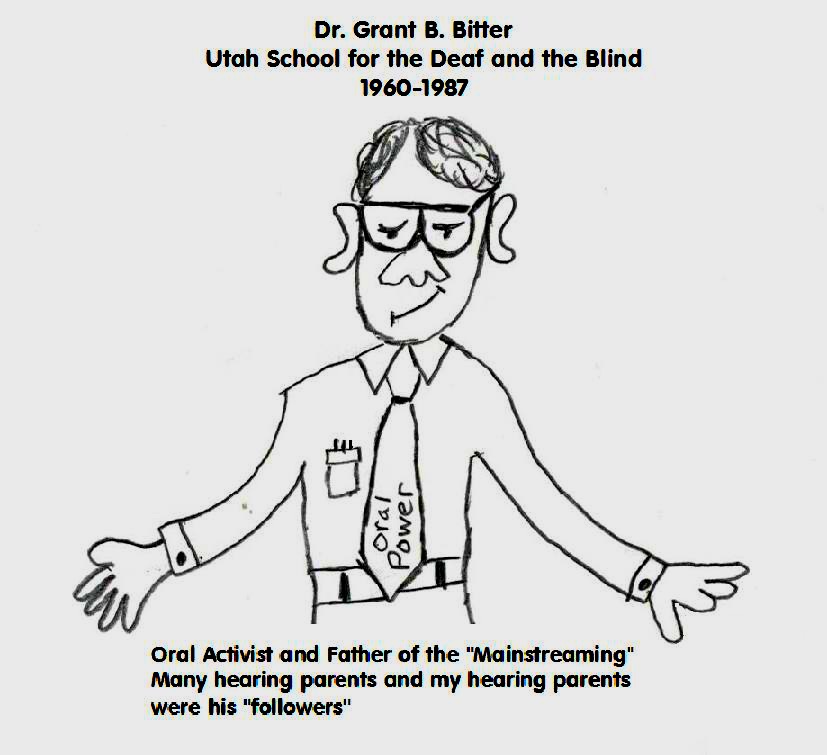
Drawn by Lisa Richards, a former student of the Oral Program at the Utah School for the Deaf
Today, Lisa's artwork stands as both a personal expression and a historical reflection on a pivotal period in Utah Deaf education. It invites viewers to consider the impact of educational philosophies on Deaf children's language development, identity, and well-being while honoring the importance of preserving the diverse experiences of members of Utah's Deaf community.
*****
A Rivalry Between Two Giants:
Dr. Grant B. Bitter and Dr. Robert G. Sanderson
in Deaf Education in Utah
The rivalry between Dr. Grant B. Bitter and Dr. Robert G. Sanderson represents a significant chapter in the history of Deaf education in Utah. Both men played influential roles in shaping educational policy and advocacy within the Utah Deaf community. Their fundamentally different views on communication, language, and educational placement created a longstanding conflict that reflected broader national debates about Deaf education. The impact of their rivalry extended beyond personal disagreements, influencing educational policies, legislative discussions, and opportunities available to Deaf children throughout Utah.
During the 1960s, Dr. Robert "Bob" G. Sanderson, who graduated from the Utah School for the Deaf in 1936 and Gallaudet College in 1941, observed a decline in the use of sign language within Utah's educational system as spoken language gained popularity. His dedication to the Deaf community defined his life's work. In 1964, he was elected president of the National Association of the Deaf after previously serving as president of the Utah Association of the Deaf from 1960 to 1963. In 1965, he became the Deaf Services Coordinator at the Utah State Office of Rehabilitation, which enabled him to directly influence the education and well-being of Deaf children. It was also in 1965 that Bob began his advocacy against Grant (Dr. Robert G. Sanderson, personal communication with the author, October 21, 2006).
His fearless nature led him to challenge Grant, a powerful figure and influential at the University of Utah and in the legislative arena, who supported both oral and mainstream approaches to Deaf education. Many parents who supported oral education backed Grant. Bob's repeated confrontations with him angered Grant and his supporters, who subsequently demanded that Dr. Avaad Rigby, Bob's supervisor at the Utah State Office of Rehabilitation, terminate his employment (Dr. Robert G. Sanderson, personal communication with the author, October 21, 2006; Stewart, DSDHH Newsletter, April 2012).
Avaad recognized the importance of Bob's work and the value he brought to the state of Utah, and he refused to fire Bob. This decision highlighted the crucial role that supportive alliances, even within the administrative hierarchy, play in advocating for Deaf education. Bob had recently been hired as a Deaf Services Coordinator, underscoring his significant value to Utah. Avaad's support for Bob's various political activities outside of work further strengthened their alliance (Stewart, DSDHH Newsletter, April 2012).
The conflict between Grant and Bob mirrored the historic clash between Dr. Edward Gallaudet, the esteemed president of Gallaudet College, and Alexander Graham Bell in the 1800s. Edward advocated for sign language, while Alexander fervently promoted speech and lipreading. This rivalry had a significant impact on the direction of Deaf education in America.

Source: 'Never the Twain Shall Meet: The Communication Debate by Richard Winefield'
Grant Bitter's challenge to the Utah Association for the Deaf was not a random act; it was a response to what he perceived as a threat to his position. During the interview with the University of Utah in 1987, Grant stated that Bob, who became Deaf when he was 11 and grew up in both public school and state school for the deaf, "knew nothing about school programs, but because he was deaf and an advocate of the Deaf community, he obviously played a vital role as far as the Deaf community was concerned" (Bluhm, March 17, 1987, p. 30).
Bob campaigned politically for sign language and was appointed by the Utah State Office of Education to serve on committees alongside other members of the Utah Association for the Deaf. Grant challenged this, particularly targeting Della Loveridge, a legislator and advocate for the Deaf community, who had appointed Bob and other Deaf members to her committee, of which Grant was also a member. He felt threatened by their appointments but denied this during his interview. He believed that his objections were perceived as a threat to them (Bluhm, March 17, 1987).
During a state committee meeting, Della described Grant as "emotionally disturbed." Grant expressed concern that the Utah Association for the Deaf had become too powerful and deeply entrenched within the Utah State Office of Education, where its meetings were held. In response to his concerns, he requested that Della resign as chairperson of the committee, which sparked a vendetta against him (Bluhm, March 17, 1987). The UAD board members were likely heavily invested in Deaf education because they had been excluded from the two years of preparation and implementation of the dual-track program introduced in 1962. This program, which offered both oral communication and sign language, was highly controversial and created divisions within the community, leading to intense debates that exacerbated the conflict. The discussions within the community reflected a broader struggle for recognition and respect for sign language education.
Grant's interview also revealed a significant conflict between him and Dr. Jay J. Campbell, the Deputy Superintendent of the Utah State Office of Education and an advocate for the Utah Deaf community, as well as Dr. Sanderson. Both Jay and Bob were part of a committee studying the operations of the Utah School for the Deaf. With the support of 300 parents of Deaf oral children, Grant successfully blocked their proposal on how the Utah School for the Deaf should run (Bluhm, March 17, 1987).

Dr. Robert G. Sanderson. Source: The UAD Bulletin, Winter 1965
Dr. Frank R. Turk, the national director of the Jr. NAD, worked with Dr. Sanderson, who served as the president of the National Association of the Deaf in the 1960s. Frank's portrayal of Dr. Sanderson differed from that of Dr. Bitter. As a Deaf educator, Frank regarded Bob as an outstanding educator and a passionate advocate for the education of Deaf individuals. Bob had a deep understanding of the connection between a Deaf child's K–12 education and their opportunities in higher education, which ultimately leads to successful employment outcomes.
Additionally, Frank noted Bob's dedication to advocating for young individuals with leadership potential. Bob made significant contributions to promoting social, educational, economic, and community equality for Deaf Americans (Turk, 2019). Bob's personal experience of losing his hearing and feeling out of place in public school likely shaped his commitment to this cause. After overcoming an illness, he thrived at the Utah School for the Deaf, where he observed the educational and social challenges many Deaf children faced in mainstream settings. He was acutely aware of the loneliness and isolation that these children often experienced compared to their hearing peers due to communication barriers. Bob's transformation from feeling lost in public school to succeeding at the Utah School for the Deaf exemplifies his resilience and profound understanding of the obstacles faced by Deaf students.
According to Frank, Bob emphasized the importance of socialization in education. Bob urged teachers to cultivate a culture of inquiry among students regarding their school experiences. He stressed that educators in both public and residential schools should create an environment where Deaf students feel comfortable asking questions and expressing their concerns. He highlighted that socialization is a crucial aspect of Deaf education that is often overlooked (Turk, 2019).
This philosophy is more than just a belief; it serves as a call to action for educators and the wider community to create inclusive and supportive learning environments for Deaf students. Bob's advocacy has raised awareness of the challenges that Deaf students face, underscoring the need for a nurturing educational environment that encourages curiosity. He argued that children should learn not only the traditional three R's—reading, writing, and arithmetic—but also the essential role of socialization. His emphasis on social interaction led to the concept of "resourcefulness," which encompasses the ability to adapt, solve problems, and communicate effectively (Turk, 2019).
Bob believed that nurturing resourcefulness through after-school activities focused on leadership, empowerment, a positive attitude, discipline, empathy, respect, perseverance, and humility is crucial for achieving success in school, college, the workplace, and community life. Consequently, organizations such as the Junior National Association of the Deaf (Jr. NAD) and the Student Body Government (SBG) have taken on the responsibility of fostering these vital skills (Turk, 2019). Bob's advocacy for resourcefulness serves as a powerful reminder of the importance of creating inclusive and supportive environments for Deaf students.

Dr. Frank R. Turk, a Deaf Educator. Source: Deaf Life, August 1989
In a 1982 interview with Gallaudet College, Bob discussed his one-year professorship at the college, during which he held the Powrie V. Doctor Chair of Deaf Studies. In contrast to oralism, Bob argued in an interview for “total communication,” a term used in the 1970s and 1980s to describe the use of all available means of communication to support the development of Deaf children. This approach encompasses sign language, speech, lipreading, and written language (Kent, The Deaf American, 1982).
Bob consistently advocated for the importance of early communication throughout his work. He believed that communication is essential from birth and remains vital throughout life. He stated with urgency that "Communication is life. It starts at birth and is a lifelong process. If a baby is suspected of being deaf, I believe the communication process should begin as soon as the baby can focus their eyes. I would be very concerned that parents understand this. If the process is delayed, a deaf child just cannot catch up—too much is lost. It doesn't matter if the child later learns language or how to read lips; he still won't be able to catch up." This urgent message underscored the importance of early communication (Kent, The Deaf American, 1982, 3).
He emphasized that effective communication is more critical than the specific method used. Many issues arise from a lack of clear communication. To ensure optimal learning and development for a child, the focus should be on the quality of communication rather than on the method itself. Overemphasizing a particular mode can quickly stifle the communication process (Kent, The Deaf American, 1982).
Bob explained that total communication means using all available means to convey ideas when the child is ready. Each child is different in terms of readiness, receptivity, tolerance, frustration levels, and responsiveness. While one child may quickly adapt to speech training, another may become frustrated and unresponsive. Therefore, total communication should take into account these individual differences (Kent, The Deaf American, 1982).
Bob reflected that his life took a significant turn when he lost his hearing at the age of 11. His enrollment at the Utah School for the Deaf, where he learned sign language, marked a transformative chapter in his life. He likely recognized that he had a considerable advantage in language development compared to his peers who had limited access to language at home, because they were born deaf and had hearing parents. The school provided him with full educational access, a stark contrast to the constrained options he faced in public school.
This disparity in educational opportunities likely fueled his advocacy for Deaf children, making it a priority for them to have access to language and education in residential schools. For instance, Bob became a member of the Institutional Council of the Utah Schools for the Deaf and the Blind to express his concerns about the education of Deaf children. He also addressed the USBE to share his insights on how oral and mainstream education can impact Deaf students. He focused on enhancing educational opportunities and outcomes for Deaf children, and he was a vocal critic of the oral curriculum, arguing that it did not adequately address the needs of the Utah Deaf community.
As a Deaf Services Coordinator, Bob Sanderson witnessed many Deaf individuals facing challenges with reading and writing. In 1977, he addressed the USBE, highlighting that Deaf students at the Utah School for the Deaf and those in the public school system faced significant literacy challenges. He believed that teaching the fundamentals of academics to Deaf students would better prepare them to understand the broader curriculum. Bob’s empathy for Deaf individuals was evident in his emphasis on the importance of education in their lives, stating that it was more crucial for them to understand, use, and apply academic fundamentals than to speak. His advocacy for education led the USBE to recognize the significance of the three R’s—reading, writing, and arithmetic—in expanding opportunities for Deaf individuals. He boldly asserted that education was ten thousand times more important for a Deaf person than the ability to speak (Deseret News, February 19, 1977, p. 28).
At the 1977 USBE meeting, Bob made a powerful statement against oral curriculum, asserting that using sign language does not hinder or impede speech development. "A deaf person will not lose their ability to speak if they learn sign language, and telling anxious parents otherwise is a big lie, a monstrous falsehood, and deliberate deceit," he declared. "When our speech is poor, it is due to deafness, not because of sign language" (Cummins, The Salt Lake Tribune, February 19, 1977, B5).
The challenges Bob observed in the lives of Deaf individuals included language deprivation, communication barriers, and limited opportunities to sustain their jobs over time (Cinelli, "On the Green," January 11, 1982). These experiences likely motivated him to question Grant Bitter's mission of promoting oral and mainstream education.

Dr. Robert G. Sanderson. Source: The UAD Bulletin, Fall-Winter 1962
|

Dr. Grant B. Bitter, Source: The Salt Lake Tribune, April 23, 1964
|
A Dispute Between Dr. Robert G. Sanderson
and Dr. Grant B. Bitter: Conflicting
Philosophies in Deaf Education
The dispute between Dr. Robert G. Sanderson and Dr. Grant B. Bitter represents a pivotal chapter in the history of Deaf education in Utah. Their disagreement reflected broader national debates regarding oral education, sign language, and the most effective educational approaches for Deaf children. As two of the most influential figures in Utah Deaf education, their conflict shaped educational policies, legislative discussions, and community perspectives for decades.
At the University of Utah, Grant organized "Oral Demonstration Panels," where local Deaf adults shared their experiences in oral educational settings. The audience often included supporters of sign language and total communication, including Bob Sanderson, W. David Mortensen, C. Roy Cochran, Kenneth L. Kinner, and members of the hearing community. Following the presentations, audience members were invited to participate in question-and-answer sessions. During one of these discussions, Bob asked Grant, "Have you heard the other side of the program?" Rather than responding to the question, Grant abruptly ended the meeting without offering an explanation, illustrating the tension that existed between supporters of competing educational philosophies (Kenneth L. Kinner, personal communication with the author, May 14, 2011).
The conflict extended beyond public meetings. Legia Johnson, a parent and advocate of oral education, became concerned when Grant selected her daughter, Colleen Johnson Jones, to participate in oral demonstration programs. According to later accounts, Legia felt uncomfortable with how her daughter was being used within the demonstrations and ultimately resigned from her teaching position in the Oral Extension Program of the Utah School for the Deaf. Her resignation reflected disagreements that existed even within the oral education community and demonstrated the complexity of educational debates at the time (Lisa Richards, personal communication with the author, April 14, 2009).

Beth Ann Stewart Campbell. Photograph by Robert L. Bonnell
The tension between Bob and Grant was both intense and highly visible. As Bob's designated interpreter, Beth Ann often found herself in the middle of intense debates between them over Deaf education. During an interpreting workshop at Salt Lake Community College on October 15, 2010, she recalled that whenever she entered a room to interpret for Bob, Grant openly objected to her presence. Bob's response was always straightforward:
"Well, she's staying" (Beth Ann Stewart Campbell, Utah Deaf History Channel, YouTube, October 15, 2010).
Beth Ann observed the heated exchanges between Bob and Grant. Bob provoked Grant, who responded with equal determination. During the legislative hearings, Grant deliberately spoke as rapidly as possible and used complex vocabulary to challenge Beth Ann's interpreting skills. Despite his attempts, she kept pace with the discussions, which only appeared to infuriate Grant further. She remained committed to ensuring that Bob had full access to information and equal opportunities to participate in the discussions (Beth Ann Stewart Campbell, personal communication with the author, July 1, 2007).
Throughout these encounters, Bob remained composed and consistently relied on Beth Ann's interpretation, refusing to be disturbed by Grant's taunt, "You can read my lips," Bob refused to give in to the challenge (Beth Ann Stewart Campbell, Utah Deaf History Channel, YouTube, October 15, 2010). Although Bob lost his hearing at age 11 and retained both his speech and lipreading abilities, he preferred using interpreting services whenever possible to ensure full and accurate access to communication.
Reflecting on the longstanding national debate between supporters of oral education and sign language, Beth Ann later remarked that the rivalry between Bob and Grant was particularly bitter and contentious. In her view, their disagreements represented one of the most vicious examples of the broader conflict over Deaf education in the United States (Beth Ann Stewart Campbell, Utah Deaf History Channel, YouTube, October 15, 2010).

Robert G. Sanderson ran for president at the 1964 National Association of the Deaf conference. Photo courtesy of Barry Sanderson
Although Bob lost his hearing at age 11 and retained speech and lipreading skills, he chose to use interpreting services when available to ensure full and accurate communication access. Beth Ann later remarked that while disagreements between supporters of oral and sign language approaches existed throughout the United States, she believed the rivalry between Bob and Grant was particularly intense and personal (Beth Ann Stewart Campbell, Utah Deaf History Channel, YouTube, October 15, 2010).
The disagreement between these educational philosophies also influenced how information was presented to parents. Kenneth L. Kinner recalled a meeting involving a father who was preparing to enroll his fourteen-year-old Deaf son in an oral program. Concerned about his son's limited reading and writing abilities, the father sought advice from Dr. Jay J. Campbell, Deputy Superintendent of the Utah State Office of Education. During their conversation, Jay asked whether the father was aware of the total communication program available through the Utah School for the Deaf. The father replied that he had not been informed of that option (Kenneth L. Kinner, personal communication with the author, May 14, 2011).
This conversation prompted Jay to advocate for the creation of informational materials that would explain both educational programs and their communication approaches. He believed parents should receive comprehensive and up-to-date information about all available options so they could make informed decisions for their children. Jay further emphasized the need to revise these materials regularly as new educational research became available (Campbell, 1977). Grant, however, opposed this effort, arguing that total communication represented a philosophical position rather than a distinct educational methodology (Dr. Grant B. Bitter, February 4, 1985).
Bob consistently maintained that parents should have the right to choose the educational program that best suited their Deaf children. However, he emphasized that those choices should be based on fair, accurate, and research-based information. He opposed what he described as "inaccurate, biased, or one-sided data" and argued that parents deserved access to complete information regarding all available educational options (Sanderson, UAD Bulletin, March 1992).
Ultimately, the conflict between Bob and Grant reflected a larger debate that extended far beyond Utah. Supporters of oral education emphasized speech development, listening skills, and integration into the hearing world. Advocates of sign language and total communication emphasized language access, communication equity, and the importance of providing multiple pathways to learning. While Bob and Grant frequently disagreed, both were deeply committed to improving opportunities for Deaf children and believed they were acting in the best interests of the Deaf community.
Their rivalry remains one of the most significant and influential debates in Utah Deaf history. The discussions they inspired continue to shape conversations about language, communication, educational placement, parental choice, and equal access to education for Deaf children today.
Controversy Surrounding Channel 4 News
This story recounts the events that inspired Dr. Robert G. Sanderson to pursue a Ph.D. It centers on a significant controversy during the late 1960s and early 1970s involving Dr. Grant B. Bitter, a professor of special education at the University of Utah. The conflict extended beyond disagreements over educational philosophy and ultimately motivated Bob to pursue a doctorate during the early 1970s.
Before earning his doctorate in 1974, Bob found himself at the center of a long-running debate over Deaf education in Utah. One of his principal opponents was Dr. Grant B. Bitter, a strong advocate of oralism and mainstream education. Grant believed that Deaf children should learn spoken language and attend their neighborhood public schools to achieve greater integration into society. His philosophy emphasized oral communication and often discouraged the use of sign language. Mainstreaming, likewise, promoted the placement of Deaf students in public schools rather than residential schools for the Deaf (Baldwin, 1990).
Grant's advocacy for oral communication and mainstream education placed him in direct opposition to the Utah Association of the Deaf (UAD), whose membership consisted largely of graduates of the Utah School for the Deaf. Among the organization's leaders was Bob Sanderson, who had become deaf at age 11 and strongly supported sign language and state schools for the Deaf (Becker, 2026).

Beth Ann Stewart Campbell serves as an interpreter for Deaf TV viewers during newscasts. She volunteers as the interpreter in the right-hand corner of the TV screen on Channel 4 during the news broadcast. Source: UAD Bulletin, March 1992
In 1971, another controversy emerged when Beth Ann Stewart Campbell volunteered to interpret the nightly Channel 4 News in sign language. Bob, who was serving as Deaf Services Coordinator, coordinated the effort to provide Deaf viewers with access to current events through sign language interpretation. However, Grant Bitter and other supporters of oral education strongly opposed the presence of an interpreter in the corner of the television screen. They urged Dr. Avard Rigby, Bob's supervisor, to prevent Beth Ann from interpreting the news (Stewart, DSDHH Newsletter, April 2012).
Bob and Beth Ann, along with Gene Stewart, a vocational rehabilitation counselor for the Deaf, were anxious when Avard invited them to a meeting with oral advocates who were complaining about the presence of an interpreter during the evening news broadcasts. Bob, Gene, and Beth Ann feared that the interpreting service might be discontinued and were on pins and needles waiting to learn how Avard would respond (Stewart, DSDHH Newsletter, April 2012).
During the meeting, Avard listened to the complaints from the oral advocates while serving as a mediator. At the time, there were only three major television news channels, and Beth Ann interpreted for only one of them. After hearing their concerns, Avard responded, “Well, if you don't like watching her, why don't you change the channel?” (Stewart, DSDHH Newsletter, April 2012; Becker 2026).
Avard's remark only served to further infuriate the oral advocates, who then demanded that he fire Bob. They were upset by Bob's role in organizing sign language interpretation of the news. However, Avard refused, stating that Bob was one of his best employees. His decision brought relief not only to Bob, Gene, and Beth Ann but also to many members of Utah's Deaf community who relied on the service. This powerful moment demonstrated the strength of their solidarity and underscored the importance of their cause (Robert G. Sanderson, personal communication to the author, October 21, 2006; Stewart, DSDHH Newsletter, April 2012).
Following the meeting, Bob confided in Gene Stewart:
"No one listens to you unless you have a Ph.D. after your name, so I'm going back to school" (Stewart, DSDHH Newsletter, April 2012, p. 3).
At the time, Bob held a master's degree but often felt that his expertise and opinions were discounted. In contrast, Grant benefited from the credibility and professional respect associated with holding a doctorate. Frustrated by these challenges and determined to strengthen his advocacy efforts, Bob enrolled at Brigham Young University (Deseret News, September 26, 2003).
In 1974, Bob earned a doctorate in educational administration, becoming the first Deaf person at BYU and the first Deaf Utahn to receive a Ph.D. (Deseret News, September 26, 2003). His achievements demonstrated perseverance, determination, and a commitment to advancing opportunities for Deaf people.
The rivalry between Bob and Grant intensified discussions about Deaf education throughout Utah. While Grant continued to promote oral communication, Bob remained a steadfast advocate for sign language and expanded educational opportunities for Deaf students. Their disagreements reflected broader national tensions over educational philosophies and communication approaches for Deaf students (Becker, 2026).

'State Educator First Deaf Student To Receive Doctor Degree at BYU.' Source: The Ogden Standard-Examiner, April 29, 1974
Hannah P. Lewis Recognizes
Dr. Robert G. Sanderson as a Guiding Light
Hannah P. Lewis, a mother of a grown Deaf son, wrote a compelling article for the Deseret News on November 24, 1977, in response to a meeting held by the Utah State Board of Education on November 18, 1977. In her piece, she advocated for total communication and addressed the significant challenges faced by Deaf students, questioning the duration of ongoing studies in this area. She posed a critical question: How many more years would this study require?
During the board meeting, Grant Bitter advocated for oral education and spoken communication. Hannah, on the other hand, expressed concerns about the challenges many Deaf kids face when learning speech skills. She emphasized the importance of sign language as a fundamental tool for effective communication. She challenged the idea of relying solely on spoken language, especially for those who encounter communication barriers. Hannah observed that Grant was concerned that students capable of spoken communication might choose to rely primarily on sign language instead of speech.
Hannah reflected on her personal experiences, sharing that her son, who attended the Utah School for the Deaf, often felt "dumb" during his visits home because he struggled to be understood. She reassured him that both he and his Deaf peers were intelligent and that deafness was simply a barrier to their expression. Realizing that Deaf individuals can hold jobs, raise families, and contribute to their communities, she regretted not allowing him to learn sign language, as the school superintendent had advised her to do 36 years earlier.
Hannah emphasized the importance of considering various communication methods, pushing back against the notion that authority figures, such as Dr. Bitter, should dictate how Deaf children communicate. She expressed deep gratitude to Bob Sanderson, a well-known advocate for the Deaf community, for his invaluable support during her son's upbringing (Lewis, Deseret News, November 24, 1977).
Despite having different political views, Hannah recognized Bob's significant impact as a guiding light for the Deaf community. "I cannot thank him enough for all the help he has given my son throughout his growing-up years," she stated, adding, "Thank God for a man like him" (Lewis, Deseret News, November 24, 1977, p. A4). After obtaining his Ph.D., Bob continued to advocate for the Deaf community, culminating in the naming of the Deaf Center in his honor in 2003. Given this context, Hannah would likely agree with Dr. Frank R. Turk's positive assessment of Bob.
The Impact of the Utah School for the Deaf
The Utah Association of the Deaf has played a pivotal role in advocating for sign language, educational access, and the continued support of the Utah School for the Deaf in Ogden, Utah. Throughout the 20th century, the organization worked to ensure that Deaf individuals had a voice in educational policies that affected their lives and future opportunities.
Beginning in 1962, Dr. Grant B. Bitter became one of the most influential figures in Utah Deaf education. Drawing upon his experiences as a parent of a deaf child and his professional training, he strongly promoted oral and mainstream educational approaches. His efforts contributed to a decline in enrollment at the Utah School for the Deaf's residential campus in Ogden, as increasing numbers of Deaf students were educated in local public schools. While supporters viewed mainstreaming as an opportunity for Deaf students to remain with their families and participate more fully in hearing communities, many members of the Utah Deaf community expressed concern about the loss of opportunities for peer interaction, social development, cultural connection, and direct access to sign language within a residential school environment.
As mainstreaming became increasingly common in Utah, many graduates of the Utah School for the Deaf reflected fondly on their experiences at the Ogden campus. For many Deaf students, the residential school provided more than an education. It offered a sense of belonging, lifelong friendships, leadership opportunities, cultural identity, and full access to communication. Some believed that these experiences could not be replicated in mainstream settings, where Deaf students were often isolated from other Deaf peers and had limited opportunities to participate fully in classroom and social activities.
The debate between residential education and mainstreaming became one of the most significant issues in Utah Deaf education during the latter half of the 20th century. Advocates of oral and mainstream education emphasized integration into the hearing world and the development of spoken language skills. Supporters of the Utah School for the Deaf emphasized the importance of language access, Deaf role models, cultural identity, and community. These differing perspectives shaped educational policies, legislative discussions, and community debates for decades.
Following the closure of the Teacher Training Program within the Department of Special Education at the University of Utah in 1986, Grant retired the following year (Bitter, A Summary Report for Tenure, March 15, 1985). Today, the University of Utah continues to offer programs for educators working with Deaf and hard-of-hearing students, including coursework in American Sign Language. Nevertheless, the influence of oral and listening-spoken-language approaches continues to be visible in many educational programs, reflecting a legacy that extends beyond Grant's lifetime.
At the same time, the Utah Association of the Deaf continued advocating for greater recognition of American Sign Language and bilingual education. Through the efforts of Deaf leaders, parents, educators, and community members, a new generation embraced the challenge of expanding educational opportunities for Deaf children. These efforts contributed to the establishment of ASL/English bilingual programs in Ogden, Salt Lake City, Springville, and St. George. Together, these programs have increased awareness of Deaf culture, promoted language access, and provided additional educational options for Deaf students and their families.
The development of ASL/English bilingual programs reflects the continuing evolution of Deaf education in Utah. These programs seek to ensure that Deaf children have full access to language while developing academic, social, and cultural competencies. They represent an ongoing commitment to providing Deaf students with educational environments where they can thrive and reach their full potential.
However, it is equally important to recognize the contributions of Grant and other advocates of oral education. Their efforts to expand educational options and promote spoken-language development remain an important part of Utah Deaf history. Although many members of the Deaf community disagreed with their philosophy, their influence helped shape educational policies and practices that affected generations of Deaf and hard-of-hearing students.
As Robert A. Heinlein observed, "A generation that ignores history has no past and no future." The history of Deaf education in Utah demonstrates the importance of understanding differing viewpoints, learning from past experiences, and continuing to advocate for educational opportunities that meet the diverse needs of Deaf children. By studying this history, we gain a deeper appreciation for the individuals, organizations, and communities whose efforts helped shape Deaf education in Utah.
The story of the Utah School for the Deaf is ultimately one of advocacy, perseverance, and continuous growth. The discussions and debates surrounding language, communication, and educational placement continue today, but they are rooted in the efforts of those who came before. Their legacy reminds us that access to language, education, and opportunity remains essential for the success and well-being of every Deaf child.

Dr. Robert G. Sanderson in his office. Photo courtesy of Barry Sanderson
A Collection of
Dr. Grant B. Bitter's Videos
During a cleaning session at work, my colleague Julie Hesterman Smith, an ASL interpreter, and I were excited to find some old videos created by Dr. Grant B. Bitter. I would like to express my heartfelt gratitude to all our interpreters, especially Julie, for their hard work in captioning these videos.
In 2011, Julie devoted countless hours to transcribing recordings. Unfortunately, a computer crash resulted in the loss of all her work, forcing her to start over. Undeterred by this setback, she persevered and successfully completed the transcripts again. Thanks to her dedication, we proudly uploaded these videos to YouTube in 2012, enabling us to share Dr. Bitter's valuable insights along with those of the oral panelists, including his daughter, Colleen.
While we aimed for accuracy in the captions, the low quality of the videos and difficulties in understanding some panel members may have led to a few inaccuracies. We sincerely appreciate the contributions of all the panelists and did our utmost to ensure their words are accurately represented.
Enjoy!
Jodi Christel Becker & Julie Hesterman Smith

The videos of Dr. Grant B. Bitter. Photograph by Jodi Christel Becker
In this video, oral Deaf education advocate and University of Utah professor Dr. Grant B. Bitter interviews Arthur Simon, Sue DeHaan, and Elaine about their educational backgrounds and experiences as Deaf individuals. The interviews provide insight into differing perspectives on Deaf education during this period.
In this 1983 discussion at the University of Utah, Deaf individuals who primarily communicated through speech and speechreading shared their perspectives on the use of interpreters, note takers, and other communication accommodations. The discussion was moderated by oral Deaf education advocate and University of Utah professor Dr. Grant B. Bitter.
Filmed in May 1987 in Dr. Grant B. Bitter's Special Education 540 class at the University of Utah, this video features a panel of Deaf individuals discussing their preferences regarding speechreading and oral interpreting. The discussion explores communication access, accommodation choices, and the role of spoken communication in their daily lives.
Filmed in May 1987 in Dr. Grant B. Bitter's Special Education 540 class at the University of Utah, this video features a panel of Deaf individuals discussing their preferences regarding speechreading and oral interpreting. The discussion explores communication access, accommodation choices, and the role of spoken communication in their daily lives.
Filmed in May 1987 in Dr. Grant B. Bitter's Special Education 540 class at the University of Utah, this video features a panel of Deaf individuals discussing their preferences regarding speechreading and oral interpreting. The discussion explores communication access, accommodation choices, and the role of spoken communication in their daily lives.
Personal Communication
Beth Ann Stewart Campbell, personal communication with the author, July 1, 2007.
Celia May Laramie Baldwin, e-mail message to Jodi Christel Becker, April 1, 2024.
Deanne Kinner Montgomery, personal communication with the author, May 4, 2024.
Diane Quinn Williams, personal communication with the author, 2007.
Dale R. Cook, Paul Arthur, and Linda Snodgrass James, personal communication with the author, May 29, 2011.
Kenneth L. Kinner, personal communication with the author, May 14, 2011.
Lisa Richards, personal communication with the author, April 14, 2009.
Jay J. Campbell, personal communication with the author, July 1, 2007.
Manuelita "Nellie" Sausedo, personal communication with the author, 2007.
Raymond Monson, e-mail message to Jodi Christel Becker, November 9, 2010.
Ronald C. Burdett, personal communication with the author, 2007.
Dr. Robert G. Sanderson, personal communication with the author, October 21, 2006.
Sources
Baldwin, Stephen C. "Mainstreaming in Retrospect: A Deaf Perception." National Association of the Deaf, 1990, pp. 14-16.
Bass, Barbara. "Profile: Teacher Dora Laramie." Perspectives for Teachers of the Hearing-Impaired, vol. 1, no. 1, September 1982.
Campbell, Beth Ann Stewart. Utah Deaf History Channel. YouTube, October 15, 2010.
Becker, Jodi Christel. "Robert G. Sanderson: Utah's Deaf Community Advocate." Scholarly Publishing Collection, vol. 94, no. 3, July 1, 2026, pp. 221-236.
Bitter, Grant B. Letter to Edward W. Clyde, March 6, 1978. Grant B. Bitter Papers, Accn. #1072, Manuscripts Division, J. Willard Marriott Library, University of Utah, Salt Lake City, Utah.
Bitter, Grant B. "Summary Report for Tenure." Grant B. Bitter Papers, Accn. #1072, Manuscripts Division, J. Willard Marriott Library, University of Utah, Salt Lake City, Utah, 1985.
Bitter, Grant B. "Utah's Hearing Impaired Children...At High Risk." Grant B. Bitter Papers, Accn. #1072, Manuscripts Division, J. Willard Marriott Library, University of Utah, Salt Lake City, Utah, October 22, 1986.
Bluhm, H. P. "Grant Bitter: Everett L. Cooley Oral History Project." J. Willard Marriott Library, University of Utah, Salt Lake City, Utah, March 17, 1987.
"Board of Education Backs Teacher Staffing Concept." Deseret News, June 12, 1970, p. C3.
Campbell, Jay J. Education of the Deaf in Utah: A Comprehensive Study. Utah State Board of Education, Office of Administration and Institution Services, February 15, 1977.
Cinelli, Pattie. "Sanderson Researches Social Factors in VR Programs for Deaf Persons." On the Green, vol. 12, no. 12, January 11, 1982, pp. 1-2.
Cummins, John. "Deaf School Appeals Lodged." The Salt Lake Tribune, February 19, 1977, p. B5.
Cummins, John. "Board to Study Methods of Teaching Deaf." The Salt Lake Tribune, August 20, 1977.
Cummins, John. "Deaf Education Methods Best Served by 'Re-Channeling Energy.'" The Salt Lake Tribune, April 15, 1977.
"Deaf School Backed." Deseret News, June 16, 1970, p. A18.
"Deaf Seek Better Schooling." Deseret News, February 19, 1977, p. 28.
"Dissatisfied Students of the Utah School for the Deaf Ended the Strike." Ogden Standard-Examiner, September 15, 1962.
"Education Board Splits Teaching Methods for Deaf." Ogden Standard-Examiner, December 29, 1970.
First Reunion of the Utah School for the Deaf Alumni. Booklet, 1976.
Gannon, Jack R. Deaf Heritage: A Narrative History of Deaf America. Silver Spring, Maryland: National Association of the Deaf, 1981.
Kent, Cheryl. "The Times Breed Leadership." The Deaf American, vol. 34, no. 8, 1982.
"Leaving the Safe Walled World of Silence Is a Challenging Step for Deaf." The Salt Lake Tribune, May 31, 1970, p. B9.
Lewis, Hannah P. "End Fight on Deaf Methods." Deseret News, November 24, 1977, p. A4.
Martha Hughes Cannon. Wikipedia, April 20, 2024.
"New Curriculum Coordinator for the Extension Division." The UAD Bulletin, vol. 6, no. 1, Summer 1969, p. 1.
"New Developments in Utah's Educational Programs for the Deaf." The Utah Eagle, vol. 79, no. 5, February 1968, pp. 13-15.
"Obituary: Grant Bunderson Bitter." Deseret News, July 2, 2000.
"Oral Approach to Teaching Deaf Is Defended at Confab." Deseret News, June 16, 1970, p. B6.
"Sanderson Deserves His Due." Deseret News, September 26, 2003.
"She Lives in a Silent World." Box Elder Journal, March 27, 1966, p. 5.
Stewart, Gene. "Robert G. Sanderson 'Sandie.'" DSDHH Newsletter, April 2012, pp. 2-3.
Smiley, William F. "State Okeys 2-Way Plan For Teaching of Deaf." Salt Lake Tribune, June 14, 1962, 1B-2B.
"Students of the Utah School for the Deaf on Strike." Ogden Standard-Examiner, September 14, 1962.
"Subcommittee #4 Recommendations." Grant B. Bitter Papers, Accn. #1072, Manuscripts Division, J. Willard Marriott Library, University of Utah, Salt Lake City, Utah, 1970.
The Ogden Standard-Examiner, April 15, 1977, p. 15.
"The University of Utah." Graduate School of Education, November 28, 1977.
"Two-Way Program to Be Instituted This Fall at Utah School for the Deaf." Ogden Standard-Examiner, June 14, 1962.
Turk, Frank R. From Oaks to Acorns: Promoting Deaf Youth Leadership Through Multigenerational Engagement. Deaf Life Press, May 2019.
Wight, R. "Deaf Teaching Methods Debated." Ogden Standard-Examiner, October 19, 1970.
"Who's for the Deaf?" The UAD Bulletin, vol. 2, no. 8, Fall-Winter 1962, pp. 2-3.
