House Bill 60: Changing the
Term from 'Hearing Impaired'
to 'Deaf and Hard of Hearing'
Compiled & Written by Jodi Christel Becker
Edited by Valerie G. Kinney
Published in 2017
Updated in 2026
Edited by Valerie G. Kinney
Published in 2017
Updated in 2026
Author's Note
When I learned that House Bill 60 had passed, replacing the term "Hearing Impaired" with "Deaf and Hard of Hearing" in Utah state law, I was thrilled. This change was not only a legislative achievement but also a personal victory. I knew I had to attend the signing ceremony and witness this historic moment. In the slideshow below, I have shared candid photos from the event, along with a tribute to the dedicated advocates who helped make this change possible.
At the signing ceremony, I had the privilege of meeting Utah Governor Gary R. Herbert. His warm smile and genuine interest in the bill made the occasion even more memorable.
This achievement was especially meaningful to me because, from 2007 to 2009, Dennis R. Platt, Jill Radford, and I represented the Utah Deaf community on the Legislative Work Group for the Utah Schools for the Deaf and the Blind. We proposed replacing the term "Hearing Impaired" with "Deaf and Hard of Hearing" in House Bill 296. Although that effort was unsuccessful at the time because the workgroup chose to retain the federal terminology, it helped lay the groundwork for future advocacy and change.
On March 25, 2009, Governor Jon Huntsman Jr. signed legislation that ended Utah's promotion of mainstreaming for Deaf and hard-of-hearing students, marking another important milestone for the community. The bill-signing ceremony took place on April 30, 2009.
Under the leadership of Stephen Persinger, the Utah Association of the Deaf made history by becoming the first state organization in the nation to successfully advocate for replacing the term "Hearing Impaired" with "Deaf and Hard of Hearing" in state law. House Bill 60, signed on March 17, 2017, officially amended Utah state statutes and recognized language that better reflects the identities of Deaf and hard-of-hearing individuals.
Many members of the Deaf community view the term "Hearing Impaired" as outdated and sometimes offensive because it focuses on perceived impairment rather than identity, language, and culture. The adoption of "Deaf and Hard of Hearing" represents a more respectful and inclusive approach. We also encourage the use of a capital "D" in "Deaf" when referring to the Deaf community and its rich language, culture, traditions, and shared experiences.
Additionally, we encourage using a capital "D" when referring to Deaf individuals and the Deaf community to promote inclusion for all, regardless of background or experience. This change is part of the Deafhood journey, which emphasizes embracing identity and advocating for rights and accessibility. Supporting Deafhood empowers individuals to thrive and highlights the value of their contributions and perspectives.
We are deeply grateful to Stephen Persinger, Pamela Mower, W. David Samuelson, and Marilyn Tiller Call for their leadership, advocacy, and support throughout the legislative process. Their efforts, combined with those of many advocates and allies, helped make this historic achievement possible.
Thank you for your interest in this important chapter of Utah Deaf history. We are proud that Utah became the first state in the nation to replace the term "Hearing Impaired" with "Deaf and Hard of Hearing" in state law, and we were honored to witness the ceremonial signing of this landmark legislation.
Enjoy!
Jodi Christel Becker
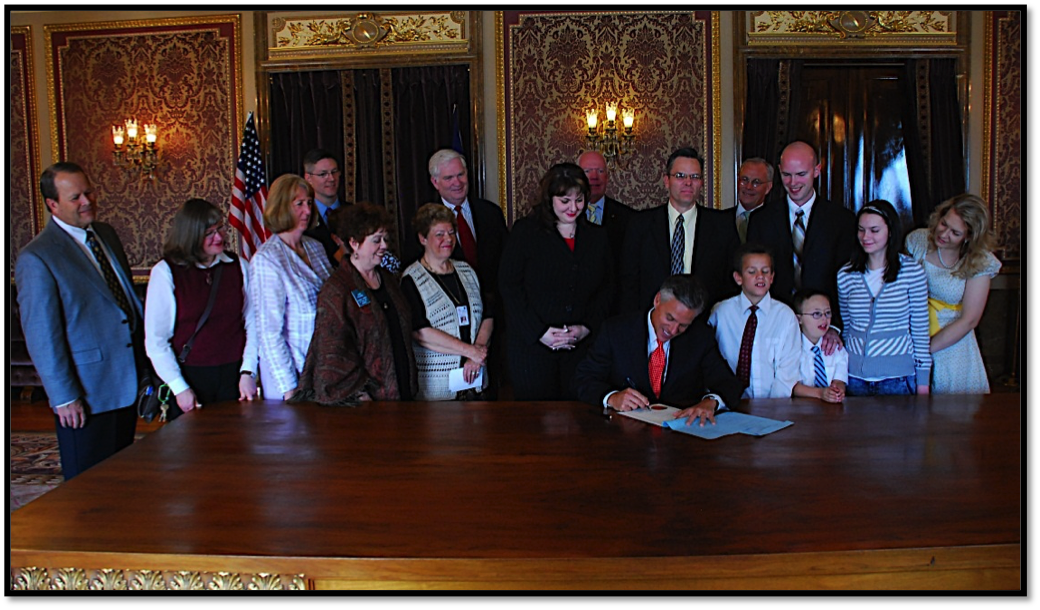
Governor Jon Huntsman, Jr., ceremoniously signed HB 296 into law at the Utah Capitol on April 30, 2009, regulating Utah Schools for the Deaf and the Blind. I'm on the left side, wearing a vest and a white blouse, witnessing the signature. Photo from the private collection of Jodi Christel Becker
In a historic milestone, Utah became the first state in the nation to officially replace the term "Hearing Impaired" with "Deaf and Hard of Hearing" throughout state law. This change was enacted through Utah House Bill (HB) 60, which Governor Gary Herbert signed into law on March 17, 2017. The Utah Association of the Deaf (UAD) played a pivotal role in advocating for this important legislative achievement. The passage of HB 60 represented a significant step toward recognizing and respecting the identities and preferences of Deaf and hard of hearing individuals while promoting more accurate and contemporary language in state statutes.
During the 2017 legislative session, Stephen Persinger, president of the Utah Association of the Deaf, Pamela Mower, vice president of the association, and W. David Samuelson, a longtime advocate for the Utah Deaf community, worked diligently to support HB 60. Their efforts received strong support from Representative Norman Thurston, who sponsored the bill and successfully guided it through both the Utah House of Representatives and the Utah Senate. Governor Herbert signed the bill into law on March 17, 2017, marking the successful culmination of a collaborative advocacy effort. The passage of HB 60 demonstrated the effectiveness of community engagement and legislative partnership in bringing about meaningful change.
Representative Thurston had already established a strong working relationship with Utah Deaf community leaders during the 2016 legislative session when he sponsored Utah House Bill (HB) 325. This legislation reorganized portions of the Utah State Office of Rehabilitation, including the Division of Services for the Deaf and Hard of Hearing, under the Department of Workforce Services. During the legislative process, Thurston worked closely with Deaf leaders such as Stephen Persinger, Philippe Montalette, Pamela Mower, and W. David Samuelson to ensure that the language used in the bill accurately reflected the community it served. This positive collaboration helped lay the foundation for the introduction of HB 60 the following year.
HB 60 sought to replace the term "Hearing Impaired" in Utah statutes with "Deaf and Hard of Hearing," reflecting terminology preferred by many members of the community. The change acknowledged the importance of language in shaping perceptions and ensuring that official government terminology reflects the identities of the people it represents.
On April 11, 2017, I had the privilege of attending the ceremonial bill-signing event with Representative Thurston, Marilyn Tiller Call, Stephen Persinger, Pamela Mower, W. David Samuelson, Brandon Bowden, Brooke Budzinski Grossinger, and her five-year-old daughter, Milika Grossinger. As we watched Governor Herbert sign the bill, the moment symbolized not only the success of years of advocacy but also the continued progress of the Utah Deaf and hard of hearing community. It was a meaningful occasion that demonstrated the power of collective action and community leadership.
Following the enactment of HB 60, several states contacted UAD President Persinger to learn more about Utah's experience and explore similar legislative efforts. According to Persinger, these inquiries reflected growing interest in adopting language that more accurately represents Deaf and hard of hearing individuals. By sharing Utah's experience, the UAD helped encourage broader discussions about respectful and inclusive language across the country (Persinger, UAD Bulletin, Spring 2017).
In the Spring 2017 issue of the UAD Bulletin, President Persinger reflected on the significance of the legislation:
"This may seem minor, but this is something that can have a ripple effect from the top down instead of trying to teach people from the bottom up, which takes a lot more energy and work. This change demonstrates that we are not merely objects in need of repair but rather individuals with feelings, emotions, and thoughts, and that our group possesses a unique language and culture that we take pride in" (Persinger, UAD Bulletin, Spring 2017, p. 1).
The passage of HB 60 stands as a landmark achievement in Utah Deaf history. It demonstrates how collaboration among community leaders, advocates, and elected officials can bring about meaningful change. Just as important, it serves as an example of how thoughtful language choices can reflect dignity, identity, and respect while inspiring similar efforts in other states. Through this legislation, Utah helped establish a model that continues to influence discussions about representation and accessibility nationwide.
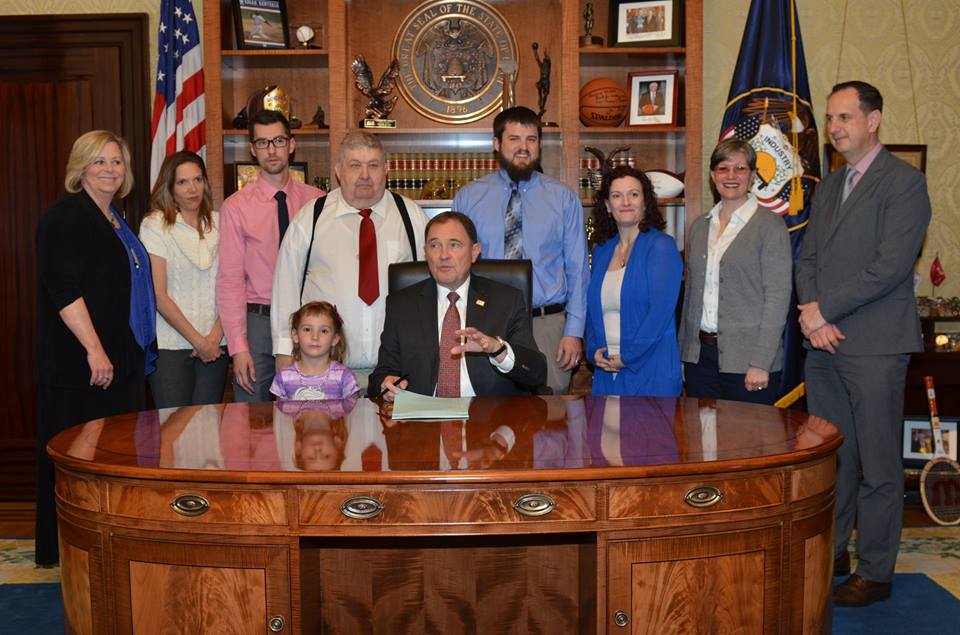
L-R: Marilyn Tiller Call, Brooke Budzinski Grossinger, Brandon Bowden, W. David Samuelsen, Stephen Persinger, Pamela Mower, Jodi Christel Becker, Utah Representative Norman Thurston. Center: Brooke's daughter and Utah Governor Gary Hebert at the HB 60 Signing Ceremony, March 11, 2017. Photo from the private collection of Jodi Christel Becker
A Slideshow of the
Ceremonial Signing of HB 60
April 11, 2017
For your interest and enjoyment, I have included photographs from the ceremonial signing of House Bill 60, the historic legislation that replaced the term "Hearing Impaired" with "Deaf and Hard of Hearing" in Utah state law. This landmark achievement reflected a growing recognition of the identities, preferences, and contributions of the Deaf and Hard of Hearing community. It also marked an important step toward ensuring that state legislation uses language that is respectful, accurate, and reflective of the people it serves.
These photographs capture a meaningful moment in Utah Deaf history and celebrate the dedicated advocates, community leaders, and legislators whose efforts helped make this change possible. I hope you enjoy viewing them and reflecting on the significance of this historic occasion.
These photographs capture a meaningful moment in Utah Deaf history and celebrate the dedicated advocates, community leaders, and legislators whose efforts helped make this change possible. I hope you enjoy viewing them and reflecting on the significance of this historic occasion.
Source
Persinger, Stephen. “President’s Corner.” UAD Bulletin, April 2017.
