Resilience and Leadership
in Utah's Deaf Women's History
Compiled & Written by Jodi Christel Becker
Edited by Valerie G. Kinney
Published in 2020
Updated in 2026
Edited by Valerie G. Kinney
Published in 2020
Updated in 2026
Author's Note
As a Deaf woman with a strong interest in women's history and Women's Studies, I have developed a deep appreciation for the contributions of Deaf women throughout Utah's history. Through my research, I have been inspired by the accomplishments of Deaf women who pursued leadership roles, higher education, professional careers, community service, and advocacy despite the challenges they often faced.
The experiences of Deaf women offer an important perspective on Utah Deaf history. Their stories help us better understand how Deaf women navigated social, educational, economic, and professional barriers while making meaningful contributions to their families, communities, and organizations.
Historically, the achievements of Deaf women have not always received the same recognition as those of their male counterparts. By documenting and preserving their stories, we gain a more complete understanding of the Utah Deaf community and the diverse individuals who helped shape its history.
This webpage highlights the lives, accomplishments, and experiences of Deaf women in Utah. Through their stories, we can better appreciate the important role Deaf women have played in education, advocacy, leadership, and community development throughout Utah's history.
In my historical work, I use first names for everyone, including men, women, and LGBTQ+ individuals, to recognize their contributions and challenge the patriarchal tradition of identifying women primarily through their spouses' surnames. This approach acknowledges individual achievements while respecting personal identity. Using first names helps make each person feel valued and recognized while highlighting the important roles women and other underrepresented individuals have played in our community's history.
Furthermore, our organization was previously known as the Utah Association for the Deaf before changing its name to the Utah Association of the Deaf in 2012. Historically, the organization was known as the Utah Association of the Deaf from 1909 to 1962. In 1963, the name changed to the Utah Association for the Deaf, and in 2012 it returned to its original name. To accurately reflect each historical period, I use both "of" and "for" throughout this website when referring to the organization.
Thank you so much for your interest in this topic! I'm thrilled to share these stories with you.
Enjoy!
Jodi Christel Becker
Deaf Women's Conference in Utah
The Deaf Women's Conference was a significant event in advancing the rights and visibility of Deaf women. Held on October 6, 1979, at the International Dunes Hotel in Salt Lake City, Utah, the conference provided a vital platform for discussing issues such as access to education, employment opportunities, and healthcare. Sponsored by W. David Mortensen of the Utah Association for the Deaf, the event marked an important step forward in advocating for the rights and empowerment of Deaf women.
The conference fostered a strong sense of connection and empowerment among participants, who left feeling motivated and better equipped to advocate for their rights and address societal barriers. It not only united Deaf women from across the region but also helped lay the foundation for future initiatives aimed at increasing their visibility, leadership, and opportunities within society.
The conference fostered a strong sense of connection and empowerment among participants, who left feeling motivated and better equipped to advocate for their rights and address societal barriers. It not only united Deaf women from across the region but also helped lay the foundation for future initiatives aimed at increasing their visibility, leadership, and opportunities within society.

W. David Mortensen. Photo courtesy of W. David and Shanna Mortensen
Lois Jones Williams, the chairperson, led a planning committee that included Celia May Laramie Baldwin, Darlene Stewart Cochran, and Ilene Coles Kinner. More than eighty women between the ages of 18 and 80 attended the conference (The Deaf American, February 6, 1980). The event provided a valuable opportunity for networking, sharing experiences, and discussing issues important to Deaf women and the broader Deaf community. Through workshops and panel discussions, participants exchanged ideas, developed leadership skills, and fostered an atmosphere of collaboration, support, and empowerment.
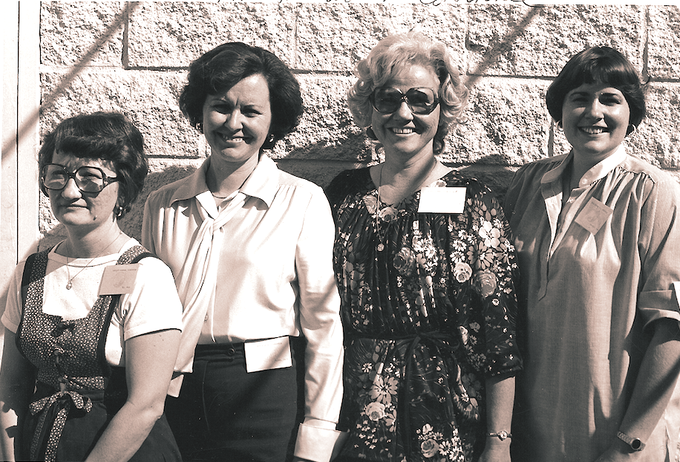
Utah Deaf Women Conference. L-R: Darlene Stewart Cochran, Ilene Coles Kinner, Lois Jones Williams, & Celia May Laramie Baldwin, 1979. Photo courtesy of Kenneth and Ilene Kinner
"New Horizons For Deaf Women"
A Deaf Advocate for Women's Rights
Dr. Gertrude Scott Galloway, a champion of Deaf women's rights and the first female president of the National Association of the Deaf, delivered a keynote address at the conference. In her speech, she emphasized the importance of women's rights and their impact on critical areas such as credit cards, salaries, and surnames. She also recognized Agatha Tiegel Hanson as the first female graduate of Gallaudet College in 1893, noting that she was not only the valedictorian of her class but also an early advocate for Deaf and women's rights.
Gertrude highlighted Agatha's influential graduation address, "New Horizons for Deaf Women," which was delivered before the passage of women's suffrage in the United States. In her speech, Agatha emphasized the importance of education and empowerment for Deaf women and advocated for their equal rights in society (The Deaf American, February 6, 1980). Through her accomplishments and advocacy, Agatha helped pave the way for greater opportunities for women at Gallaudet and beyond.
From 1864 to 1887, Gallaudet College denied admission to Deaf women (Gallaudet University: US History Encyclopedia). This exclusion reflected the prevailing social attitudes of the time, which often discouraged women from pursuing higher education. Deaf women faced the dual barriers of gender discrimination and misconceptions about hearing loss. The admission of Deaf women in 1887 marked a significant milestone, reflecting years of perseverance and advocacy for equal educational opportunities. This historic change underscored the value of accessibility, diversity, and inclusion in higher education.
Gertrude's speech drew attention to the challenges faced by Deaf women while calling for expanded opportunities and equal rights. By referencing Agatha's legacy, she underscored the continuing struggle for equality and the vital role of education in empowering women within the Deaf community. Her message reminded attendees that progress is achieved through advocacy, leadership, and the determination to challenge barriers. The contributions of pioneers such as Agatha and Gertrude continue to inspire future generations to pursue equality and ensure that the voices and experiences of Deaf women are recognized and respected.

Dr. Gertrude Scott Galloway. Source: Deaf Life, August 2014
"Women should be free as the air to
learn what she will and do devote her life to
whatever vocation seems good to her…It is true
that we have made a start in the right direction. But that start hasbeen made very recently, and it is too
early to pass sentence on the results."
- Agatha Tiegel Hanson, 1893

Agatha Tiegel Hanson. Source: gupress.gallaudet.edu
Workshops at the
Deaf Women's Conference
The conference workshops, led by Beth Ann Stewart Campbell, an esteemed local interpreter and Child of Deaf Adults (CODA), and Nancy R. Rarus, a passionate advocate for Deaf rights, covered a wide range of topics relevant to Deaf women. Beth Ann's discussions on family life, sexuality, and financial matters addressed issues that touched many aspects of daily life. At the same time, Nancy's presentations on women's leadership and the proposed Utah Community Center for the Deaf provided valuable insight into important developments within the Deaf community.
These workshops fostered an atmosphere of connection, learning, and empowerment. Participants were encouraged to share their experiences, exchange ideas, and support one another in addressing common challenges. The combination of Beth Ann's practical guidance and Nancy's advocacy-oriented perspective created a dynamic environment that inspired attendees to become active participants in shaping their communities and advocating for positive change.
The conference was widely regarded as a success and left a lasting impression on those who attended. Discussions soon emerged about organizing another women's conference in the future. The event's positive impact was reflected in a comment published in The Deaf American (February 6, 1980), in which one husband remarked that his wife returned home happier than ever and pledged to support her attendance at future conferences, even if it meant paying the $9.00 registration fee each time. His lighthearted comment illustrated the conference's meaningful influence on participants and their families.
Since Agatha Tiegel Hanson's groundbreaking 1893 graduation address at Gallaudet, opportunities for women have continued to expand. While significant progress has been made, the pursuit of equal opportunities for women and girls remains an ongoing endeavor. The Deaf Women's Conference reflected this continuing commitment by encouraging advocacy, leadership, and community engagement. Through unity, collaboration, and mutual support, participants strengthened the foundation for future generations of Deaf women to thrive and contribute their unique talents and perspectives to society.

Nancy Rarus, Gertrude Galloway & Beth Ann Stewart Campbell, hands making a female symbol shape. Source: The Deaf American, February 6, 1980
A Female Symbol

Female Symbol. Source: clipart-library.com
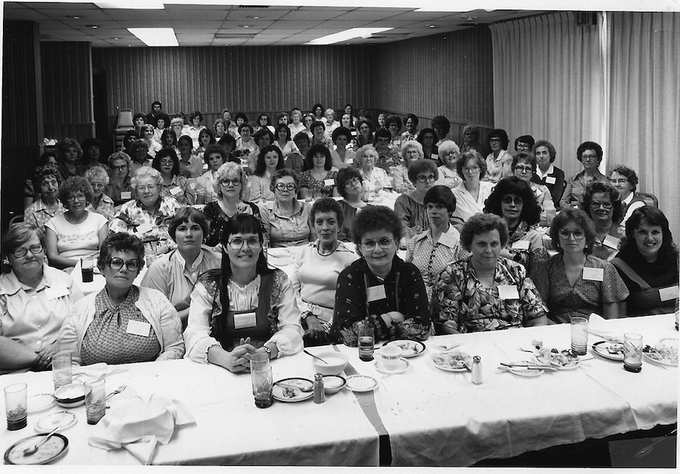
The Utah Deaf Women's Conference attendees, 1979. From the left side of the front row: Vera Eyre, Irene Garvos, Carolbeth Nielson Cook, ___, Carol Masich, ___, and ___. In the second row from the left: Celia May Laramie Baldwin, Shanna Lee Christiansen Mortensen, Valerie G. Kinney, Jane Loveland, and ___ Honey. In the third row from the left: Ruth Smith, Georgia Henricks Walker, Lois Jones Williams, Dora Benoit Laramie, Sue Wessman, _, _, _, and _. On the right side of the fourth row: Georgie Mae Stewart, followed by Beth Ann Stewart Campbell and Darlene Stewart Cochran. In the fifth row from the left: Gladys Burnham Wenger, Kate Kelley, Helen Potter, Rosa Marie Flores Rathbun, _, _, _, and _ Underwood, Zelma Lundquist Moon, Edna Sevy, and Kleda Barker Quigley. Photo courtesy of Kenneth and Ilene Kinner
1994 Deaf Women's Conference in Utah
Fifteen years after the landmark 1979 conference, another Deaf Women's Conference was held at Salt Lake Community College on October 21-22, 1994. Chaired by Kristi Lee Mortensen, a local Deaf feminist and advocate, the conference embraced the theme, "Towards the 21st Century: An Exciting Journey." The gathering continued the tradition of promoting leadership, empowerment, and equality among Deaf women.
The keynote speaker was Dr. Barbara Brauer, a pioneer in Deaf mental health. Dr. Petra M. Horn-Marsh, a respected advocate for Deaf bilingual education, also presented on the history of Deaf women's struggles and accomplishments. Their presentations highlighted both the progress that had been achieved and the challenges that remained, encouraging participants to continue advocating for meaningful change within the Deaf community and society at large.
Workshop sessions provided attendees with opportunities to explore important issues affecting Deaf women. Dr. Brauer presented "Women and Violence," addressing concerns related to safety, awareness, and support. Dr. Lawrence Fleischer, a professor of Deaf Studies at California State University, Northridge, delivered a presentation titled "The Enhanced Image of a Deaf Woman: Amee Mathews." Through this session, attendees examined the importance of positive representation and leadership among Deaf women.
Together, the presentations and workshops created a rich dialogue about the accomplishments, challenges, and aspirations of Deaf women. Participants shared experiences, exchanged ideas, and strengthened their commitment to advocacy and leadership. Building upon the momentum of the 1979 conference, the 1994 gathering reaffirmed the importance of empowering Deaf women and ensuring that their contributions continued to shape the future of the Deaf community.

Kristi Lee Mortensen. Photograph by Jodi Christel Becker
Women Viewed as a Marginalized Group
Despite significant advances in education, employment, and public life, women have historically been viewed as a marginalized group. Deaf women, in particular, have often faced additional challenges due to the intersection of gender and hearing loss, resulting in what has been described as double discrimination (The Deaf American, February 6, 1980). Women have encountered barriers in educational, social, economic, professional, and political settings, limiting their opportunities and representation.
In Utah, women have faced ongoing challenges related to political representation, wage equity, and educational attainment. In response, women across the state and the nation have worked to advocate for greater equality and expanded opportunities. Through grassroots activism, mentorship, leadership development, and policy advocacy, they have sought to remove systemic barriers and create a more equitable society. Their collective efforts continue to strengthen opportunities for women and future generations.
In Utah, women have faced ongoing challenges related to political representation, wage equity, and educational attainment. In response, women across the state and the nation have worked to advocate for greater equality and expanded opportunities. Through grassroots activism, mentorship, leadership development, and policy advocacy, they have sought to remove systemic barriers and create a more equitable society. Their collective efforts continue to strengthen opportunities for women and future generations.

Dr. Petra M. Horn-Marsh. Photo provided by Petra M. Horn-Marsh
Deaf Women Face Double Barriers
In a society shaped by both patriarchy and audism, Deaf women have often encountered unique challenges resulting from the intersection of gender and hearing loss. Communication barriers, social attitudes, and limited access to opportunities have contributed to forms of double marginalization that affect education, employment, social participation, leadership opportunities, and political representation.
Despite these obstacles, Deaf women have demonstrated remarkable resilience and determination. Many have built successful careers, pursued higher education, served in leadership roles, and made lasting contributions to their communities. Some have overcome significant barriers to achieve accomplishments that have inspired future generations of Deaf women and girls.
It is important to recognize and celebrate these achievements. This website's section, "Biographies of Prominent Utah Deaf Women," highlights the lives and accomplishments of women who have made meaningful contributions to Utah's Deaf community and society as a whole. Their stories not only preserve an important part of Utah Deaf history but also serve as powerful examples of perseverance, leadership, and advocacy.
By sharing these biographies, we gain a deeper understanding of both the challenges Deaf women have faced and the remarkable impact they have had on their communities. Their experiences remind us that progress is made possible through courage, determination, and a commitment to expanding opportunities for future generations.

Source: 'Towards the 21st Century: An Exciting Journey.' The Utah Deaf Women's Conference at Salt Lake Community Center on October 21-22, 1994
Deaf Women Who
Shaped Utah Deaf History
During the late 19th and early 20th centuries, Utah emerged as a center for progressive women who pursued education and careers while advocating for political and social change, even as many lived within the practice of polygamy. These women worked in a variety of fields, including activism, medicine, education, journalism, and politics, and played an important role in shaping Utah's social and political landscape (Brooks, Steenblik, & Wheelwright, 2016). The women's suffrage movement significantly influenced their aspirations and expanded opportunities for leadership and civic engagement.
This spirit of advocacy and progress also influenced Deaf women in Utah. Pioneers such as Elizabeth DeLong, Mary Anne Woolslayer, and Emma Magdalene Emmertson demonstrated leadership, determination, and a commitment to advancing opportunities for Deaf individuals. Their accomplishments reflect the broader movement for women's rights while highlighting the unique experiences of Deaf women navigating barriers related to both gender and hearing loss.
The contributions of these women helped strengthen Utah's Deaf community and paved the way for future generations of Deaf leaders. Their lives illustrate the intersection of gender, disability, education, and social justice, offering valuable insight into the diverse forces that shaped Utah's history. By preserving and sharing their stories, we gain a deeper appreciation for their resilience, achievements, and lasting impact on the Deaf community.
Elizabeth DeLong, First Female President
of the Utah Association of the Deaf
Elizabeth DeLong, affectionately known as "Libbie," was one of the most influential figures in Utah Deaf history. After graduating from the Utah School for the Deaf in 1897, she became the first Utah School for the Deaf graduate to earn a degree from Gallaudet College in 1902. She then returned to Utah and became the first Deaf teacher with a college degree to teach at her alma mater. Her achievements opened doors for future generations of Deaf students and educators throughout the state.
Libbie's leadership extended beyond education. Inspired by the formation of the National Association of the Deaf (NAD) in 1880, Deaf leaders across the nation began establishing state organizations to advocate for the interests and welfare of Deaf individuals. Libbie played a central role in co-founding the Utah Association of the Deaf (UAD) on June 10, 1909. Her commitment to community service, education, and social welfare quickly established her as one of Utah's most respected Deaf leaders (Evans, 1999).
The day after the UAD was established, members elected officers for the new organization. In a historic election on June 11, 1909, Libbie defeated two male candidates and became the first female president of the Utah Association of the Deaf. Her election was groundbreaking not only for Utah but also nationally, as she became the first woman to serve as president of any state association affiliated with the National Association of the Deaf. At a time when women faced widespread discrimination and had limited political rights, her victory demonstrated the confidence that Utah's Deaf community placed in her leadership.
Libbie's success reflected years of preparation and advocacy. While attending Gallaudet College, she joined a secret support organization for women known as O.W.L.S., now Phi Kappa Zeta. Established to address the challenges faced by Deaf women in the predominantly male environment of Gallaudet College, the organization encouraged leadership, mutual support, and advocacy. Libbie's fellow members recognized her abilities by electing her president in 1901 (The Buff and Blue, October 1901; This Week in 19th Amendment History: Agatha Tiegel Hanson, October 17, 1959).
The experiences Libbie gained through O.W.L.S. strengthened her commitment to women's rights and equality. During this era, Deaf women faced barriers related to both gender and hearing loss. Although hearing women in Utah had gained the right to vote in 1870 through territorial legislation, women throughout the nation continued to fight for equal political representation. Within Deaf organizations, opportunities for women were also limited. Notably, Deaf women were not permitted to vote in National Association of the NAD elections until 1964. Libbie's achievements demonstrated that Deaf women could serve as effective leaders despite these restrictions.
Growing up in Utah's progressive suffrage environment helped shape Libbie's outlook. She developed a strong belief in civic participation, education, and equal opportunity. These values guided her work as an educator, advocate, and organizational leader. Throughout her career, she promoted educational advancement, employment opportunities, and greater social inclusion for Deaf individuals.
As president of the Utah Association of the Deaf from 1909 to 1915, Libbie championed initiatives that strengthened Utah's Deaf community. At the conclusion of her second term in 1915, she delivered a memorable address at the UAD convention (The Ogden Daily Standard, June 9, 1915; The UAD Bulletin, Summer 1963). In her speech, she emphasized the importance of women's suffrage and encouraged greater civic engagement among Deaf citizens. Her ability to connect Deaf rights with broader social movements reflected her forward-thinking leadership.
Libbie's influence extended far beyond her presidency. Through her advocacy, she helped improve opportunities for Deaf people in education, employment, and community life. She also served as an important role model for Deaf women, demonstrating that leadership positions were attainable despite social barriers. Her accomplishments contributed to a more inclusive and representative Deaf community in Utah.
Today, Libbie is remembered as a pioneer whose achievements transformed Utah Deaf history. Her record of historic firsts includes becoming the first Utah School for the Deaf graduate to earn a degree from Gallaudet College, the first Deaf teacher with a college degree at the Utah School for the Deaf, a co-founder of the Utah Association of the Deaf, and the first female president of both the UAD and any state association affiliated with the National Association of the Deaf.
Her legacy continues through the Elizabeth DeLong School of the Deaf, one of Utah's ASL/English bilingual schools, which proudly bears her name. By honoring her contributions, the school preserves the memory of a remarkable leader whose dedication to education, equality, and community empowerment continues to inspire new generations of Deaf students, educators, and advocates.
The Better Days 2020 project also features Elizabeth DeLong's biography alongside other trailblazing Utah women whose contributions helped shape the state's history. Their stories remind us that meaningful progress is often achieved through perseverance, leadership, and a commitment to expanding opportunities for others.

Elizabeth DeLong. Source: FamilySearch.org
Emma Magdalene Emmertson,
Suffragette Leader
Emma Magdalene Emmertson was a dedicated educator whose life reflected the spirit of leadership and advocacy that characterized many Utah women of her era. She graduated from the Utah School for the Deaf in 1907 and later earned a degree from the University of Utah in 1917 (The 1916-1917 Catalog of the University of Utah; The 1916-1917 University of Utah Commencement Program). Her educational achievements were notable at a time when higher education opportunities were still limited for many women, especially Deaf women.
According to her grandson, Don Jorgenson II, in an interview with Carolyn Jorgenson, Emma was actively involved in the Women's Suffrage Movement during the late 19th and early 20th centuries. This movement sought to secure voting rights and greater political representation for women throughout the United States. Emma's granddaughter, Kristan Jorgensen, described her as "a very strong woman" on FamilySearch.org (KristanKap, FamilySearch.org, December 7, 2017), a description that reflects the determination and perseverance remembered by her family.
Emma's commitment to education and advocacy was shaped by an era of significant social change. Utah played a unique role in the national suffrage movement, becoming one of the first places where women gained the right to vote through territorial legislation in 1870. The movement inspired generations of Utah women to pursue greater opportunities in education, civic engagement, and public service.
The influence of Utah's suffrage movement extended into the Deaf community and inspired leaders such as Elizabeth DeLong and Emma Emmertson. These women demonstrated that Deaf women could contribute meaningfully to educational, social, and political progress despite the barriers they often faced. Their achievements reflected a growing belief that women deserved equal opportunities to participate in society and shape their communities.
Emma's dedication to education and community service exemplified the values promoted by the suffrage movement. As an educator and advocate, she contributed to the advancement of Deaf individuals while serving as an example of leadership for future generations. Her life illustrates how local activism and educational achievement can create lasting change within a community.
Today, Emma Magdalene Emmertson is remembered as a woman of strength, determination, and civic engagement. Her story serves as an important reminder that the history of Utah's Deaf community was shaped not only by well-known leaders but also by individuals whose commitment to education, equality, and service helped create opportunities for those who followed. Her legacy continues to inspire future generations to value advocacy, perseverance, and the pursuit of equal opportunity for all.

Emma M. Emmertson. Source: The Utah Eagle, June 6, 1907
Mary Anne Wooslayer, Resilient Leader
Mary Anne Woolslayer, a 1907 graduate of the Utah School for the Deaf, made history as the first Deaf woman to earn a bachelor's degree from the University of Utah in 1916 (University of Utah Transcript, 1916; Mary Woolslayer's Autobiography). Her achievement marked an important milestone for Deaf women in higher education and reflected the expanding educational opportunities available to women during the early 20th century.
Mary's success was supported by Maud May Babcock, a member of the Utah School for the Deaf Board of Trustees and a faculty member at the University of Utah. Through her guidance and advocacy, Maud played an important role in helping Mary pursue her academic goals (Mary Woolslayer Photograph Collection, 1890). The efforts of early advocates who promoted education and career opportunities for women, combined with Mary's connection to Maud, likely influenced her decision to continue her education and break new ground for Deaf women in Utah.
Mary's accomplishment was part of a broader movement that opened educational opportunities for Deaf women. Similarly, Emma M. Emmertson enrolled at the University of Utah in 1911 and graduated in 1917. After completing their studies, both Mary and Emma dedicated their careers to Deaf education, teaching at schools for the deaf and serving as role models for future generations.
As Deaf educators, Mary and Emma demonstrated the transformative power of education. Their dedication improved opportunities for Deaf students and highlighted the importance of higher education within the Deaf community. Through their achievements and service, they helped pave the way for future generations of Deaf women to pursue professional careers and leadership roles.
Today, Mary Anne Woolslayer is remembered as a pioneer whose determination and academic accomplishment expanded educational opportunities for Deaf women in Utah. Her legacy continues to inspire students, educators, and advocates who follow in her footsteps.

Mary Anne Wooslayer. Photo courtesy of Gillian Nolan
Justina Woodridge Keeley,
Community Advocate Leader
Justina Wooldridge Keeley played a significant role in the early development of the National Fraternal Society of the Deaf (NFSD) in Utah. Founded in 1901, the NFSD was a Deaf-owned and operated insurance organization created to provide financial protection and community support for Deaf individuals. However, like many organizations of its era, the NFSD initially limited membership and benefits to Deaf men, reflecting prevailing social attitudes regarding gender roles (Records of the National Fraternal Society of the Deaf, 1900-2006).
In early 1915, Deaf women across the nation began advocating for greater participation and equal rights within the organization. Their efforts challenged longstanding barriers and highlighted the growing movement for gender equality within the Deaf community. Despite facing resistance, these women demonstrated determination and courage as they sought recognition and inclusion within the NFSD (Records of the National Fraternal Society of the Deaf, 1900-2006).
Justina's contribution to Utah Deaf history began during a visit to Missouri, where she learned about a Deaf-owned insurance organization. Recognizing its potential value to Utah's Deaf community, she shared this information with her friend, Melville John Matheis. Inspired by her discovery, Matheis traveled to Chicago to learn more and became a member of the NFSD on August 1, 1916. With assistance from Francis P. Gibson, Grand Secretary-Treasurer of the NFSD, Salt Lake City Division No. 56 was established on October 24, 1916 (UAD Bulletin, Summer 1966; Walker, 1966).
The establishment of the Salt Lake City division provided Deaf Utahns with access to insurance, fellowship, and community support. It quickly became an important institution within Utah's Deaf community, strengthening connections among members and promoting mutual assistance.
Although Justina helped introduce the organization to Utah, she and other Deaf women remained excluded from full membership because of their gender. Women did not gain regular insurance membership in the NFSD until 1951 (Records of the National Fraternal Society of the Deaf, 1900-2006). This long-awaited change represented a significant step toward equality within the organization and reflected broader advances in women's rights throughout the United States.
Justina's story illustrates how Deaf women contributed to their communities even when they were denied equal participation. Her initiative, leadership, and commitment to strengthening Utah's Deaf community helped lay the foundation for future progress. Today, she is remembered as a community advocate whose efforts contributed to the growth of Deaf organizations and expanded opportunities for future generations.

Justina W. Keeley. Source: Golden Anniversary: Salt Lake City Division No. 56. October 15, 1966
Gallaudet College Denies Deaf Women Admission
From 1864 to 1887, Gallaudet College denied admission to Deaf women, reflecting the prevailing social attitudes of the era that limited educational opportunities for women, particularly those who were Deaf (Gallaudet University: US History Encyclopedia). During this period, Deaf women faced significant barriers to higher education because of both gender discrimination and misconceptions about their abilities.
The admission of Deaf women in 1887 marked a significant turning point in the history of Deaf education. Their acceptance into Gallaudet represented progress toward greater educational equality and expanded opportunities for Deaf women to pursue academic and professional careers. This milestone reflected the determination of Deaf women who challenged social barriers and sought access to the same educational opportunities available to men.
The inclusion of Deaf women also strengthened Gallaudet by broadening the diversity of its student body and enriching campus life through a wider range of perspectives and experiences. The change laid the foundation for future generations of Deaf women to become educators, advocates, professionals, and leaders within the Deaf community and society at large.
The Civil Rights Act of 1964
and the Voting Rights Act of 1965
Promote Inclusivity in the National
Association of the Deaf
In July 1964, Dr. Robert G. Sanderson, a distinguished Deaf leader from Utah, became president of the National Association of the Deaf (NAD), marking an important moment in Deaf history. His election coincided with a period of significant social change in the United States. That same year, Deaf women gained voting rights within the NAD, reflecting the organization's growing commitment to equality and inclusion.
In 1965, the NAD took another important step by extending membership and voting rights to Black Deaf individuals following the passage of the Voting Rights Act of 1965. These changes represented a significant departure from earlier policies that had denied women full participation in elections and excluded Black Deaf individuals from membership (2012 Conference Resolutions).
Together, these developments reflected the NAD's evolving commitment to equal rights, representation, and participation within the Deaf community. Bob's presidency occurred during this transformative period, linking his leadership to an era of important organizational and social progress.
The expansion of voting and membership rights strengthened the National Association of the Deaf by making it more representative of the diverse community it served. These changes created opportunities for broader participation in the organization's leadership, advocacy efforts, and decision-making processes.
Reflecting on this history reminds us that progress is often achieved through the collective efforts of individuals working toward a common goal. The NAD's expansion of voting and membership rights remains an important chapter in Deaf history and serves as a powerful reminder of the continuing importance of inclusion, participation, and equal opportunity for all members of the Deaf community.

Dr. Robert G. Sanderson. Photo courtesy of Gallaudet University Archives
Kim Lucas, the Second Female President
of the Utah Association of the Deaf
In 2019, Kim Lucas made history by becoming the second woman to serve as president of the Utah Association of the Deaf (UAD), ending 104 years of male leadership within the organization. The first female president, Elizabeth DeLong, served from 1909 to 1915. Kim's election marked an important milestone in the history of the UAD, reflecting the organization's continued evolution and commitment to broad representation within the Deaf community.
Kim also became the first openly queer president of the UAD. Her election represented increased visibility and representation for members of the Deaf LGBTQ+ community while continuing the legacy of leadership established by Elizabeth DeLong more than a century earlier.
During her four and a half years as president, Kim guided the UAD toward a stronger focus on social justice, community engagement, and collaboration among organizations serving Utah's Deaf community. Under her leadership, the UAD supported initiatives such as Queer ASL Utah, Utah Deaf Women, and the revival of Deaf Night Out. Her administration emphasized advocacy, inclusion, and increased opportunities for community involvement.

Kim Lucas. Photo provided by Kim Lucas
For the first time since the founding of the UAD in 1909, the organization was led by two women serving as its principal officers: Kim Lucas as president and Ashli-Marie Grant as vice president. This historic achievement reflected the growing leadership opportunities available to women within Utah's Deaf community and demonstrated the value of diverse perspectives in organizational leadership.

Ashli-Marie Grant. Source: Facebook
The Establishment of the
Utah Deaf Womxn Group
In 2019, the Utah Deaf Womxn Group was established under the leadership of Kim Lucas, president of the Utah Association of the Deaf, and Ashli-Marie Grant, vice president of the organization. They collaborated with advocates Emisha Sill and Jodi Christel Becker to create a space dedicated to supporting, empowering, and connecting Deaf womxn throughout Utah.
The group's mission is to recognize and celebrate the diverse experiences of Deaf womxn regardless of gender identity, race, or sexual orientation. Through networking opportunities, educational events, mentorship, and community engagement, the organization encourages members to learn from one another while building a stronger support system.
Operating under the umbrella of the Utah Association of the Deaf, the Utah Deaf Womxn Group was created in response to challenges that Deaf women and gender-diverse individuals continue to face in educational, social, economic, professional, and political settings. By promoting leadership development, advocacy, and community service, the group seeks to improve the quality of life of Deaf womxn throughout Utah.
The organization also highlights the accomplishments of women and LGBTQ+ leaders within the Deaf community, providing visible role models for future generations. Through collaboration and advocacy, the group continues to work toward greater equality, representation, and opportunity within Utah's Deaf community.
The milestones achieved by Deaf women and women leaders throughout history demonstrate how opportunities continue to expand through advocacy, education, and civic engagement. Their accomplishments remind us that progress is often built upon the efforts of those who challenge barriers and create opportunities for future generations.

Emisha Sill. Source: Linkedin
Deaf Women United
Deaf Women United is an organization dedicated to empowering Deaf women through education, mentorship, leadership development, and advocacy. The organization works to raise awareness of issues affecting Deaf women while celebrating their accomplishments and contributions to society.
By fostering community connections and leadership opportunities, Deaf Women United encourages Deaf women to become active advocates and leaders within their communities. Additional information can be found through the organization's social media platforms.
By fostering community connections and leadership opportunities, Deaf Women United encourages Deaf women to become active advocates and leaders within their communities. Additional information can be found through the organization's social media platforms.

Deaf Women United. Source: www.dwu.org
Deaf and Hearing Women
Who Shaped Utah History
Utah's history has been shaped by the achievements, leadership, and perseverance of both Deaf and hearing women. Through their contributions to education, advocacy, public service, community leadership, and social reform, these women helped expand opportunities and improve the lives of future generations.
To learn more about their remarkable accomplishments, visit the "Deaf and Hearing Women Who Shaped Utah History" webpage. There, you will discover the stories of women whose dedication and leadership left a lasting impact on Utah's communities and institutions. Their experiences provide valuable insight into the progress that has been made toward equality while reminding us of the individuals whose efforts helped shape Utah's history.
By preserving and sharing these stories, we honor the legacy of the women who came before us and ensure that their contributions continue to educate, inspire, and empower future generations.

Susan B. Anthony with suffrage leaders from Utah and elsewhere. Source: Women Suffrage in Utah
Sources
Brooks, Joanna, Rachel Hunt Steenblik, and Hannah Wheelwright, eds. Mormon Feminism: Essential Writings. Oxford University Press, 2016.
"Deaf People of Two States Will Hold Reunion." The Ogden Daily Standard, June 9, 1915.
Evans, David S. A Silent World in the Intermountain West: Records from the Utah School for the Deaf and Blind: 1884-1941. Thesis presented to the Department of History, Utah State University, 1999.
"From the Minutes." The UAD Bulletin, vol. 2, no. 10 (Summer 1963): 4-5.
Gallaudet University Library Deaf Collections and Archives. Records of the National Fraternal Society of the Deaf, 1900-2006.
KristanKap. "My Grandma." FamilySearch.org, December 7, 2017.
"Locals." The Buff and Blue, vol. 10, no. 1 (October 1901), p. 29.
Mary Woolslayer Photograph Collection (1890). J. Willard Marriott Library, University of Utah. Collection Number UU_P0669.
Mary Woolslayer's Autobiography.
"NAD History." National Association of the Deaf. Available at: https://www.nad.org/about-us/nad-history/
"National Fraternal Society of the Deaf, 1901-2007 Manuscripts." Records of the National Fraternal Society of the Deaf, 1900-2006. Gallaudet University Archives.
"Salt Lake Frat to Mark 50th Year." The UAD Bulletin, vol. 4, no. 3 (Summer 1966): 1.
The 1916-1917 Catalog of the University of Utah.
The 1916-1917 University of Utah Commencement Program.
The Deaf American, vol. 32, no. 6 (February 1980).
The University of Utah Transcript, 1916.
"This Week in 19th Amendment History: Agatha Tiegel Hanson." Arlington Public Library, October 14, 2019. Available at: https://library.arlingtonva.us/2019/10/14/this-week-in-19th-amendment-history-agatha-tiegel-hanson/
"US History Encyclopedia: Gallaudet University." Available at: http://www.answers.com/topic/gallaudet-university
Walker, Rodney Wilson. Outlined History of the National Fraternal Society of the Deaf. In Golden Anniversary: Salt Lake City Division No. 56, National Fraternal Society of the Deaf, 1916-1966. Prudential Plaza Auditorium, October 15, 1966.
