The History of the
Jean Massieu School of the Deaf
Compiled & Written by Jodi Christel Becker
Published in 2021
Updated in 2026
Published in 2021
Updated in 2026
Author's Note
As the parent of two Deaf children, Joshua and Danielle, I was honored to serve on the board of Utah Deaf Education and Literacy, Inc. (UDEAL) from 2003 to 2005. During that time, my children attended the Jean Massieu School of the Deaf (JMS), which was governed by UDEAL. JMS provided an ASL/English bilingual educational environment that supported their academic, social, and personal development. Watching them thrive in a setting that valued their language, culture, and identity was a meaningful experience for our family.
During my service on the board, I had the privilege of working alongside Minnie Mae Wilding-Diaz, co-founder of JMS and a respected leader in the Utah Deaf community. Together with many dedicated parents, educators, and advocates, we worked to strengthen educational opportunities for Deaf students. Like many new educational programs, JMS faced challenges, including limited resources, funding concerns, and the need to build greater understanding of ASL/English bilingual education.
The school also faced broader educational and legislative challenges. Existing policies often favored mainstream educational placements, making it difficult for JMS to maintain student enrollment and long-term stability. In addition, the absence of permanent facilities created ongoing obstacles for the school and its leadership.
Despite these challenges, the merger of JMS with the Utah School for the Deaf in 2005 represented an important milestone. The merger helped preserve ASL/English bilingual educational opportunities while expanding access to resources and services for Deaf students throughout Utah. The impact of this effort can still be seen today through the educational programs available to Deaf children and their families.
I first learned about JMS while attending graduate school at Gallaudet University in 1999. At the time, I never imagined that I would one day become involved with the school or enroll my own children there. Looking back, I am grateful for the opportunity to work with JMS, UDEAL, and the many individuals who dedicated their time, energy, and resources to its success.
Without the vision and perseverance of those involved, families like mine might have faced difficult choices between mainstream educational settings and relocating to access Deaf educational programs. Because of JMS, my children had the opportunity to learn in an ASL/English bilingual environment surrounded by Deaf peers, role models, and a supportive community.
The following webpage presents a brief history of the Jean Massieu School for the Deaf, founded in 1999. The school played an important role in promoting bilingual Deaf education and strengthening the Utah Deaf community. Its history reflects the dedication of parents, educators, advocates, and community leaders who worked to expand educational opportunities for Deaf and hard-of-hearing students.
I would also like to express my sincere appreciation to Minnie Mae Wilding-Diaz for her leadership, vision, and dedication to JMS. I am equally grateful to Jeff Allen and Joe Zeidner, whose contributions and commitment helped support the school and its students. Their efforts left a lasting impact on Deaf education in Utah and continue to be remembered by the families and students whose lives they touched.
Thank you!
Jodi Christel Becker

Jean Massieu. Source: erenow.org
The Creation of the Utah Deaf Bilingual-Bicultural Conference Led to the Establishment of the
Jean Massieu School of the Deaf
The 1997 Utah Deaf Bilingual and Bicultural Conference was a major catalyst in the establishment of the Jean Massieu School of the Deaf. This pivotal event was driven by the collaborative efforts of the Utah Deaf community and spearheaded by Shirley Hortie Platt, a dedicated Deaf Mentor in the Parent Infant Program (PIP) at the Utah School for the Deaf. The PIP plays an important role in supporting families with Deaf children as they navigate the unique opportunities and challenges of raising a Deaf child. Shirley was instrumental in organizing the conference and advocating for families whose children were not receiving the educational opportunities they deserved. The community's determination stemmed from growing concerns about Deaf education at the Utah School for the Deaf, where many students were not achieving satisfactory academic outcomes in either specialized or mainstream educational settings.
These concerns echoed observations made two decades earlier by Gene D. Stewart, a Child of Deaf Adults and vocational rehabilitation counselor. In 1977, he described the state of Deaf education in Utah to the Utah State Board of Education as being in the "Dark Ages" (The Ogden Standard-Examiner, March 26, 1977). Gene emphasized the urgent need for educational reform and warned that, without significant changes, Deaf students would continue to face barriers to academic achievement and personal growth.
In response to these challenges, the Utah Association for the Deaf supported Shirley's initiative to establish the Utah Deaf Bilingual and Bicultural Conference. The terms "bilingual and bicultural" emphasize the importance of recognizing and promoting both American Sign Language (ASL) and English, as well as Deaf culture, in the education of Deaf children. Shirley chaired the conference, which was held on April 25-26, 1997, at the Eccles Conference Center in Ogden, Utah, under the supervision of Dr. Petra M. Horn-Marsh, director of the Deaf Mentor Program (UAD Bulletin, June 1997; Shirley Hortie Platt, e-mail message to Jodi Christel Becker, November 7, 2008).
The conference marked a significant turning point for Utah's Deaf community by increasing awareness of the linguistic, cultural, and educational needs of Deaf children. Participants engaged in meaningful discussions, exchanged ideas, and explored strategies for improving educational outcomes while promoting a greater understanding of Deaf culture and identity.

Shirley Hortie Platt. Photo provided by Shirley Hortie Platt
Shirley's determination to bring about change motivated her to take a leading role in organizing the conference. She was troubled by the large number of Deaf children in Utah who struggled to communicate effectively, the lack of progress within the Parent Infant Program, and the limited recognition given to Deaf mentors. Despite encountering patronizing attitudes from some hearing teachers and administrators at the Utah School for the Deaf, she remained steadfast in her belief that meaningful change was necessary (Shirley Hortie Platt, e-mail message to Jodi Christel Becker, November 7, 2008). To address these concerns, she worked with Deaf leaders and advocates to develop solutions that would elevate Deaf perspectives and strengthen support for Deaf children and their families.
The conference proved to be an outstanding success, attracting approximately 400 participants, many of whom traveled from outside Utah. The distinguished presenters greatly enriched the discussion. Featured speakers included Dr. Lawrence "Larry" Fleischer, Chair of the Department of Deaf Studies at California State University, Northridge, who discussed Deaf identity; Dr. Martina J. "MJ" Bienvenu, Director of the Language and Culture Center in Gaithersburg, Maryland, who presented on Deaf culture; Dr. Marlon "Lon" Kuntze of the University of California, Berkeley, who addressed language development; and Dr. Joseph "Jay" Innes of Gallaudet University, who shared his expertise in Deaf education. Representatives from the Indiana School for the Deaf, including Diane Hazel Jones, David Geeslin, and Rebecca Pardee, also shared their experiences in establishing a bilingual-bicultural educational program (UAD Bulletin, June 1997).
Throughout the conference, presenters and participants emphasized the importance of creating educational environments that valued both linguistic and cultural diversity within the Deaf community. Their discussions highlighted the benefits of bilingual-bicultural education and reinforced the belief that Deaf children thrive when their language, culture, and identity are respected and supported.
Perhaps most importantly, the conference provided an unprecedented platform for reexamining long-held assumptions about Deaf people and Deaf education. It encouraged a broader understanding of Deaf individuals as members of a linguistic and cultural minority rather than as people defined by a disability. The ideas and momentum generated by the conference helped lay the foundation for future educational reforms and ultimately contributed to the establishment of the Jean Massieu School of the Deaf, leaving a lasting impact on Deaf education in Utah.

'Bi-Bi Conference a Big Hit.' Source: UAD Bulletin, June 1997
The Creation of a Bilingual
and Bicultural Committee
During the Utah Association for the Deaf (UAD) conference on June 13-14, 1997, an important step toward educational reform took place. Dennis R. Platt, the husband of Shirley Hortie Platt, who had recently been elected president of the UAD and served on the USDB Institutional Council, established the Bilingual and Bicultural (Bi-Bi) Committee. During the conference, W. David Samuelsen, a UAD member, proposed the appointment of Minnie Mae Wilding-Diaz as chair of the committee. Widely respected within the Deaf community, Minnie Mae was a strong advocate for ASL/English bilingual education and the Deaf mother of three Deaf children. The UAD approved the proposal, setting in motion efforts that would significantly influence the future of Deaf education in Utah (W. David Samuelsen, e-mail message to Jodi Christel Becker, July 26, 2016).
Through its advocacy, the Bi-Bi Committee promoted an educational philosophy that recognized the value of both American Sign Language and English while emphasizing the importance of Deaf culture. Committee members believed that Deaf children would benefit from an educational environment where language, culture, and identity were fully respected and supported. Their efforts helped increase awareness of bilingual-bicultural education and encouraged broader discussions about improving educational opportunities for Deaf students throughout Utah.
Through its advocacy, the Bi-Bi Committee promoted an educational philosophy that recognized the value of both American Sign Language and English while emphasizing the importance of Deaf culture. Committee members believed that Deaf children would benefit from an educational environment where language, culture, and identity were fully respected and supported. Their efforts helped increase awareness of bilingual-bicultural education and encouraged broader discussions about improving educational opportunities for Deaf students throughout Utah.

'Utah Deaf Bi-Bi Conference.' Source: UAD Bulletin, June 1997
Minnie Mae's appointment as committee chair was influenced, in part, by the success and momentum of the 1997 Utah Deaf Bilingual and Bicultural Conference. Her commitment to bilingual-bicultural education had developed years earlier. In her 1990 paper, "Exciting Developments in Deaf Education," she expressed admiration for the Indiana School for the Deaf's bilingual-bicultural approach and the educational opportunities it provided Deaf students. It is therefore unsurprising that she later became a co-founder of the Jean Massieu School of the Deaf (JMS), which opened in 1999. Through her leadership and advocacy, Minnie Mae helped transform an educational vision into a reality for Deaf children and their families.
Throughout their campaign, members of the UAD committee strategically used the term "Bi-Bi," shorthand for "bilingual-bicultural," to emphasize their vision of incorporating both ASL and English into Deaf children's education while recognizing Deaf culture as an essential component of that experience (Minnie Mae Wilding-Diaz, e-mail message to Jodi Christel Becker, March 29, 2010). They believed that Deaf students thrive when they have full access to language, culture, and a positive sense of identity. By advocating for bilingual-bicultural education, the committee sought to create a more inclusive and empowering educational environment for future generations of Deaf children.
The work of the Bi-Bi Committee laid important groundwork for educational reform in Utah and contributed to the growing movement that ultimately led to the establishment of the Jean Massieu School of the Deaf. Their advocacy represented a significant shift in thinking about Deaf education, one that emphasized language access, cultural pride, and educational excellence for Deaf students.

Minnie Mae Wilding-Diaz. Source: Facebook
The Bi-Bi Committee Presents Its Proposal to
USDB Superintendent Lee Robinson
One of the Bi-Bi Committee's primary goals was to explore the introduction of bilingual-bicultural education at the Utah School for the Deaf, which at the time offered only oral and total communication options (UAD Bulletin, July 1999; Minnie Mae Wilding-Diaz, e-mail message to Jodi Christel Becker, April 23, 2011). On March 30, 1998, committee leaders Minnie Mae Wilding-Diaz and Jeff Allen, the father of a Deaf daughter, met with Superintendent Dr. Lee Robinson and Assistant Superintendent Joseph DiLorenzo of the Utah Schools for the Deaf and the Blind. The committee believed that a bilingual-bicultural approach would greatly benefit Deaf students by promoting both language development and cultural identity.
The timing seemed favorable. In 1994, the Utah State Legislature passed Senate Bill 42, officially recognizing American Sign Language (ASL) as a language. Additionally, the 1997 reauthorization of the Individuals with Disabilities Education Act (IDEA) included ASL in its definition of "native language" for Deaf students. Together, these developments strengthened the committee's belief that Utah was ready to embrace bilingual-bicultural education and expand educational options for Deaf children.
However, Superintendent Dr. Lee Robinson and Assistant Superintendent Joseph DiLorenzo declined the committee's proposal to incorporate bilingual-bicultural education into the curriculum. According to Minnie Mae Wilding-Diaz, the response was essentially, "No thanks and good luck" (Minnie Mae Wilding-Diaz, e-mail message to Jodi Christel Becker, March 29, 2010).
Despite this setback, support from the Utah Deaf community and parents of Deaf children remained strong (UAD Bulletin, May 1998). Their encouragement reinforced the committee's commitment to pursuing educational reform and advocating for greater recognition of ASL and Deaf culture in the classroom. Rather than abandoning their efforts, committee members continued exploring alternative pathways for implementing bilingual-bicultural education, convinced that Deaf students would benefit from an educational environment that fully embraced both ASL and English.
Although their proposal was rejected, the experience strengthened the committee's resolve and further unified supporters of bilingual-bicultural education throughout Utah. The challenges they encountered ultimately fueled a growing movement that would lead to the establishment of the Jean Massieu School of the Deaf, creating new educational opportunities for future generations of Deaf children.

Dr. Lee Robinson. Photo courtesy of the Blinder Book of the 2009 Utah School for the Deaf Reunion
The Utah Charter Schools Act Leads to the
Formation of the Jean Massieu School of the Deaf
The Bi-Bi Committee met regularly every two weeks. Over time, more hearing parents began attending the meetings, reflecting a growing awareness of the importance of providing Deaf children with the best possible education. The Utah Deaf community strongly supported the effort, recognizing that Deaf children would become the future leaders of the Utah Association for the Deaf. The committee's primary goal was to establish or identify a program or school that would educate Deaf students using a bilingual-bicultural ("Bi-Bi") approach (Mortensen, UAD Bulletin, June 1998; Wilding-Diaz, UAD Bulletin, June 1999). This educational philosophy emphasized both American Sign Language (ASL) and English while promoting Deaf culture and identity. Committee members believed that such an environment would help Deaf students thrive academically, linguistically, and socially.
During its work, the Bi-Bi Committee learned that the Utah State Legislature was considering legislation that would allow charter schools to be established throughout the state. This discovery prompted the committee to support efforts that would create new educational opportunities for Deaf children. At the conclusion of the 1998 legislative session, the Utah Legislature passed the Utah Charter Schools Act, providing a legal framework for the establishment of charter schools (Utah Charter Schools Act, 1998; Wilding-Diaz, UAD Bulletin, June 1999). The legislation gave communities greater flexibility in meeting students' educational needs and paved the way for innovative educational programs throughout Utah.
In May 1998, the Bi-Bi Committee took an important step by contacting Governor Mike Leavitt's Office and the Utah State Office of Education regarding the possibility of creating a charter school for Deaf students. The following month, the committee began developing a charter school proposal that would later be submitted to the Utah State Board of Education. The proposed school's mission was to promote ASL as the primary language of communication and instruction while providing students with strong English-language skills. On July 17, 1998, the committee formally submitted its charter school application for the 1998-1999 academic year (Utah Charter Schools Application 1998-1999, July 17, 1998). The proposal outlined a bilingual-bicultural educational model designed to support both language development and cultural awareness among Deaf students.
On July 29, 1998, the Utah State Board of Education approved the Bi-Bi educational option, marking an important step toward expanding educational opportunities for Deaf children in Utah. Tuacahn High School for the Performing Arts was the first charter school approved under the new legislation, and the Bi-Bi Committee's proposal soon followed. By November 1998, the Utah State Board of Education was preparing to consider applications from six additional schools (UAD Bulletin, September 1998). These developments reflected a growing interest in educational innovation across the state.
Co-founders Minnie Mae Wilding-Diaz and Jeff Allen worked tirelessly toward a shared goal: establishing the Jean Massieu School of the Deaf. Their efforts culminated in the opening of the school in 1999. As a public charter school, Jean Massieu School of the Deaf embraced a bilingual-bicultural philosophy that emphasized both ASL and English while fostering a strong appreciation for Deaf culture and identity.

Jeff Allen. Photo provided by Jeff and Mindi Allen
In September 1998, the Bi-Bi Committee announced plans to open the new school in the fall of 1999 (UAD Bulletin, September 1998). Before the school opened, committee members considered three potential names: the Alice Cogswell School, the George Veditz School, and the Jean Massieu School. Each honored an influential figure in Deaf history. Following a community vote, the committee selected the name Jean Massieu School of the Deaf (Minnie Mae Wilding-Diaz, e-mail message to Jodi Christel Becker, March 29, 2010).
Jean Massieu was a pioneering educator whose influence extended far beyond his native France. His accomplishments attracted the attention of prominent visitors, including royalty, philosophers, and religious leaders. His most famous student, Laurent Clerc, carried Massieu's teachings to the United States and co-founded the American School for the Deaf in Hartford, Connecticut, in 1817. According to Loida R. Canlas of Gallaudet University's Laurent Clerc National Deaf Education Center, Massieu's linguistic expertise also contributed to the publication of an English-French dictionary in 1808. Many of his students later became educators themselves, helping establish Deaf schools throughout the world. His legacy continues to inspire Deaf education today through its emphasis on language access, communication, and educational opportunity.
The Utah Charter Schools Act required all charter schools to operate as nonprofit organizations. In 1998, Utah Deaf Education and Literacy, Inc. (UDEAL) was established as a nonprofit organization independent of the Utah Association for the Deaf. UDEAL's primary purpose was to create, manage, and oversee the new charter school while also coordinating fundraising efforts (UAD Bulletin, September 1998; Minnie Mae Wilding-Diaz, e-mail message to Jodi Christel Becker, March 29, 2010).
Minnie Mae Wilding-Diaz emphasized the importance of creating an inclusive educational environment that addressed the needs of Deaf and hard-of-hearing students. Through a bilingual ASL-English approach, UDEAL sought to strengthen literacy, language development, and educational opportunities for Deaf learners. Its founders envisioned a school where Deaf children could flourish academically while developing a strong sense of identity, community, and cultural pride. The creation of UDEAL and the passage of the Utah Charter Schools Act ultimately provided the foundation upon which the Jean Massieu School of the Deaf was built, transforming years of advocacy into a new educational opportunity for Deaf children and their families.
The Jean Massieu School of the Deaf
Opens Its Doors
After receiving approval from the Utah State Office of Education, the Bi-Bi Committee began the work of establishing the charter school. Committee members took on numerous responsibilities, including securing a suitable location, obtaining funding, selecting a curriculum, hiring teachers, purchasing supplies, and preparing the school for its opening (UAD Bulletin, September 1998). At the same time, the Utah Deaf Education and Literacy, Inc. (UDEAL) Board assumed responsibilities related to fundraising, program development, Individualized Education Program (IEP) preparation, transportation, facilities, and technology. Through close collaboration, the Bi-Bi Committee and the UDEAL Board worked diligently to ensure that the new school would meet the educational needs of Deaf children and their families. Their partnership laid the foundation for a school built upon language accessibility, community involvement, and educational excellence.
On August 29, 1999, the Jean Massieu School of the Deaf (JMS) opened its doors to 21 students ranging from preschool through third grade. The school was founded on the principle of providing full language accessibility in both American Sign Language (ASL) and English (Minnie Mae Wilding-Diaz, e-mail message to Jodi Christel Becker, March 29, 2010). JMS subsequently expanded by adding one grade level each year and eventually grew to serve students from pre-kindergarten through twelfth grade. Its bilingual approach enabled students to develop strong language, academic, and social skills while fostering a positive sense of identity and belonging. As the school grew, it remained committed to empowering Deaf students through language-rich and culturally affirming educational experiences.
During its first six years, JMS operated as an independent bilingual-bicultural charter school supported through state funding based on student enrollment as well as private donations. Although funding levels often presented challenges, the school remained committed to providing high-quality educational opportunities for Deaf students. At the time, some families were unfamiliar with JMS and its educational philosophy. In addition, the Parent Infant Program and some personnel within the Utah School for the Deaf did not actively present JMS as an educational option for parents seeking placement choices for their children. As a result, misunderstandings about the school's mission and academic program limited awareness among some families.
Despite these challenges, JMS continued to establish itself as a viable educational choice for Deaf children in Utah. Its commitment to ASL-English bilingual education, Deaf culture, and full language accessibility attracted families who sought an educational environment centered on language acquisition and academic achievement. Over time, the school's success demonstrated the value of the vision first championed by the Bi-Bi Committee and its supporters.
The opening of the Jean Massieu School of the Deaf represented the culmination of years of advocacy, planning, and collaboration by Deaf leaders, parents, educators, and community members. What began as a movement for educational reform evolved into Utah's first charter school specifically designed to provide Deaf children with a bilingual educational environment. The school's founding marked a historic milestone in Utah Deaf history and created new opportunities for generations of Deaf students to learn, grow, and thrive.
The Merger Agreement Between
the Utah School for the Deaf
and Jean Massieu School of the Deaf
Faced with ongoing financial challenges, the Utah Deaf Education and Literacy, Inc. (UDEAL) Board recognized the need to reassess its long-term strategy. Board members believed that incorporating the ASL/English bilingual educational option into the Utah School for the Deaf would make bilingual education more accessible to Deaf children and their families throughout Utah. As a result, a merger between the Jean Massieu School of the Deaf (JMS) and the Utah School for the Deaf emerged as both a practical and strategic solution.
According to Laurel Stimpson, the merger was intended not only to preserve the quality educational services offered by JMS but also to provide greater financial stability and improve employee salaries and benefits (Stimpson, UAD Bulletin, March 2005). Supporters believed that combining resources would strengthen educational opportunities for Deaf students while creating a more inclusive environment for families across the state.
In 2004, the Jean Massieu Charter School faced significant financial difficulties and began exploring the possibility of merging with the Utah School for the Deaf. At the time, the Utah School for the Deaf was hesitant to incorporate the ASL/English bilingual program into its educational offerings. In response, members of the UDEAL Board sought support from state legislators who recognized the value of preserving bilingual education as an option for Deaf students and their families.

Joe Zeidner. Photo provided by Joe Zeidner
One of the strongest advocates for the merger was Joe Zeidner, a UDEAL board member, attorney, and parent of a Deaf child. During the 2005 legislative session, he worked tirelessly to promote the integration of the JMS educational model into the Utah School for the Deaf. His efforts helped secure the inclusion of legislative "intent language," expressing the Legislature's desire to see the services of JMS and the Utah Schools for the Deaf and the Blind combined (Harrington, Memorandum, 2005).
After nearly a year of negotiations, a steering committee developed a Letter of Intent and Terms of Agreement governing the proposed merger (Intent of the Legislature, 2007). These documents addressed philosophy, instruction, educational programs, assets, finances, governance, personnel, transportation, facilities, and organizational structure. Under the agreement, JMS would continue operating as a distinct school within the Utah School for the Deaf while reporting directly to the superintendent of the Utah Schools for the Deaf and the Blind (General Exhibit No. 9634, Intent of the Legislature, April 5, 2007; Jean Massieu and Utah Schools for the Deaf and the Blind: Terms of Agreement, 2005).
The Legislature's intent language stated:
"It is the intent of the Legislature that a substantial effort be made by the State Superintendent and the State School Board to combine the services of USDB and the Jean Massieu Charter School of the Deaf. This will include instruction in American Sign Language, as well as bilingual and bicultural education, which will receive administrative support. Representatives from the Jean Massieu School shall be integrated into the USDB Institutional Council in a meaningful and effective manner. The State Superintendent shall report to the Education Interim Committee regarding the progress of this effort." (General Exhibit No. 9634, Intent of the Legislature, April 5, 2007; Jean Massieu and Utah Schools for the Deaf and the Blind: Terms of Agreement, 2005).
The Letter of Intent and Terms of Agreement were subsequently approved by the USDB Institutional Council, UDEAL, and the Utah State Board of Education. These approvals marked a significant milestone in the merger process and demonstrated broad support among key stakeholders.
After a year of legislative and administrative efforts, a historic signing ceremony took place on June 3, 2005, at the Jean Massieu School of the Deaf. Kim Burningham, Chair of the Utah State Board of Education; Linda Rutledge, Superintendent of the Utah Schools for the Deaf and the Blind; and Craig Radford, Chair of the Utah Deaf Education Advocacy League, signed the merger documents that had been approved by the Utah State Board of Education and supported by Dr. Patti Harrington, State Superintendent of Public Instruction (Stimpson, UAD Bulletin, July 2005).

Linda Rutledge. Photo courtesy of the Blinder Book of the 2009 Utah School for the Deaf Reunion
The signing ceremony marked the culmination of years of advocacy and dedication by members of Utah Deaf Education and Literacy, Inc. (UDEAL). Among those present to witness this historic milestone were board members Chris Palaia (Deaf), Laurel Stimpson (Deaf), Sean Williford, Joe Zeidner, LaDawn Rinlinsbaker, Jeff Allen, Minnie Mae Wilding-Diaz (Deaf), and Jodi Christel Becker (Daef). Through their leadership, perseverance, and shared commitment to ASL-English bilingual education, they helped transform years of community advocacy into a lasting educational opportunity for Deaf children and their families throughout Utah.

Craig Radford, UDEAL Chair; Kim Burningham, Utah Board of Education Chair; and Linda Rutledge, USDB Superintendent, signed the Letter of Intent and Terms of Agreement between Jean Massieu School of the Deaf and Utah School for the Deaf. Karl Wilson, the supervisor of USDB, was instrumental in conducting the merger. June 3, 2005. Photograph by Duane Lee Kinner
The Legacy of the Merger Between the Utah School for the Deaf and the Jean Massieu School of the Deaf
The merger between the Utah School for the Deaf and the Jean Massieu School of the Deaf marked a historic achievement for Deaf education in Utah. Like many significant organizational changes, the transition presented challenges as educators, administrators, students, and families worked to integrate two educational systems while preserving the ASL/English bilingual philosophy that had guided JMS. Despite these challenges, both schools collaborated to implement essential changes and strengthen educational opportunities for Deaf and hard-of-hearing students throughout the state.
One of the most significant developments occurred in August 2016 when Dr. Michelle Tanner, Associate Superintendent of the Utah Schools for the Deaf and the Blind, helped establish the hybrid program. This initiative represented an important step forward by fostering collaboration between the ASL/English bilingual program and the listening and spoken language program. The hybrid program expanded placement options for families and reflected an ongoing commitment to meeting the diverse educational needs of Deaf and hard-of-hearing students.
For a more detailed discussion of these developments, readers may wish to explore the webpage, "Deaf Education History in Utah." This resource provides additional information about the evolution of Deaf education in Utah and the continuing efforts to expand educational opportunities for Deaf and hard-of-hearing students.
Those interested in learning more about the history of the Jean Massieu School of the Deaf and its relationship with the Utah School for the Deaf are also encouraged to visit "Minnie Mae Wilding-Diaz, Co-Founder of the Jean Massieu School of the Deaf." The page highlights Minnie Mae's leadership and advocacy, as well as her contributions to the founding and development of JMS.
The educational philosophy championed by JMS continues to influence Deaf education in Utah today. Its emphasis on ASL/English bilingual education recognizes the importance of language accessibility, cultural identity, and academic achievement. By promoting proficiency in both ASL and English, this approach seeks to provide Deaf and hard-of-hearing students with the tools necessary to succeed in school and beyond while fostering pride in Deaf culture and community.
Today, the Utah School for the Deaf operates four ASL/English bilingual schools: the Kenneth C. Burdett School of the Deaf in Ogden, the Jean Massieu School of the Deaf in Salt Lake City, the Elizabeth DeLong School of the Deaf in Springville, and the Southern Utah School for the Deaf in St. George. Three of these schools bear the names of influential figures in Deaf history: Kenneth C. Burdett, Jean Massieu, and Elizabeth DeLong. Their contributions to Deaf education, advocacy, and community leadership continue to inspire future generations of Deaf students. The existence of these schools reflects the lasting impact of the advocacy efforts that led to the creation of JMS and the expansion of ASL/English bilingual education throughout Utah.

Michelle Tanner. Source: Twitter
The Yellowjackets Becomes the Mascot of the Jean Massieu School of the Deaf

Doug Stringham. Source: Utah Valley University
In 2003, Doug Stringham, a senior designer and art director at Stephen Hales Creative, Inc. in Provo, Utah, created the Yellow Jacket mascot for the Jean Massieu School of the Deaf. Although Doug is hearing, he has long been involved in and supportive of the Utah Deaf community and generously volunteered his time and artistic talents to develop the design. The mascot features a yellow jacket whose body forms the letter "J," while its hands create the "M" and "S" handshapes, symbolizing JMS and its connection to the Utah Deaf community (Leanna Turnman, e-mail message to Jodi Christel Becker, 2009; Minnie Mae Wilding-Diaz, e-mail message to Jodi Christel Becker, March 29, 2010).
More than a school mascot, the Yellow Jacket reflects the spirit of the Jean Massieu School of the Deaf and the community that helped bring the school into existence. Its distinctive design celebrates Deaf identity, community collaboration, and the shared commitment to educational excellence that has guided JMS since its founding. Doug's contribution remains a meaningful symbol of the pride, unity, and cultural heritage embraced by the Utah Deaf community.
More than a school mascot, the Yellow Jacket reflects the spirit of the Jean Massieu School of the Deaf and the community that helped bring the school into existence. Its distinctive design celebrates Deaf identity, community collaboration, and the shared commitment to educational excellence that has guided JMS since its founding. Doug's contribution remains a meaningful symbol of the pride, unity, and cultural heritage embraced by the Utah Deaf community.

Jean Massiue School of the Deaf's Yellowjacket logo was designed by Doug Stringham in 2003
The Jean Massieu School of the Deaf
Operates at Various Locations
The Jean Massieu School of the Deaf operated at several locations before establishing its permanent home at 1655 E. 3300 South in Salt Lake City, Utah, where it has been been located since 2010. Each move reflected the school's continued growth and commitment to serving Deaf students and their families. The following list traces the school's journey through its various locations:
- Bella Vista Elementary School 2131 East 7000 South, Salt Lake City – August – November 1999
- Riverton at 1530 West 12600 South, Unit 3 and 4 – November 1999 – 2002
- Riverton City Library 12750 South Redwood Road, Riverton – 2002 – 2004
- Salt Lake Arts Academy 209 E. 500 South, Salt Lake City – 2004 – 2005
- USDB/JMS 1350 West 10400 South, South Jordan – 2005 – 2008
- USDB Extension Conner Street 2870 Connor Street Salt Lake City, UT 84109 – 2008 – 2010
- Libby Edwards Elementary 1655 E. 3300 South Salt Lake City, Utah 84106 - 2010- present
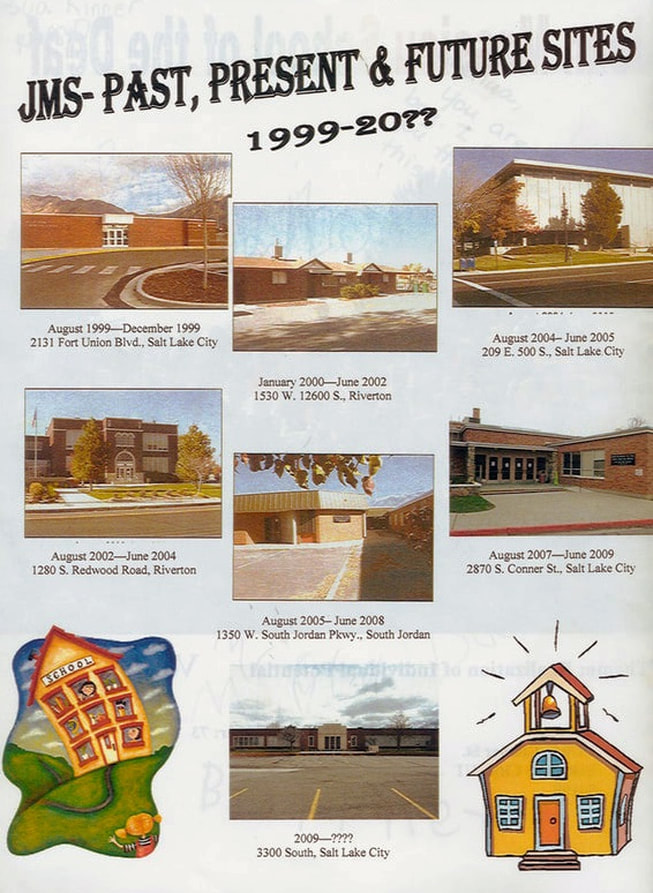
JMS-Past, Present, & Future Sites, 1999 to Present, created by Mike Holland, JMS principal and teacher
Personal Communication
Leanna Turnman, e-mail message to Jodi Christel Becker, 2009.
Minnie Mae Wilding-Diaz, e-mail message to Jodi Christel Becker, March 29, 2010.
Minnie Mae Wilding-Diaz, e-mail message to Jodi Christel Becker, April 23, 2011.
Shirley Hortie Platt, e-mail message to Jodi Christel Becker, November 7, 2008.
W. David Samuelsen, e-mail message to Jodi Christel Becker, July 26, 2016.
Sources
"Bi-Bi Conference a Big Hit." UAD Bulletin, vol. 21, no. 1 (June 1997): 1, 3.
General Exhibit No. 9634. Intent of the Legislature, April 5, 2007; Jean Massieu School and Utah Schools for the Deaf and the Blind: Terms of Agreement, 2005.
"In Support of Charter Schools." UAD Bulletin, vol. 22, no. 4 (September 1998): 1.
Intent of the Legislature. April 5, 2007.
"Methods of Teaching Deaf Students Stir Debate." The Ogden Standard-Examiner, March 26, 1977.
Mortensen, Kristi. "American Dreams, The Deaf's Desires, Thoughts & Views, Part I." UAD Bulletin, vol. 21, no. 12 (May 1998): 2.
Mortensen, Kristi. "American Dreams, Part II." UAD Bulletin, vol. 22, no. 1 (June 1998): 2.
Stimpson, L. "USD and JMS Merger." UAD Bulletin, vol. 28, no. 10 (March 2005): 4.
Stimpson, L. "JMS/USDB Merger." UAD Bulletin, vol. 29, no. 2 (July 2005): 4.
"Utah Charter Schools Act." Utah Code, § 53A-1a-501, 1998.
Utah Charter Schools Application, 1998-1999. Jean Massieu School, July 17, 1998.
Wilding-Diaz, M. M. "Standing Committee Reports." UAD Bulletin, vol. 23, no. 1 (June 1999): 5-6.
