The History of the Robert G. Sanderson Community Center
of the Deaf & Hard of Hearing
Compiled & Written by Jodi Christel Becker
Edited by Valerie G. Kinney
Published in 2012
Updated in 2026
Edited by Valerie G. Kinney
Published in 2012
Updated in 2026
Author’s Note
I am grateful for the opportunity to share my experiences with the Robert G. Sanderson Community Center of the Deaf and Hard of Hearing, a place that has become an important part of my family's life and the Utah Deaf community. For many individuals and families, the center serves as a gathering place for community activities, services, education, leadership development, and cultural events.
I would like to express my appreciation to leaders such as Dr. Robert G. Sanderson and W. David Mortensen, whose efforts over three decades helped make the community center a reality. Through their work with the Utah Association of the Deaf, they advocated for a permanent community center and worked with the Utah Legislature and state agencies to bring that vision to fruition.
Today, the center provides a wide range of services and programs, including interpreting services, case management, employment assistance, training opportunities, and community events. These resources have strengthened communication access and provided valuable support to Deaf and hard-of-hearing individuals throughout Utah.
This webpage is not intended to duplicate the information presented in Dr. Sanderson's book, "A Brief History of the Origins of the Robert G. Sanderson Community Center of the Deaf and Hard of Hearing." Instead, it seeks to provide additional historical context by examining some of the challenges encountered during the effort to establish the center. These challenges included discussions with state officials, differing viewpoints regarding the center's purpose and services, Dr. Grant B. Bitter's concerns about certain aspects of the project, and W. David Mortensen's advocacy on behalf of the Deaf community.
The history of the Robert G. Sanderson Community Center illustrates how Deaf leaders, community members, and advocates worked together over many years to achieve a common goal. Their efforts resulted in a lasting institution that continues to serve the Utah Deaf community today.
As we reflect on this history, we gain a deeper appreciation for the individuals whose vision, perseverance, and collaboration helped make the center possible. Their contributions remain an important part of Utah Deaf history and continue to benefit future generations.
In my historical work, I use first names for everyone, including men, women, and LGBTQ+ individuals, to recognize their contributions and challenge the patriarchal tradition of identifying women primarily through their spouses' surnames. This approach acknowledges individual achievements while respecting personal identity. Using first names helps make each person feel valued and recognized while highlighting the important roles women and other underrepresented individuals have played in our community's history.
Furthermore, our organization was previously known as the Utah Association for the Deaf before changing its name to the Utah Association of the Deaf in 2012. Historically, the organization was known as the Utah Association of the Deaf from 1909 to 1962. In 1963, the name changed to the Utah Association for the Deaf, and in 2012 it returned to its original name. To accurately reflect each historical period, I use both "of" and "for" throughout this website when referring to the organization.
Thank you for taking an interest in this topic.
Enjoy!
Jodi Christel Becker
Acknowledgement
I am grateful to Eleanor McCowan for encouraging me to undertake the Utah Deaf History Project, an opportunity I gladly accepted. None of this work would have been possible without her initial request and encouragement.
Additional information was incorporated from Dr. Robert G. Sanderson's book, A Brief History of the Origins of the Robert G. Sanderson Community Center of the Deaf and Hard of Hearing. Thank you, Dr. Sanderson, for preserving this history and making my work much easier.
Eugene W. Petersen deserves special recognition for his writings and publications documenting the establishment of services for Deaf adults and for his steadfast support of this important mission.
I would like to thank Marilyn Tiller Call for taking the time to review this material and share her valuable insights.
I sincerely appreciate the enthusiastic support of W. David Mortensen throughout this project.
Valerie G. Kinney's invaluable assistance with editing and guidance during the preparation of this work is gratefully acknowledged.
Finally, I owe a special debt of gratitude to my spouse, Duane Kinner, and my children, Joshua and Danielle, for their unwavering support, patience, and encouragement while I worked to complete this project.
Thank you!
Jodi Christel Becker

Source: Dr. Robert G. Sanderson's "A Brief History of the Origins of the Robert G. Sanderson Community Center of the Deaf and Hard of Hearing" book, 2004
A Gathering Place of their Own
Dr. Robert G. Sanderson, affectionately known as "Bob" or "Sandie" to his friends, played a pivotal role in the establishment of the Robert G. Sanderson Community Center of the Deaf and Hard of Hearing, an institution that grew out of decades of advocacy within Utah's Deaf community. In his book, A Brief History of the Origins of the Robert G. Sanderson Community Center of the Deaf and Hard of Hearing, he described how the idea of a dedicated gathering place first emerged during the Utah Association of the Deaf Convention in 1946. Attending his first convention, Bob witnessed Deaf participants passionately discuss the need for a "Club for the Deaf," a place where Deaf people could gather, socialize, and govern their own activities. Inspired by the existence of Deaf clubs in many major cities across the United States, members of Utah's Deaf community questioned why no such facility existed in Utah (Sanderson, 2004).
At the time, Bob was living in Nevada and paid little attention to the proposal. Years later, however, he came to appreciate its significance and the determination behind the effort (Sanderson, 2004). His book provides valuable insight into these early discussions and traces the long journey that ultimately led to the creation of the Robert G. Sanderson Community Center. Today, the center continues to play a vital role in serving Deaf and Hard of Hearing individuals throughout Utah.
Bob also explained that the Utah Deaf community had gathered for many years for social events, parties, sporting activities, and community functions. However, they often found themselves having to "beg for time and space." Rather than choosing locations that best suited their needs, they were required to accept whatever time, date, and venue were available. Community events were held in a variety of rented or borrowed facilities, including hotel ballrooms, local auditoriums, the gymnasium at the Utah Schools for the Deaf and the Blind, and the Murray B. Allen Center for the Blind. Each location came with its own restrictions and challenges, such as strict time limits and additional janitorial fees for extended use. Although the Deaf community longed for a gathering place of its own, Bob noted that they remained grateful for the cooperation and generosity of Blind community leaders who shared their facilities (Sanderson, 2004).

Robert G. Sanderson. Photo courtesy of Barry Sanderson
Possible Factors That Limited Early Efforts
In reflecting on the long struggle to establish a "Club for the Deaf" in Utah, Bob Sanderson proposed four factors that may have hindered progress:
Despite these challenges, Bob recognized the leadership potential that already existed within Utah's Deaf community. Deaf individuals successfully served in organizations such as the Utah Association of the Deaf, local divisions of the National Fraternal Society of the Deaf, the Utah Athletic Club of the Deaf, and other community groups. However, he believed that additional leadership training could help Deaf individuals strengthen their skills, build confidence, and communicate more effectively with influential leaders within the hearing majority. Such preparation, he argued, would better equip them to advocate for the needs and aspirations of the Deaf community (Sanderson, 2004).
- The Deaf adult population may not have had sufficient financial resources to establish and maintain an independent facility.
- The dominant religion in Utah, The Church of Jesus Christ of Latter-day Saints, discouraged alcohol consumption. In many other states, Deaf clubs frequently generated revenue through the sale of alcoholic beverages, providing a source of financial support that was largely unavailable in Utah.
- Many Deaf adults worked full-time industrial or production jobs while supporting their families, leaving little opportunity to interact regularly with influential professionals in education, community agencies, or government. Few Deaf individuals could afford to leave their jobs to pursue public service or political careers, and only a small number received compensation for their involvement in community leadership activities.
- There was a shortage of trained Deaf leaders who could effectively communicate the needs and concerns of the Deaf community to hearing decision-makers who possessed the authority and financial resources to bring about change (Sanderson, 2004).
Despite these challenges, Bob recognized the leadership potential that already existed within Utah's Deaf community. Deaf individuals successfully served in organizations such as the Utah Association of the Deaf, local divisions of the National Fraternal Society of the Deaf, the Utah Athletic Club of the Deaf, and other community groups. However, he believed that additional leadership training could help Deaf individuals strengthen their skills, build confidence, and communicate more effectively with influential leaders within the hearing majority. Such preparation, he argued, would better equip them to advocate for the needs and aspirations of the Deaf community (Sanderson, 2004).
Training Utah Deaf Leaders
Changes were on the horizon for the American Deaf community as Utah Deaf leaders, including Bob Sanderson, who relocated from Nevada to Utah in 1947, observed nationally recognized Deaf leaders successfully working with hearing officials in positions of authority. Among these leaders were Gallaudet College graduates Dr. Boyce R. Williams and Dr. Malcolm Norwood, whose advocacy demonstrated the importance of effective communication, leadership, and collaboration in advancing the interests of Deaf people (Sanderson, 2004).
Bob deeply admired Dr. Williams, a close friend and respected advocate for the Deaf community. As Director of the Office of Deafness within the Vocational Rehabilitation Administration of the U.S. Department of Health, Education, and Welfare, Dr. Williams effectively communicated the needs of Deaf Americans to senior government officials. He worked tirelessly to secure greater recognition, resources, and services for Deaf and hard-of-hearing individuals, who had often been overlooked in comparison to other disability groups (Sanderson, 2004).
Likewise, Dr. Malcolm Norwood, Director of the Office of Deaf Captioned Films, played a pivotal role in educating federal officials about the importance of captioned films for Deaf audiences. His efforts led to the expansion of captioned media and significantly improved access to information and entertainment for Deaf viewers (Sanderson, 2004).
Through their advocacy and leadership, Dr. Williams and Dr. Norwood became role models for Deaf leaders across the country, including those in Utah. Their success demonstrated that Deaf individuals could effectively advocate for their communities, influence public policy, and work collaboratively with hearing leaders to bring about meaningful change. According to Sanderson, their example encouraged Utah Deaf leaders to strengthen their legislative and communication skills so they could better serve the needs of Deaf adults and advance community initiatives (Sanderson, 2004).
The influence of these national leaders extended beyond inspiration. Dr. Williams and Dr. Norwood helped organize leadership workshops on issues affecting Deaf people at the local, regional, and national levels. These workshops provided valuable educational opportunities and encouraged Deaf individuals to develop leadership skills, build confidence, and gain a deeper understanding of community advocacy (Sanderson, 2004).

Dr. Boyce R. Williams. Source: From Oaks to Acorns

Dr. Boyce R. Williams' letter, 1964

Boyce R. Williams (center) received the first Daniel T. Cloud Memorial Award for Leadership in a special ceremony in conjunction with commencement exercises at San Fernando Valley State College. Dr. Ray L. Jones, (left) Director of the Leadership Training Program in the Area of the Deaf which sponsors the award, made the presentation. Robert Sanderson (right) president of the National Association of the Deaf, was present for the ceremony. Source: The Utah Eagle, November 1968
The National Leadership Training Program for the Deaf was established in 1962 at San Fernando Valley State College, now California State University, Northridge, with funding from the Rehabilitation Services Administration. The program sought to address the social, educational, and economic challenges facing Deaf individuals through specialized leadership training. The college also became the first institution in the United States to provide full-time sign language interpreters for a graduate program.
Admission to the Leadership Training Program (LTP) was highly competitive. Applicants were expected to demonstrate a commitment to the Deaf community and articulate a clear vision for future leadership and service. Among those selected for the 1965 class was Robert G. Sanderson of Utah, whose acceptance into the program reflected his growing reputation as a community leader (The UAD Bulletin, Winter 1964; Sanderson, 2004).
Admission to the Leadership Training Program (LTP) was highly competitive. Applicants were expected to demonstrate a commitment to the Deaf community and articulate a clear vision for future leadership and service. Among those selected for the 1965 class was Robert G. Sanderson of Utah, whose acceptance into the program reflected his growing reputation as a community leader (The UAD Bulletin, Winter 1964; Sanderson, 2004).

Dr. Malcolm Norwood. Source: dcmp.org
Observation of National Deaf Club
While Utah's Deaf community continued its efforts to establish a Deaf club, progress was often hindered by limited leadership experience and financial resources. Community leaders envisioned a Deaf club and service agency that would address the social, educational, and economic challenges facing Deaf individuals, similar to organizations already operating in larger cities across the country. Their efforts highlighted both the determination of Utah's Deaf community and the obstacles it faced (Sanderson, 2004).
During his service as president of the National Association of the Deaf, Bob Sanderson visited numerous Deaf clubs throughout the United States. These clubs provided Deaf individuals with opportunities for social interaction, recreation, and community involvement through activities such as card games, captioned films, sports, conversations, and social gatherings. Most clubs relied primarily on revenue from food and alcohol sales, while some had even acquired and renovated their own buildings (Sanderson, 2004).
During these visits, Bob observed that many club members expressed concerns about limited employment opportunities, inadequate mental health services, and a lack of other essential resources. He also noted that club leaders often lacked the training and organizational support necessary to effectively address these community needs. Furthermore, he observed the absence of comprehensive Deaf centers, despite growing discussions in Deaf newsletters and professional publications across the nation about the need for such facilities (Sanderson, 2004).
At the time, professional literature frequently emphasized the importance of having psychiatrists, psychologists, social workers, and other service providers who were fluent in sign language and able to communicate effectively with Deaf individuals. Recognizing these needs, Bob worked with Dr. Boyce R. Williams and the Rehabilitation Services Administration to organize and fund a series of workshops addressing issues affecting the Deaf community. Their long-term goal was to establish Deaf rehabilitation programs throughout the United States, providing more comprehensive support and services for Deaf individuals (Sanderson, 2004).
These efforts represented an important step toward expanding accessibility, strengthening community leadership, and improving services for Deaf individuals nationwide. The knowledge and experience gained through these initiatives would later contribute to the vision that ultimately led to the establishment of the Robert G. Sanderson Community Center of the Deaf and Hard of Hearing.

Robert G. Sanderson, after whom the Deaf Center was named, served as the president of the National Association of the Deaf from 1964 to 1968. The September 1966 issue of the Deaf American magazine features a photo of him shaking hands with Dr. Boyce R. Williams, a Deaf and Hard of Hearing Consultant at the Vocational Rehabilitation Administration in Washington, D.C. At the convention banquet in San Francisco, California, Robert G. Sanderson announced the award and presented the first National Association of the Deaf Distinguished Service Award to Dr. Boyce R. Williams. Source: The Deaf American, September 1966. The photo was taken by Floyd Barlow.
Utah Association of the Deaf
Officers Become Activists
During a period of national change, Deaf Utahns took proactive steps to secure rehabilitative and social services for their community. A group of determined advocates, including Robert G. Sanderson, Eugene W. Petersen, and G. Leon Curtis, all officers of the Utah Association of the Deaf (UAD), resolved to bring about change rather than wait for it to occur (Sanderson, 2004).
Beginning in 1962, Bob, Eugene, and Leon demonstrated exceptional leadership and commitment as they worked toward establishing a full-time office to serve Deaf adults in Utah. Their primary concern was the lack of access to essential services. Communication barriers often made it difficult, if not impossible, for Deaf adults to obtain the assistance they needed. As a result, they sought to ensure that Utah would provide more accessible and effective social services for Deaf citizens (The UAD Bulletin, Winter 1965).
Deaf leaders urged the Division of Vocational Rehabilitation to develop specialized services for Deaf adults. They proposed a program in which personnel would divide their time between vocational rehabilitation and social services, with particular attention given to the accessibility needs of the Deaf community. Their vision included counseling, interpreting services, and assistance with legal, personal, social, emotional, marital, family, financial, and educational concerns.

Eugene W. Petersen. Source: The Utah Eagle, April 1955
The leaders also emphasized the importance of employing qualified professionals who were fluent in sign language and knowledgeable about Deaf culture. Such qualifications would enable staff members to communicate effectively and assist Deaf adults in overcoming barriers related to language access, education, employment, and daily life.
Furthermore, they stressed that the proposed agency would become involved in personal matters only when assistance was requested and when issues were beyond an individual's ability to resolve independently. They made it clear that the agency was not intended to replace, duplicate, or interfere with the activities of existing Deaf organizations in Utah (The UAD Bulletin, Winter 1965).
Furthermore, they stressed that the proposed agency would become involved in personal matters only when assistance was requested and when issues were beyond an individual's ability to resolve independently. They made it clear that the agency was not intended to replace, duplicate, or interfere with the activities of existing Deaf organizations in Utah (The UAD Bulletin, Winter 1965).

G. Leon Curtis. Source: UAD Bulletin, Winter 1964
To strengthen their case, the UAD launched a campaign to investigate the challenges Deaf adults faced in accessing social services. The organization emphasized the need to document these barriers and conduct a comprehensive assessment to ensure that future services would be delivered efficiently and cost-effectively. Bob, Eugene, and Leon then developed a strategy to seek support from the Salt Lake Area United Fund to establish social services for the Utah Deaf community.
At the same time, Bob was preparing to leave Utah to attend the National Leadership Training Program for the Deaf in California. Before departing, he entrusted Eugene and Leon with advancing the effort in his absence, ensuring that the campaign continued to move forward while he pursued additional leadership training (Sanderson, 2004).
At the same time, Bob was preparing to leave Utah to attend the National Leadership Training Program for the Deaf in California. Before departing, he entrusted Eugene and Leon with advancing the effort in his absence, ensuring that the campaign continued to move forward while he pursued additional leadership training (Sanderson, 2004).
Did You Know?
By 1963, leaders within Utah's Deaf community observed that many Deaf adults who were born deaf had spent years using hearing aids, learning speech, and practicing lipreading before gaining access to a fully accessible language. As a result, some experienced language deprivation and faced challenges in developing language and communication skills. According to an article in The UAD Bulletin, many Deaf adults suffered from what the publication described as "mental starvation," a consequence of language deprivation that affected their speech and language development. The article further noted that many Deaf adults were not actively seeking traditional vocational rehabilitation services but instead needed assistance in transitioning to life as Deaf adults through personal adjustment services, vocational training, counseling, and job placement assistance (The UAD Bulletin, Fall 1963, p. 3).
The article also emphasized that Deaf adults were not necessarily interested in hearing and speech services, a misunderstanding that was common among professionals and the general public at the time. Deaf leaders distinguished culturally Deaf individuals from the much larger hard-of-hearing population, noting that many hard-of-hearing people relied on residual hearing, hearing aids, speech, and lipreading for communication. Consequently, common services for hard-of-hearing individuals included hearing aids, lipreading instruction, speech correction, and auditory training (The UAD Bulletin, Fall 1963, p. 3).
These observations helped Utah Deaf leaders advocate for services specifically designed to address the communication, social, educational, and vocational needs of Deaf adults. Their efforts strengthened the case for specialized programs and community-based services that would later contribute to the development of Deaf-centered support systems in Utah.
A Study Committee Under the
Community Services Council Forms
The Utah Association for the Deaf (UAD) submitted a request to become a participating member of the Salt Lake Area United Fund. Their goal was to raise awareness of the lack of accessible services available to Deaf adults. United Fund staff showed considerable interest in the concerns raised by Deaf leaders (Petersen, The Silent Worker, December 1963; The UAD Bulletin, Fall 1963).
After discussing these concerns, the admissions committee agreed that further research was needed. The UAD requested a study to determine the number of Deaf adults requiring services and to evaluate the most effective and economical ways of addressing their needs. As a result, the committee initiated a formal study and developed several recommendations (Petersen, The Silent Worker, December 1963; The UAD Bulletin, Fall 1963).
The admissions committee subsequently referred the matter to the Community Services Council, the coordinating agency for the United Fund, for additional investigation. In March 1963, the council approved a proposal for a comprehensive study, which was completed later that year. A study committee was appointed to examine whether existing community agencies could provide the specialized services needed by Deaf adults throughout Utah (Petersen, The Silent Worker, December 1963; The UAD Bulletin, Fall 1963).
Demonstrating a strong spirit of community collaboration, the Community Services Council coordinated the efforts of eighty-seven public and voluntary organizations dedicated to addressing the health, welfare, and recreational needs of Utah's residents. Dr. Lawrence D. Schroeder, chair of the study committee, presented findings that recommended establishing services for Deaf adults within an existing public or voluntary agency. This recommendation reflected the belief that cooperation among established organizations offered the most practical path toward expanding services for Deaf individuals (Petersen, The Silent Worker, December 1963).
Darell J. Vorwaller, assistant executive director of the Community Services Council, organized a fourteen-member study committee composed of both Deaf and hearing representatives. Their task was to investigate the challenges facing Deaf adults and determine how services could be integrated into an existing community organization. Larry W. Blake, personnel manager at Ajax Pressing Machine Company, one of the region's largest employers of Deaf workers, was appointed chairman of the committee.
Committee members included:
The latter four members represented the Utah Association for the Deaf. Eula Regland Pusey served as interpreter for the committee (The UAD Bulletin, Fall 1963; Petersen, The Silent Worker, December 1963; The UAD Bulletin, Spring 1964; Sanderson, 2004).
After discussing these concerns, the admissions committee agreed that further research was needed. The UAD requested a study to determine the number of Deaf adults requiring services and to evaluate the most effective and economical ways of addressing their needs. As a result, the committee initiated a formal study and developed several recommendations (Petersen, The Silent Worker, December 1963; The UAD Bulletin, Fall 1963).
The admissions committee subsequently referred the matter to the Community Services Council, the coordinating agency for the United Fund, for additional investigation. In March 1963, the council approved a proposal for a comprehensive study, which was completed later that year. A study committee was appointed to examine whether existing community agencies could provide the specialized services needed by Deaf adults throughout Utah (Petersen, The Silent Worker, December 1963; The UAD Bulletin, Fall 1963).
Demonstrating a strong spirit of community collaboration, the Community Services Council coordinated the efforts of eighty-seven public and voluntary organizations dedicated to addressing the health, welfare, and recreational needs of Utah's residents. Dr. Lawrence D. Schroeder, chair of the study committee, presented findings that recommended establishing services for Deaf adults within an existing public or voluntary agency. This recommendation reflected the belief that cooperation among established organizations offered the most practical path toward expanding services for Deaf individuals (Petersen, The Silent Worker, December 1963).
Darell J. Vorwaller, assistant executive director of the Community Services Council, organized a fourteen-member study committee composed of both Deaf and hearing representatives. Their task was to investigate the challenges facing Deaf adults and determine how services could be integrated into an existing community organization. Larry W. Blake, personnel manager at Ajax Pressing Machine Company, one of the region's largest employers of Deaf workers, was appointed chairman of the committee.
Committee members included:
- G. Harold Bradley, Adult Evening School
- Philip R. Clinger, Division of Vocational Rehabilitation
- Marguerite Davis, Salt Lake County Department of Public Welfare
- Clarence O. Fingerle, Salt Lake County General Hospital
- Vera Gee, Utah State Department of Health
- Madeleine Helfrey, Department of Special Education, University of Utah
- C. Russell Neale, Community Mental Health Center
- R. Elwood Pace, State Department of Public Instruction
- Ray G. Wenger (Hard of Hearing), Governor's Advisory Council of the Utah School for the Deaf
- Brigham E. Roberts
- Harvey S.
- Eugene W. Petersen (Deaf)
- Jerry Westberg (Deaf)
The latter four members represented the Utah Association for the Deaf. Eula Regland Pusey served as interpreter for the committee (The UAD Bulletin, Fall 1963; Petersen, The Silent Worker, December 1963; The UAD Bulletin, Spring 1964; Sanderson, 2004).

Ray G. Wenger. Source: FamilySearch.org
|

Jerry Westberg. Photo courtesy of the Kenneth C. Burdett Bulletin Board
|
Throughout 1963, the committee met weekly to examine the challenges confronting Deaf adults. Their work culminated in a comprehensive 22-page report titled Services to Adult Deaf, Salt Lake Area, a landmark study that helped lay the foundation for improving services to Deaf individuals, particularly in the Salt Lake metropolitan area (Petersen, The Silent Worker, December 1963).
The report attracted national attention. According to Sanderson, approximately 100 copies were requested for a national workshop for social workers held in Berkeley, California, from November 18 to 22, 1963, demonstrating widespread interest in Utah's efforts to improve services for Deaf adults (Sanderson, 2004).
The report attracted national attention. According to Sanderson, approximately 100 copies were requested for a national workshop for social workers held in Berkeley, California, from November 18 to 22, 1963, demonstrating widespread interest in Utah's efforts to improve services for Deaf adults (Sanderson, 2004).

Eula Ragland Pusey. Source: FamilySearch.org
Study Results in Recommendations
for Community Services
in the Salt Lake Area for Deaf Adults
Eugene W. Petersen, a member of the Study Committee and board member of the Utah Association for the Deaf (UAD), strongly advocated for social services to support the Deaf community. In the December 1963 issue of The Silent Worker, he explained that the UAD sought assistance primarily because of the lack of accessible services available to Deaf adults. The organization's goal was to ensure that community services were readily available and accessible to Deaf individuals without communication barriers.
To address this issue, the committee collected information from Deaf adults as well as health and welfare agencies to identify the needs of approximately 300 Deaf adults in the Salt Lake area. The study found that many Deaf adults encountered significant barriers when attempting to access community services despite expressing a strong need for them.
According to the committee's findings, most available services for Deaf adults were either designed primarily for children or offered through speech and hearing centers. The report concluded that this imbalance left many Deaf adults without access to services tailored to their specific needs. It further noted that an emphasis on speech and hearing services often failed to address the broader social, vocational, and personal challenges facing Deaf adults. Additionally, communication barriers frequently reduced the effectiveness of counseling and other support services (Petersen, The Silent Worker, December 1963).
Eugene Petersen's article provides a detailed summary of the committee's findings, conclusions, and recommendations. In discussing these issues, Utah Deaf leaders frequently used the term "Adult Deaf," reflecting the terminology commonly used within the Deaf community and professional literature of the 1960s.

Services for Adult Deaf Urged. Source: The UAD Bulletin, Fall 1963
Eugene W. Petersen's Summary of Findings and
Conclusions for Deaf Adult Services
- "Adult deaf persons represent a group for whom community services, although available, cannot be readily rendered. The barrier obstructing the provision of such services on an equitable basis with that of the hearing population is the inability of the persons requesting the services to communicate with those who offer the services. This is particularly true of casework and psychological or psychiatric services, which are dependent upon the flow of free and spontaneous communication between client and worker or therapist. Because of the communication barrier afflicting the deaf handicapped person, he is more prone to the development of social and emotional problems than are hearing persons, and this difficulty is intensified by the inability of professional persons to render needed services. Although the number of persons who would use these services in Salt Lake County in any one year cannot be documented, it would be a sizable proportion of the 296 estimated adult deaf persons residing in the county.
- In the process of seeking professional help with social and emotional problems, deaf persons realize little success in finding the desired services, either from community health and welfare agencies or from speech and hearing services as presently constituted. In a survey of deaf persons, it was disclosed that while over half of the persons represented in the survey are concerned with personal, social and emotional problems for which they desire professional help, one-third actually seek professional services, and only one-fifth receive a limited degree of satisfaction in the services rendered. Speech and hearing services are designed primarily to meet the needs of hard of hearing children and adults and deaf children, and fall short of meeting the need for social and emotional adjustment services for the adult deaf.
- Of the nine agencies and departments designated as carrying some responsibility for serving the deaf and hard of hearing, none, with the exception of the Division of Vocational Rehabilitation, reported the provision of social and emotional adjustment services. The Division of Vocational Rehabilitation services are oriented to the gainful employment of those persons accepted as clients, and therefore, cannot serve deaf persons unless there is an indicated feasibility of gainful employment resulting from services rendered. Six of these nine agencies and departments limit their services to children.
- Other problems revealed by the survey to be of primary concern to the adult deaf, were management of finances and legal matters. These were followed by employment difficulties and health problems, with emotional problems often complicating the picture. Again, the basic problem is that of com-munication. The agencies reporting indicated that the accessibility of services to the adult deaf was conditional upon the extent to which communication did not significantly interfere with the rendering of services effectively. Nearly all of the 27 agencies indicated that services are available on this basis. Ten agencies not identical with those referred to in the preceding paragraph, indicated that contacts had been made by adult deaf in search of services.
- The Salt Lake County Department of Public Welfare rendered the largest number of services to adult deaf in 1962, the majority of whom had become deaf in later years. The Division of Vocational Rehabilitation served the next largest number of adult deaf. The other agencies reporting served from one to five persons on an irregular basis.
- Adult deaf persons were nearly unanimous regarding the felt need for Adult Education courses, provided that appropriate arrangements could be made to overcome the communication barrier. Adult Education courses for adult deaf have a great potential in serving as one of the approaches in assisting the deaf to acquire a better understanding of themselves, their families, and the community, thus enhancing better social and emotional adjustment" (Petersen, The Silent Worker, December 1963, p. 3-4).

Eugene W. Petersen, 'Community Services For Salt Lake Area Deaf Near Realization.' Source: The Silent Worker, December 1963
Eugene W. Petersen's
Summary of Recommendations
for Deaf Adult Services
It is recommended:
- "That a service be established as a part of an existing public or voluntary agency in the Salt Lake area to render personal, social and emotional adjustment services to the adult deaf. The Family Service Society, Division of Vocational Rehabilitation, and the University of Utah Rehabilitation Center were considered as agencies which might logically provide such services. To meet manifest needs, the service should be designed to provide counseling or casework services in matters related to family, child behavior, personal, marital, budgeting, legal, employment relations and related problems, with provision for referral to sources of other services, when needed. An advisory committee, consisting of deaf and hearing persons, should be appointed by the agency in which the service is lodged, in order to assist in giving direction to the program.
- That a person be emploved by the designated agency who would be capable of communicating manually and orally with the deaf. Immediate needs suggest that the services of a skilled interpreter be employed in this position on a temporary basis until the ultimate objective of a professional social worker, skilled in communication with the deaf, can be achieved.
- That the broad obiective of the service be that of bringing about in the community an adequate social and emotional adjustment of the deaf, to enhance an integration of persons with this handicap into the total community.
- That services be clearly identified as a service for the deaf, for the purpose of enabling the development of public understanding of the service and of problems of the deaf.
- That the Graduate School of Social Work of the University of Utah be encouraged to recruit a student skilled in communication with the deaf by virtue of his background, such as the child of deaf parents, and that an appropriate stipend be awarded to underwrite the cost of training.
- That the State Division of Adult Education cooperate with the Utah Association for the Deaf in developing, on an experimental basis, classes for adult deaf, including such subjects as English, money management, mathematics, arts and crafts, vocational training, business and commercial courses, etc.
- That all health, welfare, and leisure time service agencies make effort to make appropriate services more accessible to the deaf. To this end, agencies should become better acquainted with the problems of deafness and develop special provisions needed in order to make services available to the deaf" (Petersen, The Silent Worker, December 1963, p. 3-4).
The Community Services Council
Documents the Challenges Faced by Deaf Adults
The Community Services Council identified several significant concerns affecting Deaf adults in Utah. According to the committee's findings, these challenges included:
Twenty-seven agencies reported that although Deaf adults technically had access to many community services, communication barriers often limited the effectiveness and quality of those services (The UAD Bulletin, Fall 1963).
The Utah Association for the Deaf further emphasized that the primary challenge facing many Deaf individuals was not simply the inability to hear or speak but limited access to language. According to the report, developing a functional vocabulary was a major objective of Deaf education at the time. The report noted that learning speech and lipreading required considerable time and that many Deaf children lagged behind their hearing peers in language development. The lack of auditory access to language in daily life often compounded these challenges into adulthood. As a result, the report concluded that language deprivation could significantly affect a Deaf adult's ability to fully understand and participate in the social, economic, political, cultural, and humanitarian aspects of modern society (The UAD Bulletin, Fall 1963).
- Difficulties communicating with family members, friends, and professionals.
- Difficulties understanding information related to plans, arrangements, and courses of action.
- Challenges in providing training and instruction because of communication barriers.
- Limitations in counseling services, which depended heavily on verbal communication and freedom of expression between counselor and client.
- Concerns regarding the lack of accessible communication. The committee observed that some Deaf consumers had participated in therapy for only short periods, which may have reflected limited experience working with Deaf adults or difficulties resulting from communication barriers.
- Reduced opportunities for social participation due to communication barriers.
- Difficulties in teaching lipreading to Deaf individuals.
- Challenges in obtaining family health information during public health assessments.
- Difficulties experienced by some Deaf parents in teaching spoken language to their hearing children, which could contribute to misunderstandings and discipline concerns within the family.
- Challenges in conducting hearing evaluations because of communication barriers.
- Limited knowledge among Deaf individuals regarding available community health and social service resources (The UAD Bulletin, Fall 1963, p. 4).
Twenty-seven agencies reported that although Deaf adults technically had access to many community services, communication barriers often limited the effectiveness and quality of those services (The UAD Bulletin, Fall 1963).
The Utah Association for the Deaf further emphasized that the primary challenge facing many Deaf individuals was not simply the inability to hear or speak but limited access to language. According to the report, developing a functional vocabulary was a major objective of Deaf education at the time. The report noted that learning speech and lipreading required considerable time and that many Deaf children lagged behind their hearing peers in language development. The lack of auditory access to language in daily life often compounded these challenges into adulthood. As a result, the report concluded that language deprivation could significantly affect a Deaf adult's ability to fully understand and participate in the social, economic, political, cultural, and humanitarian aspects of modern society (The UAD Bulletin, Fall 1963).

Larry W. Blake, left, received the first UAD Award from President G. Leon Curtis at the 21st Biennial Convention of the Utah Association for the Deaf. Miss Dixie Lee Nastfell served as the ceremony's interpreter. The award, a beautifully engraved silver tray, was awarded to Larry W. Blake in appreciation for his efforts on behalf of the Utah Deaf community. Source: UAD Bulletin, Fall 1965
In 1965, a study concluded that the Division of Vocational Rehabilitation was the most suitable agency to lead the development and implementation of services for Deaf adults in Utah. Operating through local district offices, the division provided comprehensive statewide services and employed a multidisciplinary staff with extensive experience serving individuals with disabilities (The UAD Bulletin, Winter 1965).
After two months of review, the Community Services Council presented its findings and recommendations to the Utah State Board of Education. Although the proposed budget represented a substantial investment in expanding services for Deaf adults, committee members emphasized that it addressed a critical and long-standing community need. Recognizing the urgency of the situation, the Division of Vocational Rehabilitation expressed strong support for the proposal and its goals (The UAD Bulletin, Spring 1965).
After two months of review, the Community Services Council presented its findings and recommendations to the Utah State Board of Education. Although the proposed budget represented a substantial investment in expanding services for Deaf adults, committee members emphasized that it addressed a critical and long-standing community need. Recognizing the urgency of the situation, the Division of Vocational Rehabilitation expressed strong support for the proposal and its goals (The UAD Bulletin, Spring 1965).
Did You Know?
The 1963 listing of agency services for Deaf adults did not include the Utah Association for the Deaf (UAD) because it was a membership organization rather than an agency providing professional services to individual consumers. Nevertheless, the association played an important role in the Deaf community by conducting public awareness campaigns about hearing loss and addressing many of the social and recreational needs of Deaf individuals through its activities and programs. As a result, while the UAD was not classified as a service agency, it remained a vital source of advocacy, community engagement, and support for Deaf adults (The UAD Bulletin, Fall 1963, p. 3).
Lobbying the 1965 Utah State Legislature
for Services to Deaf Adults
The effort to establish an ideal "Deaf Club" eventually led Utah Deaf leaders to conclude that such a facility was not financially feasible at the time. Demonstrating resilience and strategic vision, they shifted their focus toward securing state support for Deaf services through the Division of Vocational Rehabilitation.
During the 1965 session of the Utah State Legislature, several Deaf leaders made significant personal sacrifices in support of this effort. UAD President G. Leon Curtis, Eugene W. Petersen, Joseph B. Burnett, Ned C. Wheeler, and interpreter Eula Ragland Pusey took unpaid leave from work to accompany President Curtis to the Utah State Capitol. Their purpose was to meet with Governor Calvin L. Rampton and advocate for funding to establish services for Utah's Deaf community (Curtis, The UAD Bulletin, Spring 1965; Sanderson, 2004).
During the 1965 session of the Utah State Legislature, several Deaf leaders made significant personal sacrifices in support of this effort. UAD President G. Leon Curtis, Eugene W. Petersen, Joseph B. Burnett, Ned C. Wheeler, and interpreter Eula Ragland Pusey took unpaid leave from work to accompany President Curtis to the Utah State Capitol. Their purpose was to meet with Governor Calvin L. Rampton and advocate for funding to establish services for Utah's Deaf community (Curtis, The UAD Bulletin, Spring 1965; Sanderson, 2004).

Joseph B. Burnett. Photo courtesy of LaVern Petersen Burnett
Initially, the Legislative Budget Committee received requests that exceeded available state funds, preventing the approval of every proposal under consideration. As a result, funding for Deaf services was among the programs eliminated during the budget review process (The UAD Bulletin, Spring 1965).
Undeterred, the Utah Association for the Deaf intensified its advocacy efforts. Representatives met with members of the Utah Legislature, including Representatives Della L. Loveridge (D-Salt Lake), Nathaniel D. Clark (D-Ogden), and Earl H. Whittaker (R-Circleville), who prepared and introduced legislation supporting Deaf services. Governor Rampton, along with several legislators and senators, also participated in discussions concerning the proposal. At the same time, Deaf individuals throughout Utah wrote letters to their elected representatives, urging them to support funding for essential services (The UAD Bulletin, Spring 1965).
Although the bill itself was never brought to a vote, the advocacy campaign proved successful. The influential Joint Appropriations Committee reconsidered the proposal and ultimately approved funding for Deaf Services (The UAD Bulletin, Spring 1965).

Ned C. Wheeler. Photo courtesy of Edith Deininger Wheeler
The committee allocated $10,000 to the Department of Public Instruction to establish specialized social services for Deaf adults. This appropriation represented a major breakthrough and reflected growing recognition by state leaders of the need for specialized services within Utah's Deaf community (The UAD Bulletin, Spring 1965; Sanderson, 2004). At the time, the appropriation was substantial. The federal government subsequently matched the state's investment with an additional $26,713 to support the creation of a new office within the Division of Vocational Rehabilitation Services (The UAD Bulletin, Fall 1966).
The success of this effort demonstrated the effectiveness of collaboration between the Utah Association for the Deaf, the Salt Lake Area United Fund, the Community Services Council, and members of the Utah Legislature. Together, these organizations and individuals helped establish a foundation for accessible services for Deaf adults throughout the state. Throughout the process, Deaf leaders also forged valuable relationships with members of the hearing community, strengthening future advocacy efforts (The UAD Bulletin, Spring 1965).
UAD leaders emphasized that they were not seeking special treatment for Deaf individuals. Rather, they advocated for equal access to opportunities and services available to hearing citizens. Their goal was to ensure that Deaf Utahns could participate fully in society and receive the support necessary to overcome communication barriers and other obstacles encountered in everyday life (The UAD Bulletin, Spring 1965).

Legislature Okehs Funds for Services for the Adult Deaf. Source: The UAD Bulletin, Spring 1965
Robert G. Sanderson Appointed
Utah's First Coordinator of Services for Deaf Adults
Robert G. Sanderson was about to begin a new phase of his career, one that would significantly influence the development of rehabilitation and social services for Deaf adults in Utah. In 1965, the Division of Vocational Rehabilitation, then operating under the Utah State Office of Education, recruited Bob from his position as a draftsman for Weber County. This effort was part of a national initiative led by Dr. Boyce R. Williams, a Deaf educator and administrator who became a close friend and mentor to Bob. Through this program, Bob attended the Leadership Training Program for the Deaf at San Fernando Valley State College, now California State University, Northridge, where he earned a master's degree in educational administration. The program's broader goal was to establish comprehensive rehabilitation services for Deaf individuals in every state (Stewart, DSDHH Newsletter, April 2012).
On July 30, 1965, after funding became available, the Utah Merit System Council announced the creation of a new position within the Department of Public Instruction: Coordinator of Adult Deaf Services. Dr. Vaughn Hall, state administrator of the Division of Vocational Rehabilitation, played an important role in establishing the position and advancing the state's commitment to Deaf services (Sanderson, 2004).
Bob was an ideal candidate for this groundbreaking role. At the time, he was serving as president of the National Association of the Deaf and had recently completed his graduate studies in educational administration. His application received enthusiastic support from members of Utah's Deaf community, who recognized both his leadership experience and his commitment to improving services for Deaf adults. Reflecting on the opportunity years later, Bob explained, "I saw this as an opportunity to make a real difference in the lives of deaf individuals in Utah" (Trotter, The Ogden Standard-Examiner, January 2, 2011).

Robert G. Sanderson. Source:
UAD Bulletin, Winter 1965
On November 15, 1965, Bob officially began his duties at the Atlas Building, located at 36 West Second South in Salt Lake City. The building served as a central gathering place for Utah's Deaf community and became the headquarters for many of the initiatives that followed (UAD Bulletin, Winter 1965). His appointment represented a major milestone in Utah history, making him the first Deaf person hired by the Utah State Board of Education to coordinate services for Deaf adults.
Working closely with the Division of Vocational Rehabilitation, Bob immediately began advancing plans for a Deaf community center and expanding specialized rehabilitation services for Deaf and hard-of-hearing individuals. Under his leadership, Utah became a national model for Deaf rehabilitation services. Dr. Boyce Williams, Dr. Mary Switzer, and other federal leaders in Washington, D.C., recognized Utah's accomplishments and viewed the state's programs as examples of effective service delivery for Deaf adults. As a result, rehabilitation agencies in other states began adopting many of Utah's approaches (Sanderson, 2004).
Over the following decades, Bob became one of the most influential figures in the history of Deaf services in Utah. He served as a rehabilitation counselor, coordinator, and director while helping expand employment opportunities, interpreting services, vocational rehabilitation programs, and community resources for Deaf individuals. Because of his pioneering work, he later earned recognition as the "Father of Vocational Rehabilitation" for Utah's Deaf community.

Program for Better Services to the Adult Deaf Becomes Reality. Source: The UAD Bulletin, Winter 1965
Today, his legacy continues through the Robert G. Sanderson Community Center of the Deaf and Hard of Hearing, which houses the Division of Services of the Deaf and Hard of Hearing, now part of the Utah Department of Workforce Services. The center provides services for individuals who are Deaf, Hard of Hearing, DeafBlind, DeafDisabled, or Late Deafened and offers employment assistance, assistive technology, workshops, and other resources that promote independence and accessibility.
Looking back on his career, Bob credited many of his accomplishments to the friends and colleagues who helped pave the way before him (Trotter, The Ogden Standard-Examiner, January 2, 2011). Nevertheless, his leadership, vision, and persistence transformed services for Deaf Utahns. Many programs and resources available today can trace their origins to the ideas he championed more than half a century ago. His work not only improved the lives of thousands of Deaf individuals in Utah but also influenced Deaf rehabilitation programs throughout the United States.
Looking back on his career, Bob credited many of his accomplishments to the friends and colleagues who helped pave the way before him (Trotter, The Ogden Standard-Examiner, January 2, 2011). Nevertheless, his leadership, vision, and persistence transformed services for Deaf Utahns. Many programs and resources available today can trace their origins to the ideas he championed more than half a century ago. His work not only improved the lives of thousands of Deaf individuals in Utah but also influenced Deaf rehabilitation programs throughout the United States.

Program for Better Services to the Adult Deaf, January 1965. Courtesy of the Sanderson Community Center

Program for Better Services to the Adult Deaf, January 1965. Courtesy of the Sanderson Community Center

Program for Better Services to the Adult Deaf, January 1965. Courtesy of the Sanderson Community Center

Program for Better Services to the Adult Deaf, January 1965. Courtesy of the Sanderson Community Center
One-Year Anniversary of
Services to Deaf Adults
In the fall of 1966, Services for Deaf Adults celebrated its first anniversary. During that year, Bob Sanderson and his staff, including secretary Mildred Richardson, found themselves managing a rapidly growing workload. Prior to the establishment of the program, the Utah Division of Vocational Rehabilitation served only about 11 Deaf and hard-of-hearing individuals annually. Once word spread that the new coordinator was fluent in sign language and understood the needs of the Deaf community, the number of clients increased dramatically to ninety-four. Many Deaf and hard-of-hearing individuals who had previously been unable to access services because of communication barriers now sought assistance through the program (The UAD Bulletin, Fall 1966).
As demand increased, Bob assumed a wide range of responsibilities. He provided rehabilitation and counseling services, coordinated vocational training and job placement, supported adult education programs, conducted sign language workshops, and advocated for greater access to captioned films. In addition, Services for Deaf Adults offered support to families of Deaf and hard-of-hearing individuals through counseling and educational resources (The UAD Bulletin, Fall 1966).
Despite the many challenges associated with launching a new statewide program, Bob later described the position as the most rewarding work of his career. Reflecting on his experiences in the Fall 1966 issue of The UAD Bulletin, he expressed his deep respect for the Deaf and hard-of-hearing communities:
"I enjoy working with these people. The vast majority are capable, self-reliant, and a credit to the community. Some of them need guidance and some additional training; others may need only a chance; they all need more understanding. The one thing they don't need or want is sympathy. The office is here to work with deaf adults and to help when needed. But it was not and never intended to be done for them" (The UAD Bulletin, Fall 1966).
This statement reflected Bob's philosophy throughout his career. Rather than viewing Deaf individuals as dependent on charity, he believed they were capable and self-reliant people who deserved equal access to opportunities, effective communication, and the resources necessary to achieve their goals. Under his leadership, Services for Deaf Adults helped lay the foundation for many of the programs and services that would later expand throughout Utah's Deaf community.

Robert G. Sanderson (center), mid 1960s. Photo courtesy of Barry Sanderson
The Growth in Rehabilitation Service
Eugene W. Petersen, president of the Utah Association for the Deaf (UAD), observed that the Division of Vocational Rehabilitation's Services for Deaf Adults had become a beacon of hope for Deaf adults in Utah during its first two years of operation, from 1965 to 1967. The number of new consumers receiving rehabilitation services had grown to 135, with an additional 15 or 16 individuals awaiting assistance. Recognizing the program's success and growing demand, the Utah State Legislature approved funding for a second counselor and an office assistant. The legislature also enacted a law authorizing the provision of interpreters for Deaf individuals in court proceedings, relieving Bob Sanderson, as service coordinator, from the responsibility of locating interpreters for court cases (The UAD Bulletin, Spring-Summer 1967).
The Utah Association for the Deaf welcomed many Deaf consumers who were new to the community. Some had never been exposed to sign language and had few opportunities to connect with Utah's Deaf community. Through the services provided by the rehabilitation program and the support of the UAD, these individuals found opportunities for communication, community involvement, and assistance tailored to their needs (The UAD Bulletin, Spring-Summer 1967).
The Utah Association for the Deaf welcomed many Deaf consumers who were new to the community. Some had never been exposed to sign language and had few opportunities to connect with Utah's Deaf community. Through the services provided by the rehabilitation program and the support of the UAD, these individuals found opportunities for communication, community involvement, and assistance tailored to their needs (The UAD Bulletin, Spring-Summer 1967).

Robert G. Sanderson, Coordinator
of the Deaf Services. Source: UAD Bulletin, Summer 1968
At the same time, rehabilitation professionals faced increasingly complex challenges. Many Deaf consumers had additional disabilities, and the Utah School for the Deaf reported that more than one-third of its students had multiple disabilities (The UAD Bulletin, Spring-Summer 1967). The growing number of young Deaf adults seeking rehabilitation services further increased demands on the program. Providing training, counseling, and job placement services often required extensive effort and individualized support (The UAD Bulletin, Fall 1966).
Some assumed that the expansion of state services would eliminate the need for organizations such as the Utah Association for the Deaf. Bob strongly disagreed with this view. He argued that those who believed "the state will take care of us" misunderstood the purpose of rehabilitation services. Rather than creating dependency, the rehabilitation philosophy emphasized working with individuals to help them achieve independence and self-sufficiency (The UAD Bulletin, Spring-Summer 1967).
Bob explained that Deaf individuals who were willing to invest effort in their own education, vocational training, and career development often achieved the greatest success. Although learning a trade, completing an educational program, or developing job skills could be difficult and time-consuming, those who persevered were more likely to secure stable employment and long-term career opportunities. The rehabilitation program sought to provide opportunities, guidance, and support while encouraging personal responsibility and independence (The UAD Bulletin, Spring-Summer 1967).
Community-sponsored adult education programs also played an important role by helping Deaf adults overcome educational barriers that limited their opportunities. Through vocational training, counseling, and educational support, rehabilitation services helped Deaf individuals acquire the skills necessary to become more self-sufficient and participate more fully in community life. Utah was not alone in facing these challenges; similar issues confronted Deaf communities throughout the United States (The UAD Bulletin, Spring-Summer 1967).
Bob further emphasized that both the National Association of the Deaf and the Utah Association for the Deaf had an ongoing responsibility to advocate for members of the Deaf community who could not always advocate effectively for themselves, particularly those with multiple disabilities. As the number of individuals with additional disabilities increased, he believed that volunteer organizations needed to continue bringing their unique needs to the attention of government agencies. Recognizing these challenges, the Utah School for the Deaf collaborated with rehabilitation services to provide additional support for these students and assist them in the transition to adulthood (The UAD Bulletin, Spring-Summer 1967).
This growth in rehabilitation services demonstrated the effectiveness of the partnership among the Utah Association for the Deaf, the Division of Vocational Rehabilitation, and community organizations. Together, they expanded opportunities for Deaf adults while laying the groundwork for future programs and services that would eventually contribute to the development of the Robert G. Sanderson Community Center of the Deaf and Hard of Hearing.
Did You Know?
In 1965, Deaf leaders expressed concern about the growing number of Deaf children with multiple disabilities and the challenges this trend posed for Deaf education. According to The UAD Bulletin, some advocates believed that residential schools for the Deaf would increasingly serve students with additional disabilities, regardless of whether educational authorities supported such a development. The publication also argued that some oral day schools, in their efforts to promote integration, risked overlooking the educational needs of Deaf children with average cognitive abilities and academic potential (The UAD Bulletin, Spring 1965).
These concerns reflected broader debates taking place within Deaf education during the 1960s regarding mainstreaming, residential schools, language access, and the educational rights of Deaf students (The UAD Bulletin, Spring 1965).
These concerns reflected broader debates taking place within Deaf education during the 1960s regarding mainstreaming, residential schools, language access, and the educational rights of Deaf students (The UAD Bulletin, Spring 1965).
Beth Ann Stewart Campbell’s
New Role in the Deaf Section
In 1967, Bob Sanderson and his secretary, Linda Campbell, were the only two employees in the Deaf Unit (Stewart, DSDHH Newsletter, April 2012). As the demand for services continued to grow, the need for additional staff became increasingly apparent.
In 1970, the Services to the Deaf Section welcomed an important new member, Beth Ann Stewart Campbell. She joined the Division of Adult Education and Training as a rehabilitation assistant. Her appointment stemmed from a resolution passed by the Utah Association for the Deaf (UAD) at its convention, where members advocated for the hiring of a female counselor to assist clients who preferred discussing personal matters with a woman. In response to this request, Beth Ann was hired to help meet the growing and diverse needs of Deaf consumers (UAD Bulletin, Fall-Winter 1970-71).
In 1970, the Services to the Deaf Section welcomed an important new member, Beth Ann Stewart Campbell. She joined the Division of Adult Education and Training as a rehabilitation assistant. Her appointment stemmed from a resolution passed by the Utah Association for the Deaf (UAD) at its convention, where members advocated for the hiring of a female counselor to assist clients who preferred discussing personal matters with a woman. In response to this request, Beth Ann was hired to help meet the growing and diverse needs of Deaf consumers (UAD Bulletin, Fall-Winter 1970-71).

Beth Ann Stewart Campbell. Photograph by Robert L. Bonnell
Beth Ann worked closely with Bob Sanderson and John A. "Jack" White, a rehabilitation counselor in Provo and the son of Deaf parents John F. and Vida White. Her responsibilities included conducting consumer intake interviews, providing interpreting services, assisting with job placement, preparing case reports, conducting follow-up services, and offering work-adjustment counseling (UAD Bulletin, Fall-Winter 1970-71).
Already well known within Utah's Deaf community, Beth Ann brought both professional skills and personal experience to her position. She was the daughter of Arnold and Zelma Moon, both of whom were Deaf (UAD Bulletin, Fall-Winter 1970-71). Her familiarity with Deaf culture and sign language made her a valuable asset to the rehabilitation program.
As services expanded throughout the 1970s, Beth Ann's interpreting responsibilities grew substantially. In addition to her rehabilitation duties, she increasingly served as a communication bridge between Deaf consumers and service providers, helping ensure that Deaf individuals could access the programs and resources available to them (Beth Ann Stewart Campbell, email message to Jodi Christel Becker, September 20, 2012).
Beth Ann's appointment reflected the continuing growth of Utah's rehabilitation services for Deaf adults. Her work strengthened the Services to the Deaf Section and helped expand the individualized support available to Deaf consumers throughout the state.

President Nixon's Rehab Act Veto. Source: UAD Bulletin, March 1973
Feasibility Study for a
Community Center for the Deaf
During his tenure with the Division of Vocational Rehabilitation, Robert G. Sanderson played a leading role in efforts to establish a community center for Deaf individuals in Utah. His leadership, vision, and years of advocacy contributed significantly to the development of plans for a center that would serve the social, educational, cultural, and rehabilitative needs of the Deaf community. These efforts culminated in the creation of the center's initial concept in June 1975.
To evaluate the feasibility of such a facility, Dr. Walter D. Talbot, Superintendent of Public Instruction for the Utah State Office of Education, appointed a committee to study the desirability of establishing a community center for the Deaf modeled after the Murray B. Allen Center for the Blind and Visually Impaired. Bob Sanderson was selected to chair the committee. Other members included Dr. Harvey Hirschi, Administrator of the Division of Vocational Rehabilitation; Dr. Jay J. Campbell, Deputy Superintendent of the Utah State Office of Education; Dr. Charles C. Schmitt, Facilities Coordinator for the Division of Vocational Rehabilitation; and Deaf community representatives W. David "Dave" Mortensen, Lloyd H. Perkins, Dora Benoit Laramie, and Ned C. Wheeler (UAD Bulletin, December 1975; Sanderson, 2004).
To evaluate the feasibility of such a facility, Dr. Walter D. Talbot, Superintendent of Public Instruction for the Utah State Office of Education, appointed a committee to study the desirability of establishing a community center for the Deaf modeled after the Murray B. Allen Center for the Blind and Visually Impaired. Bob Sanderson was selected to chair the committee. Other members included Dr. Harvey Hirschi, Administrator of the Division of Vocational Rehabilitation; Dr. Jay J. Campbell, Deputy Superintendent of the Utah State Office of Education; Dr. Charles C. Schmitt, Facilities Coordinator for the Division of Vocational Rehabilitation; and Deaf community representatives W. David "Dave" Mortensen, Lloyd H. Perkins, Dora Benoit Laramie, and Ned C. Wheeler (UAD Bulletin, December 1975; Sanderson, 2004).

Dr. Walter D. Talbot. The Utah Egale
On December 1, 1975, the committee submitted a comprehensive 47-page feasibility study and set of recommendations to Dr. Talbot (UAD Bulletin, December 1975). The proposal received widespread support from Governor Calvin L. Rampton and numerous local and national organizations, including the National Association of the Deaf, the Utah Association for the Deaf, the Utah Athletic Club of the Deaf, and the Parent-Teacher-Student Association of the Utah School for the Deaf (Sanderson, 2004).

Dr. Jay J. Campbell.
Source: UAD Bulletin, June 1973
Deaf Members of the Feasibility Study
for a Community Center for the Deaf Committee

W. David Mortensen. Photo courtesy of David and Shanna Mortensen
|

Lloyd H. Perkins. UAD Bulletin, Winter 1970
|

Dora Benoit Laramie. Source: Utah School for the Deaf Yearbook
|

Ned C. Wheeler. The Utah Eagle, Feb 1972
|
As the proposal advanced through the legislative process, Dr. Talbot, Bob Sanderson, and interpreter Beth Ann Stewart Campbell made numerous visits to legislative committees to present testimony and advocate for funding. Governor Rampton's continued support proved especially valuable as the proposal moved through the various stages of review (Sanderson, 2004).

Utah Governor Calvin L. Rampton Source: Wikipedia
After considerable effort, all legislative committees approved the measure. However, at the conclusion of the legislative session in February 1977, an unexpected error brought the process to a halt. According to Bob Sanderson's account, Governor Rampton discovered that the word "deaf" had been mistakenly typed as "blind" in the legislation awaiting his signature. Because the legislative session had already adjourned at midnight, the error could not be corrected before the bill expired (Sanderson, 2004).
The failure of the legislation was a devastating setback for Deaf leaders. For weeks, they had testified before legislative committees and worked diligently to secure support for the proposed Utah Deaf Community Center. Yet the measure failed because of what appeared to be a clerical error. In later years, Bob attempted to locate documentation explaining how the mistake occurred but was unable to find definitive evidence. He speculated that someone unfamiliar with Deaf services may have inadvertently substituted the word "blind" because services for blind individuals were more widely recognized at the time (Sanderson, 2004).
Bob also noted the surprising absence of several Utah State Board of Education records from 1975, 1976, 1977, 1980, and 1981. These missing records reportedly included studies, resolutions, and legislative materials related to the proposed center. Furthermore, he was unable to locate evidence that Dr. Talbot's 1976 budget included funding for a community center. Despite these gaps in the historical record, publications such as the UAD Bulletin and Silent Spotlight have provided valuable documentation of the long campaign to establish a community center for Utah's Deaf community (Sanderson, 2004).
Although the proposal ultimately failed in 1977, the feasibility study represented a significant milestone. It demonstrated broad support from state officials, community organizations, and Deaf leaders and laid important groundwork for the efforts that would eventually result in the establishment of the Robert G. Sanderson Community Center of the Deaf and Hard of Hearing.

Report to the Superintendent of Public Instruction from the Committee to Study the Feasibility of a Comprehensive Community Center for the Deaf. Utah State Board of Education, Office of the Superintendent of Public Instruction. Courtesy of the Sanderson Community Center
Utah State Board of Education
Adopts a Policy on Deaf Rehabilitation Services
Following extensive debate, the Utah State Board of Education voted on June 15, 1976, to adopt a policy that decentralized vocational rehabilitation services for Deaf consumers. Under the new policy, counselors previously based at the state school office were reassigned to vocational rehabilitation offices in Ogden, Salt Lake City, and Provo. Consumers seeking vocational rehabilitation services were given the option of working with either counselors who supported a total communication approach or those who emphasized oral methods.
Dr. Vaughn Hall, associate state superintendent, proposed the change in response to concerns raised by members of Utah's oral Deaf community, who argued that they lacked meaningful choices when selecting rehabilitation counselors. Several oral Deaf individuals testified that they were reluctant to seek services through the vocational rehabilitation office at the Utah School for the Deaf because they feared they would not receive services aligned with their communication preferences. Supporters of the new policy believed that decentralization would provide consumers with greater flexibility and choice.
The proposal generated considerable opposition from many members of the total communication community, who expressed concern that dispersing counselors across multiple offices could weaken existing services and reduce access to counselors familiar with Deaf culture and sign language. In response, Dr. Hall assured the public that the policy was not intended to reduce services but rather to expand consumer choice and improve the ability of counselors to address individual needs (The Salt Lake Tribune, June 16, 1976).
On June 16, 1976, W. David "Dave" Mortensen, president of the Utah Association for the Deaf and a respected leader within Utah's Deaf community, published an article discussing the Board of Education's decision. In his response, he reflected the concerns of many Deaf individuals who feared that the policy could undermine the centralized services that had been developed through years of advocacy and community collaboration. At the same time, the debate demonstrated the diversity of perspectives within Utah's Deaf community regarding communication methods, service delivery, and the future direction of Deaf rehabilitation services.
Dave Mortensen stated the following:

Dr. Vaughan Hall. Source: UAD Bulletin, Summer 1968
Won’t Listen
“The Board of Education is making a serious mistake in listening to the wrong people in its plan to “decentralize” services to deaf people. Never once did they invite the input of the deaf people of the community itself. They listened only to people who do not understand the implications of deafness. People who do not know nor understand what it means to live in deafness everyday. They listened to people into their ivorytowers who are far removed from the reality of life.
Never once did the Board of Education or personnel connected with it ask the deaf community nor make a survey of the services provided to the deaf to see if the present organization was satisfactory. The deaf community asked for services years ago and has been happy with the services rendered. Why change without asking the consumer if he likes what he’s getting?
The deaf people are tired of paternalism, of being told by hearing people and educators that all we need is more speech and lip reading. We express to them – that such concepts deny deafness – and mislead people who have deaf children who will one day be as we are – deaf adults!
Apparently, the Board of Education is turning its back on deaf people, upon the mass of experience, and is listening only to those who have axes to grind. It was the deaf community that forced the board to take a hard look at its educational programs at the deaf school; to take another look at the conditions in school dormitories and to evaluate them.
If it were not for the alertness of the deaf people then parents of deaf children would continue to receive a less than adequate program for their children. When deaf people speak, we speak with knowledge and experience, and perception that no hearing person can experience.
We believe the Board of Education should retain its Unit of Services to the Deaf as it is presently made up, and if needed, add another counselor to work exclusively with those deaf who are, by personal choice, oral in philosophy. We support the desires of such deaf people when they express themselves but no when others paternalistic step in and try to do for them” (Mortensen, The Ogden Standard-Examiner, June 16, 1976).
Dr. Grant B. Bitter, a prominent advocate for oral education and a professor in the University of Utah's Oral Training Program, was speculated to be involved in and influenced by the upcoming changes. Additionally, he served as the coordinator for The Church of Jesus Christ of Latter-day Saints Deaf Seminary in the state of Utah.
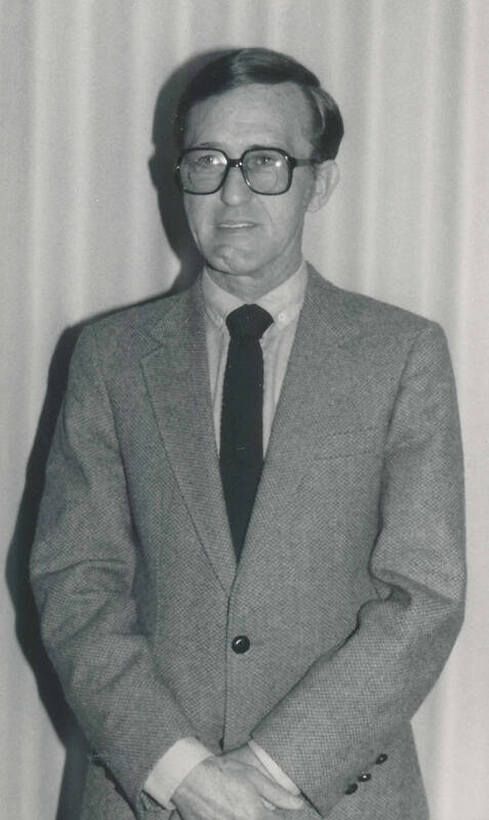
W. David Mortensen. Photograph by Robert L. Bonnell

W. David Mortensen. 'Board Adopts Policy on Deaf.' Source: The Salt Lake Tribune, June 16, 1978

W. David Mortensen. 'Won't Listen.' Source: Ogden Standard-Examiner, June 16, 1978
Restructuring the Office
of Services to the Deaf
On June 15, 1978, the Utah State Board of Education approved a plan to restructure the Office of Services to the Deaf. The decision generated considerable concern within the Utah Deaf community, particularly among members of the Utah Association for the Deaf (UAD). At the time, community members had not received the revised policy statement or the proposed organizational chart, creating uncertainty about how the reorganization would affect existing services (The Silent Spotlight, June 1978).
In response to these concerns, Dr. Walter D. Talbot, State Superintendent of Public Instruction, emphasized that the purpose of the reorganization was to protect the rights of Deaf consumers to choose the counselor with whom they felt most comfortable. Whether consumers preferred a counselor who used sign language or one who communicated primarily through speech, the new policy aimed to provide greater flexibility and choice. Under the reorganization, Bob Sanderson received expanded responsibilities that included overseeing the entire Rehabilitation Services to the Deaf Program and providing training to counselors and supervisors who worked with Deaf consumers throughout the state. The plan also provided for the addition of a Deaf counselor in the Salt Lake area (The Silent Spotlight, June 1978).
In response to these concerns, Dr. Walter D. Talbot, State Superintendent of Public Instruction, emphasized that the purpose of the reorganization was to protect the rights of Deaf consumers to choose the counselor with whom they felt most comfortable. Whether consumers preferred a counselor who used sign language or one who communicated primarily through speech, the new policy aimed to provide greater flexibility and choice. Under the reorganization, Bob Sanderson received expanded responsibilities that included overseeing the entire Rehabilitation Services to the Deaf Program and providing training to counselors and supervisors who worked with Deaf consumers throughout the state. The plan also provided for the addition of a Deaf counselor in the Salt Lake area (The Silent Spotlight, June 1978).

W. David Mortensen. 'Break Up Deaf Services?' Source: The Deseret News, June 27, 1973
Since its establishment in 1965, the Office of Services to the Deaf had experienced substantial growth. To accommodate increasing demand, the State Board of Education approved a major restructuring that created three regional offices. The new structure included a director, four counselors, district supervisors, and interpreting support services. The offices were strategically located to improve accessibility for Deaf consumers throughout Utah.
Under the new organization, the counseling staff included Norman Roberts in Ogden, Gene D. Stewart in North Salt Lake, Jim Hilber in central Salt Lake, and Jack White in Provo. Bob Sanderson remained director and continued supervising statewide activities. The objective was to ensure that Deaf and hard-of-hearing consumers, regardless of educational background or communication preference, had access to appropriate rehabilitation services (The Silent Spotlight, June 1978).
The counselors served not only as rehabilitation professionals but also as advocates and community liaisons. Through employment assistance, counseling, and outreach efforts, they helped expand job opportunities for Deaf individuals throughout Utah. Sign language classes sponsored by various organizations further increased public awareness and contributed to broader employment opportunities. As a result, many Deaf individuals gained access to occupations that had previously been difficult to enter. Counselors also spoke before civic organizations, helping educate the public about the needs and contributions of the Deaf community (The Silent Spotlight, June 1978).

Jim Hilber. Source: UAD Bulletin, November 1973
The restructured program sought to ensure that services were accessible to all Deaf consumers regardless of communication preference. Counselors communicated through sign language, speech, writing, or other methods as needed. Services included vocational counseling, job placement, financial assistance, hearing-aid evaluations, marriage counseling, sign language instruction, speech therapy, career training, and related support programs (The Silent Spotlight, June 1978).
To preserve consumer choice, district supervisors reviewed incoming referrals and allowed applicants to select counselors based on their preferred communication methods. Consumers could choose between counselors who communicated primarily through speech and those who could communicate using sign language, writing, speech, or a combination of methods (The Silent Spotlight, June 1978).
To preserve consumer choice, district supervisors reviewed incoming referrals and allowed applicants to select counselors based on their preferred communication methods. Consumers could choose between counselors who communicated primarily through speech and those who could communicate using sign language, writing, speech, or a combination of methods (The Silent Spotlight, June 1978).

Gene D. Stewart. Source: UAD Bulletin, Winter 1970
Despite these assurances, UAD President W. David "Dave" Mortensen remained concerned. He questioned whether district supervisors possessed sufficient training and experience to fully understand the needs of Deaf adults. He also worried that the reorganization might diminish the influence of counselors who had spent years developing specialized expertise in Deaf rehabilitation services. In his view, the accumulated knowledge and experience of these counselors should not be overlooked (The Silent Spotlight, June 1978).
At the same time, Utah's model of Deaf services had received recognition from several other states as an effective approach to serving Deaf consumers. While acknowledging that some complaints existed, the Utah Association for the Deaf believed that the large number of people benefiting from the program demonstrated its overall effectiveness. The organization also recognized that some Deaf individuals preferred communicating through speech and noted that general rehabilitation counselors could continue serving those consumers who chose that option (The Silent Spotlight, June 1978).
Ultimately, the Utah Association for the Deaf maintained that dismantling the centralized Deaf unit would not improve services and could potentially harm Deaf adults and parents seeking assistance for Deaf children. The organization stated that it had seen no evidence demonstrating that the restructuring would enhance service delivery for consumers with unique communication and accessibility needs. UAD leaders urged State Board of Education members to meet directly with Deaf individuals and gather feedback before making decisions that would significantly affect Deaf taxpayers and their families (The Silent Spotlight, June 1978).
This debate reflected broader questions facing Deaf services during the late 1970s: whether specialized services should remain centralized under Deaf leadership or be decentralized within general rehabilitation systems. Although opinions differed, both supporters and critics of the restructuring shared a common goal of improving opportunities and services for Utah's Deaf community.

John A. "Jack" White. Source: UAD Bulletin, Winter 1970
W. David Mortensen as a Spokesman
at the Utah State Capitol
In June 1978, the Utah State Board of Education proposed a budget request for the next legislative session to establish a community center for the Deaf. If approved, the center would provide a broad range of programs and services for Deaf and hard-of-hearing individuals throughout Utah, including those receiving services through the Division of Rehabilitation Services. The Utah Association for the Deaf (UAD) viewed the proposed center as an inclusive resource that would serve Deaf, oral Deaf, and hard-of-hearing individuals alike, while also offering speech and hearing conservation services (The Silent Spotlight, June 1978).
During the same month, W. David "Dave" Mortensen, president of the Utah Association for the Deaf, appeared before the Joint House-Senate Committee on Social Services at the Utah State Capitol to advocate for the establishment of a comprehensive community center for the Deaf and a state commission for the Deaf. Speaking on behalf of many members of Utah's Deaf community, Dave emphasized the need for services that would benefit all Deaf individuals rather than only those eligible for rehabilitation programs.
In his presentation, Dave expressed concern about recent policy changes implemented by Dr. Vaughn Hall and the Utah State Board of Education. He argued that the increasing emphasis on rehabilitation services had reduced or eliminated several community-based services that Deaf Utahns had relied upon for more than a decade. While rehabilitation programs served an important role, Dave maintained that many Deaf individuals required additional educational, social, recreational, advocacy, and community support services that extended beyond vocational rehabilitation (The Silent Spotlight, June 1978; Sanderson, 2004).
Dave urged legislators to consider the broader needs of Utah's Deaf population and emphasized that a community center should serve as a statewide resource for all Deaf and hard-of-hearing individuals. He envisioned a center that would provide opportunities for social interaction, community programs, public education, leadership development, advocacy, and access to information and services. Such a center, he argued, would strengthen the Deaf community while promoting greater independence and participation in society (The Silent Spotlight, June 1978; Sanderson, 2004).
His testimony represented an important turning point in the effort to establish a community center. Rather than focusing solely on rehabilitation services, Deaf leaders increasingly advocated for a comprehensive approach that recognized the cultural, social, educational, and communication needs of the entire Deaf community. Dave's leadership at the State Capitol helped keep the vision of a Deaf community center alive and laid important groundwork for the future establishment of what would later become the Robert G. Sanderson Community Center of the Deaf and Hard of Hearing.

W. David Mortensen. Photograph by Robert L. Bonnell
Back to Square One
Despite the setback of the failed 1977 legislation, Utah Deaf leaders refused to abandon their vision of a community center. Obtaining funding for such a facility remained a difficult challenge, but the determination of the Deaf community never wavered. During this period, W. David "Dave" Mortensen, president of the Utah Association for the Deaf, and Robert G. Sanderson, director of Services to Deaf Adults, developed a strong working partnership. By attending legislative meetings with Bob, Dave quickly gained valuable knowledge about the legislative process and became an increasingly effective advocate for the Deaf community. Together, they laid the groundwork for future efforts to secure state support for a community center (Sanderson, 2004).
In the years following the unsuccessful 1977 bill, Bob continued his work with Services to Deaf Adults while Dave intensified his lobbying efforts on behalf of the Utah Deaf community. Although the defeat of the legislation forced advocates to begin the process again, they remained committed to their goal. Through persistent communication with legislators and continued public advocacy, they kept the vision of a community center alive (Sanderson, 2004).
Their perseverance eventually produced encouraging results. In 1979, the Utah Legislature responded favorably to Dave's request for assistance in establishing a community center for Deaf individuals. While this represented a significant step forward, an equally important challenge remained: finding a suitable facility that could serve as the long-envisioned center for Utah's Deaf community.
This breakthrough marked the beginning of a new phase in the effort to establish a permanent gathering place, moving the project from the planning stage toward the search for a physical home. (Sanderson, 2004).
Lobbying the 1980 Utah
State Legislature for a Building
for the Community Center for the Deaf
In September 1979, the Utah State Board of Education approved a request for $2.5 million from a proposed $15.1 million construction budget to fund the construction and renovation of a Community Center for the Deaf. The project was designated as one of the board's highest funding priorities and was subsequently submitted to the State Building Board and the Utah Legislature for consideration (UAD Bulletin, September 1979).
As the proposal moved through the funding process, challenges quickly emerged. In January 1980, Governor Scott M. Matheson moved the Deaf Center project from 6th place to 11th place on the state building appropriations list, reducing its chances of receiving funding. Under the leadership of W. David "Dave" Mortensen, members of the Deaf community responded by contacting legislators and members of the appropriations subcommittee to advocate for the project. Despite these efforts, the center failed to regain a high enough ranking to secure immediate funding (UAD Bulletin, January 1980).
Even with this setback, planning for the center continued. In May 1980, an architectural firm in Ogden submitted preliminary drawings for the proposed facility to the State Building Board. However, inflation created another obstacle. The estimated cost of the project had increased to approximately $3.4 million for both the land and the building, substantially exceeding earlier projections (UAD Bulletin, May 1980).

Utah Governor Scott M. Matheson. Source: historytogo.utah.gov
Momentum returned in July 1980 when the Social Services Committee met at the Utah State Capitol to discuss the proposal. Representative Charles Doane of Salt Lake City introduced a motion urging both the State Building Board and the Appropriations Committee to give the Deaf Center high priority. The proposal received overwhelming support, with only one dissenting vote. The committee's endorsement represented an important step forward and strengthened hopes for funding during the upcoming 1981 legislative session. The Utah State Board of Education subsequently identified the Deaf Center as one of its major legislative priorities (The UAD Bulletin, August 1980).
Throughout this period, the Utah Association for the Deaf led an active statewide campaign to build public and legislative support. Association leaders encouraged Deaf community members to write to legislators and emphasize the importance of the proposed facility. They argued that Salt Lake City was the most practical location because it was home to the largest concentration of Deaf residents, while also serving as a central location accessible to Deaf individuals from across Utah. Through lobbying efforts, public awareness campaigns, and community mobilization, the UAD worked to demonstrate that the center would benefit Deaf and hard-of-hearing Utahns statewide (UAD Bulletin, August 1980).
In September 1980, Dave Mortensen informed the Deaf community that state committees would soon be reviewing proposals for the center and urged continued participation in the advocacy effort. At the same time, he acknowledged that some Deaf individuals opposed the project. According to Dave, some preferred the idea of a private membership club that would include a bar. He responded that the proposed Deaf Center would provide extensive community services and programs but would not include alcohol. Dave emphasized the importance of maintaining unity within the Deaf community while respecting differing viewpoints (UAD Bulletin, September 1980).
To further strengthen legislative support, the UAD invited state legislators to its October Funfest on October 11, 1980, at the Utah School for the Deaf in Ogden. The event provided lawmakers with an opportunity to meet members of Utah's Deaf community and learn firsthand about the need for a permanent community center. It also demonstrated the community's commitment to the project and the broad support it enjoyed among Deaf Utahns (UAD Bulletin, October 1980).
In November 1980, the UAD urged members of the Deaf community to oppose Initiatives A and B, warning that their passage could reduce tax revenues and jeopardize funding for projects such as the Deaf Center. Association leaders emphasized the importance of informed civic participation and the direct connection between public funding decisions and services for Deaf citizens (UAD Bulletin, November 1980).
By December 1980, Deaf leaders had played a central role in helping the Utah State Board of Education advance its request for a comprehensive community center. Their advocacy kept the project at the forefront of legislative discussions and underscored the continuing need for a statewide facility (UAD Bulletin, December 1980).
Despite years of planning and lobbying, the proposed Deaf Community Center failed to receive funding during the 1981 legislative session. UAD leaders expressed disappointment, particularly because substantial efforts had been made to mobilize support throughout the state. According to Bob Sanderson, legislative leaders ultimately chose to fund other construction priorities, including a dairy facility at Utah State University and the purchase of a building for the Utah State Board of Education. Funding options previously available for the Deaf Center expired, leaving the project once again without financial support (Sanderson, 2004).
Although Walter D. Talbot remained a strong advocate for the center, the setback forced Deaf leaders to continue their campaign. In July 1981, the Utah Association for the Deaf passed a resolution calling for renewed support and immediate action to establish the center. While the legislative defeat was discouraging, Deaf leaders refused to abandon a vision they had pursued for decades. Their persistence ensured that the dream of a statewide community center for Deaf Utahns remained alive (UAD Bulletin, March 1981; UAD Bulletin, April 1981; Sanderson, 2004).
This setback represented another chapter in the long struggle to establish a permanent home for Utah's Deaf community. Although funding remained elusive, the dedication of Dave Mortensen, Bob Sanderson, Walter Talbot, and countless Deaf advocates kept the project moving forward. Their perseverance would eventually help transform a long-held dream into the Robert G. Sanderson Community Center of the Deaf and Hard of Hearing.

Dr. Robert G. Sanderson. Photo courtesy of Barry Sanderson
Dr. Robert G. Sanderson
Appointed to Dr. Powrie V. Doctor Chair
In July 1981, Gallaudet College announced the selection of Dr. Robert G. Sanderson, Director of Utah's Services to the Deaf Office, as the recipient of the prestigious Dr. Powrie V. Doctor Chair for the 1981-82 academic year. This appointment represented a major professional achievement, as Bob became only the fourth individual to receive the honor (UAD Bulletin, July 1981; Sanderson, 2004).
On August 24, 1981, Bob and his wife, Mary, began a new chapter as they left Utah for Washington, D.C. Bob took an educational leave of absence from the Division of Vocational Rehabilitation through May 1982 to further expand his knowledge and expertise in vocational rehabilitation and services for Deaf individuals. Mary also took a one-year leave of absence from the United States Forest Service to support the transition and accompany him during his fellowship year (UAD Bulletin, July 1981).
According to Gallaudet's On the Green publication, Bob focused his work on the social factors affecting Deaf individuals and the challenges they faced in obtaining and maintaining employment (Cinelli, On the Green, January 11, 1982). During his appointment, he shifted much of his attention from traditional vocational rehabilitation toward the broader field of social rehabilitation. In addition to conducting research, he taught counseling courses and visited rehabilitation agencies throughout the country to collect information and evaluate successful service models. These experiences broadened his understanding of national issues affecting Deaf adults and provided valuable insight that would later benefit Utah's Deaf community. In June 1982, Bob and Mary returned to their respective positions in Utah, enriched by their experiences and newly acquired knowledge (UAD Bulletin, July 1981).

Dr. Robert G. Sanderson, Gallaudet Powrie V. Doctor Chair of Deaf Studies. Source: On The Green, November 23, 1981

'Utahn to Chair Deaf Studies.' Source: Deseret News, July 27-28, 1981

Dr. Robert Sanderson. Source: On the Green, January 11, 1982
While Bob was away, Dave Mortensen, president of the Utah Association for the Deaf, continued advocating for a community center for Deaf Utahns. Seeking to revive the stalled project, Dave requested a meeting with Governor Scott M. Matheson. When the governor was unable to attend, he sent his aide, Tony Mitchell, to meet with Dave, Valerie G. Kinney, secretary of the Utah Association for the Deaf, and Alden Broomhead, a member of the UAD Board of Directors.
During the meeting, the group expressed frustration over the repeated failure of the legislature to fund a Deaf community center, despite years of planning, studies, and advocacy. They also discussed what became known among Deaf leaders as the "cows before deaf people" controversy, referring to the legislature's earlier decision to fund a dairy facility rather than the proposed Deaf Center. Recognizing the importance of the issue, Tony Mitchell instructed his assistant, Boren, to identify $500,000 within the Division of Rehabilitation budget and begin searching for a possible location for the center (Sanderson, 2004).
This meeting represented a significant breakthrough. Although the community center had suffered repeated legislative setbacks, state officials again demonstrated a willingness to explore alternative paths toward making the long-awaited facility a reality. While Bob was expanding his expertise at Gallaudet College, Dave and other Deaf leaders continued the campaign at home, ensuring that the vision of a statewide community center remained alive and moving forward.

Valerie G. Kinney. Photograph by Robert L. Bonnell
Resignation of Dr. Walter D. Talbot
Takes Utah Deaf community by Surprise
On January 15, 1982, the Utah Deaf community received unexpected news when Dr. Walter D. Talbot, Superintendent of Utah Public Education, announced his resignation during a meeting of the Utah State Board of Education. His resignation was scheduled to take effect on June 30, 1982 (UAD Bulletin, February 1982).
Walter had long been a supporter of the Utah Deaf community and a strong advocate for the proposed Deaf community center. Throughout the planning and legislative efforts of the late 1970s and early 1980s, he worked closely with Deaf leaders and supported initiatives aimed at expanding services and opportunities for Deaf Utahns. As a result, his departure created uncertainty about the future of several ongoing projects, including efforts to secure funding and state support for a community center for the Deaf (UAD Bulletin, February 1982).
For many Deaf leaders, Walter's resignation came at a critical time. The community center proposal had already experienced numerous legislative setbacks, and his support within the Utah State Board of Education had been instrumental in keeping the project alive. With his impending departure, Deaf advocates faced the challenge of maintaining momentum and building relationships with new state leaders who would ultimately influence the future of the proposed center.
Although the announcement was disappointing, Deaf leaders remained committed to their goal. They continued their advocacy efforts, determined to ensure that the vision of a statewide community center for Deaf and hard-of-hearing individuals would not be lost despite the leadership transition (UAD Bulletin, February 1982).
Walter's resignation represented another obstacle in the long campaign to establish a Deaf community center. Nevertheless, the persistence of leaders such as Bob Sanderson, Dave Mortensen, and many other Deaf advocates ensured that the movement continued forward. Their determination would ultimately help bring the long-envisioned community center closer to reality.
Lobbying the 1982 Utah State Legislature for the Community Center for the Deaf
Following the announcement of Dr. Walter D. Talbot's resignation, the Utah Association for the Deaf moved quickly to address issues affecting the proposed Deaf community center. UAD leaders met with Walter to discuss several important matters, including the appointment of a director, the formation of an administrative board, and plans for renovating the future facility (UAD Bulletin, March 1982).
Progress on the Community Center for the Deaf
On January 14, 1982, the Public Education Appropriations Committee at the Utah State Capitol proposed converting a former meetinghouse of The Church of Jesus Christ of Latter-day Saints in Midvale, Utah, into a community center for the Deaf. The proposed purchase price of the building was $110,000, with an additional $30,000 allocated for remodeling. Built in 1929, the structure was appraised by the State Building Board, and the Church subsequently negotiated the final purchase price before presenting the proposal to the legislature (UAD Bulletin, February 1982).
Momentum continued to build during the 1982 legislative session.
Momentum continued to build during the 1982 legislative session.
Funding for the Center Approved
After years of persistent advocacy by Deaf leaders and their allies, the Utah Association for the Deaf achieved a significant breakthrough during the final days of the 1982 legislative session. The State Building Board approved funding for several construction projects, including an allocation of $200,000 for a Deaf Center. This decision marked the first major legislative victory toward establishing a permanent community center for Utah's Deaf community (UAD Bulletin, March 1982).
Although funding had been secured, several important issues still had to be resolved, including selecting a director, establishing an administrative board, and overseeing renovations. UAD officers and members quickly addressed these challenges by meeting with Walter to begin the organizational process (UAD Bulletin, March 1982).
On March 19, 1982, the Utah State Board of Education formally placed the Community Center for the Deaf on its agenda and approved the creation of a committee composed primarily of Deaf community members to oversee the center's development. The center would be located in the former Latter-day Saints ward building in Midvale. Shortly thereafter, advertisements were posted for the positions of director and secretary (UAD Bulletin, April 1982).
The newly appointed committee reflected broad representation from Utah's Deaf community. Members included George Gavros, Peter Green, Dennis Platt, Fred Bass, Robert Welsh, Dora Benoit Laramie, Richard Snow, Janny Scheeline, William Sevy, Celia May Laramie Baldwin, Lynn Losee, and Dave Mortensen. Together, these individuals brought a wide range of experiences, perspectives, and leadership skills to the planning and development of the center (UAD Bulletin, April 1982).
The establishment of this committee represented a significant milestone. For the first time, Deaf Utahns were given direct responsibility for helping shape the future of a statewide Deaf community center. After decades of planning, legislative efforts, setbacks, and renewed advocacy, the vision of a permanent gathering place for Utah's Deaf community was beginning to take shape.
Deaf Members of the Community
Center for the Deaf Committee

Pete Green. Photograph by Robert L. Bonnell
|

Dennis R. Platt. Photo courtesy of Shirley Hortie Platt
|

Dora Benoit Laramie. Photographby Robert L. Bonnell
|

Robert Welsh. The Utah Eagle, April 1955
|

Richard Snow. Courtesy of Richard Snow
|

Lynn Losee. Photo courtesy of the Salt Lake Valley Ward for the Deaf
|

Celia May Laramie Baldwin. Photograph by Robert L. Bonnell
Search for a New Location
With funding approved, the next challenge was finding a suitable location for the proposed Deaf Center. The original plan focused on acquiring a facility in Midvale, Utah. However, concerns about parking and site limitations soon became apparent. Despite these obstacles, Deaf leaders remained committed to finding a location that would adequately serve the needs of Utah's Deaf community (Sanderson, 2004).
One possibility was a historic church building in Midvale owned by The Church of Jesus Christ of Latter-day Saints. Although the structure was relatively small and lacked a gymnasium, Robert G. Sanderson, Gene D. Stewart, Beth Ann Stewart Campbell, Norman Williams, and Robert Lunnen agreed that it could serve as a reasonable starting point with appropriate remodeling. To support the project, the 1982 Utah Legislature appropriated $200,000 for the purchase of a chapel to be used as a Deaf Center (Sanderson, 2004).
As plans moved forward, the Division of Facilities Construction and Management, which oversaw state-owned facilities, began working with an architect to develop renovation plans. Rehabilitation Services, the Utah State Board of Education, and The Church of Jesus Christ of Latter-day Saints worked cooperatively to complete the necessary arrangements. Their collaboration reflected a shared commitment to creating a permanent community center for Deaf Utahns.
Before renovation of the Midvale facility began in October 1982, an unexpected opportunity emerged. Dora Benoit Laramie, a teacher at the Utah School for the Deaf, and her husband, George Laramie, both longtime members of Utah's Deaf community, informed Bob about a larger church building in Bountiful, Utah, that had been vacant for some time. Unlike the Midvale building, the Bountiful facility contained a gymnasium and numerous meeting rooms that could better accommodate community activities. The building also required only minor repairs, making it available for immediate use (Sanderson, 2004).

George L. Laramie. Source: The UAD Bulletin, Summer 1969
After learning about the property, Bob discussed the opportunity with Dr. Harvey Hirschi, acting administrator of Rehabilitation Services. Harvey immediately recognized the advantages of the Bountiful building and supported suspending work on the Midvale project while the alternative was evaluated. As news spread, interest in the Bountiful facility grew among both the Utah Deaf community and Rehabilitation Services.
Support for the relocation increased further when Kim R. Burningham, who succeeded Dr. Walter D. Talbot as State Superintendent of Public Instruction, informed the Utah State Board of Education that the proposed center could be moved from the Midvale site to the larger and more attractive Bountiful building. The Board approved the change, allowing the project to move forward at the new location (Sanderson, 2004).
Support for the relocation increased further when Kim R. Burningham, who succeeded Dr. Walter D. Talbot as State Superintendent of Public Instruction, informed the Utah State Board of Education that the proposed center could be moved from the Midvale site to the larger and more attractive Bountiful building. The Board approved the change, allowing the project to move forward at the new location (Sanderson, 2004).

State Superintendent Kim R. Burningham. Source: The Salt Lake Tribune
Eventually, The Church of Jesus Christ of Latter-day Saints agreed to exchange the Bountiful church building for the Midvale church property. The financial benefits were substantial. The projected cost of purchasing and renovating the Midvale facility was estimated at approximately $525,000. By comparison, the total cost of acquiring and renovating the Bountiful building, including real estate expenses and architectural fees, was approximately $333,000. The decision not only provided a larger and more functional facility but also saved approximately $191,000 (Sanderson, 2004).
The acquisition of the Bountiful building marked a significant milestone in the history of Utah's Deaf community. While it was not the final chapter in the search for a statewide Deaf Center, it provided the community with a dedicated facility and demonstrated what could be achieved through years of advocacy, determination, and collaboration. The experience gained from establishing the Bountiful center would help shape future efforts to expand services and facilities for Deaf Utahns (Sanderson, 2004).
The acquisition of the Bountiful building marked a significant milestone in the history of Utah's Deaf community. While it was not the final chapter in the search for a statewide Deaf Center, it provided the community with a dedicated facility and demonstrated what could be achieved through years of advocacy, determination, and collaboration. The experience gained from establishing the Bountiful center would help shape future efforts to expand services and facilities for Deaf Utahns (Sanderson, 2004).
Deaf Dedicates "Home of Their Own"
After years of planning, advocacy, and patience following the 1975 feasibility study for a community center, the Utah Deaf community achieved a major milestone with the opening of the first Utah Community Center for the Deaf (UCCD) in January 1983. Located in the former Bountiful 33rd Ward chapel at 388 North 400 South and acquired from The Church of Jesus Christ of Latter-day Saints, the center stood as a testament to the dedication and perseverance of Deaf Utahns and their supporters (Sanderson, 2004).
The opening of the UCCD represented far more than the acquisition of a building. It symbolized years of advocacy, determination, and community collaboration. Reflecting on the center's significance, W. David "Dave" Mortensen, president of the Utah Association for the Deaf and Utah's only Deaf social worker at the time, stated, "The study identified the unique and specific needs of the Deaf people of Utah" (The Salt Lake Tribune, May 29, 1983).
On June 9, 1983, members of the Utah Deaf community gathered for a ribbon-cutting ceremony to dedicate the renovated UCCD, which many proudly regarded as a "home of their own." During the ceremony, Bob Sanderson and Dave Mortensen emphasized the importance of accessible communication. Bob stressed that communication between Deaf and hard-of-hearing individuals and the professionals serving them should be clear, accessible, and based on individual preferences. He noted that service providers should adapt their communication methods to meet the needs of those they served. Dave added that Deaf individuals needed a dependable place where they could receive understanding, assistance, and support. He further emphasized the importance of confidence and trust in service providers, particularly when communication barriers affected understanding and access to services (The Salt Lake Tribune, May 29, 1983).
The UCCD served as an important resource for the approximately 78,000 Deaf and hard-of-hearing individuals living in Utah at the time, including an estimated 10,000 people considered deaf for communication purposes (The Salt Lake Tribune, May 29, 1983). The center was established to address the social, recreational, educational, and service needs of Deaf, hard-of-hearing, and Deaf individuals with additional disabilities. Through its programs and activities, the center sought to strengthen community connections while improving access to information and support (The Salt Lake Tribune, May 29, 1983).
Reflecting on the accomplishment, Bob expressed his appreciation for those who had made the center possible: "It was a dream of many years come true, with much appreciation to the Utah State Board of Education, Rehabilitation Services, and the Utah State Legislature" (Sanderson, 2004).
The opening of the UCCD marked a significant milestone in Utah Deaf history. While it was not the final chapter in the search for a statewide Deaf community center, it provided Deaf Utahns with a dedicated gathering place and demonstrated what could be achieved through years of advocacy, cooperation, and persistence. The success of the Bountiful center would help shape future efforts to expand services and facilities for Utah's Deaf community.

Dedication Program at the Utah Community Center for the Deaf, June 8, 1983. Courtesy of the Sanderson Community Center
Home of the First Utah
Community Center for the Deaf
The Utah Community Center for the Deaf (UCCD) in Bountiful, Utah, became a reality through years of advocacy and planning by Utah's Deaf community. Bob Sanderson was appointed as the center's first director by Dr. Harvey Hirschi. In 1982, three staff members joined the center: Beth Ann Stewart Campbell, Norman Williams, and Robert Lunnen (UAD Bulletin, July 1982; Sanderson, 2004).
The UCCD offered a wide range of services designed to support Deaf and hard-of-hearing individuals throughout Utah. These services included vocational rehabilitation, counseling, interpreting services, telecommunications assistance, information and referral services, a library, training programs, volunteer services, peer support programs, and educational classes (Sanderson, 2004).
To assist Deaf individuals seeking employment, the UCCD collected books, research materials, equipment, photographs, and other resources related to Deaf subjects. The center also established a printing laboratory and created opportunities for entrepreneurship. On December 5, 1983, Robert J. Welsh, a Deaf photographer who operated a successful color-separation and photography business, taught a class to help Deaf individuals develop employment skills. The UCCD provided both the space and resources necessary to encourage business development and self-employment within the Deaf community (Sanderson, 2004; The Salt Lake Tribune, May 29, 1983).

Robert J. Welsh. Source: The Deaf American, January 1965
The UCCD quickly became much more than a service center. It evolved into a focal point for community life, bringing together rehabilitation services, adult education, training programs, recreation, and social activities under one roof. The 22,000-square-foot facility provided space for physical activities, social gatherings, meetings, and community events. Basketball games, archery, volleyball, movie screenings, parties, and other activities helped strengthen relationships and foster a sense of belonging among Deaf and hard-of-hearing Utahns (Sanderson, 2004).
Following renovation of the building, the Utah Association for the Deaf and several Deaf and hard-of-hearing organizations, including Self Help for the Hard of Hearing, established offices within the center. For many organizations, this was the first time they had dedicated space to store records, conduct meetings, and coordinate activities. The renovation also upgraded existing facilities and created new spaces that expanded opportunities for services and community programs (Sanderson, 2004).
Following renovation of the building, the Utah Association for the Deaf and several Deaf and hard-of-hearing organizations, including Self Help for the Hard of Hearing, established offices within the center. For many organizations, this was the first time they had dedicated space to store records, conduct meetings, and coordinate activities. The renovation also upgraded existing facilities and created new spaces that expanded opportunities for services and community programs (Sanderson, 2004).

Utah Community Center for the Deaf in Bountiful Utah, 1983.
Pencil drawing by Robert Winkelkotter. Courtesy of the Sanderson Community Center
Members of the Deaf communities in Ogden, Salt Lake City, and surrounding areas volunteered countless hours to transform the building into a welcoming gathering place. What had once existed only as a dream discussed at the 1946 Utah Association for the Deaf convention had finally become a reality. For the first time, many activities that had previously been scattered across multiple locations could be held in one central facility.
The establishment of the UCCD represented a major milestone in Utah Deaf history. It demonstrated the determination, persistence, and vision of Deaf leaders and community members who spent decades advocating for a place of their own. The center provided a space where Deaf and hard-of-hearing individuals could gather, share experiences, build friendships, and support one another. Although the Bountiful facility was not the final chapter in the search for a statewide Deaf center, it marked a significant achievement and laid the foundation for future developments that would continue to strengthen Utah's Deaf community (Sanderson, 2004).
The establishment of the UCCD represented a major milestone in Utah Deaf history. It demonstrated the determination, persistence, and vision of Deaf leaders and community members who spent decades advocating for a place of their own. The center provided a space where Deaf and hard-of-hearing individuals could gather, share experiences, build friendships, and support one another. Although the Bountiful facility was not the final chapter in the search for a statewide Deaf center, it marked a significant achievement and laid the foundation for future developments that would continue to strengthen Utah's Deaf community (Sanderson, 2004).
Dream Becomes a Nightmare
The Utah Community Center for the Deaf (UCCD) soon encountered a variety of challenges after opening its doors. As director, Bob Sanderson faced numerous maintenance and operational issues. A neighboring sprinkler system caused flooding along the east side of the property, parking became overcrowded during major events, the upper floor lacked adequate air conditioning during the summer months, and an aging coal-fired heating system posed a potential fire hazard during the winter. Security also became a concern after a break-in and theft prompted the center to rekey all exterior doors. As repairs and maintenance issues accumulated, operating expenses increased substantially. At the same time, some of the initial enthusiasm surrounding the center diminished as community members found that traveling long distances to Bountiful was not always convenient (Sanderson, 2004).
Additional challenges emerged in 1983 when rapid snowmelt triggered severe mudslides along the Wasatch Front. One of the slides struck 400 North Street near the center and deposited approximately three feet of mud into the basements of several neighboring homes located below street level. Fortunately, the UCCD escaped serious damage. Because the building sat on higher ground on the south side of the street and was protected by a four-foot retaining wall, the mudflow did not reach the structure itself (Sanderson, 2004).
Although the center survived the disaster, the mudslide served as another reminder that maintaining a community center involved challenges that extended far beyond simply acquiring a building. What had begun as the fulfillment of a long-held dream now required constant attention, maintenance, and community support. Nevertheless, despite these setbacks, the UCCD remained an important gathering place for Utah's Deaf community and continued fulfilling the vision first expressed by Deaf leaders decades earlier (Sanderson, 2004).
The Utah Community Center for the Deaf
Officially Dedicated
The Deaf Advisory Council of the Utah Community Center for the Deaf (UCCD), with support from members of the Deaf community, spent months organizing a formal dedication for the center. On November 5, 1983, the UCCD was officially dedicated, marking another important milestone in the history of Utah's Deaf community. According to dedication chairperson Celia May Laramie Baldwin, approximately 325 people attended the ceremony (UAD Bulletin, June 1983).
The dedication celebrated more than just a building. It represented the fulfillment of a vision first discussed decades earlier and the successful outcome of years of advocacy, planning, and perseverance. For many attendees, the center symbolized a place where Deaf and hard-of-hearing individuals could gather, communicate freely, and access services designed to meet their unique needs.
The dedication celebrated more than just a building. It represented the fulfillment of a vision first discussed decades earlier and the successful outcome of years of advocacy, planning, and perseverance. For many attendees, the center symbolized a place where Deaf and hard-of-hearing individuals could gather, communicate freely, and access services designed to meet their unique needs.

Utah Community Center for the Deaf Dedication Ceremony, November 5, 1983. Courtesy of the Sanderson Community Center

Utah Community Center for the Deaf Dedication Ceremony, November 5, 1983. Courtesy of the Sanderson Community Center

Utah Community Center for the Deaf Dedication Ceremony, November 5, 1983. Courtesy of the Sanderson Community Center
The Utah Community Center for the Deaf
Continues to Thrive
During the next two years, the Utah Community Center for the Deaf became a busy hub of activity. One significant development occurred when the Utah Association for the Deaf established what Bob Sanderson described as the nation's first official UAD office. Valerie G. Kinney was appointed part-time business manager, helping to strengthen the organization's administrative operations and expand its services (Sanderson, 2004).

Valerie G. Kinney. Photo courtesy of the Kenneth C. Burdett Bulletin Board
Beth Ann Stewart Campbell, a Child of Deaf Adults (CODA) and experienced interpreter, demonstrated remarkable initiative by securing sponsorships and donations from local service organizations. Her efforts provided equipment and supplies that state funding could not cover, helping the center expand its services and programs (Sanderson, 2004).
Technology also played an increasingly important role in the center's success. The Text Telephone (TTY), originally developed in 1964 by Deaf physicist Robert Weitbrecht, transformed communication for Deaf individuals by allowing conversations to be transmitted through typed messages rather than voice communication. The UCCD's TTY service became especially valuable because it repaired and maintained teleprinter equipment used throughout Utah's Deaf community (Sanderson, 2004).
Later developments continued to improve communication access. In 2003, Sorenson Communications introduced videophone technology and free Video Relay Service (VRS), creating new communication opportunities for Deaf individuals. That same year, Salt Lake City became the first city to adopt a Video Relay Service system (Sanderson, 2004).

Dr. Robert H. Weitbrecht. Source: Ultratec, Inc.
The success of the TTY program owed much to individuals such as Robert Lunnen, who had repaired teleprinter equipment while serving during World War II. His expertise proved invaluable as he maintained and restored machines donated by Western Union, AT&T Mountain States Telephone, and other organizations (Sanderson, 2004).
Another key contributor was Norman Williams, a graduate of the Utah School for the Deaf in 1962. Norman's technical abilities extended well beyond TTY maintenance. A skilled craftsman, builder, electrician, and mechanic, he contributed countless hours to maintaining and improving the center's facilities and equipment. His work helped ensure that the center remained operational and welcoming for the community it served (Sanderson, 2004).
Another key contributor was Norman Williams, a graduate of the Utah School for the Deaf in 1962. Norman's technical abilities extended well beyond TTY maintenance. A skilled craftsman, builder, electrician, and mechanic, he contributed countless hours to maintaining and improving the center's facilities and equipment. His work helped ensure that the center remained operational and welcoming for the community it served (Sanderson, 2004).

Norman Williams. Source: The Utah Eagle, 1962
Reflecting on the impact of the communications program, Bob Sanderson described it as one of the most important accomplishments of Utah Rehabilitation Services. Before the availability of TTY technology, rehabilitation counselors and social workers had limited options for communicating with Deaf consumers. Counselors often had to travel to consumers' homes and hope they were available. The introduction of TTY technology dramatically improved communication and enabled counselors to provide more timely and effective services (Sanderson, 2004).
The UCCD continued to grow as both a service center and community gathering place. Through its programs, technology, educational opportunities, and dedicated volunteers, the center strengthened communication access and helped foster a stronger, more connected Deaf community throughout Utah. While future developments would eventually lead to an even larger center, the UCCD in Bountiful represented a major step forward in realizing the long-held dream of a place where Deaf Utahns could gather, receive services, and build community together.
The UCCD continued to grow as both a service center and community gathering place. Through its programs, technology, educational opportunities, and dedicated volunteers, the center strengthened communication access and helped foster a stronger, more connected Deaf community throughout Utah. While future developments would eventually lead to an even larger center, the UCCD in Bountiful represented a major step forward in realizing the long-held dream of a place where Deaf Utahns could gather, receive services, and build community together.
Did You Know?
Under the supervision of Beth Ann Stewart Campbell at the Utah Community Center for the Deaf (UCCD) in Bountiful, Utah, Norman Williams took the initiative to furnish the conference room with Deaf-friendly seating. In 1984, he ordered circular conference tables in pieces from the Utah State Prison for $2,000. Drawing on his understanding of Deaf communication, Norman believed that round and oval tables were ideal because they allowed Deaf and hard-of-hearing individuals to maintain visual contact with one another, facilitating more effective communication and participation in group discussions (Norman Williams, e-mail message with Jodi Christel Becker, April 12, 2012).
The purchase became a source of pride for Beth Ann. According to W. David "Dave" Mortensen, she often spoke enthusiastically about her office furnishings, the tables constructed by prison inmates, and the conference room setup that helped create a more welcoming and accessible environment for the Deaf community (W. David Mortensen, e-mail message to Jodi Christel Becker, April 3, 2012).
The conference tables reflected an important principle of Deaf space design: arranging seating to maximize visibility and communication among participants. What may have seemed like a simple furniture decision actually helped create a more inclusive environment where Deaf individuals could interact comfortably and communicate with ease.
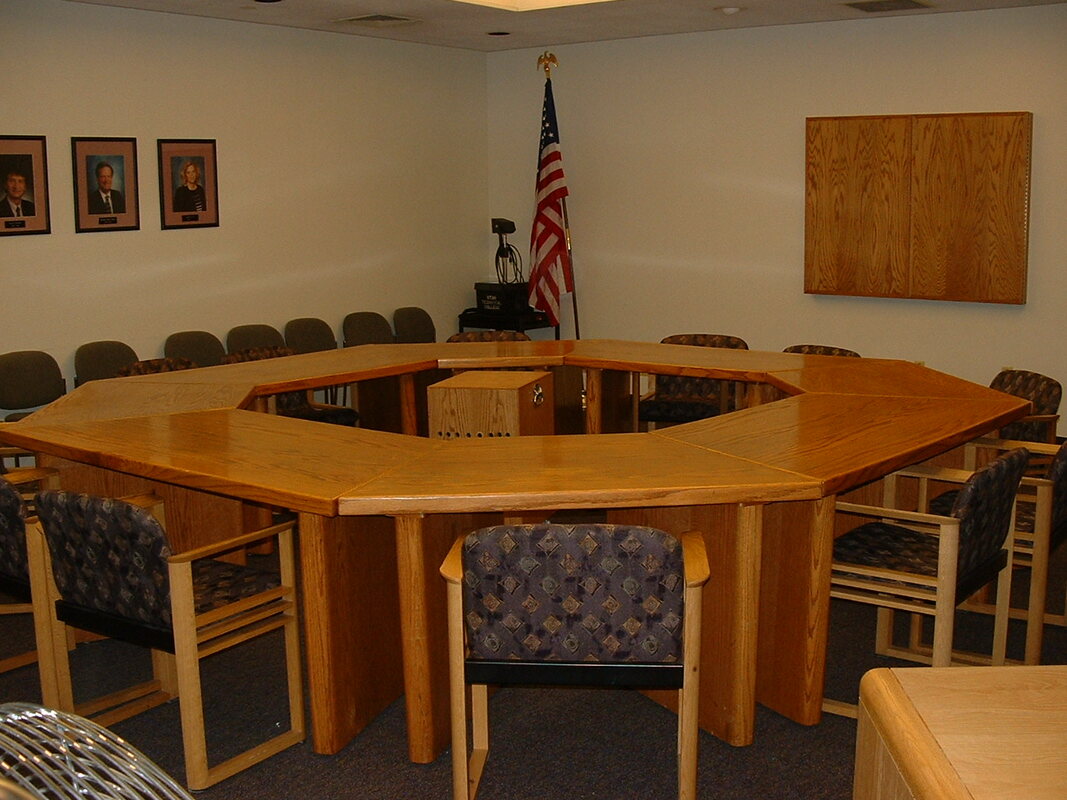
Round tables made by prisoners in the Marilyn T. Call Conference room. Photo courtesy of the Sanderson Community Center
Dr. Grant B. Bitter Criticizes
the Utah Community Center for the Deaf
On January 2, 1985, Dr. Grant B. Bitter, a prominent advocate of oral and mainstream education, publicly criticized several aspects of the Utah Community Center for the Deaf (UCCD). His concerns focused on the recreational activities offered at the center, the approach used by UCCD counselors in providing rehabilitation services to oral Deaf individuals, and the center's relationship with the Utah Association for the Deaf (UAD). Grant believed that the needs and preferences of oral Deaf individuals were not being adequately represented and questioned whether the center was serving the entire Deaf and hard-of-hearing population as intended.
In a written statement, Grant argued:
"No currently employed rehabilitation counselors for the deaf should be appointed as director for the Center for the Deaf…unless it is entirely separate from rehabilitation services; then the center should be supported by private funds and contributions as a "recreation center" for the Deaf community. Under those circumstances it should not be supported by public tax dollars. If the center is to be a place where all hearing impaired persons may go for appropriate services in meeting individual needs, then it must be divested from any relationship to UAD or any other organization of a special interest nature and be entirely free from these groups to pressure special interest decisions or control" (Bitter, January 2, 1985).
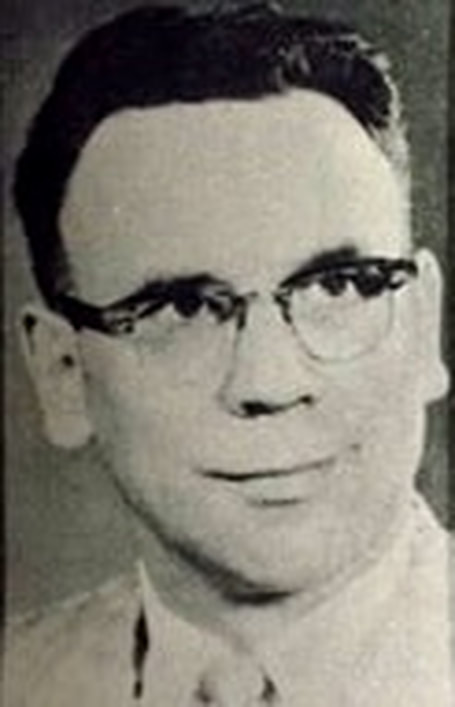
Dr. Grant B. Bitter. Source: The Utah Egale, October 1962
Grant's criticism extended beyond the governance of the center. He also expressed concern that rehabilitation programs and counselors were promoting sign language and total communication at the expense of oral approaches. To emphasize his concerns, he wrote the following statement in capital letters:
“NO PROGRAMS FROM ANY OFFICE SHOULD MANIPULATE, PROMOTE, OR OTHERWISE INFLUENCE THINKING OF CLIENTS OR POTENTIAL CLIENT TOWARD EITHER SIGN LANGUAGE OR THE ORAL, AURAL/ORAL APPROACH. COUNSELORS ARE TO ASSIST IN PROVIDNG APPROPRIATE SUPPORT SYSTEMS, REASONABLY, IN ORDER THAT CLIENTS MIGHT BE GAINFULLY EMPLOYED REALISTICALLY AND PRODUCTIVELY, WITHOUT INTIMIDATION AND PRESSURE. COUNSELORS MUST NOTGIVE INFORMATION FALSELY IN AN EFFORT TO PROMOTE ONE’S OWN WAY OF THINKING. HERE ARE SOME THAT HAVE BEEN USED TO PROMOTE SIGN LANGUAGE: (Bitter, January 2, 1985).
Grant then listed several examples that he believed were being used to encourage the acceptance of sign language over oral communication. Among his concerns were claims regarding the relationship between sign language and spoken language development, the role of Deaf identity, speechreading effectiveness, total communication philosophy, mainstreaming, and the use of sign language by interpreters.
His criticism reflected the continuing debate within Utah's Deaf community over communication methods, educational philosophy, and service delivery. For decades, advocates of oral education and supporters of sign language and total communication had disagreed on the best approaches to educating and supporting Deaf individuals. Grant argued that public agencies should remain neutral and avoid influencing Deaf individuals toward any particular communication philosophy.
Grant also expressed concern that oral Deaf individuals were not receiving equal consideration within existing programs. He believed that insufficient collaboration existed among organizations serving the Deaf community and questioned whether alternative communication approaches were being adequately supported.
Ironically, while Grant criticized the relationship between the UCCD and the Utah Association for the Deaf, the UAD had been one of the principal organizations responsible for advocating for the creation of the center. Through decades of feasibility studies, legislative campaigns, fundraising efforts, and public advocacy, UAD leaders had worked tirelessly to establish a community center that would serve Deaf and hard-of-hearing Utahns.
The controversy surrounding the UCCD also raised broader questions about access and inclusion. Hearing individuals generally had access to countless recreational, educational, and social opportunities through community organizations and public facilities. Deaf individuals, however, often encountered communication barriers that limited their ability to participate fully in those same opportunities. Supporters of the UCCD viewed the center as a way to reduce those barriers by creating a space where Deaf and hard-of-hearing individuals could access services, information, recreation, and community activities in an accessible environment.
The debate surrounding the Utah Community Center for the Deaf illustrated the diversity of viewpoints within Utah's Deaf community during the 1980s. While Deaf leaders, educators, rehabilitation professionals, and oral advocates often disagreed about communication methods and service models, they shared a common goal: improving opportunities and quality of life for Deaf and hard-of-hearing individuals throughout Utah.
“NO PROGRAMS FROM ANY OFFICE SHOULD MANIPULATE, PROMOTE, OR OTHERWISE INFLUENCE THINKING OF CLIENTS OR POTENTIAL CLIENT TOWARD EITHER SIGN LANGUAGE OR THE ORAL, AURAL/ORAL APPROACH. COUNSELORS ARE TO ASSIST IN PROVIDNG APPROPRIATE SUPPORT SYSTEMS, REASONABLY, IN ORDER THAT CLIENTS MIGHT BE GAINFULLY EMPLOYED REALISTICALLY AND PRODUCTIVELY, WITHOUT INTIMIDATION AND PRESSURE. COUNSELORS MUST NOTGIVE INFORMATION FALSELY IN AN EFFORT TO PROMOTE ONE’S OWN WAY OF THINKING. HERE ARE SOME THAT HAVE BEEN USED TO PROMOTE SIGN LANGUAGE: (Bitter, January 2, 1985).
Grant then listed several examples that he believed were being used to encourage the acceptance of sign language over oral communication. Among his concerns were claims regarding the relationship between sign language and spoken language development, the role of Deaf identity, speechreading effectiveness, total communication philosophy, mainstreaming, and the use of sign language by interpreters.
- Learning sign language will not affect your use of spoken language. That statement must be qualified considerably. Which hearing impaired person will it not affect? Obviously, the “deafened” adult such as Dave Mortensen, Paul Chamberlain, Robert Sanderson, etc…persons who have developed oral language (spoken, written) before losing their hearing and who continue to use their spoken and written language daily in their work will retain that ability. However, most children who are prelingually hearing impaired if they have been educated orally and then learning sign language will lose a great deal of proficiency. Those who attempt to use a mix of sign language and oral language will use pre-dominantly the sign language modality. The phenomenon is demonstrated by research.
- To use spoken language is to deny your deafness or to not use sign language is to deny your deafness, or if you don’t sign, you deny your deafness.
- Deafness is your heritage.
- Speechreading is impossible (“40% look alike sounds on the lips, etc). This is a myth…..some research indicates that hearing impaired person who are visual oral (speechreading) as their primary mode of communicating, will comprehend about 95% of the concepts).
- Total communication really includes the oral approach. Such a statement is most commonly used and is not true. In reality don’t make of sign language something it is not and cannot do. It has its place for those who prefer that system of communication, but total communication is a philosophy not a method. It is a “supermarket” term. Sign language has many limitations. It isolates and segregates, creates dependency rather than functional independence and creates a psychological/emotional conditioning that is resistant to the concept of mainstreaming, etc…(“Mainstreaming denies deafness”).
- Sign language appears to have some charismatic affect on hearing people; many hearing people, including interpreters, frequently use it as a vehicle of control rather than a means of assisting the consumer to become functionally independent, or facilitating the sending of accurate messages to the receiver only (Bitter, January 2, 1985).
His criticism reflected the continuing debate within Utah's Deaf community over communication methods, educational philosophy, and service delivery. For decades, advocates of oral education and supporters of sign language and total communication had disagreed on the best approaches to educating and supporting Deaf individuals. Grant argued that public agencies should remain neutral and avoid influencing Deaf individuals toward any particular communication philosophy.
Grant also expressed concern that oral Deaf individuals were not receiving equal consideration within existing programs. He believed that insufficient collaboration existed among organizations serving the Deaf community and questioned whether alternative communication approaches were being adequately supported.
Ironically, while Grant criticized the relationship between the UCCD and the Utah Association for the Deaf, the UAD had been one of the principal organizations responsible for advocating for the creation of the center. Through decades of feasibility studies, legislative campaigns, fundraising efforts, and public advocacy, UAD leaders had worked tirelessly to establish a community center that would serve Deaf and hard-of-hearing Utahns.
The controversy surrounding the UCCD also raised broader questions about access and inclusion. Hearing individuals generally had access to countless recreational, educational, and social opportunities through community organizations and public facilities. Deaf individuals, however, often encountered communication barriers that limited their ability to participate fully in those same opportunities. Supporters of the UCCD viewed the center as a way to reduce those barriers by creating a space where Deaf and hard-of-hearing individuals could access services, information, recreation, and community activities in an accessible environment.
The debate surrounding the Utah Community Center for the Deaf illustrated the diversity of viewpoints within Utah's Deaf community during the 1980s. While Deaf leaders, educators, rehabilitation professionals, and oral advocates often disagreed about communication methods and service models, they shared a common goal: improving opportunities and quality of life for Deaf and hard-of-hearing individuals throughout Utah.
Did You Know?
During a retreat of the Utah Schools for the Deaf and the Blind Advisory Council on August 28, 2009, Superintendent Steven W. Noyce, a former University of Utah student of Dr. Grant B. Bitter's oral education program, stated that the Robert G. Sanderson Community Center of the Deaf and Hard of Hearing primarily served Deaf individuals who used American Sign Language.
Marilyn Tiller Call, then director of the Sanderson Community Center and a member of the Advisory Council, responded that the center had undergone significant changes since the early years of the Deaf Center in Bountiful. While the Sanderson Community Center continued the mission of serving Utah's Deaf community, it operated under a broader state mandate. According to Marilyn, the State of Utah required the center to remain neutral regarding communication preferences and to provide services to all Deaf and hard-of-hearing individuals, regardless of whether they used American Sign Language, speech, assistive listening technology, or other communication methods.
Marilyn's comments reflected the center's evolving role as a statewide resource serving a diverse population with a variety of communication needs. Her response also highlighted the principle that had guided the center for many years: providing accessible services to all Deaf and hard-of-hearing Utahns while respecting individual communication choices.
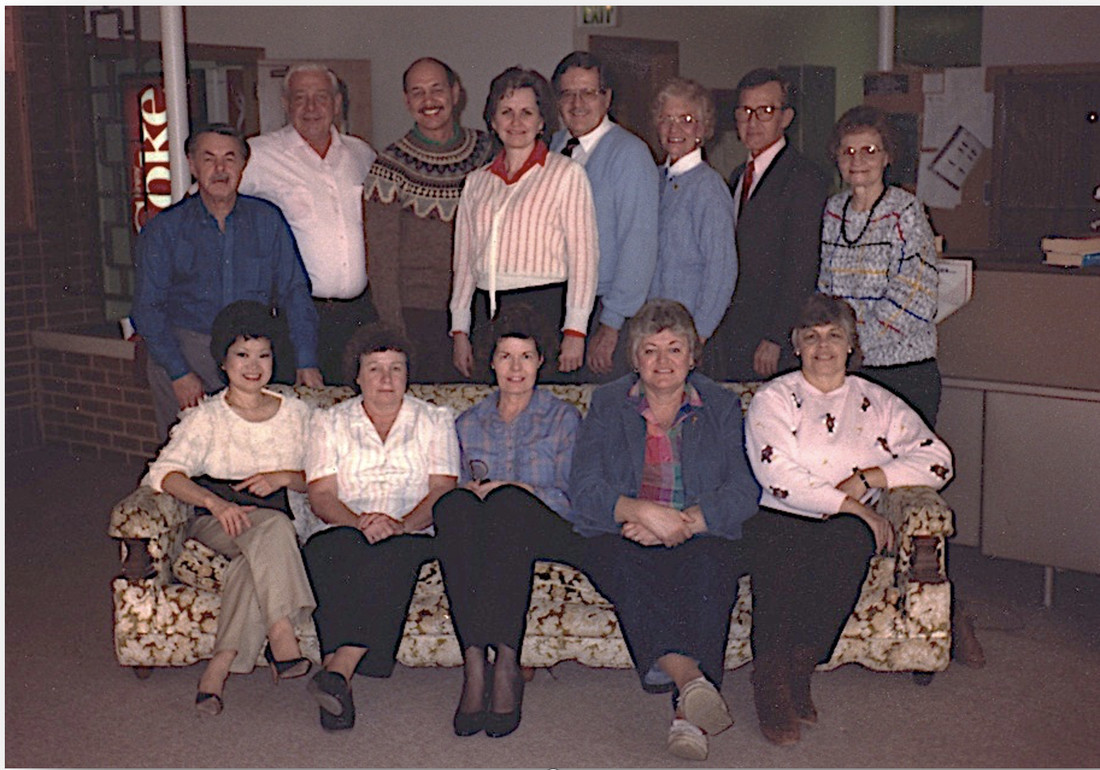
Members of the Utah Deaf community at the Utah Community Center for the Deaf in Bountiful, Utah, January 24, 1988. Top Row: Pete Green, Jerry Wesrbery, Art Valdez, Ilene Coles Kinner, Kenneth Kinner, Shanna Christiansen Mortensen, David Mortensen, Clara Kendall. Bottom Row: (L-R): Sally Shimoda Green, Donna Lee Westberg, Eleanor Kay Kinner Curtis, Donna Mae Deyarmon, and Carol Wilson. Photo courtesy of Kenneth and Ilene Kinner
Dr. Robert G. Sanderson
Announces Retirement
On November 15, 1985, Dr. Robert G. Sanderson announced his retirement from state service after a distinguished 37-year career, including 20 years with the Utah Division of Rehabilitation. During his tenure, Services to the Deaf expanded from a one-person operation in 1965 into a statewide program serving Deaf and hard-of-hearing individuals throughout Utah. When Bob began working in rehabilitation services in 1965, only 11 Deaf consumers were receiving services, and there was just one counselor proficient in sign language. Despite limited resources, the program steadily grew under his leadership (UAD Bulletin, March 1985).
One of Bob's most significant contributions was improving communication access for Utah's Deaf community. Under his leadership, approximately 500 telecommunication devices for the Deaf (TTYs) were installed throughout the Wasatch Front. These devices enabled Deaf individuals to communicate by telephone through typed messages, dramatically increasing their ability to stay connected with family, friends, employers, and service providers. At a time when TTY technology was the primary means of long-distance communication for Deaf people, its widespread availability represented a major advancement for the community (UAD Bulletin, February 1985).
One of Bob's most significant contributions was improving communication access for Utah's Deaf community. Under his leadership, approximately 500 telecommunication devices for the Deaf (TTYs) were installed throughout the Wasatch Front. These devices enabled Deaf individuals to communicate by telephone through typed messages, dramatically increasing their ability to stay connected with family, friends, employers, and service providers. At a time when TTY technology was the primary means of long-distance communication for Deaf people, its widespread availability represented a major advancement for the community (UAD Bulletin, February 1985).

Dr. Robert G. Sanderson. Photo courtesy of the Sanderson Community Center
Another of Bob's major accomplishments was helping establish the Utah Community Center for the Deaf. The project required nearly a decade of committee work, legislative advocacy, planning, and negotiation. Even during his year at Gallaudet College, Bob remained actively involved in the effort. His persistence, together with the work of many Deaf leaders and supporters, ultimately resulted in the creation of a community center where Deaf individuals could gather, access services, participate in activities, and strengthen community ties (UAD Bulletin, February 1985).
By the time of his retirement, more than 300 Deaf and hard-of-hearing individuals had benefited from rehabilitation services and support programs developed under Bob's leadership. The program had also expanded to include several interpreting and counseling positions, including four counselors proficient in sign language, a full-time rehabilitation interpreter, and two full-time Utah Association for the Deaf interpreters (UAD Bulletin, March 1985).
Bob's retirement marked the end of an important chapter in Utah Deaf history. Through his work in rehabilitation services, communications access, community advocacy, and the establishment of the Utah Community Center for the Deaf, he helped create opportunities that had previously been unavailable to many Deaf and hard-of-hearing Utahns. His efforts laid the foundation for many of the services and programs that continue to benefit Utah's Deaf community today (UAD Bulletin, February 1985; March 1985).
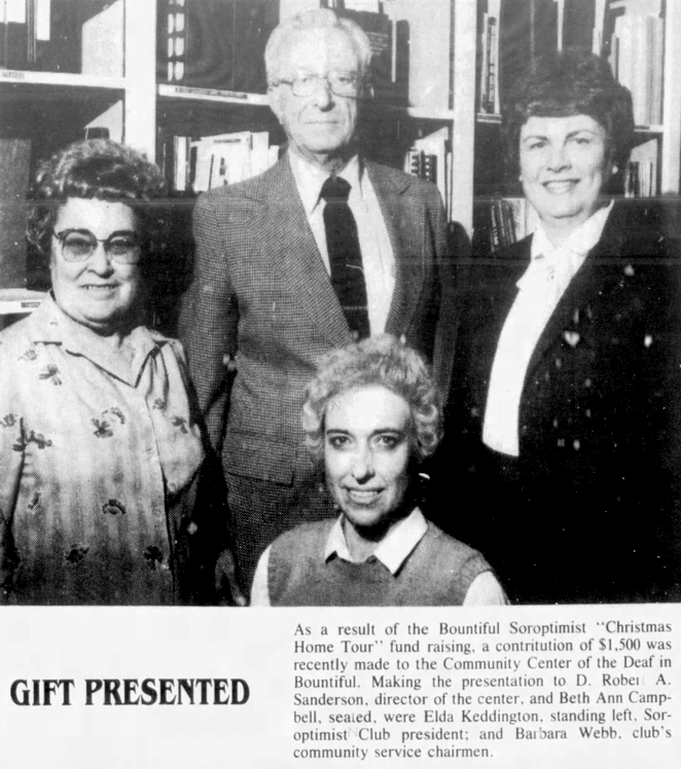
A $1,500 donation was made to the Utah Community Center for the Deaf in Bountiful, Utah, as a result of the Bountiful Soroptimist "Christmas Home Tour" fundraising. The award was given to Dr. Robert G. Sanderson, Director of the Utah Community Center for the Deaf, and Beth Ann Stewart Campbell, who was sitting. Elda Keddington, standing left, is the Soroptimist Club President, and Barabara Webb is the club's community service chairperson. Source: Ogden Standard-Examiner, February 6, 1985
Did You Know?
By 1985, the Utah Community Center for the Deaf had become one of the most active gathering places for Utah's Deaf community. According to the center's guest book, more than 9,000 visitors had signed in since the facility opened, demonstrating the center's popularity and its importance as a hub for services, meetings, educational programs, recreational activities, and community events (UAD Bulletin, March 1985).
The remarkable number of visitors reflected the success of a vision first discussed nearly 40 years earlier at the 1946 Utah Association for the Deaf convention: establishing a place that Deaf Utahns could truly call their own (UAD Bulletin, March 1985).
The remarkable number of visitors reflected the success of a vision first discussed nearly 40 years earlier at the 1946 Utah Association for the Deaf convention: establishing a place that Deaf Utahns could truly call their own (UAD Bulletin, March 1985).
Beth Ann Stewart Campbell
is Named the New Director
Following Bob Sanderson's retirement, Dr. Judy Ann Buffmire, Executive Director of the Division of Vocational Rehabilitation, appointed Beth Ann Stewart Campbell as director of the Utah Community Center for the Deaf. The appointment was made in consultation with members of Utah's Deaf community.
Beth Ann brought more than 15 years of experience with the Utah Division of Rehabilitation, where she had served as a professional interpreter and rehabilitation aide. Through her work, she developed a deep understanding of the needs of Deaf and hard-of-hearing individuals. As the daughter of Deaf parents, her personal experiences also shaped her commitment to serving the Deaf community. Throughout her career, she earned widespread respect and support through her advocacy on behalf of Deaf individuals and their families (Sanderson, 2004).
As director, Beth Ann was committed to expanding educational, social, and community programs at the Utah Community Center for the Deaf. Under her leadership, the center offered a diverse range of activities and classes, including cooking classes, income tax preparation workshops, Women on Target programs, parenting classes, senior citizen outings, financial education workshops, and sporting events (Beth Ann Stewart Campbell, e-mail message to Jodi Christel Becker, September 18, 2012).
These programs strengthened the center's role as a gathering place for Deaf and hard-of-hearing Utahns while promoting accessibility, lifelong learning, and community involvement. Through these activities, the center continued to provide opportunities for individuals to connect, share information, and participate fully in community life through American Sign Language and other accessible forms of communication.

Beth Ann Stewart Campbell. Courtesy of the Sanderson Community Center
Safety, Maintenance, Population Demographics
Drive the Search for a New Location
Although the Utah Community Center for the Deaf (UCCD) in Bountiful had become an important gathering place for Utah's Deaf community, the building presented several long-term challenges. Originally constructed in 1941 and expanded with a second story in 1956, the facility faced numerous health, safety, and accessibility concerns. Bringing the building into compliance with fire, safety, building, and disability-accessibility codes would require substantial financial investment. As the structure aged, maintenance and repair costs continued to increase (Sanderson, 2004).
The center's location also presented challenges. While the Bountiful facility was easily accessible from Ogden, Davis County, and Salt Lake City via Interstate 15, demographic trends showed that the largest concentration of Deaf consumers lived south of Salt Lake City. As a result, attendance gradually declined as travel to Bountiful became less convenient for many potential users. Although relocating farther south would create longer travel times for residents of Davis and Weber counties, it would improve accessibility for a greater number of Deaf and hard-of-hearing consumers in the Salt Lake Valley (Sanderson, 2004).
Recognizing these concerns, Dr. Judy Ann Buffmire, executive director of the Office of Rehabilitation Services, and Bernarr S. Furse, State Superintendent of Public Instruction, began corresponding with the Division of Facilities Construction and Management in 1985 about the possibility of developing a new center. Rather than continuing to invest large sums into a building with significant code violations and declining usage, they proposed allocating planning funds toward a modern facility better suited to the needs of Utah's Deaf community. Their position was strengthened by broad support from Deaf leaders and community members who advocated for a new center (Sanderson, 2004).
In 1987, a formal inspection of the Bountiful facility reinforced these concerns. Inspectors recommended acquiring a newer building that could more effectively serve Utah's Deaf and hard-of-hearing residents. The report highlighted the extensive upgrades that would be required to bring the existing structure into compliance with health, fire, safety, building, and accessibility standards. Faced with these realities, administrators and community leaders increasingly concluded that constructing or acquiring a new facility would be more practical than continuing to invest in the aging building (Sanderson, 2004).
The findings strengthened the resolve of Deaf leaders and state officials to pursue a new community center. What had begun as concerns about maintenance and accessibility gradually evolved into a larger vision: creating a modern facility designed specifically to meet the needs of Utah's Deaf and hard-of-hearing community. The Bountiful center had served an important role in bringing the community together, but by the late 1980s, many leaders believed that a new chapter was necessary to support future growth (Sanderson, 2004).

Dr. Judy Ann Buffmire. Source: The Salt Lake Tribune, August 22, 2011
An Unexpected Bill Passes
During the 1988 Legislative Session
While Deaf leaders were addressing the future of the Utah Community Center for the Deaf, a significant legislative development occurred during the 1988 Utah legislative session. Senate Bill 218 established a separate state agency known as the Division of Services to the Hearing Impaired. Governor Norman H. Bangerter signed the bill into law on March 10, 1988. Although the legislation created a statewide agency dedicated to serving Deaf and hard-of-hearing individuals, many members of Utah's Deaf community were surprised and frustrated that neither they nor their leaders had been consulted before the bill's passage (Mortensen, UAD Bulletin, April 1988; Mortensen, UAD Bulletin, May 1988).
W. David "Dave" Mortensen, president of the Utah Association for the Deaf (UAD), questioned why Deaf community members had not been informed about the legislation or invited to provide input. He emphasized the importance of including Deaf individuals in decisions affecting their social, economic, and educational future. For many, the issue was not the creation of services but the lack of community involvement in the process (Mortensen, UAD Bulletin, April 1988; Mortensen, UAD Bulletin, May 1988).
Another concern involved the agency's name. Many Deaf Utahns objected to the term "Hearing Impaired," preferring the terms "Deaf"and "Hard of Hearing." At the center of the discussion was Jim Hilber, a graduate of the University of Utah's Hearing and Speech Department and a member of Bob Sanderson's rehabilitation counseling team. Jim was appointed administrator of the new division and had actively supported the creation of the agency. While respected for his education and professional experience, his appointment and the agency's name became subjects of debate within the Deaf community (Mortensen, UAD Bulletin, April 1988).

Utah Governor Norman H. Bangerter. Source: Wikipedia
Dave argued that the agency should instead be called the Division of Services to the Deaf and Hard of Hearing, a title that more accurately reflected the population it served. Through continued advocacy by the Deaf community, this position ultimately gained support and influenced later changes to the agency's name and identity (Mortensen, UAD Bulletin, April 1988).
The controversy emerged during a period of growing Deaf activism across the nation. Earlier that year, students and supporters at Gallaudet University launched the historic Deaf President Now movement, demanding that the university appoint a Deaf president. The protest attracted national attention and became a powerful symbol of Deaf self-determination and civil rights. Gary Olsen, Executive Director of the National Association of the Deaf, observed that the movement reflected Deaf people's desire to direct their own future. Former Gallaudet president Dr. Elisabeth Zinser later described the events as a civil rights movement for Deaf people. Inspired by these developments, Dave stated that Utah's Deaf community would also seek greater involvement in decisions that affected their lives (Mortensen, UAD Bulletin, April 1988).
On March 31, 1988, Dr. Judy Ann Buffmire, Executive Director of the Utah Division of Vocational Rehabilitation, met with members of Utah's Deaf community at the Utah State Office of Education. Approximately 100 Deaf individuals attended the meeting, where they were invited to share their concerns, ideas, and recommendations regarding Senate Bill 218. During the meeting, state officials announced that the position of Director of the Division of Services to the Deaf and Hard of Hearing would be opened to a nationwide search, a decision many viewed as a positive step toward greater community participation and representation (Mortensen, UAD Bulletin, May 1988).

W. David Mortensen. Photo courtesy of David and Shanna Mortensen
In his May 1988 President's Message, Dave summarized the feelings of many Deaf Utahns. He argued that Deaf people should play a greater role in administering programs that directly affected their lives. Citing the example of Dr. Robert G. Sanderson, he noted that Deaf leadership had previously contributed to the successful development of numerous programs and services. Dave believed the time had come for qualified Deaf individuals to assume greater responsibility in leadership positions and help shape the future of services for Utah's Deaf community (Mortensen, UAD Bulletin, May 1988).
The passage of Senate Bill 218 marked a turning point in Utah Deaf history. Although the legislation created a new state agency, it also sparked important discussions about representation, self-determination, and the role of Deaf individuals in directing programs designed to serve their own community. These debates would continue to influence the development of Deaf services in Utah for years to come.
The passage of Senate Bill 218 marked a turning point in Utah Deaf history. Although the legislation created a new state agency, it also sparked important discussions about representation, self-determination, and the role of Deaf individuals in directing programs designed to serve their own community. These debates would continue to influence the development of Deaf services in Utah for years to come.
Did You Know?
Under the leadership of Stephen Persinger, president of the Utah Association of the Deaf (UAD), Utah became the first state in the nation to replace the term "Hearing Impaired" with "Deaf and Hard of Hearing" throughout state law. This historic change was accomplished through the passage of Utah House Bill 60, which was signed into law on March 17, 2017.
The achievement resulted from years of advocacy by the Utah Association of the Deaf and reflected the continuing efforts of Deaf Utahns to have a voice in how their community is represented. The legislation demonstrated the impact of organized grassroots advocacy and the longstanding commitment of the UAD to promoting policies that reflect the preferences and identities of Deaf and hard-of-hearing individuals.
Many members of the American Deaf community view the term "hearing impaired" as outdated and sometimes offensive because it emphasizes a perceived impairment rather than recognizing Deaf people as members of a linguistic and cultural community. In contrast, the terms "Deaf" and "Hard of Hearing" are widely preferred because they acknowledge individual communication preferences and identities.
The passage of House Bill 60 represented more than a change in terminology. It reflected a broader movement toward accessibility, representation, self-determination, and respect for Deaf and hard-of-hearing individuals. It also fulfilled a goal first advocated by Utah Deaf leaders nearly 30 years earlier during the debate surrounding Senate Bill 218 in 1988, when Dave Mortensen and other members of the Utah Deaf community argued that the term "Deaf and Hard of Hearing" more accurately represented the people being served.
Deaf Community Members Voice Frustration
and Criticize the New Division
The chamber of the Utah State Board of Education was filled with members of Utah's Deaf community who gathered to voice their concerns regarding the newly created Division of Services to the Hearing Impaired. Participants expressed frustration not only with the division's immediate direction but also with its long-term goals and the lack of Deaf community involvement in its formation. Several Deaf individuals stated, "We must control our own destiny. We are no longer willing to sit idly by and watch as hearing people undermine our programs and dictate our future" (Campbell, Deseret News, April 1988).
Rodney W. Walker, president of the local Gallaudet alumni association, emphasized that many Deaf Utahns felt they had long been excluded from decision-making processes affecting their lives. He observed that Utah's Deaf community shared many of the same frustrations expressed by students and supporters involved in the Deaf President Now movement at Gallaudet University (Campbell, Deseret News, April 1988).
Rodney W. Walker, president of the local Gallaudet alumni association, emphasized that many Deaf Utahns felt they had long been excluded from decision-making processes affecting their lives. He observed that Utah's Deaf community shared many of the same frustrations expressed by students and supporters involved in the Deaf President Now movement at Gallaudet University (Campbell, Deseret News, April 1988).

'Deaf Vent Frustrations and Criticize New Division. Source: Deseret News, April 1, 1988

Rodney W. Walker. Source: The Utah Eagle, April 1955
Lloyd H. Perkins argued that Deaf individuals in Utah had often been denied meaningful leadership opportunities in both educational and rehabilitation settings. Referring to statements made during the Deaf President Now movement, he asserted that the belief that hearing individuals must always make decisions for Deaf people reflected prejudice, discrimination, and a lack of understanding of Deaf people's capabilities (Campbell, Deseret News, April 1988).

Lloyd H. Perkins.
Source: The Salt Lake Valley Ward for the Deaf Directory, 1972
Dr. Robert G. Sanderson, former director of the Utah Community Center for the Deaf and a longtime rehabilitation administrator, viewed the creation of the new division as a positive development. However, Bob criticized state officials for failing to consult the Utah Deaf community before presenting the proposal to the legislature. He stressed the importance of appointing a qualified Deaf professional to lead the division, arguing that someone who understood Deaf culture, language, and community needs would be best equipped to guide its future (Campbell, Deseret News, April 1988).
Jim Harper of Provo expressed similar frustrations, stating that many Deaf people felt controlled by hearing decision-makers. He reminded officials that "They may be deaf, but they are not mentally impaired" (Campbell, Deseret News, April 1988).
The growing public response from the Deaf community, led in large part by Dave Mortensen and the Utah Association for the Deaf, prompted state officials to reconsider both the structure and identity of the new agency. As discussions continued, the Utah State Board of Education moved toward establishing the Division of Services to the Deaf and Hard of Hearing (DSDHH) at the Utah Community Center for the Deaf. The debate marked a significant turning point in Utah Deaf history, demonstrating the community's increasing insistence on representation, self-determination, and participation in decisions affecting its future.
The events of 1988 reflected a broader civil rights movement within the Deaf community. Inspired by the Deaf President Now movement at Gallaudet University, Deaf Utahns increasingly demanded a voice in shaping policies, programs, and services designed to serve them. Their advocacy helped redefine the relationship between service providers and the Deaf community and laid the groundwork for greater Deaf participation in leadership roles throughout Utah.

Jim Harper. Source: Facebook
The First Division Director Appointed
for the Utah Community Center
for Deaf and Hard of Hearing
After Jim Hilber resigned in 1988 to become a facilities specialist with the Division of Rehabilitation Services, the position he held became vacant. During his tenure, Jim had been a strong advocate for the establishment of a new community center for Deaf individuals. His efforts spanned several years and involved collaboration with legislators, budget analysts, the Division of Facilities Construction and Management, and numerous community organizations. His partnership with the Legislative Coalition for People with Disabilities proved especially valuable in securing legislative funding for the Deaf Center (Sanderson, 2004).
At the time, Marilyn Tiller Call, who was hard of hearing and would later become director of the center, served as executive director of the Legislative Coalition for People with Disabilities. Through her work, she became acquainted with Jim Hilber, Gene D. Stewart, and other advocates working to improve services for Utah's Deaf and hard-of-hearing community (Sanderson, 2004).
The Utah Association for the Deaf (UAD) and many members of the Utah Deaf community strongly advocated for the appointment of a Deaf director. In his September 1988 President's Message, W. David "Dave" Mortensen wrote:
"Should the director of the new Division of Services to the Deaf and Hard of Hearing be Deaf? This seems the most logical and wise choice. No matter how skilled and qualified a hearing person may be in the field of deafness or in understanding the psychology of deafness, Utah will still lag behind. Appointing a hearing director to lead the Deaf community would be a step backward in advancing our needs" (Mortensen, UAD Bulletin, September 1988, p. 2).
In September 1988, the search process took an unexpected turn when a Deaf candidate was selected for the position but later declined the appointment for personal reasons. This development created a difficult situation for Dr. Judy Ann Buffmire and the screening committee, which had already informed other applicants that a selection had been made. Because of equal employment requirements, the committee could not simply choose another applicant from the original pool without reopening the process (Mortensen, UAD Bulletin, September 1988).
After consulting with members of the Utah Deaf community, Judy appointed Gene D. Stewart, a hearing vocational rehabilitation counselor, as acting director of the newly established Division of Services to the Deaf and Hard of Hearing (DSDHH). According to Dave Mortensen, Judy made this decision because of the unusual circumstances and the immediate need for administrative leadership (Mortensen, UAD Bulletin, October 1988).
Support for Gene gradually grew within the Deaf community. In the spring of 1989, Kenneth C. Burdett of Ogden took the initiative to organize a petition endorsing Gene as the permanent director of the Division of Services to the Deaf and Hard of Hearing. Kenneth's effort reflected the confidence many Deaf community members had developed in Gene's leadership during his time as acting director. More than fifty Deaf individuals signed the petition, which was presented to Judy as evidence of the community's strong support for Gene's appointment (Nelson, UAD Bulletin, October 1989; Darlene Stewart Cochran, interview with Gene Stewart, April 4, 2012).

Kenneth C. Burdett. Photo courtesy of Ronald C. Burdett
On August 11, 1989, the Utah State Board of Education officially appointed Gene as director of the Division of Services to the Deaf and Hard of Hearing. Having served as acting director for more than a year, he became the first official director of the DSDHH (Nelson, UAD Bulletin, October 1989).
At the time, the Utah Community Center for the Deaf in Bountiful housed the DSDHH and continued expanding services for Deaf consumers. The organization maintained two primary leadership positions. The Division Director oversaw the statewide operations and strategic direction of the DSDHH, while the Community Center Director managed the day-to-day operations of the Utah Community Center for the Deaf.
Beth Ann Stewart Campbell continued serving as director of the Utah Community Center for the Deaf. Her responsibilities remained largely unchanged under Gene's administration. Beth Ann reported to Gene, who in turn reported to the Utah State Office of Rehabilitation.
Gene brought extensive experience to the position. He began his career as a rehabilitation counselor with the Utah Division of Rehabilitation Services in 1967, focusing primarily on vocational rehabilitation for Deaf individuals. As a Child of Deaf Adults (CODA), Gene grew up in a Deaf household with his parents, Wayne Stewart and Georgia Mae Stewart, and alongside his Deaf siblings, Keith Stewart and Darlene Stewart Cochran. These experiences provided him with a deep personal understanding of Deaf culture and community life.
To further prepare for his career, Gene earned a bachelor's degree in speech pathology with a minor in German from the University of Utah. He later completed a master's degree in Deaf Education Administration at California State University, Northridge. In addition, he became a qualified professional interpreter and accumulated decades of rehabilitation experience, making him uniquely qualified to lead the division (Sanderson, 2004).
Although many Deaf advocates had hoped for a Deaf director, the Utah Association for the Deaf ultimately welcomed Gene's appointment. His longstanding ties to the Deaf community, professional credentials, and commitment to improving services earned the respect of community members. Under his leadership, one of the division's major goals would be the continued effort to establish a new Utah Community Center for the Deaf that could better serve the state's growing Deaf and hard-of-hearing population (Sanderson, 2004).

Gene D. Stewart. Photo courtesy of the Sanderson Community Center
Working on Getting a New Community Center
for the Deaf Building in Another Location
At the biennial convention of the Utah Association for the Deaf on June 16, 1989, Dr. Judy Ann Buffmire, executive director of the Utah State Office of Rehabilitation, made an important announcement. After four years of persistent lobbying and planning, Judy revealed that she had successfully secured legislative planning funds for a new community center for Deaf and hard-of-hearing Utahns. This funding represented a significant step forward in the effort to replace the aging Bountiful facility and demonstrated continued state support for the project (Sanderson, 2004).
According to Bob Sanderson, the creation of the Ad Hoc Planning Committee marked a major milestone in the development of the proposed center. Following the appropriation of planning funds, the committee held its first meeting on July 5, 1989. The committee included Deaf and hard-of-hearing community members, architects, and representatives from the Utah Division of Facilities Construction and Management, illustrating a collaborative approach to the project. Deaf members included Shirley Platt, Lee Shepherd, John Peebler, Norman Williams, Lloyd Perkins, Keith Lauritzen, Don Jensen, Dave Mortensen, Bob Sanderson, and Robert Gillespie (Sanderson, 2004).
The committee carefully examined numerous aspects of the proposed facility. Members discussed the budget for purchasing land, the size and location of the property, the square footage of the building, construction requirements, occupancy needs, and other design considerations. Their goal was to create a center specifically designed to serve the needs of Utah's Deaf and hard-of-hearing community (Sanderson, 2004).
Among the committee's highest priorities were adequate lighting throughout the building and visual safety systems designed for Deaf individuals, including accessible fire alarms and emergency notification procedures. Recognizing the importance of recreation and athletics within Deaf culture, committee members also proposed a baseball field, basketball court, and gymnasium with a stage. These features were intended to provide opportunities for recreation, community gatherings, and youth activities (Sanderson, 2004).
Sports had long played an important role in Deaf community life. Deaf students and adults often participated in athletic competitions with other Deaf athletes throughout the United States. Graduates of the Utah School for the Deaf hoped that the new center would provide mainstreamed Deaf students with similar opportunities to connect with Deaf peers and participate in community activities (Sanderson, 2004).
As part of the planning process, Norman Williams visited numerous athletic facilities to gather ideas for the proposed center. Unsatisfied with many of the gyms he observed, Norman eventually toured the Idaho School for the Deaf, where he found a full-size basketball court with bleacher seating. Impressed by the design, he recommended that the new Utah center include a similar facility. As a result, plans were developed for a gymnasium featuring a full basketball court and movable bleachers (Kenneth L. Kinner, personal communication with the author, 2008; Norman Williams, e-mail message to Jodi Christel Becker, May 8, 2012).
On September 20, 1989, Judy reconstituted the State Advisory Committee and appointed seven new members. The committee played an important role in guiding the development of services and facilities for Utah's Deaf and hard-of-hearing community during the next three years. Among its members was Dave Mortensen, who represented the interests of the Utah Deaf community (Sanderson, 2004).
During the same month, Gene Stewart responded to a request from Dave Mortensen to explain the responsibilities and staffing structure of the newly established Division of Services to the Deaf and Hard of Hearing (DSDHH). Gene emphasized the importance of involving Deaf community members in decision-making and worked to keep them informed about the division's activities. He communicated regularly through the UAD Bulletin, the Deaf Services Advisory Committee, attendance at UAD Board meetings, and direct conversations with community members (Sanderson, 2004).
The planning efforts of 1989 represented the beginning of a new chapter. Rather than simply repairing an aging facility in Bountiful, Deaf leaders, state officials, and community members worked together to envision a modern center designed specifically for the future needs of Utah's Deaf and hard-of-hearing population. Their collaboration would ultimately help shape the next generation of Deaf services in Utah (Sanderson, 2004).
Deaf Members of the Ad Hoc Planning Committee

Shirley Platt. Photo provided by Shirley Hortie Platt

John Peebler. UAD Bulletin, July 2003

Lloyd H. Perkins. UAD Bulletin, Winter 1970

Donald Jensen. Source: The Utah Eagle

Dr. Robert G. Sanderson. Photo courtesy of Gallaudet University Archives
|

Lee Shepherd. Photo courtesy of the Kenneth C. Burdett Bulletin Board

Norman Williams. Photo courtesy of the Sanderson Community Center

Keith Lauritzen. Source: Facebook

W. David Mortensen. Photo courtesy of David and Shanna Mortensen

Robert Gillespie. Photo courtesy of the Kenneth C. Burdett Bulletin Board
|
Did You Know?
In the October 1989 issue of the UAD Bulletin, Mabel Bell, writing under the pseudonym Ronald J. Nelson, reflected on the debate over whether the new Division of Services to the Deaf and Hard of Hearing should be led by a Deaf or hearing director. Ron questioned whether hearing individuals could make the best decisions for the Deaf community without meaningful Deaf representation and pointed out that, for decades, programs affecting Deaf people had largely been administered by hearing professionals.
Drawing inspiration from the Deaf President Now movement at Gallaudet University, Ron argued that qualified Deaf individuals should be given greater opportunities to lead programs serving their own community. He wrote:
"It is long past time that Gallaudet had a deaf president, as testimony that deaf people are capable of leading themselves."
He further asked:
"Why aren't the State Board of Education and Voc Rehab, among others, selecting qualified deaf individuals to serve as administrators in programs that directly affect the deaf community in Utah?"
At the same time, Ron acknowledged that Deafness alone should not be the sole qualification for leadership. He observed:
"Deafness should not be the only criteria for the job, but if the deaf applicant is an active member of the deaf community, the deaf applicant has something that no hearing person will ever be able to develop—an intimate understanding of deafness and its culture."
Interestingly, Ron also noted that the situation had evolved over time. According to his account, the Deaf community initially rallied behind the goal of appointing a Deaf director, leading to the selection of a Deaf candidate. However, after that individual declined the position, support gradually shifted toward appointing a hearing candidate. Several Deaf organizations, including the DSDHH Advisory Council, ultimately endorsed the appointment of a hearing director.
Reflecting on this change, Ron wrote:
"If the deaf community had remained steadfast in their support for a deaf director, would the outcome have been any different? We will never know" (Nelson, UAD Bulletin, October 1989, p. 3).
Ron's column provides an important glimpse into the diversity of opinion within Utah's Deaf community during this period. While many advocates strongly supported Deaf leadership, others emphasized experience, qualifications, and community support as equally important considerations in selecting a director.

Ronald J. Nelson. Photo courtesy of the Sanderson Community Center
Utah State Board of Education Gives
the New Utah Community Center for the
Deaf #1 Facility Priority
In January 1989, Gene D. Stewart, director of the Division of Services to the Deaf and Hard of Hearing (DSDHH), joined W. David "Dave" Mortensen, president of the Utah Association for the Deaf (UAD), and Lloyd H. Perkins in launching a statewide effort to advocate for a new community center for Deaf and hard-of-hearing Utahns. They encouraged members of the Deaf community to write to their local senators and representatives in support of a new facility. This campaign reflected a strong sense of unity and determination within the Utah Deaf community (Sanderson, 2004).
On September 8, 1989, the Utah State Board of Education formally recognized the importance of establishing a new community center and designated it as the board's number one facility priority. This decision significantly strengthened the community's position as preparations began for the 1990 legislative session. UAD officers and community members were encouraged by the development, recognizing that they were closer than ever to achieving their goal of a modern center designed specifically for Deaf and hard-of-hearing individuals (UAD Bulletin, September 1989).
The architectural firm Frandsen-Chamberlain of Ogden completed preliminary building plans on October 1, 1989. The proposal included an executive summary outlining the project's goals and design features. One of the most notable elements was a full-sized basketball court positioned in front of a large stage, creating a multipurpose auditorium capable of hosting athletic, recreational, educational, and community events. As Bob Sanderson observed, one of the primary justifications for constructing a new facility was the increasing cost of maintaining the aging Bountiful center and bringing it into compliance with modern building codes (Sanderson, 2004).
State officials also recognized broader concerns affecting Utah's Deaf community. Many Deaf individuals experienced barriers related to education, employment, social participation, and access to information. In response, the Division of Services to the Deaf and Hard of Hearing continued developing programs designed to promote independence, increase employment opportunities, and reduce reliance on public assistance. Services included interpreter referral assistance, counseling, independent living support, youth programs, and opportunities for social interaction.
Officials concluded that the most effective way to provide these services was through a purpose-built facility designed specifically for Deaf and hard-of-hearing consumers. While the Bountiful center had served the community well, its structural limitations and location increasingly restricted its effectiveness. As momentum grew, the Utah Deaf community was encouraged to learn that Governor Norman H. Bangerter supported the effort to construct a new center.
Governor Norman H. Bangerter Proposes
Funding for a New Center
In 1990, Governor Norman H. Bangerter proposed funding for two major projects affecting Utah's Deaf community. The first was a new Community Center for the Deaf with an estimated cost of $3,359,100. The second was a consolidated Utah Schools for the Deaf and the Blind facility with an estimated cost of $8,184,300 (UAD Bulletin, February 1990).
Recognizing the importance of legislative approval, Gene Stewart and Dave Mortensen encouraged members of the Utah Deaf community to attend legislative hearings, meet with lawmakers, and demonstrate support for both projects. Their participation helped ensure that Deaf voices remained visible throughout the legislative process (UAD Bulletin, February 1990).
Recognizing the importance of legislative approval, Gene Stewart and Dave Mortensen encouraged members of the Utah Deaf community to attend legislative hearings, meet with lawmakers, and demonstrate support for both projects. Their participation helped ensure that Deaf voices remained visible throughout the legislative process (UAD Bulletin, February 1990).
Success at Last!
Years of advocacy finally paid off in 1990 when the Utah Legislature approved funding requests submitted by the Utah State Office of Rehabilitation and the Division of Services to the Deaf and Hard of Hearing. The approved funding included:
The victory represented one of the most significant achievements in the history of Utah's Deaf community. After decades of planning, lobbying, feasibility studies, legislative hearings, and community advocacy, the long-awaited dream of a new center was finally moving forward.
The search for an appropriate site proceeded quickly. After visiting a proposed property, Gene Stewart secured unanimous support for a parcel of land located at 5770 South 1500 West. Excited by the progress, Gene reportedly exclaimed, "Isn't that a miracle!" (UAD Bulletin, March 1990). Deaf and hearing supporters alike worked together toward a common goal, demonstrating the remarkable cooperation that had carried the project forward.
In the March 1990 issue of the UAD Bulletin, Dr. Judy Ann Buffmire announced that she had authorized Gene Stewart to sign the documents on March 13, 1990, allowing the purchase of the property for the future Deaf Center (UAD Bulletin, March 1990).
The approval of construction funding and the acquisition of a building site marked one of the most important milestones in Utah Deaf history. For the first time, the vision of a modern community center designed specifically for Deaf and hard-of-hearing Utahns was no longer just a plan on paper. After decades of advocacy that stretched back to the Utah Association for the Deaf's early discussions about a Deaf club and community center, construction of a new facility was finally becoming a reality.
- Equipment and program funding for the Utah Community Center for the Deaf beginning June 30, 1990.
- Permanent annual funding for interpreter training and employment.
- Permanent annual funding to expand and improve community center programs.
- Approval of building funds for the construction of a new Deaf Center (Sanderson, 2004).
The victory represented one of the most significant achievements in the history of Utah's Deaf community. After decades of planning, lobbying, feasibility studies, legislative hearings, and community advocacy, the long-awaited dream of a new center was finally moving forward.
The search for an appropriate site proceeded quickly. After visiting a proposed property, Gene Stewart secured unanimous support for a parcel of land located at 5770 South 1500 West. Excited by the progress, Gene reportedly exclaimed, "Isn't that a miracle!" (UAD Bulletin, March 1990). Deaf and hearing supporters alike worked together toward a common goal, demonstrating the remarkable cooperation that had carried the project forward.
In the March 1990 issue of the UAD Bulletin, Dr. Judy Ann Buffmire announced that she had authorized Gene Stewart to sign the documents on March 13, 1990, allowing the purchase of the property for the future Deaf Center (UAD Bulletin, March 1990).
The approval of construction funding and the acquisition of a building site marked one of the most important milestones in Utah Deaf history. For the first time, the vision of a modern community center designed specifically for Deaf and hard-of-hearing Utahns was no longer just a plan on paper. After decades of advocacy that stretched back to the Utah Association for the Deaf's early discussions about a Deaf club and community center, construction of a new facility was finally becoming a reality.
Did You Know?
In 1990, Utah legislators recognized an important connection between two major initiatives: the proposed new Utah Community Center for the Deaf and the consolidation efforts involving the Utah Schools for the Deaf and the Blind. Although the projects had different purposes, both were intended to improve services, accessibility, and opportunities for Deaf Utahns.
The success of these initiatives was largely the result of a coordinated lobbying effort by Utah Deaf leaders, community advocates, and administrators from the Utah Schools for the Deaf and the Blind. Their persistence helped demonstrate the need for modern facilities and improved services for Deaf individuals across the state.
The effort gained additional momentum when the Utah State Office of Education formally endorsed both projects. With support from Deaf community leaders, educational administrators, and state officials, legislators responded favorably and approved funding that helped move the projects forward (Sanderson, 2004).
The legislative victories of 1990 demonstrated the effectiveness of collaboration between the Utah Deaf community, the Utah Association for the Deaf, the Utah Schools for the Deaf and the Blind, the Utah State Office of Rehabilitation, and the Utah State Office of Education. Together, these organizations helped lay the groundwork for a new generation of services and facilities for Deaf Utahns (Sanderson, 2004).
Groundbreaking!
On June 10, 1991, under clear skies, approximately 200 people gathered to celebrate the groundbreaking of the new Utah Community Center for the Deaf (UCCD), marking a major milestone in the history of Utah's Deaf community (UAD Bulletin, July 1991; Sanderson, 2004). Dr. Blaine Petersen of the Utah State Office of Rehabilitation welcomed those in attendance and introduced the speakers as the ceremony began (UAD Bulletin, July 1991).
Gene D. Stewart, director of the Division of Services to the Deaf and Hard of Hearing (DSDHH), shared a childhood story that symbolized the Deaf community's long struggle to obtain a new center. He recalled wanting a cap gun with an ivory handle as a young boy. After finally persuading his father to buy it, Gene realized he needed a roll of caps to use it properly. When he asked for the caps, his frustrated father returned the gun altogether, leaving Gene disappointed. Gene compared this experience to the Deaf community's long quest for a community center. Through persistence, patience, and determination, the community eventually achieved the goal that had seemed out of reach for so many years (UAD Bulletin, July 1991).
At the ceremony, Beth Ann Stewart Campbell, director of the Utah Community Center for the Deaf, pledged to document every stage of the construction process. Norman Williams, known for his meticulous attention to detail, jokingly assured attendees that he would make sure every nail was placed correctly. Their comments reflected the pride and commitment shared by many members of the Deaf community as construction of the new center finally began.
Several distinguished guests also spoke at the ceremony, including Dr. Judy Ann Buffmire, retired executive director of the Utah State Office of Rehabilitation; Lieutenant Governor Val Overson; and representatives of the architectural team. Their remarks emphasized the broad coalition of support that had made the project possible (UAD Bulletin, July 1991).
W. David "Dave" Mortensen, president of the Utah Association for the Deaf, reviewed the long history of the community center movement. He reminded attendees that the dream of a Deaf center had first emerged decades earlier and described the many obstacles Deaf leaders had faced while working with legislators and state agencies. Dave recounted the effort required to establish the first center in Bountiful and the subsequent eight-year campaign to secure funding and approval for a new facility. His remarks highlighted the perseverance that had brought the community to this historic moment (UAD Bulletin, July 1991; Sanderson, 2004).

W. David Mortensen UAD president briefly outlines the history of the UCCD.
Photo courtesy of the Sanderson Community Center
Dr. Robert G. Sanderson, chairman of the Utah Association for the Deaf and retired director of both Utah Rehabilitation Services for the Deaf and the Utah Community Center for the Deaf, also addressed the crowd. Bob expressed his gratitude to everyone who had contributed to the project and shared his excitement at witnessing a dream become reality after years of planning, lobbying, and community advocacy (UAD Bulletin, July 1991).

Dr. Robert Sanderson, UAD chairman and retired USOR state coordinator of services to the Deaf adults and UCCD director, spoke briefly, expressing deep gratitude to those who made it possible for the dream to come true for Deaf people in Utah. Photo courtesy of the Sanderson Community Center
Adding to the excitement of the day, a drawing was held to select one community member to participate in the ceremonial groundbreaking. Larry Kinnett was the lucky recipient. He joined Mary Guy-Sell, Beth Ann Stewart Campbell, Dr. Judy Ann Buffmire, Norman Williams, and Lieutenant Governor Val Overson in turning the first shovels of dirt for what was promoted as a first-of-its-kind center for Deaf and hard-of-hearing individuals in the United States (UAD Bulletin, July 1991; Sanderson, 2004).
For many attendees, the ceremony represented far more than the start of a construction project. It symbolized the fulfillment of a vision that Deaf leaders had pursued for decades through advocacy, community organizing, legislative action, and unwavering persistence. What began as a dream voiced by members of the Utah Association for the Deaf many years earlier was finally taking physical shape before their eyes.
For many attendees, the ceremony represented far more than the start of a construction project. It symbolized the fulfillment of a vision that Deaf leaders had pursued for decades through advocacy, community organizing, legislative action, and unwavering persistence. What began as a dream voiced by members of the Utah Association for the Deaf many years earlier was finally taking physical shape before their eyes.

L-R: Norman Williams, Larry Kinnett, Mary Guy-Sell, Beth Ann Stewart Campbell, Lt. Governor Val Oveson and Dr. Judy Ann Buffmire host shovels and break ground. Photo courtesy of the Sanderson Community Center
UAD President’s Message
In the August 1991 issue of the UAD Bulletin, Lyle G. Mortensen, president of the Utah Association for the Deaf (UAD), expressed his gratitude to Dr. Robert G. Sanderson and W. David "Dave" Mortensen for their many years of service and leadership on behalf of Utah's Deaf community. As construction of the new Utah Community Center for the Deaf moved forward, Lyle recognized the important roles both men had played in expanding services and advocating for Deaf and hard-of-hearing Utahns.
Lyle wrote:
"To Robert Sanderson and David Mortensen... a TREMENDOUS THANKS... for a job well done from the UAD members and the Deaf/Hard-of-Hearing of Utah. You've made outstanding accomplishments and done excellent teamwork in providing us with the UCCD, interpreting services, telephone relay, TDD's and repair services, and the new building complex Center which is more centrally located and will provide increased space and better activities and attendance. Our hats are off to your excellent leadership and to the past UAD Board of Directors which served you so well" (Mortensen, UAD Bulletin, August 1991, p. 3; Sanderson, 2004).
Lyle's remarks reflected the feelings of many members of Utah's Deaf community. Through decades of advocacy, Bob and Dave had helped expand rehabilitation services, improve communication access, increase the availability of interpreting services, support the growth of TTY technology and relay services, establish the Utah Community Center for the Deaf in Bountiful, and secure funding for a larger and more accessible community center. Their efforts, along with the work of numerous Deaf leaders, volunteers, and UAD board members, helped transform services and opportunities for Deaf and hard-of-hearing individuals throughout Utah (Mortensen, UAD Bulletin, August 1991, p. 3; Sanderson, 2004).
At the time of Lyle's message, the new community center was under construction, and many community members viewed the project as the culmination of decades of persistence, cooperation, and leadership. The tribute served not only as a thank-you to Bob and Dave but also as recognition of the collective efforts of the Utah Deaf community in turning a long-held dream into reality.

Lyle G. Mortensen. Photo courtesy of the Kenneth C. Burdett Bulletin Board
Construction Begins
While construction of the new Utah Community Center for the Deaf and Hard of Hearing proceeded between 1991 and 1992, the existing center in Bountiful continued serving Deaf and hard-of-hearing individuals throughout Utah. Despite its important role, the facility's location and physical limitations made it increasingly difficult to meet the community's growing needs. Programs were often restricted by limited space, parking remained a persistent problem, and the aging building required ongoing maintenance. In contrast, the new center was designed to be more accessible, require less maintenance, and better accommodate future growth (Sanderson, 2004).
As construction progressed, excitement spread throughout Utah's Deaf community. Many individuals regularly drove past the construction site to watch its progress and imagine the opportunities the new facility would provide. The project represented far more than a new building; it embodied decades of advocacy, planning, and community involvement.
Among the most enthusiastic supporters was Norman Williams, whose dedication to the project became legendary. As a member of the planning committee and a skilled maintenance specialist, Norman became intimately familiar with every aspect of the building. He closely monitored the construction process and developed extensive knowledge of the facility's design, materials, maintenance requirements, and future operation. His attention to detail and personal investment reflected the pride many Deaf Utahns felt as they watched their long-awaited community center take shape (Sanderson, 2004).
For many members of the Deaf community, each stage of construction served as a visible reminder that a dream pursued for generations was finally becoming reality. The new center promised improved accessibility, expanded programs, enhanced recreational opportunities, and a more central location that would better serve Deaf and hard-of-hearing individuals throughout Utah (Sanderson, 2004).
The Utah Community Center for the
Deaf and Hard of Hearing Opens its Doors
After a remarkable 46-year journey, the dream of establishing a permanent community center for Utah's Deaf and hard-of-hearing population became a reality. The vision traced its roots to discussions held at the 1946 Utah Association for the Deaf convention, where Deaf leaders first expressed the desire for a place they could call their own. In 1992, that dream was realized with the opening of the new Utah Community Center for the Deaf and Hard of Hearing in Taylorsville, Utah. The achievement reflected decades of dedication, advocacy, and collaboration by members of Utah's Deaf community and their supporters (Deseret News, September 26, 2003; Sanderson, 2004).
The new center quickly became a statewide hub for services, education, recreation, and community involvement. It provided support for individuals who were Deaf, Hard of Hearing, DeafBlind, DeafDisabled, and Late Deafened. Programs included interpreting services, case management, employment assistance, adaptive technology resources, outreach programs, educational opportunities, and social and recreational activities. By providing these services in one location, the center created a welcoming environment where individuals with hearing loss could access resources, build relationships, and participate fully in community life.
The 25,000-square-foot facility was completed and ready for occupancy in September 1992. Gene Stewart and Beth Ann Stewart Campbell helped oversee the move and delivery of furniture and equipment, while staff members prepared their offices for operation. To better reflect the growing number of individuals who identified as hard of hearing, the Utah Community Center for the Deaf officially added "Hard of Hearing" to its name, becoming the Utah Community Center for the Deaf and Hard of Hearing (UCCDHH). The Division of Services to the Deaf and Hard of Hearing (DSDHH) was housed within the new facility (Sanderson, 2004).
Bob Sanderson enthusiastically described the center's many features and activities. Designed as a multipurpose community facility, it included a full-size gymnasium, a large kitchen, a weight and exercise room, a lounge and library, a bookstore, and a demonstration room for assistive technology. This technology center allowed Deaf and hard-of-hearing individuals to evaluate communication equipment and learn about emerging technologies that could improve accessibility and independence (Sanderson, 2004).
As the center prepared to open, the Division of Services to the Deaf and Hard of Hearing continued expanding its programs for Deaf and hard-of-hearing adolescents and adults. Growing responsibilities led to the creation of a new Program Director position in 1992, reflecting the increasing scope of services offered by the center.
A major transition occurred on March 13, 1992, when Beth Ann Stewart Campbell retired after years of service to Utah's Deaf community. Beth Ann later cited several factors that influenced her decision, including the lack of a college degree, the retirement of her longtime supervisor, Dr. Judy Ann Buffmire, and a lack of support from some individuals in positions of authority (Campbell, UAD Bulletin, March 1992; Beth Ann Stewart Campbell, e-mail message to Jodi Christel Becker, December 7, 2023).
Following Beth Ann's retirement, the position of center director was reclassified as Program Director. The newly created position was filled by Marilyn Tiller Call, who brought extensive experience in disability advocacy and public policy. Prior to her appointment, Marilyn had served as executive director of the Legislative Coalition for Individuals with Disabilities, where she successfully advocated before the Utah Legislature on behalf of people with disabilities (Marilyn Tiller Call, e-mail message to Jodi Christel Becker, December 15-16, 2023).
Marilyn also brought a personal understanding of the challenges facing Deaf and hard-of-hearing families. As the mother of two Deaf children, Ashley and Camille, she possessed firsthand knowledge of accessibility, education, and communication issues affecting Deaf individuals and their families. Her professional experience and personal perspective made her well prepared to guide programs at the new center during a period of growth and transition (Sanderson, 2004).
The opening of the Utah Community Center for the Deaf and Hard of Hearing marked a historic achievement for Utah's Deaf community. What began as a dream discussed by Deaf leaders in 1946 had evolved into a modern statewide facility dedicated to services, advocacy, recreation, education, and community life. The center stood as a lasting testament to the perseverance of generations of Deaf Utahns who worked tirelessly to create a place where their community could thrive.
Did You Know?
According to Dr. Robert G. Sanderson, the Utah Community Center for the Deaf and Hard of Hearing represented far more than a new building. It symbolized the power of collaboration between the Utah Deaf community, state officials, rehabilitation professionals, and community advocates.
Bob noted that the center was the first facility in the United States specifically designed by a state to serve Deaf and hard-of-hearing individuals while actively incorporating input from Deaf community members throughout the planning process. Rather than having decisions imposed from the top down, Deaf individuals participated in discussions about the building's design, services, recreational facilities, accessibility features, and long-term goals. Their involvement helped ensure that the center reflected the actual needs and priorities of those it was intended to serve (Sanderson, UAD Bulletin, July 1991, p. 7).
This community-driven approach made the center a landmark achievement in Utah Deaf history. The project demonstrated what could be accomplished when Deaf individuals were included as active partners in planning and decision-making, setting an example for future Deaf services and facilities throughout the nation (Sanderson, UAD Bulletin, July 1991, p. 7).
The Dedication of the Utah
Community Center of the Deaf Building
In the spring of 1993, the Utah Community Center for the Deaf and Hard of Hearing (UCCDHH) held its official dedication ceremony, celebrating the completion of a project that had been decades in the making. The event reflected the determination, vision, and perseverance of Utah's Deaf community. Attendees gathered to plant flowers, tour the new facility, share refreshments, exchange stories, and celebrate the realization of a long-held dream (Stewart, DSDHH Newsletter, June 1993).
During the ceremony, Grant Hurst, chairman of the Utah State Board of Education, recognized the tireless efforts of the Utah Association for the Deaf and reaffirmed the Board's continued support for the center and its mission. James Dixon, Regional Rehabilitation Commissioner, conveyed greetings from the Regional Office and presented plaques to Dr. Blaine Petersen, executive director of the Utah State Office of Rehabilitation, and Gene Stewart, director of the Division of Services to the Deaf and Hard of Hearing, in recognition of their contributions to the project (Stewart, DSDHH Newsletter, June 1993).
Several Deaf community leaders also participated in the dedication. Dr. Robert G. Sanderson, Lyle G. Mortensen, Norman Williams, and Lisa Cochran, daughter of C. Roy Cochran and Darlene Stewart Cochran, shared their personal reflections, experiences, and hopes for the future of the center. Their remarks highlighted the significance of the building not only as a facility, but also as a symbol of community pride, self-determination, and progress (Stewart, DSDHH Newsletter, June 1993).
Among the guests were Dr. Judy Ann Buffmire and her husband, La Mar Buffmire, who spent time visiting with friends and supporters from the Deaf community. Kay McDonough, a member of the Utah State Board of Education, and her husband, Gene McDonough, also attended the dedication and joined in the celebration (Stewart, DSDHH Newsletter, June 1993).

Lisa Cochran. Source: UAD Bulletin
The program featured a presentation by Gary Sanderson, son of Bob and Mary Sanderson, who spoke about the important role of interpreters in promoting communication access. His presentation was complemented by a poem written by Steve Zacharias. Steve and Kristi Mortensen performed the poem in American Sign Language, adding a meaningful artistic element to the ceremony and celebrating the language and culture of the Deaf community (Stewart, DSDHH Newsletter, June 1993).

Gary Sanderson. Source: UAD Bulletin
Steve Zakharias’s Poem
We meet to dedicate a building.
We meet a center to bless.
Through our presence
On this historic day.
A landmark – our success
We meet to dedicate this day
At this historic space
When we can proudly now proclaim
In the course of Utah’s deaf.
“This is, indeed, the Place.”
Within these walls a culture thrives
A culture of our own
With our own language.
Our design.
A place to call our home.
We bless this center with our hearts
That it may always be
The center place
To set the pace
For our own destiny.
We bless this center with our minds
That we may share our thought.
Our goals, our triumphs,
And ourselves
That which our hands wave wrought.
We bless this center with our eyes
So we may communicate clear
And teach those
Who don’t understand
The way to use that’s dear.
We bless this center with our time
For generations here.
And for those yet to come
May we make successes bold.
In these halls where eyes can hear.
For many years we sought the funds.
A center for us all.
A place, a home.
A space where friends can meet.
Not many heard our call.
Took 18 long years, but we prevailed!
A building, new, and strong.
Thanks to the people
Of our State.
A place where we belong.
While there be those who do not care
Or see as we’re not.
We’ll show the world
How it is done.
With equal access wrought.
We bless this building with our hands.
With which we work and speak.
May it remain
For many years.
Its shelter strong we seek.
We meet to dedicate a building.
We meet a center to bless.
Through our presence here
On this historic day.
A landmark – our success.
We meet to dedicate this day
At this historic space
When we can proudly now proclaim
In the course of Utah’s deaf.
“This is, indeed the Place.”
Copyright by Steve Zakharias
Signed by Kristi Mortensen
(Zakharias, DSDHH Newsletter, June 1993, p. 3)
We meet a center to bless.
Through our presence
On this historic day.
A landmark – our success
We meet to dedicate this day
At this historic space
When we can proudly now proclaim
In the course of Utah’s deaf.
“This is, indeed, the Place.”
Within these walls a culture thrives
A culture of our own
With our own language.
Our design.
A place to call our home.
We bless this center with our hearts
That it may always be
The center place
To set the pace
For our own destiny.
We bless this center with our minds
That we may share our thought.
Our goals, our triumphs,
And ourselves
That which our hands wave wrought.
We bless this center with our eyes
So we may communicate clear
And teach those
Who don’t understand
The way to use that’s dear.
We bless this center with our time
For generations here.
And for those yet to come
May we make successes bold.
In these halls where eyes can hear.
For many years we sought the funds.
A center for us all.
A place, a home.
A space where friends can meet.
Not many heard our call.
Took 18 long years, but we prevailed!
A building, new, and strong.
Thanks to the people
Of our State.
A place where we belong.
While there be those who do not care
Or see as we’re not.
We’ll show the world
How it is done.
With equal access wrought.
We bless this building with our hands.
With which we work and speak.
May it remain
For many years.
Its shelter strong we seek.
We meet to dedicate a building.
We meet a center to bless.
Through our presence here
On this historic day.
A landmark – our success.
We meet to dedicate this day
At this historic space
When we can proudly now proclaim
In the course of Utah’s deaf.
“This is, indeed the Place.”
Copyright by Steve Zakharias
Signed by Kristi Mortensen
(Zakharias, DSDHH Newsletter, June 1993, p. 3)
The dedication ceremony marked the culmination of nearly five decades of effort that began with discussions at the 1946 Utah Association for the Deaf convention. What started as a vision for a place where Deaf individuals could gather, communicate, and support one another had evolved into a modern statewide center serving Deaf, Hard of Hearing, DeafBlind, DeafDisabled, and Late Deafened Utahns. The dedication stood as a tribute to the many community members, advocates, educators, rehabilitation professionals, legislators, and volunteers whose efforts helped transform that vision into reality (Stewart, DSDHH Newsletter, June 1993).

Kristi Mortensen. Source: UAD Bulletin
Gene D. Stewart Retires
In July 1996, Gene D. Stewart retired after nearly three decades of service to Utah's Deaf and hard-of-hearing community. During his tenure, he helped guide the Division of Services to the Deaf and Hard of Hearing (DSDHH) through a period of tremendous growth, including the planning and construction of the new Utah Community Center for the Deaf and Hard of Hearing in Taylorsville. Gene left behind an experienced staff, a strong statewide program, and a solid foundation for future expansion (Sanderson, 2004).
Following Gene's retirement, a nationwide search was conducted to identify a qualified successor who could build upon the progress made during his administration.
Following Gene's retirement, a nationwide search was conducted to identify a qualified successor who could build upon the progress made during his administration.
A New Director Takes Over
On September 3, 1996, William "Rusty" Wales was appointed director of the Utah Division of Services to the Deaf and Hard of Hearing. Prior to his appointment, Rusty had accumulated ten years of experience as a rehabilitation counselor in Denver, Colorado, and three years as a training supervisor at the Sprint Relay Center in Independence, Missouri. Before his recruitment, the title of Division Director had been changed to Director. In this position, Rusty supervised Program Director Marilyn Tiller Call and oversaw the division's statewide operations (Mortensen, UAD Bulletin, October 1996; Sanderson, 2004).
Rusty brought both professional expertise and personal experience to the position. Born Deaf, he received early intervention services through the John Tracy Clinic in California before attending the California School for the Deaf in Riverside, where he graduated. He later earned a bachelor's degree from Gallaudet College and a master's degree from California State University, Northridge, while simultaneously teaching and raising a family. His experiences as a Deaf individual shaped his commitment to improving services and opportunities for Deaf and hard-of-hearing people (Sanderson, 2004).
Rusty brought both professional expertise and personal experience to the position. Born Deaf, he received early intervention services through the John Tracy Clinic in California before attending the California School for the Deaf in Riverside, where he graduated. He later earned a bachelor's degree from Gallaudet College and a master's degree from California State University, Northridge, while simultaneously teaching and raising a family. His experiences as a Deaf individual shaped his commitment to improving services and opportunities for Deaf and hard-of-hearing people (Sanderson, 2004).

William "Rusty" Wales. Photo courtesy of the Sanderson Community Center
Expanding the Community Center
One of Rusty's most significant achievements as director was leading efforts to expand the Utah Community Center for the Deaf and Hard of Hearing. According to Bob Sanderson, it quickly became apparent that the facility opened in 1992 was too small to accommodate the rapid growth of programs and services.
Budget constraints during the original construction project had resulted in a building smaller than originally envisioned. By the mid-1990s, consumer services had tripled, office space was scarce, and staff members often worked in cramped conditions. Demand for classrooms, meeting rooms, and public gathering spaces increased dramatically. Community organizations frequently had to schedule events months in advance, and some requests for space had to be denied. Parking shortages also became an ongoing concern (Sanderson, 2004).
Recognizing these challenges, Rusty worked closely with members of the Utah Deaf community, the Utah Association for the Deaf, Rehabilitation Services, and the Utah State Office of Education to advocate for an expansion. The proposed addition would connect to the south side of the existing structure and add approximately 6,500 square feet to the building.
Plans for the new wing included:
The new addition was designed to blend seamlessly with the existing structure, using matching brick and architectural features.
Budget constraints during the original construction project had resulted in a building smaller than originally envisioned. By the mid-1990s, consumer services had tripled, office space was scarce, and staff members often worked in cramped conditions. Demand for classrooms, meeting rooms, and public gathering spaces increased dramatically. Community organizations frequently had to schedule events months in advance, and some requests for space had to be denied. Parking shortages also became an ongoing concern (Sanderson, 2004).
Recognizing these challenges, Rusty worked closely with members of the Utah Deaf community, the Utah Association for the Deaf, Rehabilitation Services, and the Utah State Office of Education to advocate for an expansion. The proposed addition would connect to the south side of the existing structure and add approximately 6,500 square feet to the building.
Plans for the new wing included:
- A lecture hall for presentations and community events.
- Office space capable of housing 12 to 15 additional offices.
- A room dedicated to assistive technology demonstrations.
- Two large classrooms with a movable divider.
- Additional storage areas.
- Expanded parking facilities south of the building (Sanderson, 2004).
The new addition was designed to blend seamlessly with the existing structure, using matching brick and architectural features.

A blue Print of the new wing.
Courtesy of the Sanderson Community Center
After receiving support from the Utah State Board of Education and State Superintendent Blaine Petersen, a formal funding request was submitted to the legislature. Rusty, joined by members of the Utah Deaf community and officers of the Utah Association for the Deaf, actively lobbied the Capital Facilities Subcommittee to support the project. Their efforts reflected the same cooperative spirit that had made construction of the original center possible (Sanderson, 2004).
As with earlier legislative campaigns, success was never guaranteed. The State Building Board evaluated proposals from state agencies and institutions across Utah and created a priority list based on available funding. DSDHH's expansion proposal ranked among the top ten projects under consideration. Bob emphasized that close monitoring of the legislative process remained necessary because political considerations could affect funding priorities at any stage (Sanderson, 2004).
Nevertheless, the expansion effort demonstrated that the center had become far more successful than originally anticipated. Only a few years after opening, the demand for services had already exceeded the building's capacity. The need for additional space reflected the growing importance of the Utah Community Center for the Deaf and Hard of Hearing as a statewide hub for services, education, recreation, and community life. (Sanderson, 2004)
New Wing for Division of Services
for the Deaf and Hard of Hearing Approved!
The approval of the new wing represented another major milestone in the history of the Utah Community Center for the Deaf and Hard of Hearing. The project reflected years of planning, advocacy, and cooperation among Deaf community leaders, state officials, and legislators. Rusty Wales, with the support of the Utah Association for the Deaf, the Utah State Board of Education, the Utah State Office of Rehabilitation, and key members of the Utah Legislature, played an important role in securing approval for the expansion.
Looking back, Bob Sanderson expressed relief that the project successfully received funding. He recalled the disappointment of 1981 when a request for a new Deaf Center was pushed down the priority list after state funds were directed toward other projects, including a new dairy facility at Utah State University. Reflecting on those earlier efforts, Bob remarked, "We were really naive back then" (Sanderson, 2004).
Despite limited state resources, the expansion project benefited from a fortunate combination of factors. Legislators approved approximately $1.5 million for the project, while the request for the new wing remained modest compared to many other state construction proposals. As a result, the expansion successfully secured the funding necessary to move forward (Sanderson, 2004).
On May 4, 2001, community members gathered for the groundbreaking ceremony for the new addition to the Utah Community Center for the Deaf and Hard of Hearing. Staff members, Deaf and hearing community leaders, state administrators, and legislators attended the celebration, marking the beginning of another chapter in the center's growth (UAD Bulletin, June 2001; Sanderson, 2004).
Construction began shortly after the ceremony and progressed with only minor interruptions to the center's daily activities. Work remained on schedule, and completion was anticipated by January 2002 (Sanderson, 2004).

Utah Community Center of the Deaf and Hard of Hearing, 2002. Photo courtesy of the Sanderson Community Center
At the same time, the Division of Services to the Deaf and Hard of Hearing experienced a leadership transition. In July 2001, Rusty accepted a new position in the State of Washington. Following his departure, Marilyn Tiller Call, who had served as program director, was appointed Acting Director of the Division of Services to the Deaf and Hard of Hearing. After serving successfully in that role for six months and receiving strong support from Utah's Deaf community, Marilyn was officially appointed director in January 2002 (Sanderson, 2004).
Construction of the new wing was completed on schedule in January 2002. The addition expanded the center's capacity and provided much-needed space for growing programs and services. An opening ceremony was held in March 2002 to celebrate the completion of the project and recognize those whose efforts had made the expansion possible (Sanderson, 2004).
The completion of the new wing demonstrated the continuing growth and success of the Utah Community Center for the Deaf and Hard of Hearing. Less than a decade after the opening of the Taylorsville facility, the demand for services had grown so dramatically that expansion became necessary. The project reflected the continuing commitment of Utah's Deaf and hard-of-hearing community to building services, programs, and facilities that would serve future generations. (Sanderson, 2004).

Marilyn Tiller Call. Courtesy of the Sanderson Community Center
Did You Know?
According to Dr. Robert G. Sanderson, one of the most important policy decisions made during William "Rusty" Wales' administration was determining who the Division of Services to the Deaf and Hard of Hearing (DSDHH) would serve and how those services would be delivered.
Rusty organized a strategic planning session to examine whether the division should expand its mission beyond serving Deaf individuals and fully include people who were Oral Deaf, Hard of Hearing, or users of cochlear implants. Committee members also discussed whether the division should remain neutral regarding communication methods. After reviewing the Utah Code governing the division, the committee agreed that DSDHH should provide services to all of these populations while respecting individual communication preferences (Sanderson, 2004).
The strategic planning process reinforced the division's commitment to communication neutrality and accessibility. Rather than promoting one communication method over another, DSDHH focused on ensuring that Deaf, Hard of Hearing, Oral Deaf, DeafBlind, DeafDisabled, and cochlear implant users could access services in ways that best met their individual needs.
To support this philosophy, the center adopted an internal communication policy designed to create a barrier-free environment. Staff members, whether Deaf, hard of hearing, or hearing, were expected to communicate in ways that allowed everyone around them to participate and understand conversations. In hallways, common areas, and public spaces, employees were encouraged to sign what they communicated so that information remained accessible to all.
The division also worked to provide a broad range of communication access services, including sign language interpreting, oral interpreting, voice interpreting, real-time captioning, and other accommodations. This commitment helped transform the center into one of the nation's most accessible communication environments for Deaf and hard-of-hearing individuals (Sanderson, 2004; Marilyn Tiller Call, e-mail message to Jodi Christel Becker to the author, October 15, 2009).
This philosophy reflected the center's broader mission: not to favor one communication approach over another, but to ensure that every individual could access services, information, and opportunities in the manner that worked best for them.
How the Division of Services to the
Deaf and Hard of Hearing Programs
Grew to Fit the New Building
When the Division of Services to the Deaf and Hard of Hearing (DSDHH) relocated to its new facility in Taylorsville in 1992, the organization faced a challenge familiar to many growing agencies: the new building offered expanded opportunities, but the budget for programs and services remained limited. The arrival of Marilyn Tiller Call as program director proved to be a turning point. Drawing upon her extensive experience working with legislators and disability advocacy organizations, Marilyn recognized that the division needed to expand its services to fully utilize the new facility and meet the growing needs of Utah's Deaf and hard-of-hearing communities (Sanderson, 2004).
The foundation for this growth had been established several years earlier. In 1988, the Division of Services to the Deaf and Hard of Hearing was created through the passage of Senate Bill 218. Although the legislation generated controversy because many Deaf community members felt excluded from the process, it ultimately established an independent division with the authority to develop statewide programs and services specifically for Deaf and hard-of-hearing individuals. The creation of DSDHH marked a major milestone in the history of services for Deaf Utahns (Sanderson, 2004).
According to Bob Sanderson, Dr. Judy Ann Buffmire's support of Senate Bill 218 created opportunities that would later prove invaluable. While many Deaf leaders advocated for greater community involvement during the bill's development, the legislation gave the Utah State Office of Rehabilitation and its divisions the ability to seek annual line-item appropriations for new programs and expanded services. This authority became a key factor in the division's future growth (Sanderson, 2004).
With the passage of SB 218, DSDHH received continuing funding for programs that included counseling, case management, classes for hard-of-hearing individuals, interpreter training, and interpreter certification. The stability provided by recurring appropriations allowed the division to plan long-term services and expand its offerings from year to year. Over the following decade, the division's budget increased by approximately $1.5 million while services expanded significantly to address the changing needs of Utah's Deaf and hard-of-hearing population (Sanderson, 2004).
The growth did not occur automatically. Each year, Deaf and hard-of-hearing community members participated in the legislative process by supporting funding requests, meeting with lawmakers, and advocating for additional services. Their involvement helped ensure that DSDHH remained responsive to community needs while continuing to expand programs throughout the state (Sanderson, 2004).
As a result of these efforts, the new center evolved beyond its original role as a community gathering place. It became the headquarters for an expanding range of statewide services that supported Deaf, Hard of Hearing, DeafBlind, DeafDisabled, Oral Deaf, and Late Deafened individuals. The combination of dedicated funding, community advocacy, and effective leadership enabled the Division of Services to the Deaf and Hard of Hearing to grow into one of the most comprehensive service organizations of its kind in the nation (Sanderson, 2004).

Source: Utah State Office of Rehabilitation Utah Division of Services to the Deaf and Hard of Hearing
Renaming the Utah Community Center
of the Deaf and Hard of Hearing to the
Robert G. Sanderson Community Center
of the Deaf and Hard of Hearing
While serving as director of the Utah Community Center for the Deaf and Hard of Hearing, Marilyn Tiller Call championed an effort to rename the facility in honor of Dr. Robert G. Sanderson. Marilyn believed the center should bear the name of a Deaf leader whose advocacy, vision, and dedication had played a crucial role in making the center possible. In her view, the center itself stood as a lasting symbol of the Deaf community's determination and decades of advocacy (Call, UAD Bulletin, September 2003; Sanderson, 2004).
Marilyn regarded the community center as much more than a building. For many Deaf and hard-of-hearing individuals along the Wasatch Front, it served as a second home, a place where communication barriers disappeared and where people could gather, learn, socialize, and access vital services. Believing that the center should honor an individual whose life reflected those same values, she proposed naming it after Bob Sanderson, one of Utah's most influential Deaf leaders.
In 2003, Marilyn shared her dream of renaming the center with a friend. She explained that she wanted to honor a Deaf hero and preserve the memory of those who had contributed so much to Utah's Deaf community. Her friend disagreed, suggesting that naming buildings after individuals was unnecessary and predicting that, within a few decades, few people would remember who Bob Sanderson was.
Marilyn strongly disagreed.
"That is exactly why we need to name this building after a Deaf leader. People must be aware of those who came before them. We need to spark their curiosity and inspire appreciation for their contributions" (Call, UAD Bulletin, September 2003; Sanderson, 2004).
For Marilyn, the proposal was about more than honoring one individual. She hoped future generations would learn about Bob Sanderson and other influential Deaf leaders such as W. David "Dave" Mortensen and Dennis R. Platt, whose advocacy helped transform services and opportunities for Deaf Utahns. She believed that understanding their struggles and accomplishments would help future community members appreciate the opportunities they enjoyed and encourage them to continue building upon that legacy (Call, UAD Bulletin, September 2003; Sanderson, 2004).

Dr. Robert G. Sanderson. Photograph by Robert L. Bonnell
Marilyn also reminded readers that Deaf leaders had been discussing the idea of a Deaf club and community gathering place as early as 1946. She noted that the Utah Association of the Deaf and other community advocates spent 30 years, from 1962 to 1992, working to secure a permanent community center for Deaf and hard-of-hearing Utahns. Along the way, they successfully advocated for essential services, including relay services, interpreting services, vocational rehabilitation programs, and other resources that significantly improved the quality of life for Deaf and hard-of-hearing individuals throughout Utah. Marilyn emphasized that many younger community members might not realize that, only a century earlier, Deaf individuals faced substantial legal and social barriers, including restrictions on marriage and driving privileges. In her view, remembering the sacrifices, perseverance, and accomplishments of earlier Deaf leaders was essential to understanding the progress that had been achieved and the opportunities enjoyed by the community today (Call, UAD Bulletin, September 2003; Sanderson, 2004).
Marilyn concluded her tribute by comparing Bob to Old Faithful in Yellowstone National Park. She noted that although Old Faithful might not erupt as high or as frequently as it once did, it remained the park's most dependable geyser. In much the same way, she said, Bob might not walk as quickly or move as energetically as he had in earlier years, but he remained a reliable source of leadership, wisdom, and support whenever the Deaf community needed him (Call, UAD Bulletin, September 2003; Sanderson, 2004).
Ultimately, Marilyn's vision prevailed. The renaming of the community center ensured that future generations would remember the contributions of Bob Sanderson and the many Deaf leaders who devoted their lives to improving opportunities for Utah's Deaf and hard-of-hearing community. Their stories became permanently connected to the building that stood as one of their greatest achievements.
Marilyn Tiller Call Gives a Speech
at the Utah State Board of Education
During a meeting of the Utah State Board of Education on August 1, 2003, Marilyn Tiller Call delivered a persuasive presentation advocating for the renaming of the Utah Community Center for the Deaf and Hard of Hearing to the Robert G. Sanderson Community Center of the Deaf and Hard of Hearing. Marilyn explained that the proposal was intended not only to recognize Bob Sanderson's contributions, but also to preserve the history of the Utah Deaf community and honor the generations of Deaf leaders whose advocacy made the center possible (Call, UAD Bulletin, September 2003).
Marilyn emphasized that the proposed name had not been selected casually. Rather, it reflected careful consideration and broad support among members of the Deaf community. She outlined several reasons why Bob deserved this recognition:
Marilyn also reminded board members that Bob's service did not end with his retirement in 1985. For nearly two decades afterward, he remained actively involved in community affairs. He continued lobbying legislators, attending meetings, serving on committees and advisory boards, volunteering at the community center bookstore, and supporting activities that benefited Deaf Utahns. Even during difficult weather conditions, Bob regularly traveled to the Utah State Capitol to advocate for issues affecting the Deaf community (Call, UAD Bulletin, September 2003).
In her remarks, Marilyn explained that naming the center after Bob was also about preserving history. She believed future generations should know the names of leaders who helped create opportunities that later generations enjoyed. By recognizing Bob's contributions, the Deaf community could also honor the work of many other advocates whose efforts transformed services for Deaf and hard-of-hearing Utahns.
The proposal received strong support from community members and Deaf leaders throughout the state. Ultimately, the Utah State Board of Education unanimously approved renaming the facility the Robert G. Sanderson Community Center of the Deaf and Hard of Hearing. The decision represented more than recognition of one individual; it acknowledged decades of advocacy, leadership, and community service that helped shape modern Deaf services in Utah (Call, UAD Bulletin, September 2003).
For many members of the Deaf community, the new name ensured that future generations would remember Bob Sanderson's contributions and the larger movement he helped lead. The renamed center stood as a lasting tribute to the perseverance, vision, and dedication that transformed a dream first expressed in 1946 into one of the nation's most significant Deaf community centers.
Marilyn emphasized that the proposed name had not been selected casually. Rather, it reflected careful consideration and broad support among members of the Deaf community. She outlined several reasons why Bob deserved this recognition:
- Bob was the first Deaf professional hired to establish a rehabilitation services program for Deaf individuals in Utah. Many of the services available today, including the Deaf Unit within Vocational Rehabilitation, can trace their origins to his pioneering efforts. The program was specifically designed to address the vocational, educational, and rehabilitation needs of Deaf Utahns and represented a major advancement in state services.
- In 1975, Bob served as chairman of the Feasibility Study Committee that submitted recommendations to Dr. Walter D. Talbotregarding the establishment of a Deaf community center. That study launched years of planning and advocacy that eventually led to the creation of both the Bountiful center and the later facility in Taylorsville.
- For more than forty years, Bob advocated for improved services for Deaf and hard-of-hearing individuals. Many programs and services available in Utah today were ideas that he helped develop, support, or promote.
- Bob broke important barriers as a Deaf professional and educator. He became the first Deaf person in Utah to earn a doctorate, demonstrating that Deaf individuals could achieve at the highest academic levels. Marilyn noted that Bob pursued this accomplishment not because his position required it, but because he wanted to prove that Deaf people were capable of achieving such goals (Call, UAD Bulletin, September 2003).
Marilyn also reminded board members that Bob's service did not end with his retirement in 1985. For nearly two decades afterward, he remained actively involved in community affairs. He continued lobbying legislators, attending meetings, serving on committees and advisory boards, volunteering at the community center bookstore, and supporting activities that benefited Deaf Utahns. Even during difficult weather conditions, Bob regularly traveled to the Utah State Capitol to advocate for issues affecting the Deaf community (Call, UAD Bulletin, September 2003).
In her remarks, Marilyn explained that naming the center after Bob was also about preserving history. She believed future generations should know the names of leaders who helped create opportunities that later generations enjoyed. By recognizing Bob's contributions, the Deaf community could also honor the work of many other advocates whose efforts transformed services for Deaf and hard-of-hearing Utahns.
The proposal received strong support from community members and Deaf leaders throughout the state. Ultimately, the Utah State Board of Education unanimously approved renaming the facility the Robert G. Sanderson Community Center of the Deaf and Hard of Hearing. The decision represented more than recognition of one individual; it acknowledged decades of advocacy, leadership, and community service that helped shape modern Deaf services in Utah (Call, UAD Bulletin, September 2003).
For many members of the Deaf community, the new name ensured that future generations would remember Bob Sanderson's contributions and the larger movement he helped lead. The renamed center stood as a lasting tribute to the perseverance, vision, and dedication that transformed a dream first expressed in 1946 into one of the nation's most significant Deaf community centers.

Dr. Robert G. Sanderson. Photo courtesy of Barry Sanderson.
Historic Moment
Several prominent members of Utah's Deaf community attended the Utah State Board of Education meeting to support Marilyn Tiller Call's proposal to rename the Utah Community Center for the Deaf and Hard of Hearing in honor of Dr. Robert G. Sanderson. Those present included Ronald J. Nelson, president of the Utah Association for the Deaf; W. David "Dave" Mortensen; Shanna Christiansen Mortensen; Kristi Lee Mortensen; Dr. Robert G. Sanderson; Mary Antonietti Sanderson; Dennis R. Platt; Camille Call-Garcia; Kathy Evans; and Mitch Jensen.
Following the Utah State Board of Education's unanimous approval of the name change, Bob Sanderson expressed his gratitude to the board members for their support. Witnesses recalled that he was visibly moved by the recognition, and his emotional response touched many in attendance. For Bob, the honor represented not only recognition of his own efforts but also acknowledgment of the many Deaf leaders, advocates, and community members whose work had contributed to the center's success over several decades (Nelson, UAD Bulletin, September 2003).
Ronald J. Nelson, president of the Utah Association of the Deaf, also thanked the board for its unanimous vote and described the occasion as a historic moment for Utah's Deaf community. He emphasized that the achievement reflected the collective efforts of many individuals, including Mary Sanderson, Dave Mortensen, and numerous others who had dedicated their time and energy to improving opportunities for Deaf and hard-of-hearing Utahns (Nelson, UAD Bulletin, September 2003).

Mary & Robert Sanderson. Photo courtesy of Barry Sanderson
Ron further noted that the community had demonstrated its deep commitment to the center by supporting its renaming after one of its own leaders. In his view, naming the facility after Bob Sanderson would help preserve the history of the Utah Deaf community while inspiring future generations to learn about the individuals whose advocacy made the center possible (Nelson, UAD Bulletin, September 2003).
The renaming of the facility marked more than a tribute to one person. It represented recognition of decades of advocacy, perseverance, and community leadership. By naming the center after Bob Sanderson, the Utah Deaf community ensured that future visitors would be reminded of the sacrifices and accomplishments of those who worked tirelessly to establish services, interpreting programs, relay systems, rehabilitation programs, and community centers for Deaf and hard-of-hearing Utahns.
For many attendees, the unanimous vote was not simply the renaming of a building. It was a celebration of Utah Deaf history and a public acknowledgment that the contributions of Deaf leaders deserved to be remembered and honored for generations to come (Nelson, UAD Bulletin, September 2003).
The Celebration of the Renaming to the
Robert G. Sanderson Community Center
On October 4, 2003, the Utah Deaf community gathered to celebrate the renaming of the Utah Community Center for the Deaf and Hard of Hearing as the Robert G. Sanderson Community Center of the Deaf and Hard of Hearing. The event marked a historic occasion, honoring a man whose leadership and advocacy had helped shape Deaf services in Utah for more than four decades. Approximately 1,000 people attended the celebration, including Bob Sanderson, his wife, Mary Antonietti Sanderson, their sons Gary Sanderson and Barry Sanderson, and other family members. The gathering reflected the deep respect and appreciation that the Deaf and hard-of-hearing communities felt for Bob and his many contributions (Sanderson, 2004).
Several distinguished guests participated in the ceremony, including:
One of the highlights of the celebration was the appearance of Dr. I. King Jordan, who traveled to Utah specifically for the event. Jordan and Bob had shared a longstanding friendship that dated back to Bob's service on the Gallaudet College Board of Trustees, including the period surrounding the historic Deaf President Now movement of 1988. His presence underscored Bob's influence not only within Utah but also within the national Deaf community (Sanderson, 2004).
Throughout the ceremony, speakers shared stories and reflections about Bob's life and accomplishments. They highlighted his leadership in vocational rehabilitation, interpreting services, telecommunications access, Deaf advocacy, and the establishment of community centers serving Deaf and hard-of-hearing individuals. Many emphasized that Bob's work had improved the lives of countless people throughout Utah and beyond.
Several distinguished guests participated in the ceremony, including:
- Marilyn Tiller Call, Director of the Division of Services for the Deaf and Hard of Hearing
- Olene S. Walker, Lietenant Governor of Utah
- AnMarie Rainey, President of the Junior Utah Association for the Deaf
- Ronald J. Nelson, President of the Utah Association for the Deaf
- Kathy Evans, President of Self Help for the Hard of Hearing, Utah Chapter
- Gary R. Sanderson, Coordinator of the Western Region Outreach Center and Consortia, and son of Robert and Mary Sanderson
- Dr. Merri C. Pearson, Director of the National Center on Deafness
- Dr. Blaine Petersen, Executive Director of the Utah State Office of Rehabilitation
- Dr. I. King Jordan, President of Gallaudet University
- Dr. Robert G. Sanderson
One of the highlights of the celebration was the appearance of Dr. I. King Jordan, who traveled to Utah specifically for the event. Jordan and Bob had shared a longstanding friendship that dated back to Bob's service on the Gallaudet College Board of Trustees, including the period surrounding the historic Deaf President Now movement of 1988. His presence underscored Bob's influence not only within Utah but also within the national Deaf community (Sanderson, 2004).
Throughout the ceremony, speakers shared stories and reflections about Bob's life and accomplishments. They highlighted his leadership in vocational rehabilitation, interpreting services, telecommunications access, Deaf advocacy, and the establishment of community centers serving Deaf and hard-of-hearing individuals. Many emphasized that Bob's work had improved the lives of countless people throughout Utah and beyond.

Robert G. Sanderson Community Center of the Deaf and Hard of Hearing Program Book, October 4, 2003. Courtesy of the Sanderson Community Center

Dr. I. King Jordan with his wife, Linda walking into the Sanderson
Community Center. Photo courtesy of the Sanderson Community Center
Marilyn Tiller Call described Bob's tireless dedication by comparing him to the Energizer Bunny:
"Bob reminds me of the Energizer Bunny. Although he is 83 years old, his passion for advocacy remains youthful" (Call, UAD Bulletin, September 2003; Deseret News, September 26, 2003).
Bob, in turn, expressed his gratitude to the community for the honor. Characteristically humble, he viewed the recognition not as a personal achievement but as a tribute to the many Deaf leaders, volunteers, family members, colleagues, and friends who had worked together for decades to improve opportunities for Deaf and hard-of-hearing Utahns (Urbani, Deseret News, October 2003).
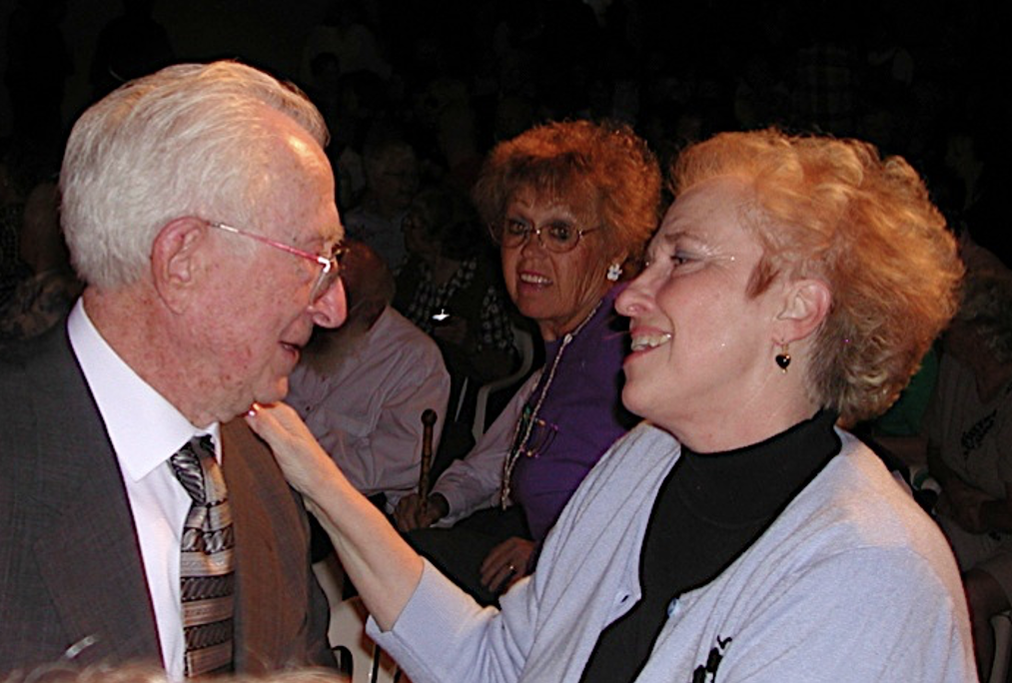
Robert G. Sanderson meets Beth Ann Stewart Campbell in a pleasant encounter. Photo courtesy of the Sanderson Community Center
The renaming of the center was historically significant because it represented the first known state-owned building in Utah to be named after a Deaf individual. The Robert G. Sanderson Community Center of the Deaf and Hard of Hearing became more than a community facility; it became a lasting symbol of Deaf leadership, perseverance, and achievement. The center stands as a reminder of what can be accomplished through advocacy, collaboration, and community involvement.
For many attendees, the celebration was about more than honoring Bob. It was also an opportunity to recognize the generations of Deaf leaders who had fought for better services, greater accessibility, interpreting programs, relay services, educational opportunities, and community spaces. By naming the center after Bob Sanderson, the Utah Deaf community ensured that future generations would be inspired to learn about those who came before them and continue the ongoing work of advocacy and inclusion.
For more information about the event, see the webpage "Honoring Dr. Robert G. Sanderson: The 2003 Naming Ceremony."
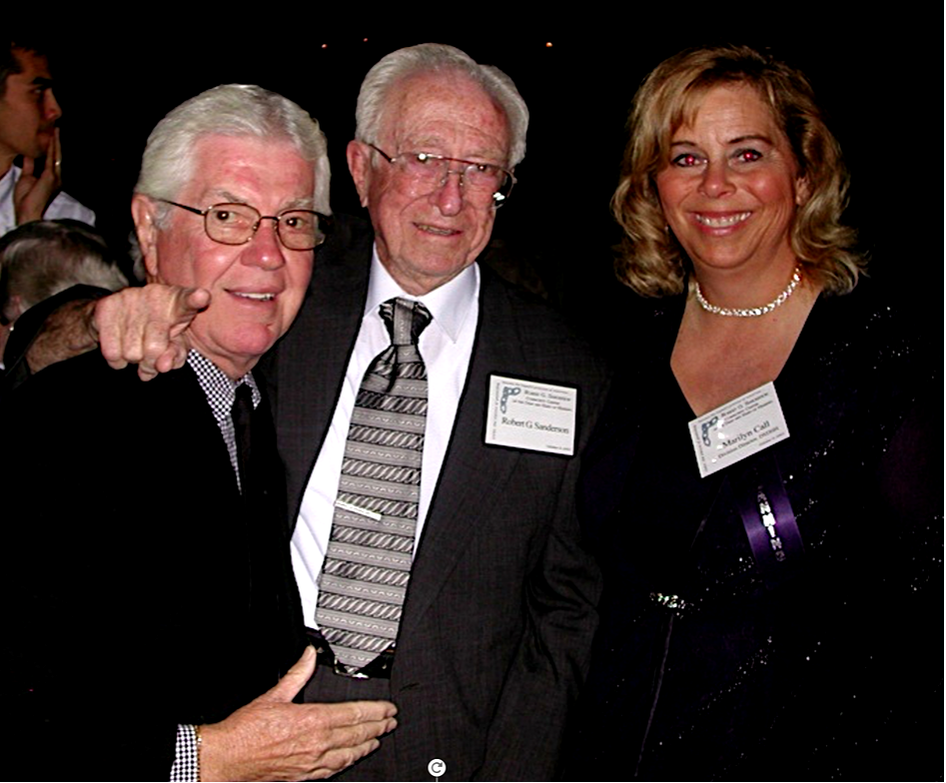
L-R: Herb Larson, Dr. Robert G. Sanderson and Marilyn Tiller Call. Photo courtesy of the Sanderson Community Center

Robert G. Sanderson Community Center of the Deaf and Hard of Hearing. Photo courtesy of the Sanderson Community Center

The Governor of Utah and the Chairperson of the Utah State Board of Education sent letters to Dr. Robert G. Sanderson recognizing the Deaf Center in his name in 2003. Courtesy of the Sanderson Community Center

Robert G. Sanderson Community Center of the Deaf and Hard of Hearing: Photograph by Jodi Christel Becker
A Video Documenting the Renaming Ceremony
for the Robert G. Sanderson Community Center
of the Deaf and Hard of Hearing
I am pleased to share a video documenting the historic renaming ceremony of the Robert G. Sanderson Community Center of the Deaf and Hard of Hearing.
On October 4, 2003, the Utah Community Center for the Deaf and Hard of Hearing in Taylorsville, Utah, was officially renamed the Robert G. Sanderson Community Center of the Deaf and Hard of Hearing. The renaming honored Dr. Robert G. Sanderson, a former president of both the Utah Association for the Deaf and the National Association of the Deaf, in recognition of his extraordinary contributions to Utah's Deaf community.
As Deaf Services Coordinator and later director of community services, Bob played a pivotal role in developing rehabilitation services, expanding communication access, and helping establish community centers for Deaf and hard-of-hearing individuals throughout Utah. His leadership and vision helped transform a long-held dream into reality for generations of Deaf Utahns.
The renaming initiative was led by Marilyn Tiller Call, director of the center, who believed it was important to honor a Deaf leader whose advocacy and dedication had profoundly shaped the community. At the time of the ceremony, Bob was 83 years old.
The celebration drew approximately 1,000 attendees, including Bob and his wife, Mary Sanderson, their sons Gary and Barry, and their families. The event brought together Deaf community leaders, state officials, educators, advocates, family members, and friends to recognize Bob's remarkable legacy.
A special highlight of the ceremony was a keynote address by Dr. I. King Jordan, president of Gallaudet University. Dr. Jordan traveled to Utah specifically for the event. He and Bob shared a longstanding friendship dating back to Bob's service on the Gallaudet Board of Trustees during the historic Deaf President Now movement of 1988.
Throughout the celebration, speakers shared heartfelt stories and reflections on Bob's decades of service. In his own remarks, Bob expressed deep gratitude for the honor and thanked his family, colleagues, and the Deaf community for their support throughout his career.
Special thanks to Ronald J. Nelson and David Lance Pickett for granting permission to upload this historic video to the Utah Deaf History YouTube channel. Their generosity allows those who were unable to attend, as well as future generations, to experience and appreciate this important moment in Utah Deaf history.
Enjoy!
Jodi Christel Becker
The Sanderson’s Memorial Stones
Following the passing of Mary Antonietti Sanderson in October 2008, Dr. Robert G. Sanderson and his son, Barry Sanderson, approached Marilyn Tiller Call about placing a memorial stone on the grounds of the Robert G. Sanderson Community Center of the Deaf and Hard of Hearing. Recognizing the Sanderson family's longstanding connection to the center and their many contributions to Utah's Deaf community, Marilyn agreed that such a memorial would be a fitting tribute (Marilyn Tiller Call, e-mail message to Jodi Christel Becker, March 21, 2012).
Together, Bob, Barry, and Marilyn discussed several possible locations for the memorial. After considering the options, they selected a site near a playground where children could gather and play. The location felt especially meaningful to the family, who believed it reflected Mary's warmth and love for people. They felt that her spirit had guided them to the spot.
Together, Bob, Barry, and Marilyn discussed several possible locations for the memorial. After considering the options, they selected a site near a playground where children could gather and play. The location felt especially meaningful to the family, who believed it reflected Mary's warmth and love for people. They felt that her spirit had guided them to the spot.

Barry, Mary, Robert, & Gary Sanderson. Photo courtesy of Barry Sanderson
On March 31, 2012, Bob added his own name and dates to the memorial stone he shared with Mary. The memorial also honors their son, Gary R. Sanderson, who passed away in 2011. Gary was widely respected within the Deaf community as a nationally recognized interpreter and served as director of the National Center on Deafness (NCOD) at California State University, Northridge (CSUN) (Marilyn Tiller Call, e-mail message to Jodi Christel Becker, March 21, 2012).
Today, the Sanderson memorial stone serves as a quiet reminder of the family's profound contributions to the Deaf community. Located on the grounds of the center that bears Bob's name, it commemorates three individuals whose lives were dedicated to advocacy, education, communication access, and service. The memorial stands as a lasting tribute to the Sanderson family's legacy and their enduring impact on Deaf and hard-of-hearing individuals in Utah and throughout the nation.
Today, the Sanderson memorial stone serves as a quiet reminder of the family's profound contributions to the Deaf community. Located on the grounds of the center that bears Bob's name, it commemorates three individuals whose lives were dedicated to advocacy, education, communication access, and service. The memorial stands as a lasting tribute to the Sanderson family's legacy and their enduring impact on Deaf and hard-of-hearing individuals in Utah and throughout the nation.

The stone is inscribed "In Loving Memory of Mary A. Sanderson." Photograph by Ronald J. Nelson

The stone is inscribed "Robert G. Sanderson." Photograph by Ronald J. Nelson

The stone is inscribed "Robert G. Sanderson." Photograph by Ronald J. Nelson

The stone is inscribed "Gary R. Sanderson." Photograph by Ronald J. Nelson
Sculpture Unveiled at the
20th Anniversary Celebration
Nine months after the passing of Dr. Robert G. Sanderson, the Robert G. Sanderson Community Center of the Deaf and Hard of Hearing celebrated its 20th anniversary. The occasion honored Bob's enduring legacy as a tireless advocate for Deaf and hard-of-hearing individuals in Utah and throughout the nation. A highlight of the celebration was the unveiling of a sculpture created by Trenton Marsh, which featured the inscription:
"When we lose the right to be different, we lose the right to be free."
The quotation reflected Bob's lifelong commitment to changing public attitudes and policies affecting Deaf people while promoting a more inclusive society. The sculpture also commemorated Bob's birth on February 20, 1920, and his passing on February 25, 2012, serving as a lasting tribute to his remarkable contributions (Kinney, UAD Bulletin, November 2012).

Trenton Marsh. Source: StreetLeverage.com
Throughout the celebration, attendees shared personal stories about how the center had influenced their lives. Many reflected on the center's role in fostering communication access, community involvement, and lasting friendships. Their experiences demonstrated how Bob's vision continued to positively affect Deaf and hard-of-hearing individuals long after his retirement and passing.
Bob's son, Barry Sanderson, shared his thoughts about the occasion:
"What struck me the most was that Dad would have been overjoyed to see so many people there, both young and old" (Kinney, UAD Bulletin, November 2012, p. 1).
Barry also reflected on the many discussions and years of planning that eventually led to the creation of the community center. He noted that few could have predicted the extent of its growth or the profound influence it would have on future generations.

Barry Sanderson and his wife, Teresa. Photo courtesy of Barry Sanderson
Marilyn Tiller Call, director of the center, spoke during the anniversary celebration and reminded attendees that the center's origins could be traced to 1975, when five Deaf leaders formed a feasibility committee to explore the possibility of establishing a community center for Deaf and hard-of-hearing Utahns. By 2012, W. David "Dave" Mortensen was the only surviving member of that original group. The others, Dr. Robert G. Sanderson, Ned C. Wheeler, Dora Benoit Laramie, and Lloyd H. Perkins, had all passed away (Kinney, UAD Bulletin, November 2012).

A sculpture of Dr. Robert G. Sanderson created by Trenton Marsh. Photograph by Jodi Christel Becker
Approximately 300 participants embraced the celebration's "Roaring 20s Party" theme by dressing in 1920s attire. Marilyn noted that the number 20 held special significance throughout the event. It represented the center's 20th anniversary, the decade of Bob's birth, his February 20 birthday, and his birth year, 1920 (Kinney, UAD Bulletin, November 2012).
Following dinner, guests enjoyed an evening of fellowship and entertainment. Activities included shuffleboard, pinball, bingo, dancing, and a costume contest. The event provided an opportunity for community members of different generations to gather, celebrate their shared history, and honor those whose efforts had made the center possible.
Reflecting on the evening, Valarie Kinney remarked:
"It was an evening to remember long after everyone had gone home" (Kinney, UAD Bulletin, November 2012).
The 20th anniversary celebration served as both a tribute to Bob Sanderson and a celebration of the community he helped build. It reminded attendees that the Robert G. Sanderson Community Center of the Deaf and Hard of Hearing was more than a building. It was the realization of a vision pursued by generations of Deaf leaders and advocates who worked tirelessly to create opportunities, services, and a sense of belonging for Utah's Deaf and hard-of-hearing community.
Dr. Robert G. Sanderson devoted his life to opening doors for others. Whether advocating for educational opportunities, expanding rehabilitation services, supporting sign language, mentoring future leaders, or helping establish a lasting home for Utah's Deaf community, he worked tirelessly to ensure that Deaf people could thrive and succeed. Although he is no longer with us, his influence continues to be felt in the organizations he strengthened, the community center that bears his name, and the lives of the countless individuals inspired by his example. His story reminds us that true leadership is not measured by personal accomplishments, but by the opportunities created for future generations. Through that measure, Bob's legacy will endure for years to come.

Dr. Robert G. Sanderson. Photo courtesy of the Sanderson Community Center
Dr. Robert G. Sanderson's Motto:
"Do Your Homework!"
On October 21, 2006, I had the privilege of interviewing Dr. Robert G. Sanderson during a board meeting of the Utah Association for the Deaf. As one of Utah's most influential Deaf leaders, Bob had dedicated much of his life to improving Deaf education, communication access, rehabilitation services, and community advocacy. Listening to his stories and experiences gave me a deeper appreciation for the rich history of Utah's Deaf community.
During our conversation, Bob offered a simple piece of advice that would stay with me for years to come:
"Do your homework. Check the UAD Bulletins, newspapers, and other relevant materials."
Although the statement was brief, it had a profound impact on me. Bob's words encouraged me to look beyond stories and memories and seek out original sources that documented the history of Utah's Deaf community. His advice inspired me to spend countless hours researching UAD Bulletins, newspaper articles, personal papers, interviews, photographs, and other historical records.

Dr. Robert G. Sanderson. Source: From Oaks to Acorns
In 2008, I purchased Bob's book, A Brief History of the Origins of the Robert G. Sanderson Community Center of the Deaf and Hard of Hearing, as part of my ongoing research for the Utah Deaf History project. I smiled when I discovered that he had repeated his well-known motto, "Do Your Homework," throughout the book. It immediately brought me back to our 2006 interview and reminded me of the importance he placed on careful research, documentation, and historical accuracy.
Bob's book provided valuable insight into the history of Utah's Deaf community, the Utah Association for the Deaf, and the decades-long effort to establish a community center for Deaf and hard-of-hearing individuals. Together with the UAD Bulletins, newspaper accounts, personal interviews, and other historical materials, it became one of the most important resources in my research.
I am also deeply grateful for Bob's commitment to preserving Utah Deaf history. Through his writing, his documentation of community events, his involvement with the UAD Bulletin, and his preservation of historical records, he left future generations with an invaluable collection of resources. Much of what we know today about the history of Utah's Deaf community exists because individuals like Bob took the time to record it.
More than anything, Bob's advice continues to guide my work. His simple instruction to "Do Your Homework" became more than a research method; it became a philosophy. It serves as a reminder to seek facts, verify sources, preserve history, and honor the stories of those who came before us.
The history presented throughout this website owes much to Bob's example. His dedication to documenting the past has helped ensure that the achievements, struggles, and contributions of Utah's Deaf community will not be forgotten by future generations.

Do your homework! How Utah's Deaf People Got a Community Center of their Own. Outlined by Dr. Robert G. Sanderson

Do your homework! How Utah's Deaf People Got a Community Center of their Own. Outlined by Dr. Robert G. Sanderson
|

Do your homework! How Utah's Deaf People Got a Community Center of their Own. Outlined by Dr. Robert G. Sanderson

Do your homework! How Utah's Deaf People Got a Community Center of their Own. Outlined by Dr. Robert G. Sanderson
|

Do your homework! How Utah's Deaf People Got a Community Center of their Own. Outlined by Dr. Robert G. Sanderson
Advocacy by the the Division of
Services to the Deaf and Hard of Hearing
Prior to its 2016 merger into the Department of Workforce Services, the Division of Services to the Deaf and Hard of Hearing (DSDHH) served as a vital resource for Utah's Deaf, Hard of Hearing, DeafBlind, DeafDisabled, Oral Deaf, and Late Deafened communities. More than a state agency, DSDHH functioned as a central hub for information, advocacy, communication access, education, and support services. Through its programs, the division worked to reduce communication barriers and improve access to employment, education, independent living, and community participation.
For many Deaf and hard-of-hearing Utahns, DSDHH represented a unique partnership between state government and the community it served. The division promoted accessibility, encouraged self-advocacy, and helped ensure that Deaf and hard-of-hearing individuals had access to information and opportunities available to the broader population. Its services included interpreting programs, community education, case management, communication access resources, outreach activities, technology assistance, and leadership development opportunities.
The Utah Deaf community took considerable pride in having a state agency devoted specifically to its needs. Over the years, DSDHH became an important voice for Deaf and hard-of-hearing individuals throughout Utah and played a significant role in advancing communication access, public awareness, and community representation. Through collaboration with community organizations, educational institutions, government agencies, and advocacy groups, the division helped improve the quality of life for thousands of Utahns.
The accomplishments of DSDHH reflected decades of advocacy by Deaf leaders who believed that Deaf and hard-of-hearing individuals should have direct access to services designed to meet their unique needs. From its establishment in 1988 through its years of growth and expansion, the division became an essential part of Utah Deaf history and a source of pride for the community it served.
However, significant changes occurred in 2016 when the Utah Legislature approved the Office of Rehabilitation Amendments (House Bill 325). The merger that followed fundamentally changed the administrative structure of DSDHH and raised concerns among many members of the Deaf community regarding representation, accessibility, and the future direction of services. Those developments are discussed in the following section, "Office of Rehabilitation Amendments, House Bill 325, and Its Impact on the Division of Services to the Deaf and Hard of Hearing."

Shanna & David Mortensen. Photograph by Robert L. Bonnell
Office of Rehabilitation Amendments,
House Bill 325 and Its Impact
on the Division of Services of the
Deaf and Hard of Hearing
Compiled & Written by Jodi Christel Becker
Edited by Valerie G. Kinney
Published in 2017
Updated in 2026
Edited by Valerie G. Kinney
Published in 2017
Updated in 2026
Author's Note
This section is intended to help readers understand the historical importance of the Robert G. Sanderson Community Center of the Deaf and Hard of Hearing and the vital services provided through the Division of Services to the Deaf and Hard of Hearing (DSDHH) to Utah's Deaf, DeafBlind, Hard of Hearing, DeafDisabled, Oral Deaf, and Late Deafened communities. Its purpose is not to criticize the Department of Workforce Services (DWS), but rather to document a significant period of change in Utah Deaf history.
The Utah Deaf community appreciates the efforts of DWS to work collaboratively with DSDHH and to continue providing services following the 2016 merger. At the same time, many community members have expressed concerns regarding the long-term effects of House Bill 325, known as the Office of Rehabilitation Amendments, which transferred DSDHH from the Utah State Office of Rehabilitation to the Department of Workforce Services.
Because the Robert G. Sanderson Community Center of the Deaf and Hard of Hearing serves as an important symbol of community, accessibility, advocacy, and communication access, it is important to understand how these administrative changes affected the center, the division, and the people they serve.
As the author of this website and a former member of both the DSDHH and DWS Task Force, I have included the document titled "Changes and Impact of the Move of the Division of Services to the Deaf and Hard of Hearing Governance to the Department of Workforce Services." Readers who wish to examine the issue in greater detail are encouraged to review the report and its findings regarding the various areas impacted by the merger.
Although some individuals opposed the public release of the report, I believe its publication is important because it forms part of the historical record. Since the study was completed in 2018, making its findings available allows community members, researchers, and future generations to better understand this period of transition and its impact on Deaf and hard-of-hearing Utahns.
History is most valuable when it is preserved, examined, and understood. This section is offered in that spirit.
Jodi Christel Becker
The Controversial Transfer of the Division of
Services to the Deaf and Hard of Hearing
to the Department of Workforce Services
Before 2016, the Division of Services to the Deaf and Hard of Hearing (DSDHH) operated with relatively little oversight from the Utah State Office of Rehabilitation (USOR). In 2016, the Utah Legislature passed House Bill 325, known as the Office of Rehabilitation Amendments, transferring USOR and its divisions, including DSDHH, from the Utah State Board of Education to the Department of Workforce Services (DWS). The legislation followed an audit conducted the previous year that identified significant financial management problems within the Vocational Rehabilitation program. The audit revealed approximately $6 million in overspending and concerns regarding the administration of federal funds, prompting lawmakers to move USOR to a separate state agency.

Standing is Cathy Holt, a Deaf advocate at the legislature session
The proposed reorganization generated considerable concern within Utah's Deaf community. During the legislative session, members of the Utah Association of the Deaf (UAD) Board of Directors, including Stephen Persinger, Philippe Montalette, Pamela Mower, and W. David Samuelsen, devoted significant time and effort to reviewing the bill and advocating for necessary revisions. Working closely with Representative Norm Thurston, the sponsor of HB 325, they sought to ensure that services for Deaf and hard of hearing Utahns would remain protected during the transition (Persinger, UAD Bulletin, April 2016).

Back L-R: David Samuelsen, Philipp Montalette, Stephen
Persinger, Joseph Nelson Front L-R: Catherine Holt, Pamela
Mower. Source: UAD Bulletin, 2016
Marilyn Tiller Call, Director of DSDHH, later explained that the transfer of USOR from the Utah State Board of Education to the Department of Workforce Services raised numerous concerns among DSDHH staff, the UAD, and the broader Deaf community. During legislative hearings and appropriation committee meetings, community members testified about the potential impact of the proposed changes. Despite these efforts, representatives from the Governor's Office indicated that a separate agency for USOR would not be created. Shortly thereafter, the Governor's Office introduced HB 325, sponsored by Representative Norm Thurston and Senator Allen Christensen (Call, DSDHH Newsletter, April 2016).
The proposed transfer was highly controversial within Utah's Deaf community. Many Deaf leaders, community members, and advocates opposed moving the Utah State Office of Rehabilitation and DSDHH to the Department of Workforce Services, fearing the loss of autonomy, reduced representation, and potential threats to specialized services. Despite their objections, it became clear that the legislation would move forward. As a result, DSDHH staff and UAD leaders shifted their efforts toward protecting the Sanderson Community Center of the Deaf and Hard of Hearing, preserving essential programs and services, and ensuring that Deaf and hard of hearing Utahns would continue to have a strong voice within the new administrative structure.
The proposed transfer was highly controversial within Utah's Deaf community. Many Deaf leaders, community members, and advocates opposed moving the Utah State Office of Rehabilitation and DSDHH to the Department of Workforce Services, fearing the loss of autonomy, reduced representation, and potential threats to specialized services. Despite their objections, it became clear that the legislation would move forward. As a result, DSDHH staff and UAD leaders shifted their efforts toward protecting the Sanderson Community Center of the Deaf and Hard of Hearing, preserving essential programs and services, and ensuring that Deaf and hard of hearing Utahns would continue to have a strong voice within the new administrative structure.

Marilyn Tiller Call. Courtesy of the Sanderson Community Center
The original version of HB 325 raised serious concerns. According to Call, "It omitted the Interpreter Certification Program and appeared to eliminate Division Directors and Divisions, opting instead to consolidate all of USOR's Divisions under Darin Brush" (Call, DSDHH Newsletter, April 2016, p. 1). UAD officers informed legislators that they could not support the legislation unless protections were added for the Sanderson Community Center and its programs. As a result, the bill underwent several revisions. The second amended version included protections for DSDHH and its offices in Taylorsville and St. George (Call, DSDHH Newsletter, April 2016).
Further amendments resulted in several important changes:
Through continued advocacy and negotiation, DSDHH staff and UAD leaders secured key protections within HB 325, helping preserve essential services and programs for Utah's Deaf and hard of hearing communities despite the transfer to the Department of Workforce Services.
Further amendments resulted in several important changes:
- In many sections of Utah law, the term "hearing impaired" was replaced with "deaf" and/or "hard of hearing."
- The Division of Services to the Deaf and Hard of Hearing retained its status as a division. Earlier drafts would have renamed it the Office of Services for the Deaf and Hard of Hearing.
- Earlier versions of the bill omitted a leadership position for DSDHH. The amended legislation restored management authority through an assistant director position.
- The Director of DSDHH was authorized to appoint four professional interpreters to serve on the Interpreter Certification Board (Persinger, UAD Bulletin, April 2016, p. 2).
Through continued advocacy and negotiation, DSDHH staff and UAD leaders secured key protections within HB 325, helping preserve essential services and programs for Utah's Deaf and hard of hearing communities despite the transfer to the Department of Workforce Services.

Back LR: Marilyn Tiller Call, David Samuelsen, Philippe Montalette, Pamela Mower, Stephen Persinger, Rep. Norm Thurston, Kent McGregor Front: Utah Governor Gary Herbert. Source: UAD Bulletin, 2016
The DWS/DSDHH Legislative Task Force
Studies the Impact of the Merger
Following the passage of House Bill 325 in 2016, many members of Utah's Deaf community remained concerned about the long-term impact of transferring the Division of Services to the Deaf and Hard of Hearing (DSDHH) to the Department of Workforce Services (DWS). To address these concerns, Utah Association of the Deaf activists asked Representative Norm Thurston to petition the Audit Subcommittee to conduct an assessment by October 2017 to determine whether Deaf and Hard of Hearing Services were a suitable fit within DWS. The request was approved (Persinger, UAD Bulletin, April 2016).
Reflecting on the legislative battle, DSDHH Director Marilyn Tiller Call described the session as "a wild roller coaster ride." She expressed confidence that the advocates who had worked for decades to establish and strengthen Deaf services in Utah would have been proud to see a new generation of leaders working together to protect DSDHH, its mission, and its programs (Call, DSDHH Newsletter, April 2016). Nevertheless, the transition from the Utah State Board of Education to the Department of Workforce Services affected many aspects of DSDHH, including its identity, mission, organizational values, communication and authorization processes, accessibility, operations, policies, procedures, and staff morale.
Reflecting on the legislative battle, DSDHH Director Marilyn Tiller Call described the session as "a wild roller coaster ride." She expressed confidence that the advocates who had worked for decades to establish and strengthen Deaf services in Utah would have been proud to see a new generation of leaders working together to protect DSDHH, its mission, and its programs (Call, DSDHH Newsletter, April 2016). Nevertheless, the transition from the Utah State Board of Education to the Department of Workforce Services affected many aspects of DSDHH, including its identity, mission, organizational values, communication and authorization processes, accessibility, operations, policies, procedures, and staff morale.

DSDHH Newsletter, April 2016
In response to these ongoing concerns, the DWS/DSDHH Legislative Task Force was established following the merger. Chaired by ASL interpreter Dawn Mancil Duran, the task force included Deaf community representatives Dr. Dan Hoffman, Stephen Persinger, Pamela Mower, and Jodi Christel Becker. The group conducted a comprehensive study of the merger and its effects on DSDHH and the Sanderson Community Center of the Deaf and Hard of Hearing. In March 2018, the task force completed a thorough structural systems analysis, which revealed the significant challenges that would accompany any effort to separate DSDHH from the Department of Workforce Services.
The task force concluded that transferring DSDHH to another organization would require the approval of the Department of Workforce Services, the Governor of Utah, and the Utah State Board of Education. Although DWS expressed a willingness to supervise and collaborate with DSDHH, the Utah State Board of Education declined to participate in discussions regarding a possible transfer. As a result, DSDHH remained within DWS and was required to follow departmental policies, procedures, training requirements, and administrative practices.
To learn more about the task force's findings, including its analysis of organizational identity, mission, accessibility, governance, operations, and morale, readers may review the report, "Changes and Impact of the Move of the Division of Services to the Deaf and Hard of Hearing Governance of the Department of Workforce Services."
Despite efforts to preserve services during the merger, the Sanderson Community Center experienced significant changes. Many community members expressed concern about the loss of autonomy, local control, and organizational identity following the transfer. Unlike in previous years, the DSDHH Director and Deaf community leaders no longer had direct authority to advocate for legislative funding and resources on behalf of the center, as DWS utilized its own lobbying structure. In addition, DWS policies restricted staff members from working through the UAD to advocate for the Sanderson Community Center. The absence of DSDHH staff participation at the 2021 UAD Conference and on the UAD Board also reflected the changing relationship between the agency and the Deaf community.
Nevertheless, the Sanderson Community Center of the Deaf and Hard of Hearing remains committed to serving Utah's Deaf, Hard of Hearing, DeafBlind, DeafDisabled, and Late Deafened communities. While adapting to its role within the Department of Workforce Services, the center continues to fulfill its mission and seeks productive collaboration in support of the individuals and communities it serves.

Task Force Report, March 2018. 'Changes and Impact of the Move of the Division of Services to the Deaf and Hard of Hearing Governance of the Department of Workforce Services'
Members of the DSDHH and DWS Task Force

Dawn Mancil Duran. Source: aslcomm.com
|

Dr. Dan Hoffman. Source: gymjohnny.wixsite.com
|

Stephen Persinger. Source: UAD Bulletin
|

Pamela Mower. Source: utrid.com

Jodi Christel Becker
|
Dan V. Mathis, Assistant Director
Dan V. Mathis, a Deaf Utah native, grandson of John F. and Vida White, and nephew of longtime vocational rehabilitation counselor Jack A. White, became Assistant Director of the Division of Services to the Deaf and Hard of Hearing (DSDHH) on March 5, 2018, following the retirement of Marilyn Tiller Call in 2017. He was committed to strengthening community and interagency relationships while expanding opportunities and services that benefited Deaf, Hard of Hearing, DeafBlind, DeafDisabled, and Late Deafened Utahns. During his tenure, the Sanderson Community Center and the Southern Utah Deaf and Hard of Hearing Program (SUDHHP) hosted numerous community events, educational activities, training sessions, workshops, and town hall meetings.
Under Dan's leadership, the Sanderson Community Center underwent significant facility improvements. These upgrades included new automatic sliding doors at the main entrance, a security camera system, a rear fence gate, LED lighting in the parking lots, pathway handrails leading to the main and southwest entrances, and a dual-purpose lawnmower and snowblower tractor. Dan also fostered collaboration among DSDHH staff, community leaders, and community members, which resulted in the successful introduction of Protactile training to Utah. This groundbreaking training expanded communication access and opportunities for DeafBlind individuals throughout the state.
Another significant accomplishment during Dan's tenure was his support for the development of a project timeline for Utah's new interpreter certification examinations and the Utah Interpreter Program website. These initiatives helped modernize interpreter certification standards and strengthened the quality and professionalism of interpreting services for Deaf individuals in Utah and neighboring regions.

Dan V. Mathis. Source: University of Washington
Dan regularly traveled to the Southern Utah Deaf and Hard of Hearing Program office in St. George to demonstrate his commitment to staff and community members in southern Utah. In an effort to foster collaboration, he and SUDHHP Director Grant Pemberton met with business leaders, educators, and community stakeholders to promote the programs and services available to Deaf and Hard of Hearing individuals in the region. They also strengthened partnerships with local Department of Workforce Services (DWS) and Utah State Office of Rehabilitation (USOR) offices to improve networking and service coordination.
Because of his strong relationship with the Utah School for the Deaf, Dan also played an important role in assisting Associate Superintendent Michelle Tanner in securing the lease of vacant office space adjacent to SUDHHP. This additional space enabled the expansion of the Utah School for the Deaf's South Deaf Education Outreach Program. Dan was particularly passionate about reaching families of young Deaf children, especially those living in rural and underserved areas, and providing support that would promote their overall growth, development, and well-being.
Among the many accomplishments during Dan's leadership, one notable event was the partnership between DSDHH, the Deaf LGBTQ+ community, and the Sego Lily Center for the Abused Deaf to host an "Ally Night" at the Sanderson Community Center. Community members, advocates, allies, parents, and other interested participants attended the event. It marked an important milestone in promoting inclusion and understanding within Utah's Deaf community. The event reflected Dan's vision of building a more inclusive, diverse, equitable, and accessible environment through patience, dialogue, mutual respect, and trust.
However, Dan assumed leadership during a challenging period in DSDHH's history. The transfer of DSDHH to the Department of Workforce Services had generated controversy and dissatisfaction among many members of Utah's Deaf community. Prior to his appointment, the Utah Association of the Deaf had completed a study examining the effects of the merger between DSDHH and DWS. Discussions regarding the report and its recommendations continued for several years, resulting in ongoing debates about the future of DSDHH and the Sanderson Community Center. Through extensive dialogue and mediation, community leaders eventually reached a resolution concerning the report's findings and recommendations.
At the same time, DSDHH staff faced the challenge of adapting to DWS policies and procedures, including mandatory annual training, employee evaluations, and other administrative requirements. These changes reflected a growing emphasis on organizational accountability, professional development, and compliance within the new structure.
Despite Dan's dedication to strengthening DSDHH and expanding services throughout Utah, the continuing challenges associated with integrating DSDHH into the Department of Workforce Services took a personal toll. The stress of navigating organizational change, community concerns, and ongoing conflicts ultimately led him to resign for the sake of his well-being. His departure represented a significant loss for Utah's Deaf community. Nevertheless, Dan's leadership left a lasting legacy through his commitment to community engagement, facility improvements, interpreter program development, Protactile training opportunities, and statewide collaboration.
Although the Department of Workforce Services made sincere efforts to collaborate with DSDHH, the merger significantly altered the center's organizational identity and relationship with the Deaf community. Nevertheless, the Sanderson Community Center of the Deaf and Hard of Hearing remains committed to serving Utah's Deaf, Hard of Hearing, DeafBlind, Late Deafened, and DeafDisabled communities. The center continues to build upon its longstanding mission while adapting to the evolving needs of the people it serves.
A New Logo of the Division of Services
of the Deaf and Hard of Hearing
Following Dan Mathis's resignation, Annette Stewart, a hearing social worker at the Sanderson Community Center, was appointed Interim Assistant Director on April 16, 2019. Her dedication and leadership during this transitional period were greatly appreciated. Nine months later, on January 13, 2020, Arlene Garcia Gunderson, who is Deaf, was appointed Assistant Director of the Division of Services to the Deaf and Hard of Hearing (DSDHH). She brought a unique perspective and a wealth of experience to the position, and her contributions were highly valued by staff and community members alike.

Annette Stewart.
Courtesy of the Sanderson Community Center
Soon after her appointment, Arlene faced the unprecedented challenges of the COVID-19 pandemic. Like many organizations, DSDHH adapted to remote work and virtual communication. Although building relationships with colleagues and community members proved difficult through Zoom and other online platforms, Arlene demonstrated resilience and adaptability during this challenging time.
Under her leadership, DSDHH successfully launched a collaborative effort to redesign its logo and update the division's name. On October 14, 2020, the division unveiled its new logo and officially changed its name from the Division of Services to the Deaf and Hard of Hearing to the Division of Services of the Deaf and Hard of Hearing. The change reflected the division's evolving identity and its commitment to representing and serving Utah's Deaf and Hard of Hearing communities.
Under her leadership, DSDHH successfully launched a collaborative effort to redesign its logo and update the division's name. On October 14, 2020, the division unveiled its new logo and officially changed its name from the Division of Services to the Deaf and Hard of Hearing to the Division of Services of the Deaf and Hard of Hearing. The change reflected the division's evolving identity and its commitment to representing and serving Utah's Deaf and Hard of Hearing communities.

Arlene Garcia Gunderson. Photo provided by Arlene Garcia Gunderson
The logo redesign was a collaborative process involving staff from throughout the state. Rather than maintaining separate logos for the Salt Lake City and St. George offices, DSDHH chose to create a single logo that would represent the entire division. Staff participated in surveys and discussions that identified key themes, including community, connection, equity, accessibility, and service. They also emphasized concepts such as collaboration, simplicity, modern design, and uniqueness.
This shared effort resulted in a logo featuring distinctive shapes and colors representing the division's various departments. Yellow symbolized Community Advocacy Services, light blue represented Continuing Education and Outreach, green reflected Facilities, Maintenance, and Operations, and red represented the Utah Interpreter Program. Together, these elements formed a unified logo that reflected the division's commitment to collaboration, inclusion, and statewide service.
The unveiling of the new logo and name marked an important milestone for the division. It symbolized not only the unity of its programs and staff but also its ongoing commitment to serving Utah's Deaf, Hard of Hearing, DeafBlind, DeafDisabled, and Late Deafened communities.


Logo of the Division of Services of the Deaf and Hard of Hearing
The Appointment of the Interim Assistant Directors
Following the resignation of Arlene Garcia Gunderson, Eric Roux, a longtime vocational rehabilitation counselor and administrator, assumed leadership of the Division of Services of the Deaf and Hard of Hearing (DSDHH) on August 4, 2021. He served as interim director until June 8, 2022.
On June 9, 2022, Sarah Brenna, Director of the Utah State Office of Rehabilitation, assumed oversight of DSDHH. She was supported by four managers, Pamela Mower, Melanie Sperry, Annette Stewart, and Jes Nelson-Julander, who collectively helped guide the division until a permanent assistant director could be appointed.
On June 9, 2022, Sarah Brenna, Director of the Utah State Office of Rehabilitation, assumed oversight of DSDHH. She was supported by four managers, Pamela Mower, Melanie Sperry, Annette Stewart, and Jes Nelson-Julander, who collectively helped guide the division until a permanent assistant director could be appointed.

Eric Roux. Source: linkedin.com
|

Sarah Brenna. Source: utah.gov
|
On July 23, 2024, David Lance Pickett, a Deaf professional and former Vice President of Corporate Marketing at Sorenson Media, Inc., began serving as Program Director. Bringing extensive leadership, business, and administrative experience, he is well positioned to contribute innovative ideas and strengthen services for Utah's Deaf and Hard of Hearing communities.

David Lance Pickett. Source: linkedin.com
Conclusion: Wrapping up with Gratitude
As the author of this website, I would like to reflect on the unique history and lasting importance of the Robert G. Sanderson Community Center of the Deaf and Hard of Hearing. For decades, the center has served as a vital resource for Utah's Deaf, Hard of Hearing, DeafBlind, DeafDisabled, and Late Deafened communities by providing services, programs, training opportunities, and social connections that enhance quality of life.
The establishment of the community center was not achieved overnight. From 1962 to 1992, dedicated leaders and members of the Utah Association for the Deaf worked tirelessly to make this vision a reality. Dr. Robert G. Sanderson, W. David Mortensen, and countless members of Utah's Deaf community played essential roles in navigating the political process and advocating for a center that would meet the communication, accessibility, and community needs of Deaf Utahns. Through their determination and advocacy, they successfully secured support from the Utah State Office of Education and the Utah Legislature, ultimately leading to the creation of the Robert G. Sanderson Community Center of the Deaf and Hard of Hearing.
Their efforts were not without setbacks. The campaign faced numerous challenges, including the legislative mix-up bill in 1977 and the disappointing decision to prioritize funding for a dairy barn over the proposed community center in 1981. Yet these obstacles did not deter the advocates who believed in the importance of Deaf community space and services. Their perseverance, commitment, and resilience ultimately led to success.
I hope this historical account helps readers appreciate the sacrifices, leadership, and vision of those who worked so hard on behalf of Utah's Deaf community. In particular, W. David Mortensen devoted decades of service, made significant personal sacrifices, and provided outstanding leadership throughout the effort to establish the community center. His dedication and accomplishments deserve lasting recognition and gratitude.
Finally, I would like to express my sincere appreciation for the collaborative efforts of Beth Ann Stewart Campbell, Dr. Robert G. Sanderson, and W. David Mortensen. Their partnership was instrumental in establishing Utah's community center for Deaf individuals. Beth's legislative interpreting, Robert's advocacy and leadership, and Dave's tireless commitment helped transform a long-held dream into a reality. Their work continues to benefit generations of Deaf Utahns, and the community remains deeply grateful for their contributions.
I also extend my gratitude to the many Deaf leaders, advocates, interpreters, educators, families, legislators, and community members whose efforts may not always appear in the history books but whose contributions helped shape the success of the Robert G. Sanderson Community Center of the Deaf and Hard of Hearing. Their collective dedication stands as a lasting testament to the power of community, advocacy, and collaboration.
HISTORICAL DOCUMENTS
I have digitized and uploaded the following historical materials related to the Robert G. Sanderson Community Center of the Deaf and Hard of Hearing for this webpage. I hope you enjoy exploring the rich history of this remarkable center.
In 2012, Marilyn Tiller Call created a Chronological Highlights of the Robert G. Sanderson Community Center of the Deaf and Hard of Hearing document. This valuable resource provides an overview of the center's history and development through the years. Thank you, Marilyn, for your important contribution to preserving Utah Deaf history.
In 2012, Marilyn Tiller Call created a Chronological Highlights of the Robert G. Sanderson Community Center of the Deaf and Hard of Hearing document. This valuable resource provides an overview of the center's history and development through the years. Thank you, Marilyn, for your important contribution to preserving Utah Deaf history.

Robert G. Sanderson (left) and W. David Mortensen (right). June 18, 1995. Photo courtesy of Robert L. Bonnell
ARCHIVES
- Program for the Better Services to the Adult Deaf Brochure (1965)
- Support Letters for the Study the Feasibility of a Comphrensive Community Center for the Deaf (1975)
- Minutes of the Committee to Study the Feasibility of a Center for the Deaf (1975)
- Study the Feasibility of a Comprehensive Community Center for the Deaf Committee Report (1975)
- Report of the Study the Feasibility of a Comprehensive Community Center for the Deaf (December 1, 1975)
- Utah State Superintendent of Public Instruction, Dr. Walter D. Talbot's Thank You Letters (1976)
- Utah Division of Services to the Deaf and Hard of Hearing Brochure-Type Magazine (2000)

Robert G. Sanderson talking to W. David Mortensen. June 18, 1995. Photo courtesy of Robert L. Bonnell
Personal Communication
Beth Ann Stewart Campbell, e-mail message to Jodi Christel Becker, September 18, 2012.
Beth Ann Stewart Campbell, e-mail message to Jodi Christel Becker, September 20, 2012.
Beth Ann Stewart Campbell, e-mail message to Jodi Christel Becker, December 7, 2023.
Dan V. Mathis, e-mail message to Jodi Christel Becker, April 20, 2022.
Darlene Stewart Cochran, interview with her brother, Gene Stewart, April 4, 2012.
Kenneth L. Kinner, personal communication with the author, 2008.
Marilyn Tiller Call, e-mail message to Jodi Christel Becker, October 15, 2009.
Marilyn Tiller Call, e-mail message to Jodi Christel Becker, January 25, 2012.
Marilyn Tiller Call, e-mail message to Jodi Christel Becker, March 21, 2012.
Marilyn Tiller Call, e-mail message to Jodi Christel Becker, December 15-16, 2023.
Norman Williams, e-mail message to Jodi Christel Becker, April 12, 2012.
Norman Williams, e-mail message to Jodi Christel Becker, May 8, 2012.
W. David Mortensen, e-mail message to Jodi Christel Becker, April 3, 2012.
Sources
Bangerter's Recommendations." UAD Bulletin, vol. 12, no. 22 (February 1990): 3.
Bitter, Grant. "Concerns with Deaf Center." Grant B. Bitter Papers, Accn #1072. Manuscripts Division, J. Willard Marriott Library, University of Utah, Salt Lake City, Utah. January 1, 1985.
"Board Adopts Policy on Deaf." Salt Lake Tribune, June 16, 1976.
Cinelli, Pattie. "Sanderson Researches Social Factors in VR Programs for Deaf Persons." On the Green, vol. 12, no. 12 (January 11, 1982): 1-2.
"Calling All Deaf Citizens!" UAD Bulletin, vol. 4, no. 10 (March 1981): 3.
Call, Marilyn. "Center for Deaf and Hard of Hearing Gets New Name." UAD Bulletin, vol. 27, no. 4 (September 2003): 1, 4.
Call, Marilyn. "Chronological Highlights of Utah's Sanderson Center." Division of Services to the Deaf and Hard of Hearing Newsletter(January 2010): 1-2.
Call, Marilyn. "Legislative Session 2016." DSDHH Newsletter (April 2016).
Campbell, Jay. "Beth Ann Resigns As Director of UCCD." UAD Bulletin, vol. 15, no. 10 (March 1992): 1.
"Celebration at New UCCD Ground-Breaking." UAD Bulletin, vol. 15, no. 2 (July 1991): 2.
Campbell, Joey. "Deaf Vent Frustrations and Criticize New Division." Deseret News, April 1, 1988, B12.
"Center for the Deaf Director Appointed." UAD Bulletin, vol. 6, no. 2 (July 1982): 2.
"Center for the Deaf Needs Your Help!" UAD Bulletin, vol. 3, no. 8 (January 1980): 2.
"Council Releases Report." UAD Bulletin, vol. 3, no. 1 (Fall 1963): 1-7.
"Council Moves to Implement Study Recommendations." UAD Bulletin, vol. 3, no. 2 (Winter 1964): 5.
Curtis, Leon. "The President's Corner." UAD Bulletin, vol. 3, no. 6 (Spring 1965): 2.
"Deaf Center Report In." UAD Bulletin, vol. 10, no. 4 (December 1975): 1.
"Deaf to Dedicate 'Home of Their Own.'" Salt Lake Tribune, May 29, 1983, 16B.
"Dr. Robert Sanderson Appointed to Dr. Powrie V. Doctor Chair." UAD Bulletin, vol. 5, no. 2 (July 1981): 3.
"Dr. Sanderson Announces Retirement." UAD Bulletin, vol. 8, no. 9 (February 1985): 1-2.
"Editorial." The Spotlight, vol. 2, no. 1 (June 1978): 1.
"Editor's Note." The Spotlight, vol. 2, no. 1 (June 1978): 1-2.
"FLASH!" UAD Bulletin, vol. 4, no. 5 (October 1980): 1.
"Friday, September 8, 1989 - Utah State Board of Education Gives the New UCCD #1 Facility Priority!" UAD Bulletin, vol. 12, no. 18 (September 1989): 4.
"Get Out and Meet Your Legislators." UAD Bulletin, vol. 4, no. 4 (September 1980): 2.
"Good Years." UAD Bulletin, vol. 4, no. 6 (Spring-Summer 1967): 2.
"Groundbreaking at UCCD." UAD Bulletin, vol. 25, no. 1 (June 2001): 1.
Kinney, Valerie. "Sculpture Unveiled at Celebration." UAD Bulletin, vol. 36, no. 6 (November 2012): 1.
"Legislature Okehs Funds for Services for the Adult Deaf." UAD Bulletin, vol. 3, no. 6 (Spring 1965): 1, 3.
Petersen, Eugene W. "Community Services for Salt Lake Area Deaf Near Realization." The Silent Worker, vol. 16, no. 4 (December 1963): 3-4.
Persinger, Stephen. "Legislative Session - HB 325." UAD Bulletin (April 2016).
"Prestigious Awards Given During UAD Conference." UAD Bulletin, vol. 31, no. 5 (October 2007): 1, 5.
"Progress on Center for the Deaf." UAD Bulletin, vol. 5, no. 9 (February 1982): 1.
"Program for Better Services to the Adult Deaf Becomes Reality." UAD Bulletin, vol. 4, no. 2 (Winter 1965): 1, 3.
Mortensen, Dave. "Won't Listen." Ogden Standard-Examiner, June 16, 1976.
Mortensen, Dave. "President's Message." UAD Bulletin, vol. 11, no. 11 (April 1988): 2.
Mortensen, Dave. "President's Message." UAD Bulletin, vol. 11, no. 12 (May 1988): 2.
Mortensen, Dave. "President's Message." UAD Bulletin, vol. 12, no. 5 (September 1988): 2.
Mortensen, Dave. "Director of the Utah DSHID: Update or Déjà Vu." UAD Bulletin, vol. 12, no. 6 (October 1988): 6-7.
Mortensen, Lyle G. "UAD President's Message." UAD Bulletin, vol. 15, no. 3 (August 1991): 3.
Nelson, Ron. "Historic Moment." UAD Bulletin, vol. 27, no. 4 (September 2003): 5.
"No Welfare State for the Deaf." UAD Bulletin, vol. 3, no. 6 (Spring 1965): 4.
"Rehabilitation Aide Begins Work in Deaf Section." UAD Bulletin, vol. 6, no. 4 (Fall-Winter 1970-71): 1.
"Resignation Takes Deaf Community by Surprise." UAD Bulletin, vol. 5, no. 9 (February 1982): 1.
"Straight Answers to Pointed Questions." UAD Bulletin, vol. 4, no. 6 (Spring-Summer 1967): 2, 7-8.
Nelson, Ron. "Letter to the Editor: An Open Forum." UAD Bulletin, vol. 12, no. 18 (October 1989): 2-3.
Sanderson, Robert G. "THANK YOU! THANK YOU!" UAD Bulletin, vol. 15, no. 2 (July 1991): 7.
Sanderson, Robert G. A Brief History of the Origins of the Robert G. Sanderson Community Center of the Deaf and Hard of Hearing. 2004.
"Sanderson Center Celebration." UAD Bulletin, vol. 27, no. 4 (September 2003): 5.
"Services for Adult Deaf Urged." UAD Bulletin, vol. 3, no. 1 (Fall 1963): 1-6.
"Services for Adult Deaf Prove Worth As First Anniversary Nears." UAD Bulletin, vol. 4, no. 4 (Fall 1966): 1.
"So Long, Folks! - Dr. Robert G. (Sandie) Sanderson." UAD Bulletin, vol. 8, no. 10 (March 1985): 1-2.
Stewart, Gene. "The UCCD Building Dedication." DSDHH Newsletter (June 1993).
Stewart, Gene. "Robert G. Sanderson 'Sandie'." DSDHH Newsletter (April 2012): 2-3.
"Support for Center for the Deaf Grows." UAD Bulletin, vol. 4, no. 3 (August 1980): 1.
"Thank You!! 1990 Utah Legislatures! APPROVED! INTERPRETER FUNDS APPROVED!NEW DEAF CENTER." UAD Bulletin, vol. 12, no. 24 (March 1990): 2.
"Tentative Drawings Submitted for Center for the Deaf." UAD Bulletin, vol. 3, no. 12 (May 1980): 2.
"UAD Joins CSC Family." UAD Bulletin, vol. 3, no. 3 (Spring 1964): 1, 5.
"Update on Center for the Deaf." UAD Bulletin, vol. 3, no. 4 (September 1979): 2.
"Update on Center for the Deaf." UAD Bulletin, vol. 5, no. 10 (March 1982): 2.
"Update on Center for the Deaf." UAD Bulletin, vol. 7, no. 1 (June 1983): 2.
Urbani, Diane. "Center for Deaf Renamed After First Director." Deseret News, October 4, 2003.
"Utah Board of Education Moves on Center for the Deaf Project." UAD Bulletin, vol. 5, no. 11 (April 1982): 5.
"Vote No to Initiatives A & B!" UAD Bulletin, vol. 4, no. 7 (November 1980): 2.
Zakharias, Steve. "Steve Zakharias's Poem." DSDHH Newsletter (June 1993): 2.
"What Has the UAD Done to the Deaf Community?" UAD Bulletin, vol. 4, no. 7 (December 1980): 2.
