The History of the Utah Association
of the Deaf: Conventions,
Conferences, and Leadership
Compiled & Written by Jodi Christel Becker
Edited by Valerie G. Kinney
Published in 2015
Updated in 2026
Edited by Valerie G. Kinney
Published in 2015
Updated in 2026
Author's Note
I thoroughly enjoyed researching the history of the Utah Association of the Deaf (UAD), one of the oldest state Deaf organizations in the nation. Since its founding in 1909, the UAD has championed the human, civil, accessibility, and linguistic rights of individuals who are Deaf, Hard of Hearing, DeafBlind, DeafDisabled, and Late Deafened. Its longstanding commitment to advocacy has strengthened the Utah Deaf community and improved the lives of countless individuals. Learning about this rich history has deepened my appreciation for the generations of leaders, advocates, and community members whose efforts have helped shape the rights and opportunities we enjoy today.
The UAD's remarkable achievements stand as a testament to the dedication and perseverance of those who worked tirelessly to advance equality, accessibility, and inclusion. I am proud to be associated with an organization that honors its past while continuing to address the evolving needs of the Deaf community. By fostering awareness, leadership, and collaboration, the UAD has helped create a stronger and more united community. As we celebrate these accomplishments, we can also look ahead with optimism and continue building upon this important legacy.
The strength of the UAD has always come from the involvement of its members. Whether you join the association, attend a conference, vote in elections, serve on a committee, or seek a board position, your participation helps shape the future of our community. Through our collective efforts, we can support the UAD's mission, strengthen advocacy efforts, and work toward a society in which Deaf individuals are fully included and respected.
The Utah Association of the Deaf has also played an important role in encouraging civic engagement, political awareness, leadership development, and community involvement. Through its advocacy initiatives and educational efforts, the organization has empowered Deaf individuals to become active participants in decisions that affect their lives. Becoming a member means joining a community committed to empowerment, advocacy, and collaboration.
As I researched the organization's history, I reflected on the transition from "for" to "of" in the Utah Association of the Deaf's name. To me, this change represented much more than a simple wording adjustment. It symbolized recognition of Deaf people as leaders of their own community rather than passive recipients of assistance. The change reflected principles of self-determination, equality, and representation, emphasizing that the Deaf community is vibrant, self-directed, and deserving of respect and recognition.
I joined the association in 2011 to contribute to meaningful change from "for" to "of." With the support of then-President Philippe Montalette, I proposed the name change in 2012, and the UAD membership unanimously approved it. This historic decision marked an important moment for the organization and reflected the evolving values of representation and inclusion within the Utah Deaf community. I am honored to have contributed to this historic milestone and to have witnessed the organization's return to its original name.

Philippe Montalette. Photograph by Jodi Christel Becker
After completing my two-year board term in 2013, I felt a profound sense of accomplishment regarding the organization's name change. While every organization benefits from constructive feedback and ongoing dialogue, it is equally important to recognize and celebrate the achievements that have resulted from decades of dedicated volunteer service and advocacy. The UAD's accomplishments deserve acknowledgment and appreciation.
I encourage anyone with concerns, ideas, or suggestions about the UAD to become actively involved. Attending conferences, participating in discussions, voting in elections, and serving on committees or the board are meaningful ways to contribute to the organization's future. Positive change is most effective when community members engage constructively and work together toward common goals.
This spirit of civic responsibility has long been part of UAD's history. At the 1963 UAD Convention, John W. Glassett, who proposed publishing the UAD Bulletin in 1954, encouraged members to choose their directors carefully and then support the decisions of the membership rather than complain about them afterward (The UAD Bulletin, Summer 1963). His message remains relevant today as we continue working together to foster accountability, collaboration, and effective leadership within our organization.

John W. Glassett. Photo courtesy of Kenneth C. Burdett Bulletin Board
This UAD history webpage aims to preserve and share the story of the association's advocacy efforts, leadership, accomplishments, and challenges. It seeks to raise awareness of the UAD's significant contributions to the Deaf community in Utah while emphasizing the importance of addressing political and social issues that affect Deaf individuals. While no organization is without imperfections, the UAD has played an essential role in advancing civil rights, accessibility, and equality throughout its history.
Joining both the Utah Association of the Deaf and the National Association of the Deaf remains important to protect our rights and strengthen our collective voice. Through unity, advocacy, and collaboration, we can continue building upon the foundation established by previous generations and create a more inclusive society that recognizes and values the contributions of Deaf individuals.
The UAD hosts conferences every two years that provide opportunities for networking, learning, leadership development, and community engagement. These events feature keynote presentations, workshops, activities, and the election of officers who help guide the organization forward. I am grateful to the many UAD board members, volunteers, presenters, and attendees whose contributions make these gatherings successful and memorable.
This webpage also highlights individuals who have shared information, photographs, and stories related to UAD conferences and activities. Their contributions help preserve our collective history and strengthen connections within the community. By sharing experiences and preserving historical records, we ensure that future generations can learn from and appreciate the work of those who came before them.
In my historical work, I use first names for everyone, including men, women, and LGBTQ+ individuals, to recognize their contributions and challenge the patriarchal tradition of identifying women primarily through their spouses' surnames. This approach acknowledges individual achievements while respecting personal identity. Using first names helps make each person feel valued and recognized while highlighting the important roles women and other underrepresented individuals have played in our community's history.
Furthermore, our organization was previously known as the Utah Association for the Deaf before changing its name to the Utah Association of the Deaf in 2012. Historically, the organization was known as the Utah Association of the Deaf from 1909 to 1962. In 1963, the name changed to the Utah Association for the Deaf, and in 2012 it returned to its original name. To accurately reflect each historical period, I use both "of" and "for" throughout this website when referring to the organization.
I would also like to express my sincere appreciation to the Utah Association of the Deaf for its unwavering commitment to the Deaf community in Utah. Through decades of service, advocacy, and leadership, the organization has helped create meaningful change and expanded opportunities for countless individuals. Its work continues to demonstrate the importance of community-driven advocacy and collective action.
My own relationship with the association has included both rewarding opportunities and significant challenges. I was elected Vice President of the Utah Association of the Deaf in 2024 and served until my resignation in 2026. While I remain deeply committed to the Utah Deaf community and the preservation of Utah Deaf history, I ultimately stepped down due to differing visions regarding the organization's future direction and my ability to contribute effectively in a leadership role. Despite those challenges, I continue to believe in the importance of documenting, preserving, and sharing the history of Utah's Deaf community for future generations.
I hope that by learning about UAD's history, future generations of Deaf individuals will be inspired to become involved in the association and carry its mission forward. The legacy of the UAD belongs not only to those who built it but also to those who will continue its work in the years ahead. By preserving and sharing this history, we help ensure that the lessons, achievements, and spirit of advocacy remain alive for generations to come.
Thank you for your interest in this important topic. We will first look at the National Association of the Deaf before exploring the UAD's history and its evolution from conventions to conferences. We will then return to the UAD and examine its advocacy efforts, resolutions, publications, and contributions to civil rights and accessibility in Utah. Through newspapers, UAD resolutions, and issues of the UAD Bulletin, we can better understand both the progress achieved and the challenges that remain. These historical records offer invaluable insight into how advocacy has shaped policies, opportunities, and public perceptions affecting Deaf individuals throughout Utah's history.
Salutations to the dedicated leaders, board members, volunteers, and advocates of the Utah Association of the Deaf. Thank you for your service, commitment, and leadership. Your efforts have shaped the past of the Utah Deaf community, strengthened its present, and inspired its future.
Jodi Christel Becker
"To make democracy work,
we must be a notion of participants,
not simply observers. One who does not
vote has no right to complain”
- Louis L'Amour
Acknowledgement
I would like to take a moment to express my heartfelt gratitude to Valerie G. Kinney for her unique and invaluable contributions to this manuscript. Her meticulous proofreading, thoughtful suggestions, and insightful edits have significantly enhanced the quality of this work. Valerie's commitment to staying informed about the latest developments within the Utah Association of the Deaf, including conferences and officer elections, has been instrumental in ensuring that this manuscript remains accurate, relevant, and up to date. Her dedication reflects not only her professionalism but also her deep commitment to the Utah Deaf community. I am sincerely grateful for her partnership, support, and encouragement throughout this project.

Valerie G. Kinney. Photo courtesy of the Kenneth C. Burdett Bulletin Board
I would also like to extend my heartfelt appreciation to Georgia Henricks Walker, a 1930 graduate of the Utah School for the Deaf, for her extraordinary contribution to preserving the history of the Utah Association of the Deaf. Through her tireless efforts to collect, preserve, and compile the UAD scrapbook from 1931 through 1973, she safeguarded an invaluable historical record that has greatly enriched our understanding of the association's past. Her dedication, foresight, and perseverance have provided future generations with a meaningful connection to our shared heritage.
We are deeply grateful for Georgia's commitment to preserving the history of our association. Her passion for documenting the people, events, and milestones of the Utah Association of the Deaf serves as a powerful reminder of the importance of preserving our collective memory. As we reflect on her lasting contributions, we are reminded that the efforts of one dedicated individual can profoundly shape how future generations understand and appreciate their history. Her legacy continues to inspire us to honor, preserve, and share the rich history of the Utah Deaf community.
We are deeply grateful for Georgia's commitment to preserving the history of our association. Her passion for documenting the people, events, and milestones of the Utah Association of the Deaf serves as a powerful reminder of the importance of preserving our collective memory. As we reflect on her lasting contributions, we are reminded that the efforts of one dedicated individual can profoundly shape how future generations understand and appreciate their history. Her legacy continues to inspire us to honor, preserve, and share the rich history of the Utah Deaf community.

Gerogia Henricks Walker. Photo courtesy of the Kenneth C. Burdett Bulletin Board

Gerogia Henricks Walker's Utah Association of the Deaf Scrapbook
|

Gerogia Henricks Walker's Utah Association of the Deaf Scrapbook
|
I would like to express my deepest gratitude to Eleanor McCowan for graciously inviting me to assist with the Utah Deaf History Project in celebration of the 100th anniversary of the Utah Association of the Deaf. Her invitation provided the opportunity to embark on this remarkable journey of discovering, preserving, and sharing the rich history of the Utah Deaf community. This project would not have come to fruition without her vision, encouragement, and trust in me to help document this important legacy.
I would also like to extend my heartfelt appreciation to my spouse, Duane Kinner, and my children, Joshua and Danielle, whose unwavering support, patience, and understanding sustained me throughout this endeavor. They made many personal sacrifices and stood by me from the very beginning, providing encouragement during the countless hours of research, writing, and editing. Their love and support made it possible to complete this history of the Utah Association of the Deaf.
The preservation of history is rarely the work of one person alone. This project reflects the contributions, encouragement, and dedication of many individuals who believe that our stories deserve to be remembered and shared. For that, I am profoundly grateful.
Thank you once again!
Jodi Christel Becker
The Advocacy of the
National Association of the Deaf
Prior to the founding of the National Association of the Deaf (NAD) in 1880, the nation's first permanent school for Deaf students, the American School for the Deaf, was established in Hartford, Connecticut, in 1817. During the 19th century, various states also organized associations for Deaf individuals, laying the groundwork for a national organization that would unite Deaf Americans in advocating for their rights and interests (Gannon, 1981).
The first meeting of the National Association of the Deaf took place on August 25, 1880, in Cincinnati, Ohio (Gannon, 1981; Van Cleve & Crouch, 1989). Deaf individuals from across the United States gathered for this historic First National Convention. Many attendees were graduates of the American School for the Deaf and later became influential educators, school founders, principals, business leaders, and advocates within the Deaf community. Their leadership helped shape Deaf education, culture, and civic engagement throughout the nation.
The NAD was founded during a pivotal period in Deaf history. In response to the Milan Conference of 1880, which endorsed oralism and contributed to the widespread suppression of sign language in Deaf education, the NAD emerged as a strong advocate for the rights of Deaf people. The organization opposed policies that restricted the use of sign language and worked to protect educational opportunities that recognized the linguistic and cultural needs of Deaf individuals. Through advocacy, public awareness, and leadership development, the NAD sought to improve the quality of life for Deaf people while promoting educational and vocational opportunities that respected and incorporated sign language (Gannon, 1981).
Among those who attended the first NAD convention was Henry C. White, who later served as a teacher and principal at the Utah School for the Deaf (Gannon, 1981). His participation highlights an early connection between Utah Deaf history and the broader national movement for Deaf rights and advocacy.
Today, the NAD remains the nation's premier civil rights organization of, by, and for Deaf and hard of hearing individuals. Through advocacy, education, and public policy efforts, it continues to protect and advance the rights, accessibility, and opportunities of Deaf people across the United States.

Henry C. White (center) at the first convention of the National Association of the Deaf in Cincinnati, Ohio, 1880. His wife, Mary E. Mann is standing behind him. Source: Deaf Heritage: A Narrative History of Deaf America
The Advocacy of the
Utah Association of the Deaf
The Utah Association of the Deaf (UAD), founded in 1909, is one of the oldest organizations representing Deaf individuals in Utah and the United States. Since its founding, UAD has worked to protect and promote the human, civil, educational, linguistic, social, accessibility, and economic rights of Deaf people, making it a cornerstone of Deaf advocacy in Utah.
Throughout its history, UAD has advocated for improved access to education, employment, telecommunications, interpreting services, rehabilitation services, traffic safety, and other programs affecting the Deaf community. Its efforts have helped advance awareness, equality, and opportunities for Deaf Utahns.
Among its many accomplishments, UAD helped establish the Robert G. Sanderson Community Center of the Deaf and Hard of Hearing, which serves as an important hub for community programs and services. The organization has also been a strong supporter of the Jean Massieu School of the Deaf, promoting ASL/English bilingual education and educational opportunities for Deaf children.
UAD has also played a significant role in legislative advocacy. Notable achievements include support for Senate Bill 41, which established interpreter certification requirements, and Senate Bill 42, which recognized American Sign Language (ASL) as a foreign language in 1994. These measures expanded access to qualified interpreting services and increased recognition of ASL throughout Utah.
For decades, UAD has advocated for accessible communication technologies, including telecommunications, closed captioning, and video relay services. The organization has also supported sign language education at the Utah School for the Deaf, particularly during periods when oral and mainstream educational approaches became more common. These efforts helped preserve language access and Deaf cultural identity for future generations.
In 1985, UAD played an important role in establishing the Deaf Education Program at Utah State University. The program initially followed a Total Communication philosophy and later transitioned to a bilingual model in 1991. Although the bilingual program ended in 2025 because of budget reductions, UAD continues to advocate for accessible, high-quality Deaf education throughout Utah.
Today, UAD remains actively involved in promoting communication access, inclusive education, community leadership, and civil rights. The organization collaborates with partners such as the Utah School for the Deaf, the Robert G. Sanderson Community Center of the Deaf and Hard of Hearing, and the Sego Lily Center for the Abused Deaf to support Deaf individuals across Utah.
UAD serves a diverse community that includes Deaf, Hard of Hearing, DeafBlind, DeafDisabled, Late-Deafened, Deaf LGBTQ+ individuals, Deaf people of color, and women. Through advocacy, education, leadership development, and community engagement, UAD continues to build upon more than a century of service to Utah's Deaf community.

Utah Association of the Deaf: Passing the Torch Since 1909
The Role of the
Utah Association of the Deaf
Dr. Robert G. Sanderson, often known as "Bob" or "Sandie," served as president of the Utah Association of the Deaf from 1960 to 1963. He advocated for an inclusive and community-centered approach to leadership. In 1996, he reaffirmed that the association existed to serve the entire Deaf community rather than any individual or group, including its own leadership (Sanderson, UAD Bulletin, September 1996).
The Utah Association of the Deaf is driven by its members, who represent a diverse community of Deaf and hearing individuals from various backgrounds. Every two years, members elect a board of directors during the UAD conference. The board then appoints officers and develops plans based on the guidance provided by conference delegates. Its primary responsibilities include managing the organization's operations, advocating for issues affecting Deaf Utahns, and developing programs that benefit both members and the broader Deaf community. This structure reflects the UAD's longstanding commitment to community engagement, representation, and inclusivity (Sanderson, UAD Bulletin, September 1996).
Many of the operational principles established during Bob Sanderson's presidency continue to influence the UAD today.
A Strong Connection Between the
Utah School for the Deaf and
the Utah Association of the Deaf
Dr. Robert G. Sanderson recognized the close relationship between the Utah School for the Deaf and the Utah Association of the Deaf. A 1936 graduate of the Utah School for the Deaf, he devoted many years to serving the UAD and observed that the school had produced numerous leaders for the organization, including himself. Both institutions shared a commitment to advancing Deaf education, advocating for Deaf rights, and strengthening Utah's Deaf community.
By 1963, most members and presidents of the Utah Association of the Deaf had attended the Utah School for the Deaf, demonstrating the school's important role in developing future leaders and encouraging lifelong service to the Deaf community (Sanderson, UAD Bulletin, Summer 1963).
The UAD established a rich tradition of conventions beginning in 1909. The first nine conventions were held in the Main Building of the Utah School for the Deaf in Ogden. Initially held every three years, the conventions later became biennial events. In 1934, the gatherings moved to Salt Lake City, although they periodically returned to Ogden, including conventions in 1944, 1965, and 1995. Additional conventions were later held in Provo in 1987, 1999, and 2015 (Sanderson, UAD Bulletin, Summer 1963, p. 6; UAD Bulletin, October 1999).
A significant milestone occurred in 1956 when Utah law granted the UAD legal recognition, enabling the organization to operate independently and more effectively advocate for the rights and interests of Deaf Utahns (Sanderson, UAD Bulletin, June 1956).
Throughout its history, the Utah Association of the Deaf has actively championed civil rights and equal opportunities for Deaf individuals. Among its many accomplishments were advocacy efforts that supported the right of Deaf individuals to obtain driver's licenses and automobile insurance. These achievements helped remove barriers and improve the quality of life for generations of Deaf Utahns (Sanderson, UAD Bulletin, Summer 1963, p. 6; UAD Bulletin, October 1999).
As oral and mainstream educational programs became more common, fewer graduates of the Utah School for the Deaf joined the Utah Association of the Deaf. Nevertheless, the organization continued to evolve. Today, its board members represent a diverse range of educational backgrounds and experiences, including graduates of public schools, schools for the deaf in other states, and various communities throughout Utah. This diversity reflects the association's ongoing commitment to representing and serving the entire Utah Deaf community.

Dr. Robert G. Sanderson
The Utah Association of the Deaf
Serves As a “Watchdog”
In the February 1995 issue of the UAD Bulletin, W. David Mortensen, affectionately known as "Dave" or "DM," described the Utah Association of the Deaf's role as a "watchdog" for Utah's Deaf and hard-of-hearing community. He emphasized the organization's commitment to equality, civil rights, and advocacy, stating, "They act as a 'watchdog' to ensure that no one's rights are pushed aside or trampled into the cold, cold ground" (D. Mortensen, UAD Bulletin, February 1995, p. 1).
Throughout its history, the Utah Association of the Deaf has worked diligently to protect and advance the rights of Deaf individuals in Utah. The organization has served as a unified voice for the Deaf community by promoting accessibility, advocating for equal opportunities, and addressing issues affecting education, employment, communication access, and civil rights.
Dr. Robert G. Sanderson, a prominent leader in the Deaf community, served as president of both the Utah Association of the Deaf and the National Association of the Deaf. His leadership reflected the UAD's longstanding commitment to Deaf education, community empowerment, and advocacy. Through his work and the efforts of Deaf Education Advocates, Bob Sanderson helped improve educational opportunities for Deaf children and strengthen support for Deaf students and their families (Sanderson, UAD Bulletin, September 1996).
W. David Mortensen, who served an impressive 22 years as president of the Utah Association of the Deaf, also played a vital role in advancing accessibility and civil rights. Working alongside Bob Sanderson and other community leaders, he helped establish the Robert G. Sanderson Community Center of the Deaf and Hard of Hearing, expand interpreting services, and support legislation benefiting Deaf Utahns. Their collaboration demonstrated the power of dedicated leadership and community advocacy.
The Utah Association of the Deaf's longstanding commitment to equality, accessibility, and community service has had a lasting impact on Deaf Utahns. Through its advocacy efforts, the organization has helped ensure greater participation, inclusion, and opportunities for Deaf individuals throughout the state.
The association's tradition of advocacy began with its first convention on June 10, 1909. Spearheaded by Elizabeth DeLong, the first Deaf female president of the Utah Association of the Deaf, this historic gathering marked the beginning of organized advocacy within Utah's Deaf community. The convention laid the foundation for more than a century of leadership, community involvement, and civil rights work on behalf of Deaf Utahns.

W. David Mortensen. Photograph by Robert L. Bonnell
The First Triennial Convention
June 10-12, 1909
Utah School for the Deaf, Ogden
Following the establishment of the National Association of the Deaf (NAD) in 1880, a landmark moment in the ongoing struggle for recognition and rights within the Deaf community, regions across the country, including Utah, began forming their own state associations. Among the key figures leading this effort was Elizabeth DeLong, affectionately known as "Libbie," who played an instrumental role in co-founding the Utah Association of the Deaf (UAD) in 1909 (Evans, 1999).
Libbie's proposal received valuable support from Superintendent Frank M. Driggs of the Utah School for the Deaf and the Blind, which helped strengthen confidence in the association's ability to advocate effectively for Utah's Deaf community. Established in 1884, the Utah School for the Deaf served as a vital institution for Deaf individuals, providing educational opportunities, communication access, and a strong sense of community. In 1909, Libbie made history by becoming the first Deaf woman to serve as president of the Utah Association of the Deaf. This groundbreaking achievement marked a significant milestone in Deaf leadership and representation within state chapters affiliated with the NAD (UAD Bulletin, October 1999).
Libbie's proposal received valuable support from Superintendent Frank M. Driggs of the Utah School for the Deaf and the Blind, which helped strengthen confidence in the association's ability to advocate effectively for Utah's Deaf community. Established in 1884, the Utah School for the Deaf served as a vital institution for Deaf individuals, providing educational opportunities, communication access, and a strong sense of community. In 1909, Libbie made history by becoming the first Deaf woman to serve as president of the Utah Association of the Deaf. This groundbreaking achievement marked a significant milestone in Deaf leadership and representation within state chapters affiliated with the NAD (UAD Bulletin, October 1999).

Elizabeth DeLong. Source: The UAD Bulletin, Summer 1963
Prior to the formal establishment of the Utah Association of the Deaf, a bylaws committee convened in early 1909. Its members included Libbie DeLong, Superintendent Frank M. Driggs of the Utah School for the Deaf and the Blind, Melville J. Matheis, Paul Mark, and Elsie M. Christiansen (UAD Bulletin, October 1999). Their collaborative efforts reflected the strength and unity of Utah's Deaf community and demonstrated a shared commitment to fostering belonging, advocacy, and representation.
On June 10, 1909, the founders gathered to commemorate a pivotal moment in Utah Deaf history by establishing their state chapter of the NAD. Superintendent Driggs presided over the first triennial convention, which began at 2:30 p.m. at the Utah School for the Deaf in Ogden, Utah. The event drew forty-nine graduates and former students from Utah, all serving as delegates (1909 First Convention Minutes; UAD Bulletin, Summer 1963, p. 1). This convention represented a significant step forward in organizing and strengthening the Deaf community in Utah. It not only connected participants to the broader national Deaf movement but also marked the beginning of an organization that would play a vital role in advocating for Deaf Utahns for generations to come.
On June 10, 1909, the founders gathered to commemorate a pivotal moment in Utah Deaf history by establishing their state chapter of the NAD. Superintendent Driggs presided over the first triennial convention, which began at 2:30 p.m. at the Utah School for the Deaf in Ogden, Utah. The event drew forty-nine graduates and former students from Utah, all serving as delegates (1909 First Convention Minutes; UAD Bulletin, Summer 1963, p. 1). This convention represented a significant step forward in organizing and strengthening the Deaf community in Utah. It not only connected participants to the broader national Deaf movement but also marked the beginning of an organization that would play a vital role in advocating for Deaf Utahns for generations to come.

The 1909 Utah Association of the Deaf Convention
Superintendent Driggs opened the convention with a prayer and warmly welcomed those in attendance. According to the convention minutes recorded by secretary Melville J. Matheis, several distinguished guests were then invited to address the delegates. Their names and remarks are presented in the following section.

Frank M. Driggs. Source: The UAD Bulletin, Summer 1963
“Rev. P. A. Simpkin of Salt Lake and a member of the Board of Trustees of the School addressed the audience upon the advancement of the deaf and did his best to co-operate with every deaf in the audience and received a hearty ovation.
Miss Elizabeth DeLong read the letters of the absent, and many regretted not being able to be in attendance.
Mr. Max W. Woodbury addressed the audience, “What Other Associations Have Done for Their Respective States?”
“America,” the beloved hymn of the people of America, was recited by the Misses E. DeLong, I. Griggs, C. Egginton, and M. Woolslayer and Mrs. M. Larson.”
Supt. F. M. Driggs congratulated the 49 delegates for being earnest workers, taking a good deal of interest in the convention, and turning over the key to the gates of welcome to the audience.
Supt. F. M. Driggs was given authority by the delegates to select a committee on by-laws and rules for the next session of the convention scheduled for June 11 at 10:30 am. Messers. M. J. Matheis Paul Mark and Miss E. DeLong were selected to act.”
In the evening, a reception and ball were held in honor of the delegates, and the program was well-organized and conducted to the enjoyment of all who attended."

Utah Association of the Deaf
Officer Election
"The convention met again the next day, on June 11th, at 10:30 a.m. There were 53 delegates present. The UAD was formed as follows, according to the 1909 minutes, which were also written by Melville J. Matheis, secretary.
Superintendent Driggs was chosen President (protem) and Miss E. Christensen secretary (protem) until the Association elected its recognized officers.
The committee on by-laws presented its rules and by-laws to Superintendent Driggs who in turn read them to the delegates.
The bylaws were passed by acclamation and so were the rules as soon as Superintendent Driggs asked, if any delegate found any dissatisfaction concerning the by-laws and rules.
Superintendent Driggs announced the election of the officers of the association as next on the program.
The nominations of Messers. Paul Mark, M. J. Matheis and Miss E. DeLong were announced for the office of president. Miss E. DeLong was proclaimed as elected president of the Association with a majority of 35 votes over Mssers P. Mark and M. J. Matheis combined.
39 votes were cast for Miss E. DeLong
2 votes were cast for Mr. P. Mark
2 votes were cast for M. J. Matheis
The newly elected president Miss E. DeLong was escorted to the chair and president (protem) Supt. F. M. Driggs, in turn, handed over the chair and rules.
President DeLong at once announced for the nominations of first vice president. Messers J. Beck, P. Mark and Miss I. Griggs were nominated. Upon first ballot Mr. J. Beck received 18 votes, Mr. P. Mark 9, Miss I. Griggs 10.
The president called the attention of the convention that a ½ vote or more was necessary before a candidate could be declared elected. Mr. J. Beck failed to get the ½ vote required and the president then ordered a second ballot. In the meantime Mr. P. Mark succeeded in having his name scratched from the nomination list, thus leaving Mr. J. Beck and Miss I. Griggs as the candidates for the office. Mr. J. Beck finally won out carrying the second ballot with 29 votes to Miss I. Griggs’ 16. The president then declared Mr. J. Beck elected first vice president of the association.
The nominations of Miss I. Griggs, Mrs. P. Mark, Messers E. Jacobs and E. Moore for second vice-president were announced by the president. Upon the first ballot, the standing of the votes were – Miss I. Griggs 16, Mr. E. Jacobson 12, Mrs. P. Mark 7, Mr. E. Moore 6."

Elizabeth DeLong. Source: FamilySearch.org
"President DeLong again announced that either of the 4 candidates failed to receive a ½ vote or more and ordered a second ballot. Mrs. P. Mark’s request to be scratched was granted, leaving 3 candidates. Miss Ivy Griggs received 39 votes, Mr. Elgin Jacobson received 10 votes, Mr. Earl Moore received 4 votes. The president declared Miss Ivy Griggs elected second vice president of the association.
Mr. M. J. Matheis was elected secretary of the association by acclamation.
A motion was moved to elect Mr. P. Mark, treasurer, by acclamation, but it was defeated. The nomination of Mr. E. Jacobson and Mr. P. Mark were recognized by the president. Mr. P. Mark carried 39 and Mr. E. Jacobson 4 votes. The president declared Mr. P. Mark elected treasurer of the association.
The unfinished program of the morning session was adjourned at 12 noon until 7 pm in the evening by order of the president."

The 1909 Utah Association of the Deaf Officers. The 1909 Utah Association of the Deaf Officers. Photo courtesy of the J. Willard Marriott Library of the University of Utah
"Everyone present at the convention gathered into a group a few minutes after 1 o’clock in front of the school on the lawn among the beautiful trees and flowers of assorted specimens, and the “Kodak man” was there to take a couple of good snaps of the crowd. Then, all in a hurry, they jumped upon the carriages, and with the words “Gid-dap” from the drivers, they were all off to the beautiful Ogden Canyon and up as far to the Idlewild Inn and back within 3 ½ hours. During the trip, Supt. F. M. Driggs delightfully explained the nature of the canyon and described and illustrated the “cartoons” of the mountains throughout the trip. Everybody was jolly when the headquarters were reached and said the trip was grand."

UAD Convention attendees are off to the Ogden Canyon. The 1909 Utah Association of the Deaf Officers. Photo courtesy of the J. Willard Marriott Library of the University of Utah
"President DeLong called the convention to order at 7:25 pm in the evening and announced the unfinished program from the morning session.
Mr. J. Beck explained, “How the Deaf Can Best Earn a Living.”
Mrs. M. Larson recited “Eating Fruits.”
Mr. E. Moore explained, “How a Union May Help a Deaf Man.”
Debate, “Resolved that (the) wisdom has more influence upon people than money.”
Affirmative: Paul Mark and Mary Woolslayer; negative, M. J. Matheis and Ivy Griggs.
The audience was given the privilege of rendering a verdict, and rendered it in favor of the affirmative – 26 to 14.
Miss E. DeLong recited, “As You Like It.”
Mr. A. Madsen recited, “Charge of the Light Brigade.”

Source: The Original Minutes of the 1909 Utah Association of the Deaf Convention
"Motions were moved, seconded and passed to send words of thanks to Rev. P. A. Simpkin, Mr. M. Woodbury, Mrs. M. Wright and the musicians for rendering their services at the convention.
Mr. Max Woodbury spoke briefly upon the future of the Utah Association of the Deaf.
Mr. P. Mark congratulated the Association upon the excellent efforts of the delegates to make the convention a success.
President E. DeLong, upon the behalf of the Ass’n, extended her best thanks to Supt. F. M. Driggs for his untiring efforts in lending the convention his “glad hand.”
Supt. F. M. Driggs responded and spoke the closing address.
Upon the motion of Supt. F. M. Driggs, the Association adjourned at 10:10 pm until further notice.
Saturday June 12th was spent at Salt Air, and all had the time of their lives and in the evening, left for their respective homes, promising to meet again in 1912."
Melville J. Matheis

Melville J. Matheis
The following day, June 11, 1909, Libbie made history by winning the presidency with a decisive 39 votes, defeating two Deaf male candidates, Paul Mark and Melville J. Matheis, who each received only two votes. Her election made her not only the first Deaf woman to serve as president of the Utah Association of the Deaf, but also the first Deaf woman to lead any state chapter affiliated with the National Association of the Deaf in the United States.

'Association for Deaf Is Fully Organized.' Source: The Salt Lake Tribune, June 12, 1909
Elizabeth DeLong and Women's Suffrage
Libbie's victory represented a significant turning point for both the Utah Deaf community and Deaf women nationwide. At a time when women faced widespread discrimination and limited opportunities for leadership, her election demonstrated the growing influence of Deaf women and challenged prevailing assumptions about gender roles. Her success underscored the importance of recognizing women's contributions and promoting greater representation in civic and community life.
The achievement was especially remarkable considering the social and political barriers facing women during the early twentieth century. Although Utah women had regained the right to vote in 1896 when Utah achieved statehood, women nationwide would not receive voting rights until the ratification of the 19th Amendment in 1920. Even within the National Association of the Deaf, women were excluded from voting in organizational elections until 1964 (NAD History Website). Libbie's election therefore stands as an extraordinary example of leadership attained despite significant institutional and societal barriers.
As a Deaf woman in a predominantly male society, Libbie also faced communication barriers and limited access to educational, employment, and political opportunities. Her accomplishments reflect both her determination and the resilience of Deaf women who worked to create greater opportunities for future generations. Through her leadership, the Utah Association of the Deaf continued to strengthen advocacy efforts, promote educational and employment opportunities for Deaf individuals, and foster a stronger sense of community among Deaf Utahns.
Libbie's involvement in Utah's suffrage movement further influenced her educational, political, and spiritual aspirations. From 1909 to 1915, she served as president of the Utah Association of the Deaf. At the conclusion of her second term in 1915, she delivered a powerful address at the UAD Convention that reflected the growing momentum of the women's suffrage movement (The Ogden Daily Standard, June 9, 1915; UAD Bulletin, Summer 1963). In her speech, Libbie advocated for women's suffrage and emphasized the importance of women's voices in shaping the future of the nation. Her commitment to advancing women's rights despite societal obstacles demonstrated remarkable courage and leadership.
Libbie's advocacy was shaped by Utah's unique suffrage history. On February 14, 1870, Utah became the second U.S. territory, after Wyoming, to grant women the right to vote and the first to do so through legislative action. However, those rights were later revoked under the Edmunds-Tucker Act before being restored when Utah achieved statehood in 1896. Growing up amid these political changes profoundly influenced Libbie's understanding of civic participation, equality, and social justice.
By the time Utah regained women's voting rights in 1896, Libbie was 19 years old. Her experiences witnessing the granting, loss, and restoration of voting rights likely strengthened her commitment to women's equality. She was also associated with other Deaf advocates, including fellow suffragist Emma Magdalene Emmertson, who shared a dedication to expanding opportunities for women and Deaf citizens alike.
Libbie's support for women's suffrage reflected a broader commitment to equality and civic engagement. The eventual passage of 19th Amendment in 1920 marked a major milestone in the struggle for women's voting rights, although many women of color continued to face discriminatory barriers for decades afterward. The Voting Rights Act of 1965 would later provide stronger federal protections against voter discrimination. Recognizing these intersecting histories helps provide a more complete understanding of the suffrage movement and the diverse individuals who contributed to it.
Libbie's presidency and advocacy left a lasting impact on both the Utah Deaf community and the broader movement for women's rights. Her story highlights the importance of collective action, representation, and perseverance in the pursuit of equality. The contributions of Deaf individuals to the suffrage movement have often been overlooked in historical narratives, yet they played an important role in advancing social and political change. Their efforts, alongside those of hearing allies, deserve recognition as an essential part of Utah's history. For more information about Deaf and hearing advocates who shaped Utah's history, please visit the "Deaf and Hearing People Who Shaped Utah History" webpage on this website.

The 1909 Utah Association of the Deaf Convention

Second Triennial Convention
June 5-8, 1912
Utah School for the Deaf, Ogden
The Utah School for the Deaf hosted the second triennial convention of the Utah Association of the Deaf from June 5 to 8, 1912. Officers and members of the association gathered once again, and for the first time in its history, the convention featured a grand reunion (UAD Bulletin, Summer 1963). Deaf people began arriving on the afternoon of June 5, and the crowd continued to grow throughout the evening. According to the registration records, eighty-one individuals attended the convention. Filled with enthusiasm and good cheer, attendees reunited with old friends, met new acquaintances, and enjoyed lively conversations that continued well into the early morning hours (UAD Bulletin, Summer 1963).

The 1912 Utah Association of the Deaf Convention. Source: The UAD Bulletin, Summer 1963
 A Ribbon of the 2nd Reunion of the Utah Association of the Deaf, June 6-8, 1912
As was done at the first triennial convention in 1909, several distinguished guests were invited to address the audience. The UAD Bulletinlater preserved the following account:
"...on the platform the Board of Trustees of the Utah School for the Deaf were seated with Superintendent Frank M. Driggs and President Elizabeth DeLong of the Utah Association of the Deaf. The following members of the board, President Maud Babcock, S. Clark and P. Simpkin were present.
President DeLong announced that Governor William Spry would be unable to arrive in time for the morning session as his automobile had broken down, and that he would try to reach Ogden in time for the afternoon session.
President M. Babcock was introduced and gave a touching address.
Peter Simpkin was next introduced and gave a fine and lengthy address which was interrupted time and again by applause.
Miss L. Egginson gracefully recited the national hymn, America.
Secretary M. J. Matheis reported on correspondence from the National Association of the Deaf concerning the World Congress of the Deaf at Colorado Springs and the request for a $5,000 congressional appropriation. He wrote Senators Smoot and Sutherland seeking their support of the measure and was assured by both senators that they would do all they could to favor the bill. That was the last report he ever heard concerning the matter."
(UAD Bulletin, Summer 1963, p. 4).
That evening, attendees enjoyed a grand ball and reception, where lemon punch was served as the beverage of choice. The festivities continued until midnight, and participants reportedly enjoyed every moment of the celebration (UAD Bulletin, Summer 1963).
On Saturday, convention attendees spent the day at Wandamere Resort in Salt Lake City. That evening, the Utah Commercial Club of the Deaf hosted a banquet from 8:30 p.m. until midnight at the Waldorf Cafeteria. Among the featured speakers were Superintendent Frank M. Driggs of the Utah School for the Deaf, President Elizabeth DeLong of the Utah Association of the Deaf, and President M. J. Matheis of the Utah Commercial Club of the Deaf (UAD Bulletin, Summer 1963).

Melville J. "M.J." Matheis, an organizer of the Utah Commercial of the Deaf. Source: Salt Lake Herald Republican, April 3, 1910
The convention concluded on Sunday as attendees began their journeys home. Some chose to remain in Salt Lake City to enjoy additional sightseeing, while others hurried home to resume their daily responsibilities, including milking cows, feeding pigs, and tending chickens. A few lingered longer, departing only when they felt ready to leave (UAD Bulletin, Summer 1963, p. 4). These charming details offer a glimpse into the rural lifestyles of many Deaf Utahns during the early 20th century and provide a personal touch to the history of the association.

Third Triennial Convention
June 9-12, 1915
Utah School for the Deaf, Ogden
The third triennial convention of the Utah Association of the Deaf was held at the Utah School for the Deaf from June 9 to 12, 1915. Superintendent Frank M. Driggs opened the convention with a warm and insightful welcome address, setting a positive tone for the proceedings. Paul Mark, First Vice President of the Utah Association of the Deaf, responded on behalf of the organization. His daughter, Pauline Veronica Mark Humphries, assisted by interpreting his remarks for audience members who did not understand sign language.

Paul Mark. Source: The UAD Bulletin, Summer 1963
Maud May Babcock, a distinguished member of the Board of Trustees of the Utah Schools for the Deaf and the Blind, shared observations from her visits to Deaf schools in France and Germany. Her remarks provided attendees with valuable insight into Deaf education abroad and offered a broader international perspective on educational opportunities for Deaf individuals.
According to the treasurer's report, the Utah Association of the Deaf remained in a stable financial position. Between June 7, 1912, and June 11, 1915, the association received $70.83 and spent only $7.10. This favorable balance reflected the organization's careful stewardship of its resources and its commitment to long-term sustainability.
During the convention, Otto P. Farley proposed the formation of a committee to welcome and host members of the National Association of the Deaf who would be traveling through Ogden on July 16, 1915, en route to California. The proposal reflected the Utah Deaf community's desire to strengthen relationships with Deaf leaders and organizations throughout the nation.

Maud May Babcock. Source: National Communication Association

Elizabeth DeLong's Suffrage Talk at the 1915 Utah Association of the Deaf Convention. Source: UAD Bulletin, Summer 1963
A significant moment of the convention came at the conclusion of President Elizabeth "Libbie" DeLong's second term. Having served as president of the Utah Association of the Deaf from 1909 to 1915, Libbie had already made history as the first Deaf woman to lead the association and the first Deaf woman to serve as president of a state chapter affiliated with the National Association of the Deaf. At the close of her presidency, she delivered a powerful address advocating for women's suffrage (UAD Bulletin, Summer 1963).
Libbie's speech reflected her deep commitment to equality, civic participation, and women's rights. At a time when the national suffrage movement was approaching a critical turning point, she urged greater recognition of women's voices and their role in shaping society. Her advocacy demonstrated remarkable leadership and courage, particularly as a Deaf woman navigating the social and political barriers of the early 20th century.
Through her service and advocacy, Libbie strengthened the Utah Deaf community while advancing broader efforts for women's equality. Her leadership left a lasting legacy within both the Deaf community and the women's rights movement, inspiring future generations of Deaf leaders and advocates.

Elizabeth DeLong's Suffrage Talk at the 1915 Utah Association of the Deaf Convention. 'Deaf People of Two States Will Hold Reunion.' Source: The Ogden Daily Standard, June 9, 1915

1918 Convention Postponed: World War I
The fourth triennial convention of the Utah Association of the Deaf, originally scheduled for 1918, was postponed because of World War I. As the nation focused its attention and resources on the war effort, many organizations faced disruptions to their regular activities and meetings. Consequently, UAD officers remained in their positions beyond their elected terms, and the association extended their terms of office until the next convention could be held in 1920 (UAD Bulletin, Summer 1963).
The postponement reflected the far-reaching impact of World War I on communities across the United States, including Utah's Deaf community. Although the association's regular convention activities were interrupted, the organization continued to serve and represent Deaf Utahns during this challenging period.
The postponement reflected the far-reaching impact of World War I on communities across the United States, including Utah's Deaf community. Although the association's regular convention activities were interrupted, the organization continued to serve and represent Deaf Utahns during this challenging period.

Fourth Triennial Convention
June 3-5, 1920
Utah School for the Deaf, Ogden
The fourth triennial convention of the Utah Association of the Deaf was held in Ogden from June 3 to 5, 1920, after being postponed from 1918 because of World War I. President Paul Mark oversaw the arrangements for the long-awaited gathering, which served not only as a convention but also as a reunion for former students of the Utah School for the Deaf. Recognizing the importance of the event, the Board of Trustees of the Utah School for the Deaf and Blind agreed to provide room and board for visitors at a cost of one dollar per day.
One of the convention's highlights was a presentation by Superintendent Frank M. Driggs titled "History and Growth of the Utah School for the Deaf since 1884." In his engaging and informative style, Frank traced the origins of Deaf education in the United States, beginning with the establishment of the first permanent school for the deaf in Hartford, Connecticut. He described the efforts of Thomas Hopkins Gallaudet to secure support and funding for the school and the challenges that accompanied its founding.
Frank Driggs then turned his attention to Utah's own Deaf educational history. He recounted how the Utah School for the Deaf began in 1884 under the leadership of Dr. William Wood, the hearing father of Elizabeth Mary Wood, a Deaf child who became the school's first student. Reflecting on the school's first 36 years, Driggs highlighted its growth from a small and modestly equipped program serving only a handful of students into one of the leading educational institutions for Deaf children in the region. His presentation gave attendees a renewed appreciation for the vision, perseverance, and dedication of the school's founders and supporters.

The Utah School for the Deaf, part of the University of Deseret, was located at Professor Henry C. White's home in Salt Lake City, Utah, in 1886. Source: American School for the Deaf, 1817-1893
The convention also featured an evening of entertainment on Friday that showcased the talents of members of Utah's Deaf community:
- Song –“Star Spangled Banner,” Mrs. Jacob Beck
- Pantomime impersonations – “As They See Each Other,” Violet Taylor as a boy and Kenneth Murphy as a girl
- Pantomime – “Looking for a Husband,” Mrs. Theresa R. Mark
- Mocking Orchestra – Arthur Wenger
- Patriotic Song – “The Charge of the Light Brigade,” Mary Woolslayer
- Cake Walk – Carl Hertell
- Recitation – Miss Gladys Burnham

Arthur W. Wenger. Source: The UAD Bulletin, Summer 1963
Additional performances were equally well received. Miss Lamb performed "The Fan Dance," delighting the audience with her portrayal of a spirited maid. Arthur W. Wenger directed the Mocking Orchestra, whose unique and entertaining performance became one of the evening's highlights. Contemporary accounts noted the enthusiasm of the audience and the memorable nature of the program.
Before the close of the convention, Superintendent Driggs also offered practical advice regarding the rising cost of living. He encouraged attendees to adopt economical habits and shared suggestions for saving money on clothing and other household necessities, reflecting concerns that many families faced during the postwar years (UAD Bulletin, Summer 1963).
Before the close of the convention, Superintendent Driggs also offered practical advice regarding the rising cost of living. He encouraged attendees to adopt economical habits and shared suggestions for saving money on clothing and other household necessities, reflecting concerns that many families faced during the postwar years (UAD Bulletin, Summer 1963).

The 1920 Utah Association of the Deaf Convention

Fifth Triennial Convention
June 11-13, 1923
Utah School for the Deaf, Ogden
The fifth triennial convention of the Utah Association of the Deaf was held at the Utah School for the Deaf from June 11 to 13, 1923. Among the highlights of the gathering was an industrial session, which reflected the association's continued interest in education, employment, and professional opportunities for Deaf individuals. The session marked another important milestone in the organization's efforts to promote vocational advancement and community engagement (UAD Bulletin, Summer 1963).
One of the featured speakers was John H. Clark, a civil engineer who graduated from the Utah School for the Deaf in 1897 and later earned his degree from Gallaudet College in 1902. During the convention, John presented a lecture titled "Professional Services." His presentation captivated the audience as he shared insights from his career and discussed the responsibilities and challenges associated with the engineering profession (UAD Bulletin, Summer 1963).
John's achievements demonstrated the opportunities available to Deaf individuals in technical and professional fields during the early twentieth century. His successful career served as an inspiring example for members of the Utah Deaf community. It is also noteworthy that he was a cousin of Elizabeth DeLong, one of the founders of the Utah Association of the Deaf and its first president.

John H. Clark. Source: FamilySearch.org

The 1923 Utah Association of the Deaf Convention

Sixth Triennial Convention
June 3-5, 1926
Utah School for the Deaf, Ogden
From June 3 to 5, 1926, the Utah Association of the Deaf held its sixth triennial convention at the Utah School for the Deaf. One of the convention's highlights was an instructional session featuring a panel discussion with Nephi Larson, Paul Mark, Alfred C. Keeley, Gilman Stebbins, Milo Cutler, Carlos Seegmiller, Gladys Jones, Rufus Elben, and Catherine Crawford. Drawing upon their diverse backgrounds and experiences, the panelists shared valuable perspectives and insights, contributing to an engaging and informative discussion for those in attendance (UAD Bulletin, Summer 1963).

Alfred C. Keeley. Source: The UAD Bulletin, Summer 1963

Seventh Triennial Convention
May 29-31, 1929
Utah School for the Deaf, Ogden
The Utah Association of the Deaf held its seventh triennial convention from May 29 to 31, 1929, at the Utah School for the Deaf. The convention featured a variety of workshops, panel discussions, and social activities designed to strengthen community ties and address matters of interest to Deaf Utahns. One of the highlights of the gathering was a performance of The Collegians by students of the Utah School for the Deaf. Presented in the school gymnasium, the play was warmly received and proved to be a favorite among attendees.
During the convention, President Alfred C. Keeley raised an important question concerning association membership. Recognizing that some individuals attended conventions regularly but had not joined the organization because of membership fees, he invited members to discuss their views on the matter. His question reflected the association's ongoing interest in encouraging broader participation and ensuring that the organization remained accessible to members of the Deaf community (UAD Bulletin, Summer 1963).
During the convention, President Alfred C. Keeley raised an important question concerning association membership. Recognizing that some individuals attended conventions regularly but had not joined the organization because of membership fees, he invited members to discuss their views on the matter. His question reflected the association's ongoing interest in encouraging broader participation and ensuring that the organization remained accessible to members of the Deaf community (UAD Bulletin, Summer 1963).

Joshua E. Wright. Source:
The UAD Bulletin, Summer 1963

The 1929 Utah Association of the Deaf Convention

Eighth Triennial Convention
September 2-6, 1931
Utah School for the Deaf, Ogden
The Utah Association of the Deaf held its eighth triennial convention from September 2 to 6, 1931, at the Utah School for the Deaf. The gathering provided members with opportunities to conduct association business, renew friendships, and discuss issues affecting Utah's Deaf community.
One of the featured speakers was Gus P. Beckman, general secretary of the Salt Lake Chamber of Commerce. During the opening session, he delivered an address titled "The Depression," discussing the economic challenges facing the nation during the early years of the Great Depression (UAD Bulletin, Summer 1963).
One of the featured speakers was Gus P. Beckman, general secretary of the Salt Lake Chamber of Commerce. During the opening session, he delivered an address titled "The Depression," discussing the economic challenges facing the nation during the early years of the Great Depression (UAD Bulletin, Summer 1963).

E. Ross Thurston. Source: The UAD Bulletin, Summer 1963

A Program of the 8th Biennial Convention of the Utah Association of the Deaf, September 2–6, 1931

The 1931 Utah Association of the Deaf Convention

Constitution and By-Laws of the Utah Association of the Deaf, 1931

Ninth Triennial Convention
May 31-June 2, 1934
Utah School for the Deaf, Ogden
The Utah Association of the Deaf held its ninth triennial convention at the Utah School for the Deaf from May 31 to June 2, 1934. One of the featured speakers was Howard Driggs, a distinguished professor at New York University, president of the Oregon Trail Memorial Association, and brother of Frank M. Driggs, superintendent of the Utah School for the Deaf and Blind. Howard delivered a captivating presentation on the history of the Pony Express, providing attendees with an engaging look at one of the most celebrated chapters of the American West (UAD Bulletin, Summer 1963).
The convention also featured entertainment by members of Utah's Deaf community. Gladys Burnham, George Laramie, Gilman Stebbins, and Kate Orr Keeley starred in the historical drama Accidents Will Happen, a performance that added a theatrical highlight to the gathering and was enjoyed by convention attendees (UAD Bulletin, Summer 1963).
The convention also featured entertainment by members of Utah's Deaf community. Gladys Burnham, George Laramie, Gilman Stebbins, and Kate Orr Keeley starred in the historical drama Accidents Will Happen, a performance that added a theatrical highlight to the gathering and was enjoyed by convention attendees (UAD Bulletin, Summer 1963).

The 1934 Utah Association of the Deaf Convention in front of the old Main Building of the Utah School for the Deaf in Ogden, Utah on June 1, 1934

A Program of the 9th Biennial Convention of the Utah Association of the Deaf, May 31-June 2, 1934

Tenth Triennial Convention
August 21-23, 1936
Newhouse Hotel, Salt Lake City
The Utah Association of the Deaf held its tenth triennial convention from August 21 to 23, 1936, at the Newhouse Hotel in Salt Lake City. This was the first convention in the association's history to be held outside the Utah School for the Deaf, marking an important milestone in the visibility and public presence of Utah's Deaf community. The convention was also the largest gathering in UAD history to that date. A record 166 individuals registered for the event, and thirty-six visitors from other states attended as guests (Cole, The Salt Lake Tribune, 1936; The UAD Bulletin, Summer 1963, p. 5; Cole, The Ogden Standard-Examiner, August 27, 1944).

A Program of the 10th Biennial Convention of the Utah Association of the Deaf, August 21-23, 1936
|
|
|
During the convention, President E. Ross Thurston addressed common misconceptions about Deaf people. He challenged the widespread belief that Deaf individuals were incapable of driving automobiles or serving in public office alongside their hearing peers. Urging the community to continue advocating for equality and recognition, he declared, "We must fight to advance." He further emphasized the need to challenge unjust laws affecting the Deaf community and to seek greater recognition for Deaf Utahns (The Ogden Standard-Examiner, 1936).

'Deaf Charge Laws Unfair.' Source: The Ogden Standard-Examiner, 1936

A Program of the 10th Biennial Convention of the Utah Association of the Deaf, August 21-23, 1936

A Program of the 10th Biennial Convention of the Utah Association of the Deaf, August 21-23, 1936
A leadership transition also took place during the convention. E. Ross Thurston of Murray was succeeded as president of the Utah Association of the Deaf by George L. Laramie of Salt Lake City. Delegates also approved several amendments to the association's constitution and bylaws (Telegram, August 22, 1936).

George L. Laramie. Source: The UAD Bulletin, Summer 1963
During the business sessions, delegates discussed whether the Utah Association of the Deaf should affiliate with the National Association of the Deaf. Recognizing the importance of the issue, members chose to postpone a decision until the next convention rather than take immediate action (The UAD Bulletin, Summer 1963, p. 5).
More than 200 members and guests from throughout Utah gathered for the convention, demonstrating a strong spirit of unity and fellowship. On Saturday evening, attendees filled a local theater to enjoy a memorable pantomime performance, one of the social highlights of the convention (The Salt Lake Tribune, August 23, 1936).
More than 200 members and guests from throughout Utah gathered for the convention, demonstrating a strong spirit of unity and fellowship. On Saturday evening, attendees filled a local theater to enjoy a memorable pantomime performance, one of the social highlights of the convention (The Salt Lake Tribune, August 23, 1936).

Announcing the Big UAD Convention flyer, August 21-22, 1936

'Leaders of the ‘Eloquent Hands’ Convention. They supervise at the 1936 UAD Convention...seated Fern Player, Eula Pusey, and E. Ross Thurston. George L. Laramie, the recently elected president, and Mrs. Joseph Taylor stand together.' Source: Telegram, August 22, 1936
The convention concluded with a Sunday picnic attended by members and guests. During the gathering, E. Ross Thurston warned that increasing noise in modern society posed a threat to people's hearing. Contemporary reports noted that some health and education experts shared concerns about the long-term effects of noise exposure and suggested that hearing people would benefit from learning sign language to communicate with those who were deaf (Telegram, August 22, 1936).
Notably absent from the convention were Frank M. Driggs, superintendent of the Utah School for the Deaf and Blind, and Max W. Woodbury, principal of the Utah School for the Deaf, both of whom were unable to attend because of scheduling conflicts (Cole, The Ogden Standard-Examiner, 1936).
Notably absent from the convention were Frank M. Driggs, superintendent of the Utah School for the Deaf and Blind, and Max W. Woodbury, principal of the Utah School for the Deaf, both of whom were unable to attend because of scheduling conflicts (Cole, The Ogden Standard-Examiner, 1936).

'New officers of the State Unit. The Utah Association of the Deaf has elected new officers. Back row L-R: George Laramie, president; John Glassett, first president; Ferdinand T. Billeter, treasurer. Front Row L-R: Lillian Coles, second vice president, and Georgia Hendricks, secretary.' Source: The Salt Lake Tribune, August 23, 1936

Eleventh Biennial Convention
September 2-4, 1938
Newhouse Hotel, Salt Lake City
The Utah Association of the Deaf held its eleventh biennial convention at the Newhouse Hotel in Salt Lake City from September 2 to 4, 1938. Prior to the gathering, President George L. Laramie told the Salt Lake Tribune that the participation of visitors from Texas had helped make the previous convention one of the most successful in the association's history. Expressing optimism about the upcoming event, he declared, "We aim to surpass that record this year" (Salt Lake Tribune, 1938). Secretary Georgia Hendricks likewise recalled the enthusiasm of the Texas visitors and expressed hope that many would return for the 1938 convention (Hendricks, Modern Silents, 1938).

A Program of the 11th Biennial of the Utah Association of the Deaf, September 2, 1938
Approximately 100 members gathered at the Newhouse Hotel, united by a common goal of improving opportunities and reducing discrimination faced by Deaf individuals (Salt Lake Tribune, September 3, 1938; Salt Lake Telegram, September 2, 1938).

A Program of the 11th Biennial of the Utah Association of the Deaf, September 2-3, 1938
During the convention, President George L. Laramie, a successful linotype operator, delivered a passionate appeal for equal employment opportunities. Challenging misconceptions about Deaf workers, he declared:
"We aren't as incapacitated as people think. We must reduce the injustice and discrimination that prevents us from working and living as ordinary people. Many deaf persons grow discouraged by the constant refusal of employment. We urge them to join us and regain their confidence."
He concluded by emphasizing, "We do not pity and we do not seek charity" (Salt Lake Telegram, September 2, 1938).
Employment discrimination emerged as one of the convention's central concerns. Delegates discussed the challenges Deaf individuals faced in securing employment despite being qualified and willing to work. Although Deaf workers were commonly employed in canneries and sugar mills, many businesses and mining companies reportedly refused to hire them because insurance carriers would not provide accident coverage (Salt Lake Telegram, September 3, 1938).

A Ribbon of the 11th Biennial of the Utah Association of the Deaf, September 2-4, 1938

'Not a Word Spoken, but All Understood. Communicating through hands. L-R: LaRue Averett, Lorenz Downsy, and Anna Downsy.' Source: The Salt Lake Tribune, September 2, 1938

'Envoys Shape Program to Aid Deaf.' September 4, 1938. Source: Publication unknown
Another major issue involved proposed laws in several states restricting Deaf individuals from driving automobiles. UAD leaders expressed concern that similar legislation could eventually appear in Utah. President Laramie argued against such restrictions, noting that only two Deaf drivers had been involved in automobile accidents in Utah during the previous decade. At the time, approximately 65 of Utah's 300 Deaf residents were licensed drivers, including 28 living in Salt Lake City (Salt Lake Telegram, September 3, 1938; Salt Lake Tribune, September 4, 1938). Determined to protect the rights and independence of Deaf citizens, UAD leaders pledged to oppose any future legislation that would prohibit Deaf individuals from driving.

'Deaf Association Launches Drive to Block Legislation Prohibiting Driving of Cars.' Source: Telegram, September 3, 1938

A banquet ticket for the 11th Biennial Convention of the Utah Association of the Deaf, September 3, 1938
The convention opened Friday morning with welcoming remarks from President Laramie. With characteristic humor, he observed that Salt Lake City was such an open city that he could not offer delegates a symbolic "key to the city" (UAD Bulletin, Summer 1963). Later that morning, Floyd Brower, president of the Idaho Association of the Deaf, addressed the convention. The program also included a rendition of The Star-Spangled Banner by Dora B. Laramie, followed by an invocation given by Elgin Jacobson (Salt Lake Tribune, 1938).
Educational and business sessions occupied much of the first two days of the convention (Hendricks, 1938). Throughout the proceedings, Pauline Veronica Mark Humphries, daughter of Paul Mark, chairman of the Board of Trustees, served as an interpreter (Salt Lake Tribune, September 3, 1938).
Several sessions focused on public policy and employment issues affecting the Deaf community. D. Hart Wenger discussed controversies involving Deaf workers and the Works Progress Administration (WPA), explaining why he opposed establishing a labor bureau for Deaf individuals in Utah due to what he believed was limited demand (UAD Bulletin, Summer 1963). D. E. Nelson, Utah safety consultant for the WPA, responded to concerns about discrimination, stating that the WPA did not intentionally exclude Deaf workers from its programs (Salt Lake Tribune, September 3, 1938).

'Nimble Fingers Tell Meaning.' Pauline Veronica Mark Humphries serves as an interpreter throughout the 1938 UAD Convention. Source: The Salt Lake Tribune, September 3, 1938
During the convention, Superintendent Frank M. Driggs urged members to advocate for the appointment of a representative to the state labor commission who could address employment issues affecting Deaf people. He also proposed establishing a cooperative fund through the UAD to provide housing assistance for elderly Deaf individuals in need (Salt Lake Tribune, September 3, 1938).
Educational concerns were also discussed. Members expressed concern about the slow academic progress and low achievement levels experienced by some Deaf students. Delegates examined educational approaches used in other states and explored ways to improve educational opportunities for Deaf and hard-of-hearing children in Utah (Salt Lake Tribune, September 2, 1938).
Educational concerns were also discussed. Members expressed concern about the slow academic progress and low achievement levels experienced by some Deaf students. Delegates examined educational approaches used in other states and explored ways to improve educational opportunities for Deaf and hard-of-hearing children in Utah (Salt Lake Tribune, September 2, 1938).

The 1938 Utah Association of the Deaf Convention
Another important topic was whether the Utah Association of the Deaf should affiliate with the National Association of the Deaf. D. Hart Wenger, Utah's representative to the NAD, outlined the benefits of membership, leading to a lively discussion among delegates. The proposal received strong support from many participants and reflected an increasing interest in strengthening ties with the national Deaf community (UAD Bulletin, Summer 1963).

D. Hart Wenger. Source: The UAD Bulletin, Summer 1963
The convention also marked a significant leadership transition. At the conclusion of the gathering, George L. Laramie was succeeded as president by D. Hart Wenger (Salt Lake Tribune, September 4, 1938).
Saturday evening concluded with a banquet and dance led by Gladys Burnham, with Max W. Woodbury serving as toastmaster. The entertainment program featured renowned San Francisco magician Les Hunt, who performed a pantomime act; Afton Curtis Burdett, who presented a song in sign language; Shirley May Brown, who delighted the audience with a dance performance; and Joseph B. Burnett, a recent graduate of Gallaudet College, who entertained attendees with a humorous song (Salt Lake Telegram, September 3, 1938).
Saturday evening concluded with a banquet and dance led by Gladys Burnham, with Max W. Woodbury serving as toastmaster. The entertainment program featured renowned San Francisco magician Les Hunt, who performed a pantomime act; Afton Curtis Burdett, who presented a song in sign language; Shirley May Brown, who delighted the audience with a dance performance; and Joseph B. Burnett, a recent graduate of Gallaudet College, who entertained attendees with a humorous song (Salt Lake Telegram, September 3, 1938).

D. Hart Wenger and Gladys Burnham Wenger. Source: UAD Bulletin
The eleventh biennial convention served as an important forum for addressing employment discrimination, educational concerns, driving rights, and national affiliation. At a time when Deaf Americans faced significant social and economic barriers, the convention demonstrated the Utah Association of the Deaf's growing commitment to advocacy, civil rights, and community empowerment.

A Poem of "Remember?" Written by Lillian Cole

Twelfth Biennial Convention
August 30 - September 1, 1940
Newhouse Hotel, Salt Lake City
The Utah Association of the Deaf held its twelfth biennial convention from August 30 to September 1, 1940, at the Newhouse Hotel in Salt Lake City. More than 150 members and visitors attended the gathering, reflecting the association's continued growth and influence. The 18th Ward of The Church of Jesus Christ of Latter-day Saints provided stage entertainment on Friday evening, adding a social highlight to the convention (UAD Bulletin, Summer 1963).
Throughout the three-day event, a variety of speakers addressed topics related to employment, public policy, safety, and community affairs. O. F. McShane of the State Industrial Commission discussed workers' compensation, Social Security legislation, and employer-employee relations, while A. D. Molohon of the United States Grazing Service provided information on homesteading laws and opportunities (Salt Lake Tribune, 1940).
Throughout the three-day event, a variety of speakers addressed topics related to employment, public policy, safety, and community affairs. O. F. McShane of the State Industrial Commission discussed workers' compensation, Social Security legislation, and employer-employee relations, while A. D. Molohon of the United States Grazing Service provided information on homesteading laws and opportunities (Salt Lake Tribune, 1940).

An announcement of the 12th Biennial Convention of the Utah Association of the Deaf, September 1, 1940

A Program of the 12th Biennial Convention of the Utah Association of the Deaf, August 20-21 & September 1, 1940
One of the convention's major concerns involved the possibility that Utah might adopt laws restricting Deaf individuals from driving, similar to legislation already enacted in other states. More than one hundred members discussed the issue and expressed concern about its potential impact on the Deaf community. During the session, Foster Kunz, traffic safety engineer for the Utah State Road Commission, encouraged Deaf pedestrians to wear light-colored clothing, particularly at night, to improve their visibility and safety. Herbert B. Simpson, executive secretary of the Governor's Traffic Safety Coordinating Committee, identified the periods between 7:00 and 9:00 p.m., as well as late Saturday nights and early Sunday mornings, as the times when traffic accidents were most likely to occur. Sergeant Rulon Bennion of the Utah Highway Patrol also participated in the discussion (Deseret News, August 29, 1940; Deaf Warned to Heed Cars, August 31, 1940).

'Deaf Warned to Heed Cars. August 31, 1940.' Source: Publication Unknown

The Utah Association of the Deaf Presents Drama and Vaudeville, August 30, 1940
The convention also featured exhibits sponsored by the Hogle Investment Company, located at 132 South Main Street, which highlighted the accomplishments and abilities of Deaf individuals (Deseret News, August 29, 1940). President D. Hart Wenger emphasized that, with appropriate training and opportunities, Deaf individuals could become skilled and efficient workers. He stressed that although Deaf people lived productive and independent lives, many still faced discrimination from employers unwilling to recognize their capabilities. Wenger noted that progress was being made but emphasized the importance of continued public understanding and support (Deseret News, August 29, 1940; Utah's Deaf Hold Meeting in Salt Lake Today, August 30, 1940).

The Utah Association of the Deaf Convention Bulletin, 1940
Elmer W. Farrar, an instructor at the Iowa School for the Deaf, spoke about career selection and the importance of adapting to changing workplace demands. He encouraged Deaf individuals to pursue focus, perseverance, and the continual development of practical skills in preparation for future opportunities (School Head Lauds Deaf on Education, August 31, 1940).

A Ribbon of the 12th Biennial Convention of the Utah Association of the Deaf, August 20-21 & September 1, 1940
During the convention, Superintendent Frank M. Driggs highlighted the educational achievements of Utah Deaf students. He stated that the Utah School for the Deaf had one of the highest percentages of graduates pursuing college and university education among schools for the deaf. Since its founding in 1884, approximately 800 students had attended the school. Graduates had entered a wide range of professions, including teaching, chemistry, design, sales, printing, surveying, and carpentry (Salt Lake Tribune, August 31, 1940).

The association's work was recognized at the 12th Biennial Convention in 1940. They formed letters with their hands, spelling out 'education,' the theme of the deaf convention. The publication where this information appeared is unknown. Left to right: Mrs. Coles, Ferdinand T. Billeter, Mrs. Stone, D. Hart Wenger, and Clara V. Martin. Source: Publication unknown
President D. Hart Wenger also presented a brief history of the Utah Association of the Deaf, noting that it had been founded in 1909 by alumni of the Utah School for the Deaf. He praised the organization for fostering strong relationships within the Deaf community and for its ability to operate independently through the dedication and support of its members. Reflecting on the association's mission, Wenger stated, "The goal of our organization is to achieve, through coordinated efforts, what would be challenging to accomplish individually, particularly in terms of public relations" (Salt Lake Tribune, August 31, 1940).

'Their Hands Converse Fluently.' D. Hart Wenger and Dr. Frank M. Driggs in action at the 1940 UAD Convention. Source: Deseret News, August 30, 1940
Following the Saturday afternoon business session, members gathered for an evening banquet. John H. Clark, a civil engineer from Panguitch, Utah, delivered an address titled "Adventures in Contentment." Through personal experiences and observations, he encouraged Deaf individuals to embrace life with optimism and confidence. His remarks were well received and generated lively discussion among attendees. Visitors from California, Arizona, Idaho, Tennessee, Wyoming, Montana, Kansas, and South Dakota also attended the convention, reflecting the event's growing regional influence (Salt Lake Tribune, September 1, 1940).

The 1940 Utah Association of the Deaf Convention
At the conclusion of the convention, Joseph B. Burnett of Ogden was elected president of the Utah Association of the Deaf, succeeding D. Hart Wenger of Salt Lake City (Salt Lake Tribune, September 1, 1940).

Joseph B. Burnett. Photo courtesy of LaVern Petersen Burnett.
Frank M. Driggs Retires
In March 1941, Superintendent Frank M. Driggs retired from the Utah School for the Deaf and Blind on his seventieth birthday. Born on November 20, 1870, in Pleasant Grove, Utah, he attended Brigham Young University and the University of Utah before graduating from Gallaudet College in Washington, D.C. During his remarkable 49-year career at the Utah School for the Deaf, he witnessed and guided significant growth and development. Under his leadership, the school expanded its educational programs, strengthened ties with Utah's Deaf community, and helped prepare generations of Deaf students for successful careers and active participation in society (Head of Utah School for Blind Retires).

'Head of Utah School for Blind Retires.' Source: Publication unknown

Burton W. Driggs, the superintendent of the Idaho School for the Deaf sent a telegram message to USDB Superintendent Driggs.

1942 Convention Postponed: World War II
World War II forced the postponement of the thirteenth convention, which had been scheduled for 1942 (UAD Bulletin, Summer 1963). As the United States mobilized for the war effort following its entry into the conflict in December 1941, organizations across the nation faced disruptions to their normal activities. Travel restrictions, military service, wartime responsibilities, and economic challenges made it difficult for associations to hold large gatherings.
Like many civic and community organizations during this period, the Utah Association of the Deaf suspended its regular convention schedule until conditions permitted members to meet again. Although the convention was postponed, the association continued to serve Utah's Deaf community throughout the war years and remained committed to its mission of advocacy, fellowship, and mutual support.
Like many civic and community organizations during this period, the Utah Association of the Deaf suspended its regular convention schedule until conditions permitted members to meet again. Although the convention was postponed, the association continued to serve Utah's Deaf community throughout the war years and remained committed to its mission of advocacy, fellowship, and mutual support.

Flyer: 'Benefits of the UAD Emergency Funds' during World War II on May 3, 1941

Joseph B. Burnett's donation to the Victory Fund of the National Association of the Deaf during World War II in 1942
Instead of holding a convention, the Utah Association of the Deaf sponsored a Victory Party on May 9, 1942, at the Utah Power & Light Auditorium in Ogden, Utah. The event was held to raise funds to support the war effort against the Axis powers. Deaf Americans across the nation were encouraged to contribute one dollar to the victory fund and to purchase defense stamps and war bonds (The Ogden Standard-Examiner, May 11, 1942).

Flyer: 'Victory Party, organized under the auspices of the Utah Association of the Deaf,' was distributed during World War II on May 9, 1942
Approximately 120 Deaf individuals attended the gathering, representing Utah as well as California, Montana, Wyoming, and Arizona. High school students and teachers from the Utah School for the Deaf also participated in the event. Students presented a patriotic program that included musical performances and a recitation of the Pledge of Allegiance (The Ogden Standard-Examiner, May 11, 1942).
At the time, many Deaf families had sons serving in the armed forces. Their support for the Victory Party reflected not only a financial contribution but also a deep sense of patriotism and commitment to the nation during a time of war. As reported by the Ogden Standard-Examiner, many believed they had already received much from their country and were eager to contribute to the war effort in return (The Ogden Standard-Examiner, May 11, 1942).
Through the collective efforts of those in attendance, the Victory Party raised $158.00, a meaningful contribution during the wartime years. The funds were forwarded to the National Association of the Deaf as part of the broader national campaign. Former superintendent Frank M. Driggs, principal Max W. Woodbury, members of the Utah School for the Deaf's Board of Trustees, and representatives of the Chamber of Commerce were among those who supported the event, demonstrating the strong partnership between the school and the Utah Deaf community (Cole, The Ogden Standard-Examiner, August 27, 1944).

Flyer: Victory Fund of the National Association of the Deaf during World War II in the 1940s

A letter from the Victory Fund of the National Association of the Deaf, written by its President Bryon B. Burnes, to Justina Keeley on September 16, 1942

Thirteenth Biennial Convention
September 2-3, 1944
Ben Lomond Hotel, Ogden
The Utah Association of the Deaf held its thirteenth biennial convention at the Ben Lomond Hotel in Ogden on September 2 and 3, 1944. A total of 331 people attended the gathering, making it one of the largest conventions in the association's history. The event provided an opportunity for members to strengthen community ties, address important issues affecting Deaf Utahns, and plan for the future. Because of rising costs during the wartime years, the convention's expenses were higher than those of previous UAD gatherings, with a per-person cost of $2.25 (UAD Bulletin, Summer 1963).

Ned C. Wheeler. Photo courtesy of Edith Deininger Wheeler
A major focus of the convention was association business. Because no convention had been held in 1942 due to World War II, new officers needed to be elected. Delegates also discussed issues affecting Deaf individuals throughout Utah, particularly housing, employment, and postwar opportunities. At the conclusion of the election, Ned C. Wheeler of Ogden succeeded Joseph B. Burnett as president of the Utah Association of the Deaf (Ogden Standard-Examiner, 1944). At the time, many Deaf individuals were employed in government war industries and defense-related occupations, making discussions about postwar employment especially important (Cole, The Ogden Standard-Examiner, August 27, 1944).

'Deaf Leader Tells Association Aims.' Source: The Ogden Standard-Examiner, 1944
Postwar employment became one of the convention's central themes. George L. Laramie presented a paper examining employment prospects for Deaf individuals after the war (UAD Bulletin, Summer 1963, p. 13; The Salt Lake Tribune, September 4, 1944). Superintendent Boyd E. Nelson of the Utah School for the Deaf also addressed the topic in a presentation titled "Deaf Employment." He encouraged Deaf workers to build upon the strong reputation they had established during the war years. Citing a United States Civil Service survey, Superintendent Nelson noted that Deaf employees demonstrated low absenteeism, high productivity, and strong job retention, qualities that would help them remain competitive in the postwar workforce (Ogden Times, September 8, 1944; UAD Bulletin, Summer 1963, p. 13).

A Program of the 13th Biennial Convention of the Utah Association of the Deaf, September 2, 1944
Addressing convention attendees, Superintendent Nelson remarked:
"The deaf in Utah are among the finest citizens. You must first establish a good reputation for yourself, then maintain good habits to satisfy an employer. It will greatly benefit you to interact with and understand people in order to hold a position" (The Ogden Standard-Examiner, September 4, 1944).
Boyd Nelson also emphasized the importance of written communication skills, noting that many Deaf employees relied on written correspondence in the workplace. He encouraged Deaf individuals to strengthen their command of English and to continue demonstrating reliability, discipline, and a strong work ethic as they sought employment opportunities (The Ogden Standard-Examiner, September 4, 1944).

Boyd Nelson
Additional presentations were given by Charles Buck, D. Hart Wenger, Kenneth C. Burdett, and Carlos Seegmiller, each contributing perspectives on issues of importance to the Deaf community (UAD Bulletin, Summer 1963).
To further address employment concerns, Joseph B. Burnett and Kenneth C. Burdett of Ogden were appointed to a standing committee charged with studying postwar employment opportunities for Deaf individuals in Utah and submitting recommendations to the Utah Association of the Deaf (The Ogden Standard-Examiner, September 4, 1944; Ogden Times, September 8, 1944).
The convention concluded with a banquet and dance on Saturday evening at the Ben Lomond Hotel (UAD Bulletin, Summer 1963). Joseph B. Burnett served as toastmaster for the event. The evening program included:
- "Star Spangled Banner," performed by Irene Liddel and Mary Antonietti
- "Employment of the Deaf," presented by Boyd E. Nelson from the Utah School for the Deaf
- "The First UAD Convention," presented by Paul Mark
- "Preparing for a Date, "Pantomime," performed by Robert Welsh (UAD Bulletin, Summer 1963).

A ribbon of the 13th Biennial Convention of the Utah Association of the Deaf, September 2, 1944

Report of Treasurer Verl W. Thorup for the 1944 Utah Association of the Deaf Convention

Fourteenth Biennial Convention
August 30-September 1, 1946
Newhouse Hotel, Salt Lake City
At the fourteenth biennial convention, President Ned C. Wheeler, a civil engineer, presented a report on promising activities aimed at establishing an Interstate High School for the Deaf. This initiative has the potential to significantly enhance the educational landscape for the Utah Deaf community, fostering a sense of hope and optimism for a brighter future (The UAD Bulletin, Summer 1963).

A Program of the 14th Biennial Convention of the Utah Association of the Deaf, August 30-September 1, 1946
One of the convention's major concerns was the need for improved educational facilities and expanded vocational training for Deaf students. Delegates argued that vocational courses offered at many schools for the deaf had not kept pace with modern industry and were falling behind contemporary workforce demands. The Utah Association of the Deaf urged that Deaf students be provided educational opportunities comparable to those available in hearing high schools and emphasized that vocational training was essential for success in an increasingly specialized economy (Deaf Seek Higher Education, Better Vocational Training, 1946).

A ribbon of the 14th Biennial Convention of the Utah Association of the Deaf, August 30-September 1, 1946

A reminder of the 14th Biennial Convention of the Utah Association of the Deaf Banquet, August 30, 1946
To address these concerns, the Utah Association of the Deaf proposed the establishment of a centralized high school for Deaf students serving Utah and five neighboring states. Supporters believed that a regional school would allow for more efficient use of resources, access to specialized teachers, expanded course offerings, and greater opportunities for social interaction among Deaf students. The proposal was presented through a series of resolutions, all of which received unanimous approval from convention delegates. The convention adopted the following resolutions:
#1. WHEREAS, it has been proposed that an Inter-State High School for the Deaf be set up for the purpose of higher education and more specialized vocational training; and
WHEREAS, the Utah Association of the Deaf feels it is important that the deaf students be given the opportunity of acquiring an education on level with that of the hearing high-schools and to acquire vocational training which will enable them to compete in the highly specialized industry of today; and
WHEREAS, industrial progress has left present vocational courses in schools for the deaf behind; and
WHEREAS, be it resolved that we, the members of the Utah Association of the Deaf, in convention assembled this thirty-first day of August, 1946, that the future education of the deaf could best be provided for by,
- A central High School for the Deaf people of Utah, Idaho, Montana, Wyoming, Nevada and Colorado,
- That the state schools for the deaf now exist, retain the elementary grades of these schools,
- That said proposed school be located in an industrial city of 50,000 or more populated; near a college or junior college of accredited standing near a medical center of good reputation; centrally located at a school with traditionally good standards.

The Proposes Resolution Handout was presented at the 14th Biennial Convention of the Utah Association of the Deaf, which took place from August 30-September 1, 1946
#2. WHEREAS, the deaf children now in the Utah School for the Deaf will be the adult deaf of the future, and
WHEREAS, it appears the position of principal of the Utah School for the Deaf will soon be vacant, and
WHEREAS, there appears to be no duly qualified person in field with the State of Utah,
THEREFORE, be it resolved that the interest of the deaf students, as well as the adult deaf, requires a person of outstanding background in the field of education of the deaf, fluent in the use of the sign language, for this position, and
THEREFORE, be it resolved that we, the members of the Utah Association of the Deaf, in convention assembled this thirty-first day of August, 1946, support Superintendent Boyd E. Nelson in any move he may make to secure a well qualified person for this position and in his other efforts to improve the school we extend our full-hearted cooperation and support.
#3. Be it resolved that we feel the State of Utah should make a permanent practice of having at least one member of the School for the Deaf Advisory Committee chosen from the deaf population of Utah.
The Resolutions Committee
Ned C. Wheeler, Chairman
Joseph B. Burnett
George L. Laramie
Eugene Plumby
John W. Glassett
Earl L. Rogerson
(The Utah Association of the Deaf Proposed Resolutions Handout, Aug 30 – Sept 1, 1946).

A Program of the 14th Biennial Convention of the Utah Association of the Deaf, August 30-September 1, 1946
President Wheeler also proposed that the Utah Association of the Deaf purchase a plaque recognizing outstanding academic achievement at the Utah School for the Deaf. The recipient's name would be engraved on the plaque and honored with a commemorative key or emblem in recognition of academic excellence (UAD Bulletin, Summer 1963).
At the conclusion of the convention, E. Ross Thurston succeeded Ned C. Wheeler as president of the Utah Association of the Deaf. Ross continued to advocate for vocational education, emphasizing its importance in preparing Deaf individuals for employment and economic independence in an increasingly technical and specialized workforce (Deaf Seek Higher Education, Better Vocational Training, 1946).
At the conclusion of the convention, E. Ross Thurston succeeded Ned C. Wheeler as president of the Utah Association of the Deaf. Ross continued to advocate for vocational education, emphasizing its importance in preparing Deaf individuals for employment and economic independence in an increasingly technical and specialized workforce (Deaf Seek Higher Education, Better Vocational Training, 1946).

'Deaf Seek Higher Education, Better Vocational Training.' E. Ross Thurston advocates vocational courses for Deaf. Source: Publication Unknown
Early Discussions of a Deaf Community Center
The history of the Robert G. Sanderson Community Center of the Deaf and Hard of Hearing can be traced in part to discussions that took place during the 1946 convention. In his book, A Brief History of the Origins of the Robert G. Sanderson Community Center of the Deaf and Hard of Hearing, Dr. Robert G. Sanderson, affectionately known as "Sandie" or "Bob," recalled attending a convention where Deaf individuals discussed the need for a dedicated gathering place for Utah's Deaf community (Sanderson, 2004, pp. 1-2).
At the time, Deaf clubs existed in many major cities across the United States. Convention attendees questioned why Utah's Deaf community did not have a similar facility in either Salt Lake City or Ogden where Deaf people could meet, socialize, and conduct community activities under their own leadership. Although Sanderson was living in Nevada at the time and did not initially become involved in the proposal, he later documented these early conversations as an important first step toward the creation of a permanent Deaf community center (Sanderson, 2004, pp. 1-2).
The idea discussed in 1946 would not become reality for many decades. Beginning in 1962, the Utah Association of the Deaf worked with state legislators to secure funding for Deaf services, laying the foundation for what would eventually become the Robert G. Sanderson Community Center of the Deaf and Hard of Hearing. Over the next several decades, UAD leaders and community members devoted countless hours to advocating for the project.

Dr. Robert G. Sanderson. Photo courtesy of Barry Sanderson

Robert G. Sanderson Community Center of the Deaf and Hard of Hearing: Photograph by Jodi Christel Becker
Among those who played especially important roles were Dr. Robert G. Sanderson, W. David Mortensen, and many members of Utah's Deaf community, who worked through the legislative process to ensure that the center would meet the communication and accessibility needs of Deaf and hard-of-hearing individuals. Despite numerous setbacks, including the well-known 1977 funding mix-up and the project's loss of priority to a state dairy barn project in 1981, advocates remained committed to their vision. Their perseverance ultimately resulted in the establishment of the Sanderson Community Center, which remains one of Utah's most important resources for the Deaf and hard-of-hearing community.
For a detailed history of the Robert G. Sanderson Community Center of the Deaf and Hard of Hearing, please visit "The History of the Robert G. Sanderson Community Center of the Deaf & Hard of Hearing."
For a detailed history of the Robert G. Sanderson Community Center of the Deaf and Hard of Hearing, please visit "The History of the Robert G. Sanderson Community Center of the Deaf & Hard of Hearing."

W. David Mortensen. Photo courtesy of W. David and Shanna Mortensen

Fifteenth Biennial Convention
September 3-5, 1948
Newhouse Hotel, Salt Lake City
The Utah Association of the Deaf held its fifteenth biennial convention at the Newhouse Hotel in Salt Lake City from September 3 to 5, 1948. Members from across Utah gathered to discuss issues affecting the Deaf community, including Deaf peddling, conditions at the Utah School for the Deaf, and the association's affiliation with the National Association of the Deaf. The convention reflected the organization's ongoing commitment to addressing both practical concerns and long-term issues affecting Deaf Utahns (Salt Lake Tribune, 1948).

A tentative program of the 15th Biennial Convention of the Utah Association of the Deaf, September 3-5, 1948
One of the convention's most discussed topics involved Deaf peddlers, often referred to at the time as "sympathy peddlers" or "beggar-peddlers." President E. Ross Thurston expressed concern that such activities could negatively affect public perceptions of Deaf individuals and harm employment opportunities for Deaf people seeking legitimate work (UAD Bulletin, Summer 1963).

A Program of the 15th Biennial Convention of the Utah Association of the Deaf, September 3-5, 1948
President Thurston also noted that some hearing individuals falsely claimed to be Deaf in order to solicit money from the public. As reported in a contemporary newspaper account, he stated:
"Even some hearing beggars are pretending to be Deaf to get sympathy because they know they can easily receive handouts" (Association of Deaf Rap 'Sympathy Peddlers', September 8, 1948).
Another significant issue involved concerns about conditions at the Utah School for the Deaf. During convention discussions, President Thurston described conditions at the school as "deplorable," citing concerns about teacher qualifications, salaries, and the educational program (Ogden Standard-Examiner, September 4, 1948).

A ticket for the 15th Biennial Convention of the Utah Association of the Deaf, September 3-5, 1948
In response, Superintendent Boyd E. Nelson strongly defended the school, stating:
"We have one of the best-qualified and best-paid teaching staffs in the school for the deaf in America."
Superintendent Nelson emphasized that records regarding teacher qualifications and salaries were available for public review and encouraged interested individuals to examine them for themselves (Deaf School Head Denies Charge of 'Deplorable Conditions', 1948).

Association of Deaf Rap 'Sympathy Peddlers.' E. Ross Thurston, president (left) of the Utah Association of the Deaf, Gladys Hind, trustee (center), and Dora B. Laramie, treasurer (right), look over the program plans of the UAD Convention, which opens in the Newhouse Hotel. September 3, 1948. Source: Publication Unknown
Elizabeth Fruewald, president of the Utah School for the Deaf Teachers' Association, also defended the school. She maintained that the institution ranked among the finest schools for the deaf in the nation and invited members of the public to observe classroom instruction firsthand. According to Elizabeth, the school had "nothing to hide" and welcomed honest evaluation of its programs (Ogden Standard-Examiner, September 4, 1948).

A Ribbon of the 15th Biennial Convention of the Utah Association of the Deaf, September 3-5, 1948
During the business session, delegates considered a proposal to end the Utah Association of the Deaf's affiliation with the National Association of the Deaf. After discussion, members voted to retain the affiliation, recognizing its importance in advancing and protecting the interests of Deaf people both in Utah and nationally (UAD Bulletin, Summer 1963).
The convention also provided opportunities for fellowship and entertainment. Kenneth C. Burdett chaired the annual "get-acquainted" dance on Friday evening, while Georgia Henricks Walker and George L. Laramie organized the Saturday banquet and floor show. These social events strengthened friendships and fostered a sense of community among attendees (Salt Lake Tribune, 1948).
At the conclusion of the convention, Rodney W. Walker of Salt Lake City was elected president, succeeding E. Ross Thurston.
UAD Campaign Against Deaf Peddlers, 1948-1949
At the 1948 convention, Rodney W. Walker of Salt Lake City was elected president of the Utah Association of the Deaf, succeeding E. Ross Thurston. During his first year in office, Walker confronted a growing problem involving Deaf peddlers who sold "Manual Alphabet" cards. These cards often contained messages designed to evoke sympathy, and peddlers would distribute them while soliciting money from the public (Walker, 2006).

Rodney W. Walker. Source: The Utah Eagle, April 1955
According to President Walker, the activities of these "sympathy peddlers" created difficulties for hardworking and respected Deaf citizens throughout Utah. He argued that the items being sold were often overpriced and that such practices contributed to negative public perceptions of Deaf people (Salt Lake Telegram, March 31, 1949).

Source: Newspaper articles concerning the Deaf peddlers
On April 5, 1949, Rodney issued a public warning in a Salt Lake Telegram article titled "Give Them a Helping Hand, Not a Handout." In the article, he cautioned residents about out-of-state Deaf peddlers and impostors who had recently appeared in Salt Lake City, Ogden, and other Utah communities (Salt Lake Telegram, April 5, 1949). Rodney encouraged the public to support legitimate educational institutions, such as the Utah School for the Deaf and Gallaudet College, rather than individuals seeking money through deceptive means. He emphasized that Deaf people could and did lead productive lives as workers, homeowners, parents, and contributing members of society (The Bulletin, April 1, 1949; Deaf Peddlers and Impostors, 1949).

'Utah Deaf Returns Leader to Office.' Following their election as officers of the Utah Association of the Deaf, Rodney W. Walker (left) from Salt Lake City and John Glassett (right) from Murray exchange congratulations. The Utah Association of the Deaf reelects Walker as president and elects Glassett as vice president. Source: Publication Unknown
The Utah Association of the Deaf learned that many peddlers operated in organized groups led by individuals sometimes referred to as "sergeants" or "kings." Members of these groups reportedly turned over most of their earnings to their leaders while traveling from city to city throughout the United States. Contemporary reports indicated that some peddlers earned substantial sums of money, including one individual who reportedly collected $4,600 in sixteen weeks, another who earned approximately $75 per day, and a third who collected $40 in just three hours (Deseret News, April 5, 1949; Walker, 2006).
According to Rodney, the problem was not unique to Utah but existed throughout the nation. Some individuals falsely claimed to be Deaf in order to gain sympathy and financial support from the public. UAD leaders believed these activities misrepresented the abilities and character of Deaf people and undermined public understanding of the Deaf community. They maintained that Deaf individuals were fully capable of working, supporting themselves, and contributing to society (Walker, 2006).
In April 1949, the Utah Association of the Deaf launched a public awareness campaign against professional panhandling. Working in partnership with the Utah Division of the National Fraternal Society of the Deaf (NFSD), the organization published an article titled "Do Not Give Money to Deaf Panhandlers and Impostors." The article was authored by Rodney, president of the UAD; John Palmer, president of NFSD Salt Lake Division No. 56; and Robert Welsh, president of NFSD Ogden Division No. 127 (The Bulletin, April 15, 1949).
Rodney also distributed articles about the issue to newspaper publishers throughout Utah. Several newspapers printed the information, helping to educate the public about the distinction between legitimate community needs and professional panhandling. Although some peddlers continued operating in the Salt Lake City area, Rodney noted that many deliberately avoided contact with members of the Deaf community because they were aware of the UAD's opposition to their activities (Walker, 2006).
Over time, Rodney and his fellow advocates succeeded in reducing the activities of Deaf peddlers and others who used "Manual Alphabet" cards to solicit money. Their efforts also promoted a broader message: that Deaf individuals were equal, tax-paying citizens deserving of respect, opportunity, and fair treatment. Through this campaign, the Utah Association of the Deaf strengthened public awareness of the capabilities and independence of Deaf people while continuing its advocacy for equality and self-sufficiency.

Sixteenth Triennial Convention
May 25-26, 1951
Newhouse Hotel, Salt Lake City
From May 25-26, 1951, the Utah Association of the Deaf held its sixteenth triennial convention at the Newhouse Hotel in Salt Lake City. As part of the event, convention attendees toured the Geneva Steel Plant in Provo, Utah. Nearly 150 members gathered for registration and later boarded buses for the group tour, demonstrating their unity and shared purpose (Geneva Steel Tour Features Deaf Meet, 1951; Utah Deaf Society Opens Conclave, 1951).

A Ribbon of the 16th Triennial Convention of the Utah Association of the Deaf, May 25-26, 1951

The Utah Association of the Deaf Presents "The White Phantom" and Variety Program flyer, May 26, 1951
Byron B. Burnes of Berkeley, California, president of the National Association of the Deaf, delivered the keynote address at the convention banquet. Byron's remarks resonated with attendees and left a lasting impression on the gathering (Geneva Steel Tour Features Deaf Meet, 1951).
Justina W. Keeley, UAD secretary, presented a speech titled "Know Your UAD." Justina's presentation highlighted the history of the Utah Association of the Deaf while encouraging members to deepen their understanding of the organization's mission and values (Geneva Steel Tour Features Deaf Meet, 1951).
Justina W. Keeley, UAD secretary, presented a speech titled "Know Your UAD." Justina's presentation highlighted the history of the Utah Association of the Deaf while encouraging members to deepen their understanding of the organization's mission and values (Geneva Steel Tour Features Deaf Meet, 1951).

Justina W. Keeley. Source: Golden Anniversary: Salt Lake City Division No. 56. October 15, 1966
Rodney W. Walker was re-elected president of the Utah Association of the Deaf (Utah Deaf Return Leader to Office, May 26, 1951).
During the convention's business session, the Utah Association of the Deaf achieved a significant milestone when it was approved for membership in the National Association of the Deaf Century Club. The organization pledged $100 from its fundraising activities to support the Century Club, reflecting UAD's growing influence and participation within the national Deaf community (The UAD Bulletin, Summer 1963).
During the convention's business session, the Utah Association of the Deaf achieved a significant milestone when it was approved for membership in the National Association of the Deaf Century Club. The organization pledged $100 from its fundraising activities to support the Century Club, reflecting UAD's growing influence and participation within the national Deaf community (The UAD Bulletin, Summer 1963).

A Program of the 16th Biennial Convention of the Utah Association of the Deaf, May 25-26, 1951
In 1951, Howard P. Leatham, director of the Driver License Division of the Utah Department of Public Safety, stated in the Salt Lake Tribune on July 15 that most Deaf drivers were better than average drivers. He explained that they compensated for their hearing loss by driving more cautiously than many hearing motorists. Howard also emphasized that Deaf people could legally drive in Utah (Salt Lake Tribune, July 15, 1951).
In response to misconceptions about Deaf drivers, newly elected UAD Secretary Eugene W. Petersen wrote a commentary in The Tribune's "Public Forum." He noted that Ford Times had recently published an article titled "The Safest Drivers in the World," which highlighted Deaf motorists' strong driving records. Eugene explained that Deaf drivers often developed defensive driving habits and avoided distractions such as radios and conversations while driving. He emphasized that Deaf people took pride in maintaining a strong safety record because they understood the importance of preserving their driving privileges.
In response to misconceptions about Deaf drivers, newly elected UAD Secretary Eugene W. Petersen wrote a commentary in The Tribune's "Public Forum." He noted that Ford Times had recently published an article titled "The Safest Drivers in the World," which highlighted Deaf motorists' strong driving records. Eugene explained that Deaf drivers often developed defensive driving habits and avoided distractions such as radios and conversations while driving. He emphasized that Deaf people took pride in maintaining a strong safety record because they understood the importance of preserving their driving privileges.

A letter to Eugene W. Petersen from E.H. Linford of the Salt Lake Tribune concerning the "deaf, dumb, and blind" label on July 19, 1951

Did You Know?
What Deaf People Want
The Deaf do not desire governmental aid.
They seek only these things:
The Deaf can hold employment without a doubt. Aptitude tests have demonstrated that Deaf workers outperform non-deaf workers in numerous cases. For example, industries have inescapable noise levels; others require manual dexterity, which the Deaf seem to have in abundance. – NAD publishing (The Utah Eagle, October 1951, p. 8).
The Deaf do not desire governmental aid.
They seek only these things:
- Education to the point of self-support
- Guidance in how to “do for themselves” from qualified instructors.
- Opportunity to demonstrate that they can hold jobs on merit, not pity
- The privilege of paying their way and providing for their loved ones
- The privilege of sharing responsibilities for the cost of federal, state, municipal and county governments with all other Americans.
The Deaf can hold employment without a doubt. Aptitude tests have demonstrated that Deaf workers outperform non-deaf workers in numerous cases. For example, industries have inescapable noise levels; others require manual dexterity, which the Deaf seem to have in abundance. – NAD publishing (The Utah Eagle, October 1951, p. 8).
Seventeenth Triennial Convention
May 28-30, 1954
Murray B. Allen Center for the Blind, Salt Lake City
The seventeenth triennial convention took place from May 28 to 30, 1954, at the Murray B. Allen Center for the Blind in Salt Lake City. The Utah Association of the Deaf hosted a banquet at the Newhouse Hotel on Saturday evening, followed by a picnic on Sunday (Salt Lake Tribune, May 19, 1954).
President Rodney W. Walker emphasized that the Utah Association of the Deaf sought equal social and vocational opportunities and recognition of Deaf people's capabilities rather than special treatment (Society of Deaf Waits Parley, 1954).
During his welcome address, Eugene W. Petersen compared the Utah Association of the Deaf to a volunteer fire department (The UAD Bulletin, 1954).

Utah Deaf Association Plan S.L. Convention, May 19, 1954. Source: publication Unknown
Kenneth C. Burdett expressed gratitude to the National Association of the Deaf for its assistance in overcoming the ban on Deaf teachers, which had been a significant barrier for the Deaf community. Kenneth encouraged the UAD to work with the National Association of the Deaf in opposing a proposed measure that sought to prevent Deaf teachers from teaching in state schools for the deaf. He emphasized the importance of a resolution recognizing the accomplishments of Deaf teachers at the Utah School for the Deaf and challenging oralists' efforts to require normal hearing for teaching the deaf. The UAD actively opposed this discriminatory practice (The UAD Bulletin, 1954).

Kenneth C. Burdett. Photo courtesy of Ronald C. Burdett
Mrs. R. L. Nixon, Miss Mary Eyring, and Mr. Briggs were welcomed at the convention (The UAD Bulletin, 1954). UAD leaders acknowledged that the absence of many younger Deaf people at the convention reflected dissatisfaction with the organization. To better understand these concerns, they asked individuals who did not register for the convention to write or visit with their reasons and suggestions (The UAD Bulletin, 1954).
Rodney Walker announced that the UAD Award had been presented to Peter Green and Donna Mae Dekker since the previous convention. He also noted that no additional awards had been granted because no other qualified candidates had been identified, underscoring the prestige and high standards of the award (The UAD Bulletin, 1954).
Rodney also commented on the UAD's letter to Dr. E. Ellen Bateman, Superintendent of the Utah State Board of Education, regarding the selection of the superintendent of the Utah School for the Deaf and his favorable response (The UAD Bulletin, 1954).

Dr. E. Allen Bateman. Source: The Utah Eagle
At the conclusion of Rodney's presidency, Joseph B. Burnett succeeded him as UAD president. The association's officers emphasized their goal of engaging every Deaf adult in Utah. They recognized that some people believed the UAD did little for them and urged those who had not registered for the convention to share their concerns. Questions were raised about membership fees and the convention program itself.
The officers encouraged the Utah Deaf community to examine the UAD's history and the experiences of Deaf organizations in other states. While officers were not engaged in advocacy every day, they stood ready to protect and defend the rights and privileges of Deaf people whenever necessary. They reminded members that the UAD had successfully opposed legislation that would have prohibited Deaf people from driving and had recently helped defeat a similar effort. The organization had also worked to improve conditions at the Utah School for the Deaf and had joined the National Association of the Deaf in successfully defending Deaf teachers against unfair attempts to require normal hearing as a condition of employment. The officers stressed that these efforts required financial support for legal representation, printing, postage, stationery, and other operational expenses. They urged members to invest in the UAD as the best protection for preserving their rights and favorable status (The UAD Bulletin, 1954).
The officers encouraged the Utah Deaf community to examine the UAD's history and the experiences of Deaf organizations in other states. While officers were not engaged in advocacy every day, they stood ready to protect and defend the rights and privileges of Deaf people whenever necessary. They reminded members that the UAD had successfully opposed legislation that would have prohibited Deaf people from driving and had recently helped defeat a similar effort. The organization had also worked to improve conditions at the Utah School for the Deaf and had joined the National Association of the Deaf in successfully defending Deaf teachers against unfair attempts to require normal hearing as a condition of employment. The officers stressed that these efforts required financial support for legal representation, printing, postage, stationery, and other operational expenses. They urged members to invest in the UAD as the best protection for preserving their rights and favorable status (The UAD Bulletin, 1954).

John W. Glassett. Photo courtesy of the Kenneth C. Burdett Bulletin Board

The UAD Bulletin was launched in 1954
John W. Glassett proposed that the Utah Association of the Deaf publish a small newsletter three times a year to keep people engaged with the UAD. Approval of the proposal led to the launch of the UAD Bulletin in 1954 (The UAD Bulletin, Summer 1963). Today, anyone, whether a member or not, can read the UAD Bulletin online at UAD.org. The publication provides valuable historical insights into the Utah Deaf community, covering topics such as education, rehabilitation, sports, and church activities. It also includes articles about the lives of Deaf individuals, featuring obituaries, births, weddings, and other significant community events.

Source: 'The U.A.D. Bulletin' published its first edition in 1954
Byron B. Burnes, president of the National Association of the Deaf, spoke during the business session (Salt Lake Tribune, May 19, 1954). According to Byron's personal secretary, René Epding, the National Association of the Deaf had been founded to protect Deaf people from unjust, unfair, and misdirected national legislation and executive actions. As a result, the NAD sought direct support from state and local Deaf organizations as well as individual members (The UAD Bulletin, 1954).

Bryon Benton Burnes. Source: The Deaf American, October 1964

The Silent Worker Magazine. In courtesy of Gallaudet University
In response to René's appeal, several UAD members subscribed to The Silent Worker, a prominent Deaf magazine of the era, and joined the NAD. Written, edited, and published entirely by Deaf individuals, The Silent Worker served as an important voice for the Deaf community by informing the public about Deaf people's challenges and accomplishments (The UAD Bulletin, 1954). Harry Sanger Smith, also known as "Bob White," was among its contributors. He had previously taught printing and linotype operations at the Utah School for the Deaf during the 1920s (The Silent Worker, April 1925, p. 359).

Harry Sanger Smith. Source: The Silent Worker, April 1925
One of the convention's most significant actions was the adoption of a resolution defending Deaf teachers and opposing efforts to impose oralism as the sole method of instruction. Rodney proposed the following resolution, which passed unanimously and was later echoed by the National Association of the Deaf and several state Deaf organizations:
"Whereas, the Utah Association of the Deaf recognizes the value of oral training for those deaf children who are capable of mastering oral skills, and
Whereas, it is a known fact that not all deaf children can progress satisfactorily in an educational system where oral methods alone are employed, and
Whereas, deaf teachers of the deaf by their example and their interest and enthusiasm, as well as by their ability to teach, have been invaluable force of good in the education of the deaf, and
Whereas, the services of deaf teachers are indispensable to the proper progress of many of the children,
Therefore, be it resolved, that the Utah Association of the Deaf condemns and deplores efforts of certain minority factions in the field of the education of the deaf to install rigid oral methods as the sole means of educating the deaf, and
Be it further resolved that the Utah Association of the Deaf will vigorously oppose any and all efforts to eliminate deaf teachers and replace them with teachers capable only of using the inadequate single-approach oral method of instruction."

Rodney W. Walker, president of the Utah Association of the Deaf, writes a letter to Elmor Brown, chairperson of the Board of Trustees of the Utah Schools for the Deaf and Blind, concerning the selection of the school's new superintendent on April 16, 1954

Rodney W. Walker, president of the Utah Association of the Deaf, writes a letter to Elmor Brown, chairperson of the Board of Trustees of the Utah Schools for the Deaf and Blind, concerning the selection of the school's new superintendent on April 16, 1954
Representative Oscar W. McConkie, Jr. chaired a special subcommittee that submitted a thirteen-page report to the Utah State Board of Education on August 2, 1954 (Deseret News and Telegram, August 2, 1954). The report recommended that the University of Utah establish a day school for hard-of-hearing children and strengthen educational programs for deaf students throughout the state. It also called for the creation of specialized training facilities for teachers.
Although the debate between oralism and sign language continued, the report recommended beginning instruction through oral methods, with sign language introduced when students did not progress satisfactorily through oral instruction alone. In addition, the report proposed that the state director of special education oversee and coordinate special education programs throughout Utah. Other recommendations emphasized the use of hearing aids, expanded vocational education, and broader improvements to educational services for deaf and hard-of-hearing students (Deseret News and Telegram, August 2, 1954).
Although the debate between oralism and sign language continued, the report recommended beginning instruction through oral methods, with sign language introduced when students did not progress satisfactorily through oral instruction alone. In addition, the report proposed that the state director of special education oversee and coordinate special education programs throughout Utah. Other recommendations emphasized the use of hearing aids, expanded vocational education, and broader improvements to educational services for deaf and hard-of-hearing students (Deseret News and Telegram, August 2, 1954).

'Special Deaf School Urged At University.' Source: Deseret News and Telegram, August 2, 1956

Did You Know?
The Deaf community in Utah does not view deafness as a personal tragedy but embraces it as a source of strength and resilience. Many Deaf individuals have a positive outlook and regard deafness as a blessing, reflecting their enduring spirit and sense of community. The Utah Association of the Deaf's publication, "Count Your Blessings!", reminds readers of the many blessings that enrich our lives.
Count Your Blessings!
So you are deaf? Well, are you working and earning a living? Are you healthy? Are you married and raising a family? Have you a good roof over your head, and a warm fire in the stove? Do you have an automobile, a television receiver, a washing machine?
There are thousands – even millions – of people who, even with normal hearing, do not have our blessings, if we may call them that.
Yes, we are deaf - but deafness has its compensations. We cannot hear bad music, nor the sudden, irritating blast of an auto horn; we cannot hear the endless television and radio commercials, the roar of jet planes, nor the barking of dogs and screeching of cats in the middle of the night.
As many employers are finding out, the deaf make better workers than the hearing in certain jobs where noise is a nerve shaking experience.
So, Goodbye, 1954. We have not done so badly after all (UAD Bulletin, January 1955, p. 1).
Incorporation of the
Utah Association of the Deaf
Since its founding on June 10, 1909, the Utah Association of the Deaf has played a vital role in supporting and advocating for Utah's Deaf community. The organization's official incorporation on April 19, 1956, marked an important milestone, reflecting nearly five decades of dedicated service and affirming its commitment to advancing the interests of Deaf Utahns.

Eighteenth Triennial Convention
May 24-26, 1957
Utah Power and Light Company, Ogden
The Utah Association of the Deaf, a pivotal organization in the history of Deaf education and advocacy, hosted its eighteenth triennial convention on May 24-26, 1957, at the Utah Power and Light Company in Ogden, Utah. The convention served as a platform for important discussions and decisions that helped shape the future of Deaf education and advocacy in Utah (Utah Deaf Association Opens Annual Convention in Ogden, 1957).
Ned C. Wheeler, a respected figure in the Deaf community, was selected as convention chairman and delivered the welcome address (Ogden Standard Examiner, May 29, 1957; The UAD Bulletin, Summer 1963).
Ned C. Wheeler, a respected figure in the Deaf community, was selected as convention chairman and delivered the welcome address (Ogden Standard Examiner, May 29, 1957; The UAD Bulletin, Summer 1963).

The membership cards of the Utah Association of the Deaf date back to 1957
A highlight of the convention was the spirit of cooperation demonstrated within the Utah Deaf community. This unity reflected the UAD's ability to accomplish goals once thought unattainable and underscored its commitment to progress and modernization. The organization's efforts to protect the rights and privileges of Deaf children were specifically recognized in The UAD Bulletin, demonstrating the important advocacy role the UAD played in Utah's Deaf community (The UAD Bulletin, Summer 1963).
The Utah Association of the Deaf also took a significant step in supporting Deaf education by approving and establishing the Arthur W. Wenger Scholarship Fund. At the time, it was the only scholarship funded entirely by students of the Utah School for the Deaf. The fund reflected the UAD's strong commitment to educational opportunity and its confidence in the future of Deaf education (The UAD Bulletin, April 1958).
John W. Glassett advised members to select directors carefully and refrain from complaining afterward (The UAD Bulletin, Summer 1963). His advice reflected a belief that members should take an active role in shaping the direction of the UAD through thoughtful leadership choices.

A Program of the 17th Triennial Convention of the Utah Association of the Deaf, May 24-25, 1957
On June 9, 1957, Robert W. Tegeder, a 34-year-old educator from Detroit, was appointed principal of the Utah School for the Deaf (The Ogden Standard Examiner, June 9, 1957).
Former Utah School for the Deaf Superintendent Frank Milton Driggs passed away on February 12, 1959, at the age of 88 (Former Deaf School Head Dies, 1959).
Former Utah School for the Deaf Superintendent Frank Milton Driggs passed away on February 12, 1959, at the age of 88 (Former Deaf School Head Dies, 1959).

Robert W. Tegeder. Source: The Utah Eagle, October 1959

The Bear Lake Outing sponsored by the Utah Association of the Deaf and Idaho Association of the Deaf at Lakota Beach, July 4-6, 1958

Nineteenth Triennial Convention
May 20-21, 1960
Prudential Federal Savings and Loan Plaza,
Salt Lake City
The nineteenth triennial convention, a significant event in the history of Utah's Deaf community, was held on May 20-21, 1960, at the Prudential Federal Savings and Loan Association Auditorium in Salt Lake City (The UAD Bulletin, Summer 1963).
Dr. David Peikoff, president of the Canadian Association of the Deaf and vice president of the National Association of the Deaf, delivered a powerful address. David emphasized the importance of cooperation between state Deaf associations and the National Association of the Deaf, engaging attendees with a combination of insight, humor, and personal anecdotes (The UAD Bulletin, Summer 1963).
Dr. David Peikoff, president of the Canadian Association of the Deaf and vice president of the National Association of the Deaf, delivered a powerful address. David emphasized the importance of cooperation between state Deaf associations and the National Association of the Deaf, engaging attendees with a combination of insight, humor, and personal anecdotes (The UAD Bulletin, Summer 1963).

'Deaf Leader [David Peikoff] Coming for S.L. Forum.' Source: The Salt Lake Tribune, May 6, 1959
Robert G. Sanderson, also known as "Bob" or "Sandie," the newly elected president of the Utah Association of the Deaf, firmly opposed a proposal to seek a $600 federal income tax exemption for individuals with hearing loss. Bob asserted that Deaf Utahns were self-sufficient and economically competitive with hearing individuals. He emphasized their commitment to equality by insisting on paying the same taxes as everyone else. Bob argued that accepting special tax exemptions could be viewed as seeking an unfair advantage or as placing Deaf people in the position of welfare recipients (The Ogden Standard Examiner, June 2, 1960; The Salt Lake Tribune, May 29, 1960).
According to Robert W. Tegeder, superintendent of the Utah School for the Deaf, not a single Deaf person was unemployed in Utah. He observed that many of the school's 163 Deaf students might otherwise have required public assistance if not for the education and training they received at the Utah School for the Deaf. Robert noted that the Utah Deaf community took pride in its self-sufficiency and stressed that Deaf individuals could find employment when provided with adequate training (Ogden Standard Examiner, April 7, 1960).
According to Robert W. Tegeder, superintendent of the Utah School for the Deaf, not a single Deaf person was unemployed in Utah. He observed that many of the school's 163 Deaf students might otherwise have required public assistance if not for the education and training they received at the Utah School for the Deaf. Robert noted that the Utah Deaf community took pride in its self-sufficiency and stressed that Deaf individuals could find employment when provided with adequate training (Ogden Standard Examiner, April 7, 1960).
The Problems Facing the Deaf Population
In early 1961, the Utah Association of the Deaf considered inviting parents to join the organization. UAD leaders believed the association could benefit the broader community, including Deaf individuals, their families, and others interested in Deaf issues. The proposal reflected a desire to establish common ground and was influenced by three important developments:
Historically, the Utah Deaf community relied heavily on individuals who were hard of hearing, those who had acquired language before becoming Deaf, and those who lost their hearing later in life but retained strong oral communication skills. UAD leaders anticipated a continued decline in the number of people who became Deaf later in life and expected a growing number of Deaf individuals with additional disabilities (The UAD Bulletin, Spring 1961).
UAD officers also believed they could help parents better understand hearing loss and the challenges their Deaf children might face as adults (The UAD Bulletin, Spring 1961).
In addressing these issues, the Utah Association of the Deaf committed itself to setting aside differences in communication methods and focusing instead on the importance of communication itself. Regardless of educational background or preferred method of communication, Deaf individuals continued to face many of the same challenges. UAD leaders emphasized that Deaf people could remain self-sufficient, well-adjusted members of society rather than being viewed as individuals in need of rehabilitation (The UAD Bulletin, Spring 1961).
- The quality of hearing aids was improving, providing some Deaf and hard-of-hearing individuals with greater opportunities to communicate with hearing people.
- The number of individuals who became Deaf later in life was declining, while the proportion of those born Deaf was increasing. By 1961, approximately half of the adventitiously Deaf students at the Utah School for the Deaf had developed a language base before losing their hearing. At the same time, the growing number of congenitally Deaf children raised concerns about language development and educational access.
- There was also a growing proportion of Deaf individuals with additional disabilities. Deaf leaders recognized that the Deaf population faced significant challenges. Having experienced discrimination and oppression themselves, they believed the Utah Association of the Deaf should take an active role in combating ignorance, misrepresentation, and oversimplification of Deaf people's experiences.
Historically, the Utah Deaf community relied heavily on individuals who were hard of hearing, those who had acquired language before becoming Deaf, and those who lost their hearing later in life but retained strong oral communication skills. UAD leaders anticipated a continued decline in the number of people who became Deaf later in life and expected a growing number of Deaf individuals with additional disabilities (The UAD Bulletin, Spring 1961).
UAD officers also believed they could help parents better understand hearing loss and the challenges their Deaf children might face as adults (The UAD Bulletin, Spring 1961).
In addressing these issues, the Utah Association of the Deaf committed itself to setting aside differences in communication methods and focusing instead on the importance of communication itself. Regardless of educational background or preferred method of communication, Deaf individuals continued to face many of the same challenges. UAD leaders emphasized that Deaf people could remain self-sufficient, well-adjusted members of society rather than being viewed as individuals in need of rehabilitation (The UAD Bulletin, Spring 1961).
Alexander Graham Bell Association for the Deaf
The Alexander Graham Bell Association for the Deaf, founded in 1890, was a longtime member of the Utah Association of the Deaf. UAD leaders eventually learned that its membership consisted primarily of teachers, speech-language pathologists, parents of Deaf children, hard-of-hearing adults, hearing aid dealers, and hearing aid manufacturers. Notably, Deaf adults were not included among its members (The UAD Bulletin, Fall 1961).
Deaf adults who were affiliated with the Alexander Graham Bell Association supported its goal of improving education in speech and lip-reading. However, some expressed concerns about the organization's methods and its strong emphasis on oralism. They disagreed with educational programs that prioritized speech and lip-reading over academic subjects such as mathematics, geography, and science. They feared that this approach could limit a student's intellectual development if oral skills did not progress as expected.
The Alexander Graham Bell Association maintained that exposure to sign language could reduce a Deaf child's motivation to learn oral speech. In contrast, many Deaf adults argued that a strictly oral approach often diminished motivation to learn altogether. They believed that oral speech and academic instruction should be taught together and emphasized that language, rather than speech itself, was the key to effective communication. Without a strong language foundation, they warned, Deaf children could experience communication barriers and academic delays (The UAD Bulletin, Fall 1961).
In 1961, Governor George D. Clyde proposed a budget reduction for the Utah School for the Deaf, creating a significant challenge for Deaf education in Utah. The proposed funding cut threatened the school's ability to prepare students for an increasingly competitive workforce shaped by technological advancements. UAD leaders argued that past graduates had demonstrated that every dollar invested in Deaf education was ultimately repaid through employment and taxes. They warned that reducing financial support for Deaf education would only create greater challenges in the future (The UAD Bulletin, Winter 1961).

Alexander Graham Bell. Source: Wikipedia
In 1961, Governor George D. Clyde proposed a budget cut for the Utah School for the Deaf, posing a significant challenge to Deaf education in Utah. However, the Utah Deaf community stood firm in its opposition. The potential loss of funding threatened the school's ability to prepare students for an increasingly competitive workforce shaped by technological advances. Past graduates had demonstrated that every dollar invested in Deaf education would ultimately be repaid through employment and taxes. The UAD warned that reducing support for Deaf education would only create greater challenges in the future (The UAD Bulletin, Winter 1961).
In the summer of 1962, Robert G. Sanderson, president of the Utah Association of the Deaf, appointed W. Richard Brubaker chairman of the UAD Traffic Safety Committee. Richard planned, organized, and carried out an ambitious campaign to make Utah's Deaf drivers the safest in the world. "Our overall record may be good, but if one Deaf person is involved in or injured in a traffic accident, it reflects on us as drivers," Richard stated. To support this effort, he worked closely with the Utah Safety Council and the police departments of Salt Lake City and Ogden. His goal was to maintain a zero-accident rate among Deaf drivers. Richard believed that such a record might persuade insurance companies to provide coverage for Deaf drivers, something many companies refused to do at the time (The UAD Bulletin, Summer 1962).
In the summer of 1962, Robert G. Sanderson, president of the Utah Association of the Deaf, appointed W. Richard Brubaker chairman of the UAD Traffic Safety Committee. Richard planned, organized, and carried out an ambitious campaign to make Utah's Deaf drivers the safest in the world. "Our overall record may be good, but if one Deaf person is involved in or injured in a traffic accident, it reflects on us as drivers," Richard stated. To support this effort, he worked closely with the Utah Safety Council and the police departments of Salt Lake City and Ogden. His goal was to maintain a zero-accident rate among Deaf drivers. Richard believed that such a record might persuade insurance companies to provide coverage for Deaf drivers, something many companies refused to do at the time (The UAD Bulletin, Summer 1962).

W. Richard Brubaker. Source: The UAD Bulletin, Spring 1963
Robert also authored an article titled "Community Service for the Deaf," in which he emphasized the importance of community service, not only for Deaf people but for society as a whole. His message reflected a deep belief in civic responsibility and active participation:
"The deaf ordinarily seldom have the opportunity to participate in community service of the type that we associate with the Jaycees, the Rotarians, the Kiwanis, and various other organizations such as the Community Chest, United Fund. Yet we owe our community some service, for it is only service that we give freely and voluntarily that counts on that last great scorecard.
I have personally tried community service with the Jaycees, and, even with fair speech, (and lousy lipreading) it was not easy. To be very frank, even though I participated in some projects, even to getting out and digging post holes for street signs in my town, the great fellowship with others that is a part of the service is something that I missed. The communication barrier is simply too great. But I valued the experience, and I learned much.
For the deaf, the greatest opportunity for community service is right within their own organizations: The UAD, the UACD, the Frat, the NAD and the U-O. Here, among our own kind, we plan and carry out ambitious projects; we fight and haggle, eventually compromise, and still remain friends while we work on behalf of the deaf. For some there is criticism, for others, praise. Yet the greatest reward of all goes to he who can, with clear conscience and calm heart, say, 'I have done my part, and have done my best.'
The President's Service Award was given to those members who completed an assigned task, which was, in the president's opinion, helpful to the UAD. Other awards will follow from time to time, when earned.
The members of the board, many of whom worked very hard on our projects, receive no award. The reason? You members expect your elected officers to work and to do their best. They realized that in accepting their positions. But the rank and file who pitch in and help when asked, they are the salt of the earth and deserve recognition for their efforts. He who would serve quickly finds that it is a rough road. There are those who honestly differ with the leadership, and earn respect with their opposition; and there are those who criticize for the sake of criticism, or to hear themselves talk. All through the conflicts of personalities and ideas, however, we must and do remain friends."
— R.G.S. (UAD Bulletin, Spring 1961, p. 6)
Robert was actively involved in numerous organizations throughout his life, including the Utah Association of the Deaf, the National Fraternal Society of the Deaf (Ogden Division No. 127), Ogden Elks Lodge No. 719, the Ogden Engineers Club, and the United States Junior Chamber of Commerce (The UAD Bulletin, Winter 1964). His dedication to service and leadership later led him to serve as president of the National Association of the Deaf and as a member of the Gallaudet University Board of Trustees. Robert's impact on the Utah Deaf community was profound, and his legacy continues to be felt today.

'Deaf Persons in Utah Are Self-Supporting.' Source: The Ogden Standard-Examiner, April 7, 1960
The Launch of the Junior National
Association of the Deaf
In the summer of 1962, the Utah School for the Deaf took an important step in developing leadership skills among its Deaf students by establishing the Junior National Association of the Deaf (The UAD Bulletin, Summer 1962). The organization promoted essential values such as advocacy, awareness, commitment, cooperation, friendship, information sharing, involvement, leadership, and a positive attitude. Through meetings and activities held on campus, students developed the knowledge, skills, and confidence needed to become future leaders and advocates within the Deaf community.
The Dual-Track Program's Impact
on the Utah Association of the Deaf
The most significant issue facing the Utah Association of the Deaf in the early 1960s was the implementation of the dual-track program, commonly known as the "Y" system, at the Utah School for the Deaf. Introduced in 1962, the program divided students into separate oral and simultaneous communication tracks and required all Deaf children to begin their education in the oral program (The UAD Bulletin, Fall-Winter 1962; The Utah Eagle, February 1968).
The Utah Deaf community was surprised by the change, as many learned about the new program only after it had already been approved and put into operation. While the UAD supported efforts to improve Deaf education, the organization opposed policies that restricted sign language, separated students socially, or limited educational choices for Deaf children and their families (The UAD Bulletin, Fall-Winter 1962).
The Utah Deaf community was surprised by the change, as many learned about the new program only after it had already been approved and put into operation. While the UAD supported efforts to improve Deaf education, the organization opposed policies that restricted sign language, separated students socially, or limited educational choices for Deaf children and their families (The UAD Bulletin, Fall-Winter 1962).

Dr. Grant B. Bitter. Source: The Utah Eagle, October 1962
The introduction of the dual-track program marked the beginning of a long-standing debate over oral and sign language education in Utah. At the center of this debate were Dr. Grant B. Bitter, a leading advocate of oral and mainstream education, and Dr. Robert G. Sanderson, president of the Utah Association of the Deaf and a strong supporter of sign language and residential Deaf education. Their differing philosophies would shape discussions about Deaf education in Utah for decades.
The impact of the dual-track program extended far beyond the classroom. It influenced educational policies, family choices, community relationships, and the direction of Deaf advocacy throughout Utah. The Utah Association of the Deaf remained actively involved in these discussions through resolutions, advocacy efforts, and public education.
To learn more about the history of the Utah School for the Deaf, the dual-track program, and the ongoing debate over Deaf education in Utah, please visit "The History of Deaf Education in Utah."

WHODUNIT? Von Jones, as Detective Wimple, center, pacing the floor with hand to head, ponders the mystery as other members of the cast try to look innocent in this scene from "The Black Derby," a 3-act mystery comedy presented by the Utah Athletic Club of the Deaf at the Blind Center on December 1, 1962. From left to right are Keith Stewart as John, the caretaker; Bob Potter as Ted Bronson; Carol Weenig as Betty Kay, a social girl; Leon Curtis as Mickey, "nobody special"; Darlene Stewart as Cora Kipper, the maid; Helen Potter as Jane Bronson; Dian Todd as the housekeeper; and Roy Cochran as Tom Randall, a college boy. Rodney Walker was in charge of chores. Photo by Keith Nelson. Source: The UAD Bulletin, Fall-Winter 1962

Twentieth Biennial Convention
Name changed from “of” to “for”
June 28-29, 1963
Hotel Utah, Salt Lake City
Before the June 1963 convention, President Robert G. Sanderson convened a general meeting on January 12, 1963, to discuss whether the association should change its name from the Utah Association of the Deaf to the Utah Association for the Deaf. Some members believed the word of suggested an exclusive organization limited to Deaf individuals, while for reflected a broader commitment to serving and involving the larger community. They felt the change would encourage participation by hearing allies and strengthen cooperation between Deaf and hearing individuals (The UAD Bulletin, Spring 1963, p. 2).

The Utah Association of the Deaf votes name change. Source: The UAD Bulletin, Spring 1963
Members voted to change the organization's name to the Utah Association for the Deaf and to allow hearing individuals to become active members with the right to vote and hold office. The only requirement was that members of the executive committee be Deaf. Hearing allies such as Gene D. Stewart and Beth Ann Stewart Campbell subsequently joined the organization. Utah became the first state association in the nation to replace "of" with "for" in its name, and the State of Utah officially approved the change on February 26, 1964.

Beth Ann Stewart Campbell. Source: UAD Bulletin, Winter 1970
|

Gene D. Stewart. Source: UAD Bulletin, Winter 1970
|
The Utah Association for the Deaf joined the National Association of the Deaf and other organizations in welcoming hearing individuals as active members. However, Utah's decision to change its name was a bold and unprecedented step. In support of greater inclusion, James H. Galloway, superintendent of the Rochester School for the Deaf, observed:
"To achieve effective social action, the deaf will... have to drop the deadly idea that the deaf person lives in his own world, for the deaf person does not, never has, and never will live in a world of his own" (The UAD Bulletin, Spring 1963, p. 2).
Members also voted to hold conventions every two years instead of every three years, changing the gathering from a triennial convention to a biennial convention (The UAD Bulletin, Spring 1963).

Robert G. Sanderson.
Source: The UAD Bulletin, Summer 1963
Members also voted to hold conventions every two years instead of every three years (The UAD Bulletin, Spring 1963). G. Leon Curtisplayed a key role in organizing the twentieth triennial convention, with assistance from Gladys Wenger, Kenneth L. Kinner, and Richard Brubaker (The UAD Bulletin, Spring 1963). Their collaborative effort reflected the unity and shared vision of the Utah Association for the Deaf.
The twentieth biennial convention began with registration at the Hotel Utah on June 28, 1963. In addition to conducting association business, members gathered to socialize and strengthen community ties. A banquet and dance were held in the Lafayette Ballroom, featuring entertainment by John Rock and his Royal Family of Magic (The UAD Bulletin, Summer 1963). During the convention, the new board selected executive officers and established operating procedures for the organization.
The twentieth biennial convention began with registration at the Hotel Utah on June 28, 1963. In addition to conducting association business, members gathered to socialize and strengthen community ties. A banquet and dance were held in the Lafayette Ballroom, featuring entertainment by John Rock and his Royal Family of Magic (The UAD Bulletin, Summer 1963). During the convention, the new board selected executive officers and established operating procedures for the organization.

G. Leon Curtis. Source: The UAD Bulletin, Winter 1964
Among the featured speakers was Dr. David A. Dolowitz, an otologist at the University of Utah School of Medicine, who discussed the Deafness Research Foundation Temporal Bone Bank. The UAD promoted the program and offered assistance to individuals interested in donating temporal bones for medical research (The UAD Bulletin, Spring 1963, p. 4).
E. LaMar Buckner, former president of the United States Junior Chamber and owner of Buckner Insurance Counselors in Ogden, spoke about insurance issues affecting Deaf individuals, particularly the challenges Deaf drivers faced in obtaining coverage (The UAD Bulletin, Spring 1963).
E. LaMar Buckner, former president of the United States Junior Chamber and owner of Buckner Insurance Counselors in Ogden, spoke about insurance issues affecting Deaf individuals, particularly the challenges Deaf drivers faced in obtaining coverage (The UAD Bulletin, Spring 1963).

Gladys Burnham Wenger. Source: The UAD Bulletin, Spring 1963
Following the convention, former UAD president Robert G. Sanderson outlined several ongoing challenges facing the Deaf community, including access to social services, vocational rehabilitation, employment discrimination, insurance barriers, Deaf education, employment opportunities, adult education, and youth involvement in the organization (The UAD Bulletin, Fall 1963, p. 5).
Bob emphasized the importance of community service and active participation in Deaf organizations. He urged young people to become involved, learn leadership skills, and prepare to assume future responsibilities within the Deaf community. He believed that strong organizations depended on members who were willing to contribute rather than simply benefit from the work of others.
As Bob reminded members, "To avoid making difficult decisions is to stagnate." He encouraged young Deaf adults to take initiative, embrace responsibility, and recognize that the future of the Deaf community depended on their willingness to become its next generation of leaders (The UAD Bulletin, Fall 1963, p. 5).

Kenneth L. Kinner. Source: The UAD Bulletin, Spring 1963
The UAD Successfully Launches Adult
Education Classes for Deaf Adults
AdultsIn 1964, the Utah Association for the Deaf experienced a period of growth and progress as it expanded educational opportunities for Deaf adults. Working in partnership with the Salt Lake City Adult Evening School and the Community Services Council of the Salt Lake Area, the UAD helped establish adult education classes designed specifically for the Deaf community (The UAD Bulletin, Winter 1964).
Joseph B. Burnett, chairman of the UAD, taught the first class at West High School in Salt Lake City. The course focused on family legal issues and attracted approximately 40 students, demonstrating strong interest in educational opportunities for Deaf adults (The UAD Bulletin, Winter 1964).
Joseph B. Burnett, chairman of the UAD, taught the first class at West High School in Salt Lake City. The course focused on family legal issues and attracted approximately 40 students, demonstrating strong interest in educational opportunities for Deaf adults (The UAD Bulletin, Winter 1964).

Joseph B. Burnett, instructor, pauses at the start of the lesson on family legal problems. Attendance has averaged nearly 40, with many making the 80-mile round trip from Ogden each week to participate. Source: The UAD Bulletin, Winter 1964
The program received positive support from educational leaders and continued to expand. Edith Wheeler and Pat Stone introduced pilot English classes for Deaf adults, while Patricia Francis of the University of Utah's Speech and Hearing Department developed a speech conversation course for Deaf individuals with functional but declining oral speech. Plans soon followed for a permanent program designed to meet the accessibility needs of the Deaf community (The UAD Bulletin, Winter 1964).
The UAD also sponsored a variety of accessible community programs, including captioned films and culinary classes, while continuing its collaboration with the United Organizations to coordinate a community-wide social calendar (The UAD Bulletin, Winter 1964).
In 1965, the Utah State Legislature appropriated funds to establish Deaf Adult Services within the Division of Vocational Rehabilitation. This initiative eventually led to the creation of the Robert G. Sanderson Community Center of the Deaf and Hard of Hearing in Taylorsville, Utah (The UAD Bulletin, Winter 1964).
As the needs of Utah's Deaf community grew, the UAD evolved from a primarily social and membership-based organization into one that actively advocated for important issues and expanded services for Deaf individuals throughout the state. Recognizing that many Deaf Utahns benefited from its work regardless of membership status, the UAD increasingly focused on serving the broader Deaf community while continuing its advocacy and educational efforts (The UAD Bulletin, Winter 1964).

The Utah Association for the Deaf proudly presents Bernard Bragg at the Moench Theater in Ogden, Utah, on March 7, 1964. Source: The UAD Bulletin, Winter 1964


Why are you deaf or hard of hearing? Doctors do not know why...yet. Source: The UAD Bulletin, Winter 1964
Robert G. Sanderson Becomes the 17th President
of the National Association of the Deaf
Robert "Bob" G. Sanderson began his involvement with the Utah Association of the Deaf (UAD) in 1954. At that time, he worked as a draftsman at the Weber County Recorder's Office, a political position. His interest in politics and advocacy grew as he observed the inadequate implementation of legislation affecting Deaf people, including access to sign language in education, rehabilitation services, closed captioning, sign language interpreters, and telephone communication (Newman, 2006).

'Ogdenite Elected Head of Association of Deaf.' Source: The Ogden Standard-Examiner, June 2, 1960
While serving on the UAD board, Bob became a pioneering figure in Deaf education and advocacy. Beginning in 1955, he actively supported sign language and championed state schools for the deaf throughout his career. He often found himself at odds with Dr. Grant B. Bitter, a leading advocate of oral and mainstream educational methods. Their disagreements reflected the broader debate over the best educational approaches for Deaf children and became a defining aspect of Bob's advocacy work. Bob's involvement with the Utah Association of the Deaf spanned 45 years, including five years as president emeritus. His unwavering commitment to the Deaf community continued until his passing in 2012.
Leading and Strengthening
the National Association of the Deaf
By 1960, Robert G. "Bob" Sanderson was serving on the executive board for the National Association of the Deaf (NAD) as well as with the UAD as well as with the UAD. He was the sole representative from Utah at the national convention in Dallas, Texas. His supportive wife, Mary, was a constant presence by his side, even accompanying him to the convention, which took place from July 3 to July 9, 1960 (The Sun Chronicle, August 18, 1960).

'Robert G. Sanderson Elected to State Post.' Source: The Sun Chronicle, August 18, 1960
During the NAD Convention held from July 1-7, 1962, Bob's already significant advocacy for the Deaf community became nationally visible. During the July 1962 NAD convention, Bob proposed the possibility of relocating the NAD headquarters from San Francisco, California, to Washington, D.C. Since 1960, Bob had been the chair of NAD's Ways and Means committee, which was responsible for overseeing financial planning and resource allocation. Byron B. Burnes, who had served as president of the NAD since 1946, opposed this idea. President Burnes expressed concern that relocating the headquarters to Washington, D.C., would compromise NAD's identity as an independent organization—a core value it has maintained since its founding—and the organization would become a pawn of government bureaucracy. He argued for keeping the NAD office fully staffed in California (The UAD Bulletin, Summer 1962; Lawrence, 2006).
Bob strongly disagreed, pointing out the logistical challenges involved in effectively distributing NAD messages to members and in providing ongoing support for the organization (The UAD Bulletin, Summer 1962). He argued that the current headquarters felt too remote and impersonal for Deaf individuals living in isolated areas. State associations often found it challenging to sustain memberships due to limited resources, communication barriers, and other obstacles. Consequently, many Deaf youths and adults across the nation remained disconnected from major organizations (Newman, 2006; Turk, 2019).
As anticipated, the 1962 NAD convention rejected the motion to relocate the headquarters—a clear statement of NAD's commitment to its independence and autonomy (Schein, 1981). Despite the initial rejection, Bob and his committee continued their efforts to relocate the NAD headquarters to Washington, D.C. (The UAD Bulletin, Summer 1962). Personally, Bob took it a step further by running for president in 1964; during his campaign he again called for moving the headquarters from Berkeley, California, to Washington, D..C, aiming to enhance the organization's support system for future challenges.

'Sanderson Takes NAD Helm.' Source: The UAD Bulletin, Summer 1964
Bob's bold challenge to Byron B. Burnes marked a pivotal moment in his career. He gained recognition for his gutsy challenge to Byron's long-standing presidency, which was significant given that Byron was an iconic figure in the eyes of many members of the Deaf community (Scoggins, NADmag, Spring 2012, p. 1; Newman, 2006; National Association of the Deaf, March 5, 2012).

'Sanderson Bids for NAD Helm.' Source: The UAD Bulletin, Winter 1964
Bob's journey to the presidency began at NAD's twenty-seventh biennial convention in July 1964 in Washington, D.C. The convention was a truly momentous event. Arthur W. Wenger, a delegate from Utah, nominated Bob for the position of president, a nomination that would revolutionize NAD (The UAD Bulletin, Summer 1964; The Silent Worker, July–August 1964).

Bryon Benton Burnes, Source: The Deaf American, October 1964
During the convention, Bob addressed the challenges faced by the national organization, including financial instability and a lack of centralized advocacy, and proposed various solutions, including relocating the NAD headquarters. He sought support from state associations and engaged with the audience by answering their questions. Despite facing considerable obstacles, such as resistance to change and the need to unite a community with diverse needs and aspirations, Bob won the election as the seventeenth president of NAD. He served two terms as president from 1964 to 1968, demonstrating exceptional leadership and an unwavering commitment to the Deaf community (Scoggins, NADmag, Spring 2012, p. 1; Newman, 2006; National Association of the Deaf, March 5, 2012). As a result of the convention, delegates unanimously voted to move the NAD headquarters from Berkeley to the nation's capital, a decision that would significantly shape the organization's future (UAD Bulletin, Summer 1964, p. 1).

Robert G. Sanderson is running for president at the 1964 National Association of the Deaf Convention. The photo is courtesy of Barry Sanderson.
With a deep understanding of the Deaf community's needs, Bob emerged as a powerful and inspirational advocate. His collaborative, inclusive approach was key to his success. At the 1964 convention, Bob made the impactful statement:
“I have learned that it is true: No man stands alone,” which resonated deeply with the audience and emphasized the importance of unity and support within the Deaf community (UAD Bulletin, Summer 1964, p. 1).
This sense of solidarity reflected the strength and resilience of the Deaf community and empowered its members (Newman, 2006, p. 203).
Bob's success in winning the election was due in large part to the support of his wife, Mary Sanderson. His victory underscored the influence of the Utah Association for the Deaf within the national Deaf community and highlighted the respect Bob had earned through years of dedicated service (Newman, 2006).

Boyce R. Williams and Robert G. Sanderson at the 1964 National Association of the Deaf Conference. Photo courtesy of Barry Sanderson
Bob's election as president marked a historic moment for Utah's Deaf community. To celebrate the achievement, a dinner was held on July 30, 1964, at the Ramada Inn in Salt Lake City. Approximately 70 people attended, including members of the Deaf community, local leaders, and supporters. The evening featured speeches and shared memories that reflected the respect and admiration many held for Bob and the impact of his leadership. In his acceptance remarks, Bob expressed gratitude for the honor and emphasized its significance to both himself and the Deaf community (The UAD Bulletin, Summer 1964).

'Home Office Move...Robert G. Sanderson Elected NAD President.' Source: The Silent Worker, July-August 1964
Many Deaf Utahns supported Bob's successful campaign. Arthur W. Wenger, a respected Utah delegate, served as his official representative at the National Association of the Deaf convention and expressed pride in helping strengthen and expand the NAD. Joseph B. Burnett also addressed the convention, discussing the effects of automation and social change on the Deaf community and highlighting challenges facing the association. During the celebratory dinner, Ned C. Wheeler shared stories from Bob's life, while G. Leon Curtis, president of the Utah Association for the Deaf, served as master of ceremonies and read an editorial tribute from the Ogden Standard-Examiner that was later published in The UAD Bulletin (Summer 1964).

Robert G. Sanderson, the new National Association of the Deaf President, receives congratulations at dinner with his friends in the Ramada Inn, July 30, 1964. L-R: Eleanor Kay Kinner Curtis, G. Leon Curtis, Mary Antonietti Sanderson, Robert G. Sanderson, Arthur W. Wenger, Source: The UAD Bulletin, Summer 1964
In 1966 and after much effort, Bob established the position of full-time executive director to manage the NAD (Newman, 20026). Frederick C. Schreiber—a Deaf writer, leader, and advocate who would come to be known for his own leadership talents—became the NAD's first executive secretary, which was the same as executive director, now known as the CEO. In 1964, Bob entrusted Fred with the task of relocating the NAD headquarters. Although this move posed a financial risk, it was part of a carefully planned strategy (The Silent Worker, July–August 1964; Schein, 1981; UAD Bulletin, March 2000; Newman, 2006). Fred noted that moving to Washington, D.C, brought NAD closer to government offices, facilitating future negotiations regarding grants and contracts (Schein, 1981).
Meanwhile, during his tenure as NAD president from 1964 to 1968, Bob lived and worked in Utah, advocating for the Deaf community at both the state and national levels. His strategic decisions significantly enhanced the visibility and influence of NAD. His willingness to face financial challenges had a lasting impact on the Deaf community, contributing to the remarkable growth and expansion of the NAD. During Bob's tenure, the association's budget increased dramatically, growing from $45,000 to $2 million every two years. This era of progress remains a source of pride for the Utah Deaf community, and for Bob, this work was more than just a job; it was a calling, and his passion and commitment endeared him to those around him (Newman, 2006).
In 1973, the National Association of the Deaf relocated its headquarters to Silver Spring, Maryland, providing a more central location for its expanding advocacy, educational, and community service efforts. The move helped strengthen the organization's national influence and its ability to advance the rights of Deaf Americans (Turk, 2019).
Despite his many responsibilities, Bob remained deeply committed to the Deaf community. His dedication and willingness to serve earned the respect of colleagues and friends alike (The UAD Bulletin, Summer 1964). For Bob, advocacy was more than a responsibility. It was a lifelong calling, and his passion for serving others left a lasting impact on the Deaf community in Utah and beyond.

Frederick C. Schreiber. Source: A Rose for Tomorrow: Biography of Frederic C. Schreiber
The Civil Rights Act of 1964
and the Voting Rights Act of 1965
Promote Inclusivity in the
National Association of the Deaf
In July 1964, Dr. Robert G. Sanderson, a distinguished leader from Utah, became president of the National Association of the Deaf (NAD), marking an important moment in Deaf history. His election coincided with a period of significant social change in the United States. That same year, Deaf women gained voting rights within the NAD, reflecting the organization's growing commitment to equality and inclusion.
In 1965, the NAD took another important step by extending membership and voting rights to Black Deaf individuals following the passage of the Voting Rights Act of 1965. These changes represented a significant departure from earlier policies that had denied women full participation in elections and excluded Black Deaf individuals from membership (2012 Conference Resolutions).
Together, these developments reflected the NAD's evolving commitment to equal rights, representation, and participation within the Deaf community. Bob's presidency occurred during this transformative period, linking his leadership to an era of important organizational and social progress.
The expansion of voting and membership rights strengthened the National Association of the Deaf by making it more representative of the diverse community it served. These changes created opportunities for broader participation in the organization's leadership, advocacy efforts, and decision-making processes.
Reflecting on this history reminds us that progress is often achieved through the collective efforts of individuals working toward a common goal. The NAD's expansion of voting and membership rights remains an important chapter in Deaf history and serves as a powerful reminder of the continuing importance of inclusion, participation, and equal opportunity for all members of the Deaf community.

NAD executive director Frederick C. Schreiber is featured at his desk in the Home Office. The secretary mentioned that the stack of papers on his desk is often taller than it appears in the photo. Louis Val of Washington, D.C., crafted the NAD emblem for the NAD convention in 1964. The Tri-State Association of the Deaf then presented it to the Home Office. Jacob Manoogian took the photo. Source: The Deaf American, December 1965
Serving as President of the National Association
of the Deaf: Strengthening the Organization
and Advocating for the Deaf Community
In addition to his role in relocating the National Association of the Deaf (NAD) headquarters, Robert "Bob" G. Sanderson, as president of the NAD, emphasized four key principles of multigenerational leadership:
Through his leadership, Bob played a vital role in bringing Deaf and hearing communities together. He promoted collaboration across generations, strengthened organizational partnerships, and advanced initiatives that supported the Deaf community. His responsibilities included overseeing NAD operations, advocating for the rights of Deaf individuals, and building relationships with organizations and community leaders nationwide.
Bob believed that the NAD's mission was clear:
"The board acts as the governing body for the nation's Deaf population, safeguarding and advocating for their civil, human, and linguistic rights" (Turk, 2019, p. 99).
Dr. Frank R. Turk, an educator who served as national director of the Junior NAD from 1966 to 1980, described Bob as a quiet and easygoing leader who valued kindness and cooperation. Bob often said, "Relationship is the glue that keeps all of us together." He frequently reached out to those who were reluctant to collaborate, seeking common ground. According to Frank, Bob's leadership was characterized by wisdom, unity, humility, and supreme confidence.
- Integration: Promoting unity and inclusivity among all members of the community.
- Collaboration: Encouraging individuals to work together toward common goals.
- Partnership: Fostering mutually beneficial relationships among diverse stakeholders.
- Reciprocity: Emphasizing the importance of giving back to the community (Turk, 2019, p. 99).
Through his leadership, Bob played a vital role in bringing Deaf and hearing communities together. He promoted collaboration across generations, strengthened organizational partnerships, and advanced initiatives that supported the Deaf community. His responsibilities included overseeing NAD operations, advocating for the rights of Deaf individuals, and building relationships with organizations and community leaders nationwide.
Bob believed that the NAD's mission was clear:
"The board acts as the governing body for the nation's Deaf population, safeguarding and advocating for their civil, human, and linguistic rights" (Turk, 2019, p. 99).
Dr. Frank R. Turk, an educator who served as national director of the Junior NAD from 1966 to 1980, described Bob as a quiet and easygoing leader who valued kindness and cooperation. Bob often said, "Relationship is the glue that keeps all of us together." He frequently reached out to those who were reluctant to collaborate, seeking common ground. According to Frank, Bob's leadership was characterized by wisdom, unity, humility, and supreme confidence.

Roy Man Elected President of National Deaf Association. Source: The Ogden.Standard-Examiner, July 27, 1964
In keeping with his commitment to education, Bob made significant contributions to the Junior National Association of the Deaf (Junior NAD), which operates independently from the NAD and focuses on preparing students for success in school, college, the workplace, and community life (Turk, 2019). Frank Turk recalled Bob's consistent emphasis on the ultimate goal of the organization's activities:
“Highly successful academic achievement and productive community involvement are absolutely possible for all deaf children in America. You, Fred, and I are living proof that this goal is achievable" (Turk, 2019, p. 100).
Bob's vision, which he tirelessly promoted, has had a profound impact on the Junior NAD, inspiring generations of Deaf children to strive for academic excellence and engage with their communities.
Patricia W. Forsythe, a mother of a Deaf child, expressed,
“The best thing about the NAD's Youth Leadership Camp is that it is not just for the superior kids or the troubled kids. It is for all types of kids who are looking for the opportunity to learn from and work with supportive people like Boyce R. Williams, Fredrick C. Schreiber, and Robert G. Sanderson, who believe that deaf people can do anything except hear" (Turk, 2019, p. 332).

Robert G. Sanderson, after whom the Deaf Center was named, served as the president of the National Association of the Deaf from 1964 to 1968. The September 1966 issue of the Deaf American magazine features a photo of him shaking hands with Dr. Boyce R. Williams, a Deaf and Hard of Hearing Consultant at the Vocational Rehabilitation Administration in Washington, D.C. At the convention banquet in San Francisco, California, Robert G. Sanderson announced the award and presented the first National Association of the Deaf Distinguished Service Award to Dr. Boyce R. Williams. The photo was taken by Floyd Barlow.
As president of the National Association of the Deaf, Robert G. Sanderson encouraged Deaf individuals interested in leadership positions to prepare for the hard work and commitment the role required (Newman, 2006; National Association of the Deaf, March 5, 2012).
During his presidency, Bob achieved several significant milestones, including substantially increasing the association's budget. He also oversaw the relocation of NAD headquarters from Berkeley, California, to Washington, D.C., and later to Silver Spring, Maryland, helping position the organization for future growth and national influence (Kent, The Deaf American, 1982). In addition, Bob played a key role in appointing Frederick C. Schreiber as NAD's first executive director. Under Frederick's leadership, major programs for young Deaf people were established, including Junior NAD, Miss Deaf America, and the Youth Leadership Camp (Newman, 2006).
In an interview with Dr. Lawrence R. Newman for Sands of Time: NAD Presidents 1880–2003, Bob reflected that his election as NAD president was "the pinnacle of my life," an honor he continued to cherish throughout his life (Newman, 2006, p. 198). Looking back on his presidency, he stated, "Today, I believe the NAD is much stronger than when I took over as president. The changes are positive. Our long-term dream of having a permanent, stable Home Office came true. The NAD is financially viable" (Newman, 2006, p. 200).
Bob credited much of his success to the support of his wife, Mary, and their sons, who stood by him during his many absences while he balanced NAD responsibilities with his career and educational pursuits (Newman, 2006). His journey to the presidency was marked by hard work, perseverance, and sacrifice, qualities that helped strengthen both the NAD and the broader Deaf community.

Frederick C. Schreiber presents gravel to the new NAD President Robert G. Sanderson in 1964. Photo courtesy of Jerome D. Schein. Source: A Rose for Tomorrow: Biography of Frederick C. Schreiber
Dr. Bobbie Beth Scoggins Recognizes
Dr. Robert G. Sanderson's Leadership Style
Exploring the Qualities That Made Him
a Transformative Leader in the
National Association of the Deaf and Beyond
Following Bob's passing on February 25, 2012, the Spring 2012 issue of NADmag featured a tribute by Dr. Bobbie Beth Scoggins, then president of the National Association of the Deaf. In her tribute, Bobbie Beth recognized Bob as a powerful and inspiring advocate whose influence continued to shape the future of the Deaf community. She noted that he held the title of President Emeritus for an extraordinary forty-four years, from 1968 until his death in 2012, a distinction that reflected the deep respect he earned throughout the Deaf community (Scoggins, NADmag, Spring 2012, p. 1).
Bob's presidency was marked by courage, vision, and determination during a pivotal period in Deaf history. His leadership helped reshape the direction of the National Association of the Deaf through initiatives such as relocating the NAD headquarters, strengthening the organization's administrative structure, and advancing education and rehabilitation services. These efforts provided the organization with renewed purpose and a stronger foundation for future growth.
Bob also championed youth leadership and encouraged greater participation across generations. Through his example, he inspired others to work toward equality in education, employment, community life, and civil rights. His leadership empowered individuals, fostered collaboration, and helped cultivate a new generation of Deaf advocates.
As a result, many viewed Bob's tenure as a transformative period in the history of the National Association of the Deaf. His leadership revitalized the organization's mission, increased member engagement, and strengthened its ability to advocate for Deaf people nationwide. His legacy continues to inspire Deaf leaders and advocates today.
To learn more about Dr. Robert G. Sanderson's remarkable leadership and lasting impact on the Deaf community, please read "Robert G. Sanderson: Utah's Deaf Community Advocate and Leader."

Dr. Bobbie Beth Scoggins. Source: Texas Lone Star
Twenty-First Biennial Convention
June 18-20, 1965
Ben Lomond Hotel, Ogden
The twenty-first biennial convention took place from June 18-20, 1965, at the Ben Lomond Hotel in Ogden, Utah. One of the highlights of the convention was the presentation of the first UAD Award, which recognized outstanding contributions to the Deaf community. Larry W. Blake received the honor for his leadership as chairman of the Community Services Council's study committee on Deaf adults. His efforts helped secure state funding for services to Utah's "forgotten people" and ultimately contributed to the establishment of the Robert G. Sanderson Community Center of the Deaf and Hard of Hearing (The UAD Bulletin, Fall 1965).

Larry W. Blake, left, accepts the first UAD Award from President G. Leon Curtis at the 21st Biennial Convention of the Utah Association for the Deaf. Dixie Lee Nasfell is an interpreter for the ceremony. Blake receives the award, a beautifully engraved silver tray, in recognition of his efforts on behalf of the Deaf people in Utah. Source: The UAD Bulletin, Fall 1965
Following Friday evening's business session, attendees enjoyed one of the most memorable entertainment programs in convention history. Celia May Laramie and Renée Hallett delighted the audience with a comedy sketch about a girl canceling a date, while Celia May's pantomime, The Farmer and the Rooster, drew enthusiastic laughter. Roy Cochran and Rodney W. Walker also entertained the crowd with their barber-chair routine and the farce Mail Order Bride. Other performers included Kenneth L. Kinner, G. Leon Curtis, Joseph B. Burnett, Lavern Burnett, Jack Peterson, and Cleo Peterson (The UAD Bulletin, Fall 1965).

Jack Peterson, Joseph Burnett, Lavern Burnett, Kenneth Kinner (front), Leon Curtis, Gleo Peterson play as principals. Source: The UAD Bulletin, Fall 1965

Celia May Laramie performs “The Farmer and the Rooster." Source: The UAD Bulletin, Fall 1965
During Saturday's business meetings, members expressed general satisfaction with the UAD's progress. The only major controversy involved the association's strong condemnation of Deaf peddling (The UAD Bulletin, Fall 1965).
At the Saturday luncheon, Dr. Ray L. Jones presented information about the Leadership Training Program for the Deaf at San Fernando Valley State College (The UAD Bulletin, Fall 1965).
During the banquet, Larry W. Blake and Robert K. Ward were honored for their contributions. Robert, a representative of the Utah Community Services Council, spoke about poverty and its impact on individuals and families (The UAD Bulletin, Fall 1965).

Robert K. Ward of the Community Services Council discusses the problem of poverty at the 21st Biennial Convention for the Utah Association of the Deaf. Dixie Lee Nasfell is the interpreter. Source: The UAD Bulletin, Fall 1965
Robert J. Welsh, a member of the Colorado Association of the Deaf, graduate of the Utah School for the Deaf, and instructor at the International Typographical Union Training Center in Colorado Springs, Colorado, discussed the growing impact of automation and its consequences for Deaf workers (The UAD Bulletin, Fall 1965).

Robert J. Welsh. Source: The Utah Eagle, April 1955
Reflecting on his two-year presidency, G. Leon Curtis highlighted several accomplishments achieved between 1963 and 1965. These included a cooking school, a fishing derby, a political seminar, the establishment of adult education classes for Deaf adults, legislative funding for services to Deaf adults, and the continued success of the UAD Bulletin. Leon described the publication as one of the association's most effective tools for communication and advocacy, noting, "The Bulletin is our best weapon. As the saying goes: 'The pen is mightier than the sword'" (The UAD Bulletin, Fall 1965, pp. 2, 6).
Leon also identified several challenges facing the Deaf community, including automation, unemployment, Deaf peddling, oral education policies, and the need for housing and services for aging Deaf adults. Despite these concerns, he remained optimistic about new programs being developed through the Division of Vocational Rehabilitation and the National Association of the Deaf. He reassured members that the UAD would continue monitoring developments in Deaf education and advocating for the interests of Deaf Utahns (The UAD Bulletin, Fall 1965, pp. 2, 6).
Leon reminded the Utah Deaf community that the Utah Association for the Deaf had been established to address the challenges facing Deaf people throughout the state. He encouraged members to continue supporting the UAD and emphasized the importance of cooperation with the National Association of the Deaf in advancing the rights and opportunities of Deaf Americans (The UAD Bulletin, Fall 1965, p. 6).

Gathering at the Weber County Memorial Park. Source: The UAD Bulletin, Fall 1965
Newly elected UAD President Eugene W. Petersen recognized that many Deaf individuals had legitimate reasons for not joining the association. To address those concerns, the UAD published responses to twenty commonly expressed objections and emphasized that it was a nonprofit organization dedicated to serving all Deaf people in Utah, regardless of membership status (The UAD Bulletin, Winter 1965, pp. 2-3). Eugene's article, "20 Reasons for Not Belonging to the Utah Association for the Dea," is attached for reference.

Eugene W. Petersen. Source: The UAD Bulletin
Additional insights can be found in the article "Straight Answers To Pointed Questions," which discusses the challenges both the National Association of the Deaf and the Utah Association for the Deaf faced in building support within the Deaf community. The article also highlights the impact of newly established services for Deaf adults, as described by Robert G. Sanderson, president of the National Association of the Deaf and Utah State Coordinator of Services for Deaf Adults, and Eugene W. Petersen, president of the Utah Association for the Deaf and editor of the UAD Bulletin. These services significantly expanded support, advocacy, and resources for Deaf adults throughout Utah.

The 1965 Utah Association of the Deaf Convention. Photo courtesy of the Utah Association of the Deaf

Twenty-Second Biennial Convention
June 23-25, 1967
Ramada Inn, Salt Lake City
Richard Brubaker chaired the twenty-second biennial convention of the Utah Association for the Deaf, which took place from June 23 to 25, 1967, at the Ramada Inn in Salt Lake City, Utah (The UAD Bulletin, Spring-Summer 1967).
The convention provided an opportunity for old friends to reconnect, exchange ideas, discuss important issues, and enjoy time together. Members received reports, made plans for the next two years, and participated in a variety of social and educational activities (The UAD Bulletin, Spring-Summer 1967).
The convention provided an opportunity for old friends to reconnect, exchange ideas, discuss important issues, and enjoy time together. Members received reports, made plans for the next two years, and participated in a variety of social and educational activities (The UAD Bulletin, Spring-Summer 1967).

The 1967 Utah Association of the Deaf Convention. Photo courtesy of the Utah Association of the Deaf
Victor H. Galloway, originally from Arizona, delivered the banquet address. After graduating from Gallaudet College, Victor pursued a successful engineering career before enrolling in the Leadership Training Program for the Deaf at San Fernando Valley State College in 1965. Despite receiving offers for lucrative engineering positions, he chose to dedicate his career to advocating for Deaf people and advancing their rights (The UAD Bulletin, Spring-Summer 1967).
The Utah Association for the Deaf also screened the Deafness Research Foundation film Silent World, Muffled World. The film featured Deaf individuals, including Robert G. Sanderson, and provided viewers with a rare look inside the human ear during microscopic surgery (The UAD Bulletin, Spring-Summer 1967).
Saturday's agenda included the election of a new board of directors to guide the association during the next two years (The UAD Bulletin, Spring-Summer 1967).
Following the banquet, attendees enjoyed a dance where they could "feel" the music. The convention concluded on a joyful note with entertainment provided by Ronald Perkins' talented parents (The UAD Bulletin, Spring-Summer 1967).

Victor H. Galloway. Source: The UAD Bulletin, Spring- Summer, 1967

'President's Message...22nd Convention of the UAD.' Source: The UAD Bulletin, Winter 1967
Peddler Warning Blankets State of Utah
The Utah Association for the Deaf continued its campaign against Deaf peddlers and imposters who exploited public sympathy by selling inexpensive trinkets and alphabet cards while falsely claiming to represent the Deaf community. To protect the reputation of Deaf Utahns, the UAD launched an extensive public awareness campaign.
Over the course of a year, the association distributed more than 1,000 warning letters to restaurants, drive-in cafés, taverns, bowling alleys, drive-in theaters, department stores, drug stores, chambers of commerce, newspapers, and police departments throughout Utah. Students from the Utah School for the Deaf also designed posters for the campaign, while the UAD covered the associated expenses (The UAD Bulletin, Winter 1967, p. 2).
UAD President Eugene W. Petersen's article, "22nd Convention of the UAD," provides additional information about the association's activities and services to the Utah Deaf community (The UAD Bulletin, Winter 1967, p. 4).

The Officers of the 1967-1969 Utah Association of the Deaf convention were present. Members of the UAD Board of Directors: L-R: Kenneth L. Kinner, G. Leon Curtis, Joseph B. Burnett, Priscilla Burdett, and Dennis Platt. Back row L-R: Roy Cochran, George Laramie, W. Richard Brubaker, Robert G. Sanderson, Ned C. Wheeler, and Spencer C. Hind. Source: The UAD Bulletin, Winter 1967
The Utah Association for the Deaf Wins
the Bid to Host the 1968 National
Associationof the Deaf Convention
The Utah Association for the Deaf won the bid to host the 1968 National Association of the Deaf convention. Although the UAD sponsored the event, responsibility for directing the convention rested with the NAD. During this period, the NAD revised its convention procedures to give the national organization greater control over planning and operations. Because Las Vegas offered superior convention facilities, the event was ultimately held there under the NAD's direction (The UAD Bulletin, Fall 1966; The UAD Bulletin, Winter 1967).
The twenty-ninth National Association of the Deaf Convention was held in Las Vegas from June 17 to 22, 1968. Robert G. Sanderson served as president and convention chairman, while Ned C. Wheeler served as chairman. The convention was widely regarded as a success (The UAD Bulletin, Fall 1968).
A historic moment occurred during the convention when Robert G. Sanderson became the first president emeritus of the National Association of the Deaf. His appointment to the Board of Directors with full rights and privileges recognized his outstanding leadership and service to the Deaf community (The UAD Bulletin, Fall 1968).

Dr. Robert G. Sanderson. Source: The UAD Bulletin, Winter 1965

Twenty-Third Biennial Convention
June 27-28, 1969
Ramada Inn, Salt Lake City
Following the completion of his term as president of the National Association of the Deaf, Robert G. Sanderson chaired the convention with assistance from Robert L. Bonnell of Salt Lake City and George L. Laramie of Bountiful (The UAD Bulletin, Spring 1969).
UAD President G. Leon Curtis opened the convention and introduced a series of workshop discussions on Friday evening. These sessions provided members with an opportunity to share their views on issues affecting the Deaf community. A subtitled film was also offered for attendees who preferred an alternative activity (The UAD Bulletin, Summer 1969).
UAD President G. Leon Curtis opened the convention and introduced a series of workshop discussions on Friday evening. These sessions provided members with an opportunity to share their views on issues affecting the Deaf community. A subtitled film was also offered for attendees who preferred an alternative activity (The UAD Bulletin, Summer 1969).

UAD Schedules '69 Convention. Source: The UAD Bulletin, Spring 1969

George L. Laramie. Source: The UAD Bulletin, Summer 1969
|

Robert L. Bonnell. Source: The UAD Bulletin, Summer 1969
|

Welcome To 1969 UAD Convention. Source: The UAD Bulletin, Summer 1969

The 1969 UAD Convention. Dennis Platt and Bridget Mary Laramie are helping with the registration. Photo courtesy of the Utah Association of the Deaf

The 1969 UAD Convention. Kennth Kinner is picking up his convention registration. Behind the table sit Dennis Platt and Bridget Mary Laramie. Photo courtesy of the Utah Association of the Deaf

At the 1969 UAD Convention, G. Leon Curtis, the UAD President, delivered a speech. L-R: ____, Eugene Peterson, his wife Kate, a grand speaker, G. Leon Curtis, Eleanor Kat Kinner Curtis, Mary Sanderson, and Robert Sanderson. Photo courtesy of the Utah Association of the Deaf
One of the convention's most innovative features was a roundtable workshop led by Bob. The session, a first in UAD convention history, was designed to encourage open communication and gather input from members on matters of importance to the Deaf community (The UAD Bulletin, Spring 1969).
Participants discussed a wide range of topics, including UAD programs, adult education, the Utah School for the Deaf, sign language versus oralism, vocational rehabilitation, welfare, financial assistance, employment, Deaf peddling, automobile insurance, and other issues affecting Deaf Utahns (The UAD Bulletin, Fall 1969).
Participants discussed a wide range of topics, including UAD programs, adult education, the Utah School for the Deaf, sign language versus oralism, vocational rehabilitation, welfare, financial assistance, employment, Deaf peddling, automobile insurance, and other issues affecting Deaf Utahns (The UAD Bulletin, Fall 1969).

The 1969 UAD Convention. L-R: Rodney Walker, Zelma Moon and Ethel Kirk. Photo courtesy of the Utah Association of the Deaf

The 1969 UAD Convention. Back left clockwise: William Woodward, Frank Stone, Knola Christensen, ___, Cleo Thorup, Rodney Walker, Zelma Moon, ___, Clem Sevy, and ____ Sobersky. Photo courtesy of the Utah Association of the Deaf

The 1969 UAD Convention. L-R: Kenneth Kinner, Keith Stewart, Joyce Hancock. Photo courtesy of the Utah Association of the Deaf

The 1969 UAD Convention L-R on the front table: Donna Mae Dekker, Arnold Moon, and ___ Hertell. Left-back of the table clockwise: William Woodward, Frank Stone, Ethel Kirk, and Clem Sevy. Photo courtesy of the Utah Association of the Deaf

The 1969 UAD Convention. L-R: Verl Thorup, Johnny Murray, Marlo Honey. Photo courtesy of the Utah Association of the Deaf

L-R: Jack White & Cyrus Freston. Photo courtesy of the Utah Association of the Deaf

The 1969 UAD Convention. L-R: Kleda Barker Quigley. ______, Rodney Walker, Valarie Kinney Platt. Photo courtesy of the Utah Association of the Deaf
According to Dennis R. Platt, the workshop's resolutions generated substantial discussion during Saturday's business meeting. He described the roundtable session as an effective way to ensure that the "voice of the deaf" was heard. The success of the experiment led UAD leaders to consider organizing similar workshops in the future (The UAD Bulletin, Fall 1969).

The attendees of the 1969 UAD Convention gathered for dinner. 1st Front Table: Right Side of the 1st Table L-R: ______, _______, Ned Wheeler, Edith Wheeler, Karen Williams, Norman Williams, _____, Clem Sevy, Edna Sevy, Joyce Hannock, and John Hannock. Left Side of the 1st Table, L-R: Rodney Walker, Georgia Walker, Jack Peterson, and Carole Garvos. 2nd Middle Table L-R: George Garvo, Gene Stewart, and afterward Jack White, _____, Vylona Perkins, Lloyd Perkins, Dorothy Young, Keith Stewart, Cleo Thorup, Verl Thorup, Ethel Kirk, ______, William Woodward, Charles Fowkes, ______, Floyd Underwood, ______, ______, and Ethel Kirk. 3rd Back Table facing forward L-R: Majorie Monson, William Willard, Georgie Mae Stewart, Wayne Stewart, Frank Stone, and Valerie Kinney Platt. Photo courtesy of the Utah Association of the Deaf

The 1969 Utah Association of the Deaf Convention. Photo courtesy of the Utah Association of the Deaf
Leon reported that the Utah Association for the Deaf had remained active during the previous two years and praised the board of directors for its efforts to serve Deaf Utahns throughout the state. He also noted that both Robert G. Sanderson, a Deaf counselor in vocational rehabilitation, and Ned C. Wheeler, a member of the Governor's Advisory Board on Deaf Education, were serving in influential state-level positions (The UAD Bulletin, Summer 1969, p. 2).
By 1969, the association's long-standing efforts to improve access to insurance had begun to show results, as more insurance companies were willing to provide coverage for Deaf drivers (The UAD Bulletin, Fall 1969).
By 1969, the association's long-standing efforts to improve access to insurance had begun to show results, as more insurance companies were willing to provide coverage for Deaf drivers (The UAD Bulletin, Fall 1969).

The officials of the 1969-1971 Utah Association of the Deaf. Front Row L-R: Richard Brubaker, Valerie Kinney Platt, Joseph Burnett, Dennis Platt, and Ned Wheeler; Back Row L-R: Robert Bonnell, Lloyd Perkins, David Mortensen, and Robert Sanderson. Absent: George Laramie and Gene Stewart. Source: The UAD Bulletin, Fall 1969

Twenty-Fourth Biennial Convention
June 25-26, 1971
Tri-Arc Lodge, Salt Lake City
W. David Mortensen and Jerry Westberg demonstrated a spirit of cooperation by co-chairing the twenty-fourth biennial convention, held on June 25-26, 1971, at Tri-Arc Lodge in Salt Lake City, Utah.

Site of the 1971 UAD Convention, Tri-Arc Travelodge, 161 West 600 South, Salt Lake City, Utah. Source: UAD Bulletin, Spring 1971
Before the convention, UAD President Dennis R. Platt challenged members to consider the future direction of the organization. He encouraged them to build on previous accomplishments, identify new opportunities for service, and share their ideas at the convention (The UAD Bulletin, Summer 1971).

Dennis R. Platt. Source: UAD Bulletin,Winter 1970
On the first evening, participants attended workshop sessions that encouraged discussion and the exchange of ideas. Saturday's program included business meetings and elections. During the election, W. David Mortensen was chosen as the new president of the Utah Association for the Deaf. More than 130 people attended the two-day event, which also featured music, dancing, and a buffet luncheon. Dr. Richard Brill, superintendent of the California School for the Deaf in Riverside, delivered a presentation titled "Education for Today's Deaf" (The UAD Bulletin, Spring 1971; The UAD Bulletin, Summer 1971; The UAD Bulletin, October 1971).

Dr. Richard Brill. Source: UAD Bulletin, Summer 1971
The convention adopted the following resolutions:
- To thank Donald Jensen and Jerry Taylor for their guidance and counseling of the Utah School for the Deaf chapter of the Junior National Association of the Deaf.
- To thank the Utah State Board of Education and the Office of Rehabilitation Services for hiring a female counselor and to congratulate Beth Ann Stewart Campbell on her excellent work.
- To support the use of total communication at all instructional levels.
- To thank Dennis R. Platt, president, and the board of directors; W. David Mortensen, editor, and the UAD Bulletin staff; and Jerry Westberg, convention chairman, and his committee members for their time and dedication.
- To congratulate Robert G. Sanderson, recipient of the 1971 Dan Cloud Award, for his dedication to Utah's Deaf community.
- To express appreciation for the late Dr. Moroni Brown and his committee for the many hours devoted to studying and establishing the dual-track system at the Utah School for the Deaf.
- To express appreciation to KCPX Channel 4 for providing an interpreter for its morning news broadcasts and to encourage the station to add interpreters to its afternoon and evening broadcasts.
- To bring to the Governor's attention the association's concern regarding the absence of Deaf representation on the Governor's Advisory Committee for Handicapped Adults and Minority Groups.
- To recommend that the University of Utah Department of Special Education and the Utah State University Department of Communicative Disorders offer courses in the psychology of deafness, manual communication, and the cultural and social aspects of deafness for future teachers of Deaf students.
- To recommend that Ned C. Wheeler be appointed to the Governor's Advisory Council on Schools for the Deaf and the Blind upon the expiration of his term.
- To require that all instructors, houseparents, and others working with students in the Total Communication Department develop proficiency in the communication methods used in that department (The UAD Bulletin, October 1971, p. 2).

W. David Mortensen, UAD President. Photograph by Robert L. Bonnell
W. David Mortensen, commonly known as Dave, would become one of the most influential leaders in UAD history. He served as president from 1971 to 1985, 1987 to 1991, and 1993 to 1997. During his years of leadership, the UAD expanded from a relatively small organization into a prominent statewide association with multiple programs and services. His long-term commitment, leadership, and advocacy played a significant role in shaping the organization and advancing opportunities for Utah's Deaf community (Dave Mortensen, Renae M. White, Don M. Mortensen, and Kristi L. Mortensen, e-mail to Jodi Christel Becker, April 17, 2009).

Officers of the Utah Association for the Deaf, 1971. Front row L-R: Jerry Taylor, treasurer; Beth Ann Campbell, secretary; Lloyd Perkins, vice president; David Mortensen, president; Ned Wheeler, chairman. Back row L-R: Robert Welsh, Leon Curtis, Kenneth Burdett, Dennis Platt, Gene Stewart, Robert Sanderson. Photo courtesy of the Utah Association of the Deaf

Twenty-Fifth Biennial Convention
June 14-16, 1973
Weber State College, Ogden
Kenneth L. Kinner, convention chair, and his committee organized the twenty-fifth biennial convention, which was held at Weber State College in Ogden, Utah, from June 14 to 16, 1973. The three-day event featured entertainment, educational presentations, and business meetings that reflected the growing influence of the Utah Association for the Deaf (UAD Bulletin, June 1973).

The 1973 UAD Convention Committee. Front Row L-R: Mary Sanderson, Valerie Platt, Darlene Cochran, and Priscilla Burdett. Back Row L-R: Jerry Taylor, Kenneth Kinner, and Dennis Platt. Source: UAD Bulletin, June 1973

A Program of the UAD 25th Biennial Convention Banquet, June 14-16, 1973
At the banquet on June 16, Dr. Jay J. Campbell, deputy superintendent of the Utah State Office of Education, delivered the keynote address, "Humanizing Education." He presented the entire speech in sign language and received enthusiastic applause from attendees (UAD Bulletin, November 1973).
Dr. Campbell was a valued ally of Utah's Deaf community. He regularly attended Deaf meetings and social events and actively supported issues important to Deaf Utahns. His wife, Beth Ann Stewart Campbell, a sign language interpreter and community advocate, frequently accompanied him. The banquet concluded with live music and dancing (UAD Bulletin, June 1973).
Dr. Campbell was a valued ally of Utah's Deaf community. He regularly attended Deaf meetings and social events and actively supported issues important to Deaf Utahns. His wife, Beth Ann Stewart Campbell, a sign language interpreter and community advocate, frequently accompanied him. The banquet concluded with live music and dancing (UAD Bulletin, June 1973).

Dr. Jay J. Campbell. Source: UAD Bulletin, June 1973

At the 1973 Utah Association for the Deaf Convention banquet, Dr. Jay J. Campbell signs his speech on "Humanizing Education." Beth Ann Stewart Campbell interprets her rendition of "I." There Be Peace on Earth. Source: UAD Bulletin, November 1973
The 1973 convention adopted a wide range of resolutions addressing Deaf education, interpreting services, youth leadership development, community inclusion, and advocacy. Members supported the use of interpreters in public schools, expanded access to television interpreting, established youth leadership initiatives, explored services for Deaf individuals with multiple disabilities, and recognized numerous individuals and organizations for their contributions to Utah's Deaf community (The UAD Bulletin, November 1973, p. 3).
Notably, the convention supported the creation of the Utah Scholarship Foundation for the Deaf, endorsed the use of interpreters in public schools, promoted youth leadership development through Junior NAD, and awarded life membership to Arthur W. Wenger in recognition of his decades of service to Deaf people in Utah (The UAD Bulletin, November 1973, p. 3).
Notably, the convention supported the creation of the Utah Scholarship Foundation for the Deaf, endorsed the use of interpreters in public schools, promoted youth leadership development through Junior NAD, and awarded life membership to Arthur W. Wenger in recognition of his decades of service to Deaf people in Utah (The UAD Bulletin, November 1973, p. 3).

The Friendship Night of the Utah Association of the Deaf Convention took place on June 14, 1973
The Utah Association of the Deaf
Sponsors Booth at Utah State Fair
In September 1973, Dave Mortensen, president of the Utah Association for the Deaf, and a team of volunteers organized and staffed a booth at the Utah State Fair. Volunteers included Art Valdez, Bridget Laramie, Nellie Sausedo, Bobbie Gavros, George Laramie, Richard Brubaker, and Joan Brubaker. Approximately 65 Deaf individuals and interpreters worked at the booth.
During a period of intense debate over communication methods in Deaf education, the exhibit helped educate the public about Deaf people and their accomplishments. Visitors viewed TTY equipment, learned the manual alphabet, and watched interpreters sign songs to music. More than 7,500 alphabet cards were distributed during the ten-day fair. According to the UAD Bulletin, the exhibit generated widespread public interest and positive visibility for Utah's Deaf community (UAD Bulletin, November 1973).
In September 1974, Dave Mortensen and Beth Ann Stewart Campbell accepted a second-place trophy on behalf of the UAD for its nonprofit organization exhibit at the Utah State Fair (UAD Bulletin, December 1974).
The Utah Association for the Deaf
Intervenes with Deaf Peddlers
In 1974, the Utah Association for the Deaf continued its efforts to discourage Deaf peddling in Salt Lake City. UAD leaders believed the practice damaged the reputation of the Deaf community and encouraged members to report and discourage such activities. At the time, city ordinances restricted downtown sales activities and required vendors to obtain daily licenses. The UAD viewed enforcement of these regulations as one way to address the growing problem (UAD Bulletin, December 1974).

The 1973 UAD Convention: I. Top L-R: Floyd Underwood, Elise Preece, Frank Monk, Stanley O'Neil, Edward (Ed) Bell, Bill Billeter & his father Fredinard Billeter, Ethel Kirk, her mate Albert Bray, and Lillian & Cyril Wheelock. 2nd row L-R: Von & Betty Jones, Marlo Honey's wife Elaine, Eleanor Kay Kinner Curtis, Lucy & Virgil Greenwood, Knola Christensen,
____, and Zelma & Arnold Moon. 3rd row L-R: Arvel & Berdean Christensen, Roy & Ruth Smith, Marsha Thruston, Jack & Cleo Peterson, Bruce Kampen, and Lavern & Joesph Burnett. 4th row L-R: Lloyd & Vynola Perkins, Everlyn & Max Hardy, _______, Georgie & Wayne Stewart, and Diane & Keith Stewart. Photo courtesy of the Utah Association of the Deaf

Top L-R: Charles Roy Cochran, Clarence Burton, and Lynn G. Losee. 2nd row L-R: Roselyn Losee, Madeline Perkins Burton, Vida White, Jack White, ___, ____, Bridgett Laramie, Buddy Scorine, Dora B. Laramie, George Laramie, Beth Jensen, Donald Jensen, Clem Sevy, William Willard, Everette Gustin, Juliana Gustin, _____, and Gladys Wenger. 3rdrow L-R: Carol Weegin, Bruce Eyre, Vera Eyre, ____, Carola Garvo, George Garvo, Edith Deininger Wheeler, Ned C. Wheeler, and _____ Richins. 4th row L-R: Kate Kelley, ______, Dennis Platt, Valeria Platt Kinney, Jerry Taylor, Nancy Taylor, Ilene Coles Kinner, Kenneth Kinner, Shanna Christiansen Mortensen, David Mortensen, Nellie Saused, and Kenneth C. Burdett. 5th row L-R: Darlene Stewart Cochran, Edna Sevy, ______, Beth Ann Stewart Campbell, Jay J. Campbell, Mary Antonietti Sanderson, Robert Sanderson, and Priscilla Steele Rogerson Burdett.

Twenty-Sixth Biennial Convention
June 19-21, 1975
Ramada Inn, Salt Lake City
Fay R. Young, convention chairperson, and the convention committee organized the twenty-sixth biennial convention, which was held from June 19 to 21, 1975, at the Ramada Inn in Salt Lake City, Utah.

A Program of the 26th Biennial Convention of the Utah Association for the Deaf, June 21, 1975
The convention's primary focus was the business session, where members considered resolutions addressing education, communication access, organizational affairs, and community recognition. The resolutions adopted by the convention reflected the Utah Association for the Deaf's continuing commitment to advocacy and service (UAD Bulletin, October 1975, p. 4).
The convention adopted the following resolutions:
A highlight of the convention was the banquet attended by Governor Calvin L. Rampton, who acknowledged the importance of Utah's Deaf community and expressed support for establishing a Deaf community center. Although he had limited prior involvement with the Deaf community, his presence demonstrated an interest in Deaf issues and was warmly received by attendees (UAD Bulletin, June 1975).
The convention adopted the following resolutions:
- To require that the dean of students at the Utah School for the Deaf be proficient in the use of American Sign Language and SEE signs within two years of employment, and that such proficiency be formally evaluated by a panel of Deaf persons selected by mutual agreement between the superintendent of the Utah School for the Deaf and the UAD.
- To support an increase in quota payments to the National Association of the Deaf if The Deaf American magazine would be provided to each member of a cooperating state association whose quota was included as part of membership dues.
- To formally transfer money from the UAD Scholarship Fund to the Utah Scholarship Fund for the Deaf, now an independent organization.
- To send a copy of the resolution expressing support for Dr. Stephen C. Baldwin's article, "Is Mainstreaming the Hearing Impaired Really Justified?" published in the April 1975 issue of The Utah Eagle, to Robert Tegeder, superintendent of the Utah School for the Deaf, and Dr. Walter Talbot, superintendent of the Utah State Board of Education.
- To send a letter of appreciation to Mrs. Ivy Low, one of the original founders of the Utah Association of the Deaf in 1909.
- To request information from Saul Moss of Milwaukee, Wisconsin, regarding the use of a rapid message apparatus that might be applicable in Utah and to have the board of directors study the feasibility of establishing a relay system.
- To thank Fay Young and the convention committee for their hard work in planning the 1975 convention (UAD Bulletin, October 1975, p. 4).
A highlight of the convention was the banquet attended by Governor Calvin L. Rampton, who acknowledged the importance of Utah's Deaf community and expressed support for establishing a Deaf community center. Although he had limited prior involvement with the Deaf community, his presence demonstrated an interest in Deaf issues and was warmly received by attendees (UAD Bulletin, June 1975).

Utah Governor Calvin L. Rampton and his wife. Source: UAD Bulletin, June 1975
The convention was further enriched by the surprise appearance of former Utah School for the Deaf Superintendent Boyd Nelson and his wife. Their unexpected visit brought back fond memories for many attendees and strengthened the sense of community among Deaf Utahns (UAD Bulletin, October 1975).
In addition to the business meetings, members enjoyed a variety of recreational activities, including a captioned showing of The Cheyenne Social Club, swimming at the Ramada Inn, golfing, and a visit to Timpanogos Cave in American Fork, Utah.
In addition to the business meetings, members enjoyed a variety of recreational activities, including a captioned showing of The Cheyenne Social Club, swimming at the Ramada Inn, golfing, and a visit to Timpanogos Cave in American Fork, Utah.

Utah Governor Calvin L. Rampton speaks to the large 1975 Utah Association for the Deaf Convention banquet crowd, with Doris Wastlund interpreting his remarks. Source: UAD Bulletin, October 1975
The Utah Association of the Deaf
Sponsors Booth at Utah State Fair
In September 1975, the UAD sponsored another exhibit at the Utah State Fair. The booth featured a television presenting sign language lessons in color, along with two TTYs that demonstrated telecommunications technology used by Deaf individuals.
Throughout the ten-day fair, Deaf volunteers and interpreters staffed the exhibit, distributed free manual alphabet cards, and educated visitors about sign language, Deaf culture, community activities, and issues affecting Deaf people.
Among approximately 300 organizations, businesses, and exhibitors, the UAD's public education exhibit received an Honorable Mention Blue Ribbon, recognizing its efforts to promote greater understanding of the Deaf community (UAD Bulletin, October 1975).

Source: W. David Mortensen's exhibitor season pass to the Utah State Fair on September 4-14, 1975
The Utah Association for the Deaf Adopts a New Logo
In 1975, the Utah Association for the Deaf adopted a new logo that would become a lasting symbol of the organization. Don Mortensen, a hearing individual and brother of UAD President W. David Mortensen, designed the logo. The board of directors unanimously approved it on June 8, 1975 (UAD Bulletin, June 1975, p. 3).
The logo's rotating arrows symbolize the UAD's ongoing commitment to advocacy, service, and forward progress within the Deaf community. One of the arrows is shaded a lighter blue to enhance visibility. The beehive, a well-known symbol of Utah, represents the hard work, industry, and dedication of both the organization and its members. The beehive and bees featured in the center of the logo are similar to those found on the Utah State Seal.
The logo's blue color may also reflect the traditional colors historically associated with the Utah School for the Deaf and Blind. Together, these elements create a meaningful symbol of the UAD's history, values, and enduring commitment to Utah's Deaf community (UAD Bulletin, June 1975, p. 3; 2005 UAD General Conference Minutes).
State of Utah Motto
"Industry" officially became Utah's state motto on March 4, 1959. The motto is closely associated with the beehive, which symbolizes hard work, self-reliance, cooperation, and perseverance. Early Utah pioneers relied on these qualities to overcome challenges and build their communities. The word Industry appears on both the Utah State Seal and the Utah State Flag.
State of Utah Emblem
The beehive was also designated as Utah's official state emblem on March 4, 1959. For generations, Utahns have associated the beehive with industry, thrift, perseverance, and productive community service. These values closely reflect the mission and spirit of the Utah Association for the Deaf and help explain why the beehive was chosen as a central element of the UAD logo.

The 1975 logo of the Utah Association for the Deaf designed by Don Mortensen


Twenty-Seventh Biennial Convention
June 16-18, 1977
Salt Lake Hilton, Salt Lake City
Paul Harris Chamberlain chaired the twenty-seventh biennial convention, which was held from June 16 to 18, 1977, at the Salt Lake Hilton in Salt Lake City, Utah (UAD Bulletin, June 1977).
The convention opened on Thursday evening with entertainment, followed by a captioned screening of Auntie Mame (UAD Bulletin, June 1977).
Friday evening was devoted to the business session. Saturday's activities included swimming at the Hilton Hotel, excursions to Antelope Island and Snowbird, and a golf tournament (UAD Bulletin, June 1977).
The three-day convention concluded with a banquet, a magic show, and dancing to a live band. Dr. Jay J. Campbell served as master of ceremonies for the evening's festivities (UAD Bulletin, June 1977).

Twenty-Eighth Biennial Convention
June 21-23, 1979
Majestic Oaks Mobile Homes Park, Murray
Norman Williams and Jerry Westberg served as co-chairs of the twenty-eighth biennial convention, which was held from June 21 to 23, 1979, at Majestic Oaks Mobile Homes Park in Murray, Utah. The convention brought together members of Utah's Deaf community for workshops, discussions, and business meetings focused on advocacy, education, and community development. During the convention, members voted to rename the association's newsletter from The Silent Spotlight to the UAD Bulletin. Elections for the board of directors and trustees were held on Friday evening, and remaining vacancies were filled during the picnic the following morning. Dr. Jay J. Campbell introduced Dr. Walter Talbot, Utah State Superintendent of Public Instruction, who discussed efforts to secure legislative funding for the proposed Utah Community Center for the Deaf (UAD Bulletin, July 1979).
A highlight of the convention was the presentation of the Golden Hand Award to Dr. Robert G. Sanderson and W. David Mortensen, the first Deaf recipients of the honor. The award recognized their outstanding leadership and long-standing service to Utah's Deaf community through the Utah Association for the Deaf (UAD Bulletin, July 1979).
A highlight of the convention was the presentation of the Golden Hand Award to Dr. Robert G. Sanderson and W. David Mortensen, the first Deaf recipients of the honor. The award recognized their outstanding leadership and long-standing service to Utah's Deaf community through the Utah Association for the Deaf (UAD Bulletin, July 1979).

Dr. Walter Talbot. Source: The Utah Eagle
Utah Association for the Deaf
Provides Services and Activities
As a United Way agency in Salt Lake Valley, the Utah Association for the Deaf provided a variety of services and programs for Deaf individuals throughout Utah. The organization arranged oral and sign language interpreters for court proceedings, hospital visits, and situations involving civil rights concerns. The UAD also loaned TTYs to members for use during medical emergencies and other critical situations (UAD Bulletin, July 1979).
In addition to providing services, the UAD sponsored educational, recreational, and social events for the Deaf community. These activities included UAD Friendship Day at Lagoon, seminars on law and Deafness, the Miss Deaf Utah Pageant, and the Utah Deaf Women's Conference (UAD Bulletin, July 1979). These programs provided opportunities for education, networking, leadership development, and community involvement while strengthening connections within Utah's Deaf community.
In addition to providing services, the UAD sponsored educational, recreational, and social events for the Deaf community. These activities included UAD Friendship Day at Lagoon, seminars on law and Deafness, the Miss Deaf Utah Pageant, and the Utah Deaf Women's Conference (UAD Bulletin, July 1979). These programs provided opportunities for education, networking, leadership development, and community involvement while strengthening connections within Utah's Deaf community.

Utah Deaf Women Conference. L-R: Darlene Stewart Cochran, Ilene Coles Kinner, Lois Jones, & Celia May Baldwin, 1979. Photo courtesy of Kenneth and Ilene Kinner

Twenty-Ninth Biennial Convention
June 12-13, 1981
Salt Lake Airport Hilton, Salt Lake City
The twenty-ninth biennial convention of the Utah Association for the Deaf was held on June 12-13, 1981, in the Wright Room of the Salt Lake Airport Hilton. The event celebrated the strength and unity of Utah's Deaf community while highlighting the association's accomplishments and ongoing advocacy efforts. During Friday's Appreciation Night, numerous members received certificates of appreciation in recognition of their service and contributions to the Deaf community (UAD Bulletin, July 1981).

A Program of the 29th Biennial Convention of the Utah Association for the Deaf, June 12-13, 1981
Saturday's business session focused on several important resolutions. Among them were:
The convention committee, led by Alden Broomhead and Stanley O'Neal, was recognized for its successful planning and organization of the event. The association also expressed appreciation to the Airport Hilton and local television stations KUTV (Channel 2), KTVX (Channel 4), KCPX (Channel 5), and KUED (Channel 7) for their support of closed-captioned programming. Recognition was also given to W. David Mortensen and Robert G. Sanderson for representing the Utah Association for the Deaf at numerous civic and professional meetings, to Sears for making TeleCaption decoders available for purchase, and to the volunteers who staffed the Utah State Fair booth (UAD Bulletin, July 1981).
The convention concluded with a banquet held in the Lindbergh Room. Following dinner, Dr. LeRay McAllister, majority leader of the Utah House of Representatives, delivered a keynote address supporting the establishment of a Deaf community center. A lively question-and-answer session followed, reflecting the strong interest and active participation of Utah Deaf community members (UAD Bulletin, July 1981).
- To authorize the Utah Association for the Deaf to print postcards urging the Federal Communications Commission (FCC) to require CBS to provide closed captioning for its television programming.
- To distribute the postcards for signatures and mailing to the FCC, establish a committee to document captioning issues, and work with local television stations to address accessibility concerns.
- To amend the UAD interpreter policy to protect a Deaf person's full right to interpreting services and to prohibit interpreters from interfering with or managing the personal affairs of Deaf individuals (UAD Bulletin, July 1981, pp. 1-3).
The convention committee, led by Alden Broomhead and Stanley O'Neal, was recognized for its successful planning and organization of the event. The association also expressed appreciation to the Airport Hilton and local television stations KUTV (Channel 2), KTVX (Channel 4), KCPX (Channel 5), and KUED (Channel 7) for their support of closed-captioned programming. Recognition was also given to W. David Mortensen and Robert G. Sanderson for representing the Utah Association for the Deaf at numerous civic and professional meetings, to Sears for making TeleCaption decoders available for purchase, and to the volunteers who staffed the Utah State Fair booth (UAD Bulletin, July 1981).
The convention concluded with a banquet held in the Lindbergh Room. Following dinner, Dr. LeRay McAllister, majority leader of the Utah House of Representatives, delivered a keynote address supporting the establishment of a Deaf community center. A lively question-and-answer session followed, reflecting the strong interest and active participation of Utah Deaf community members (UAD Bulletin, July 1981).


Thirtieth Biennial Convention
October 7-8, 1983
Utah Community Center for the Deaf, Bountiful
Dennis R. Platt and his then-wife, Valerie G. Kinney, played key roles in organizing the thirtieth biennial convention, which was ultimately held on October 7-8, 1983, at the Utah Community Center for the Deaf in Bountiful, Utah. Severe flooding and ongoing renovations forced the convention to be postponed twice before it could finally take place.
- First convention date: June 10-11, 1983 (postponed)
- Second convention date: July 30-31, 1983 (postponed)
- Third convention date: October 7-8, 1983

Dennis R. Platt. Photograph by Robert L. Bonnell
|

Valerie G. Kinney. Photograph by Robert L. Bonnell
|
At the convention, the Utah Association for the Deaf adopted the following resolution:
WHEREAS many Deaf people donated their time and skills to improve the Utah Community Center for the Deaf; many Deaf and hearing individuals donated useful items; and organizations and individuals contributed funds to help offset improvement costs,
BE IT RESOLVED that the UAD formally express its thanks and appreciation to all who generously donated their time, useful items, and financial support.
(signed) Robert G. Sanderson, Secretary (UAD Bulletin, January 1984, p. 3)
UAD Membership Increased

A Program of the 30th Biennial Convention of the Utah Association for the Deaf, October 7-8, 1983
The convention also reflected growing community involvement in the UAD. President W. David Mortensen expressed satisfaction with the increased participation, noting:
"It was gratifying to see so many people in attendance and joining the UAD. Now we have 183. That's a huge increase from the past few years" (Mortensen, UAD Bulletin, November 1983, pp. 1-2).
The rise in membership demonstrated growing interest in the association and support for its expanding programs and services.

A ticket to the 30th Biennial Convention of the Utah Association for the Deaf, June 10–11, 1983, which was postponed to October 7-8, 1983
The Launch of the Utah Association
for the Deaf Bookstore
In 1983, the Utah Association for the Deaf opened its Bookstore at the Utah Community Center for the Deaf in Bountiful. The project was initiated through the National Association of the Deaf and further developed by Dr. Robert G. Sanderson.
While serving as editor of the UAD Bulletin, Valerie G. Kinney played an important role in managing both the UAD and the Bookstore. Peter M. Green also provided leadership and supervision. Over the years, several individuals contributed to the bookstore's success. Grace Watterson managed the bookstore after it moved to the new Utah Community Center for the Deaf and Hard of Hearing in Taylorsville in 1992. Following Grace's departure, Peter managed the bookstore until his death in 2003. Valerie then resumed management responsibilities and recruited volunteers to assist with operations. After Valerie's retirement, Adele Sigoda managed the bookstore until 2018.
The bookstore eventually closed, including its St. George branch operated by Faith Bassett, under the direction of Dan V. Mathis, assistant director of the Robert G. Sanderson Community Center of the Deaf and Hard of Hearing. The closure reflected declining customer traffic and the growing availability of products through online retailers.
Throughout its history, the Bookstore adapted to changing technology and community needs. Portable TTYs were once among its most popular products, but the introduction of videophones led to a decline in TTY sales. American Sign Language books, educational materials, and doorbell and telephone signalers later became some of its best-selling items. The Bookstore served the Utah Deaf community for decades and played an important role in providing accessible products, information, and resources.

Valarie G. Kinney, the UAD Bulletin editor, outlined the history of the Utah Association for the Deaf in 1983


Thirty-First Biennial Convention
June 14-15, 1985
Utah Community Center for the Deaf, Bountiful
Charles Roy Cochran, known as Roy, chaired the thirty-first biennial convention, held on June 14-15, 1985, at the Utah Community Center for the Deaf in Bountiful, Utah. During the convention, Roy was elected president of the Utah Association for the Deaf. In 1963, at age 21 and newly married, he had been the youngest of the association's eleven directors. More than two decades later, he assumed the presidency of the organization he had long served (Cochran, UAD Bulletin, August 1985). During his tenure, Roy led several initiatives that expanded the UAD's outreach and services to Utah's Deaf community.

Charles Roy Cochran. Photo courtesy of Charles Roy and Darlene Cochran
The convention also paid tribute to W. David Mortensen in recognition of his remarkable fourteen-year tenure as president of the Utah Association for the Deaf, a record that remains unmatched. Roy praised Dave's accomplishments and jokingly suggested that he belonged in the Guinness Book of World Records or a "Who's Who" of the NAD and UAD. He credited Dave's leadership with transforming the UAD from a small grassroots organization into a sophisticated corporation overseeing multiple programs and services (Cochran, UAD Bulletin, August 1985, p. 2).
At the convention, Kirk Walker, resolutions chairperson, presented the resolutions later published in the October 1985 issue of the UAD Bulletin. The following resolutions were adopted:
At the convention, Kirk Walker, resolutions chairperson, presented the resolutions later published in the October 1985 issue of the UAD Bulletin. The following resolutions were adopted:
- Resolution 1: To express appreciation to Robert G. Sanderson for his many years of service to Deaf people prior to his retirement.
- Resolution 2: To express appreciation to Valerie (Platt) Kinney for her service as UAD business manager.
- Resolution 3: To express appreciation to KTVX Channel 4 of Salt Lake City for providing closed-captioned news programs.
- Resolution 4: To express appreciation to the UAD Achievement Award Committee: Barbara Schell Bass, Celia May Baldwin, and Kayleen Pugh.
- Resolution 5: To express appreciation to the 1983-1985 UAD Board of Directors: W. David Mortensen, Dennis R. Platt, Robert DeSpain, Jerry Taylor, Roy Cochran, Alden Broomhead, George Laramie, Stanley O'Neal, Lloyd Perkins, Glen Ross, and Robert G. Sanderson.
- Resolution 6: To express appreciation for the closed captioning provided by PBS, ABC, NBC, CBS, and NCI.
- Resolution 7: To express appreciation to UAD's full-time interpreters, Kirk Walker and Wilma Powell.
- Resolution 8: To express appreciation to convention chairman Roy Cochran and his committee members, Bruce Van Kampen, Nellie Sausedo, and Lynn G. Losee, for organizing the 1985 biennial convention.
- Resolution 9: To express appreciation to Beth Ann Stewart Campbell and the staff of the Utah Community Center for the Deaf for their continued service to the Deaf community (UAD Bulletin, October 1985, pp. 2-4).

A Program of the 31st Biennial Convention of the Utah Association for the Deaf, June 14-15, 1985
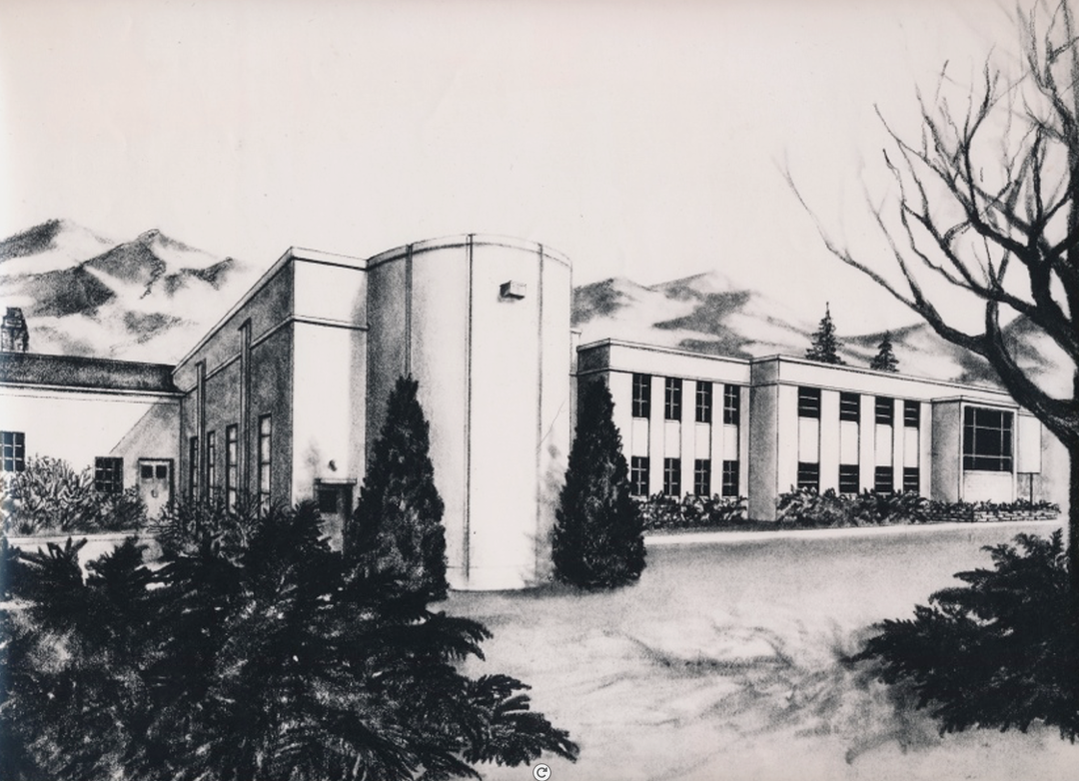
Utah Community Center for the Deaf in Bountiful Utah, 1983. Pencil drawing by Robert Winkelkotter
The Thirty-Eighth National Association
of the Deaf Convention
August 1986
Utah Community Center for the Deaf, Bountiful
After two years of planning, meetings, TTY calls, fundraising, and site preparation, the thirty-eighth National Association of the Deaf Convention took place in August 1986. Robert G. Sanderson and Mary Sanderson served as co-chairs of the convention, which was hosted at the Utah Community Center for the Deaf in Bountiful, Utah. Their dedicated efforts helped make the event a tremendous success, attracting 1,218 registered attendees from 49 states and the District of Columbia (UAD Bulletin, August 1986).

Mary & Robert Sanderson. Source: UAD Bulletin, August 1986
The convention's success depended on the work of several husband-and-wife coordinator teams. Robert and Mary Sanderson, as co-chairs, oversaw entertainment and public relations. Dennis and Valerie Kinney Platt served as assistant co-chairs and coordinated registration and convention operations. Jerry and Nancy Taylor managed finances and organized fundraising activities, including yard sales and candy sales. W. David and Shauna Mortensen coordinated tours and excursions to local attractions, including Wendover, Temple Square, and the Utah Community Center for the Deaf. Barbara and Fred Bass supervised local arrangements for the Miss Deaf America Pageant (UAD Bulletin, August 1986).

Dennis R. Platt. Photograph by Robert L. Bonnell
|

Valerie G. Kinney. Photograph by Robert L. Bonnell
|
The week was filled with activities and events. George and Dora Laramie hosted a breakfast for the Order of Georges and Georgettes. The President's Reception, chaired by Kenneth and Priscilla Burdett, drew a large attendance. The finals of the Miss Deaf America Pageant were held at the Capitol Theatre on Friday evening. On Wednesday night, the California entertainment group Excerpts performed for convention attendees. Gary Sanderson, son of Robert and Mary Sanderson, coordinated the Wednesday evening entertainment on behalf of Nancy Taylor (UAD Bulletin, August 1986).
Peter and Sally Green organized the awards luncheon, which was held at the nearby Hilton Hotel. On Saturday evening, George and Carola Gavros directed New Frontier Dance, featuring a performance by the local group Hands Up, which combined music and sign language in a song-and-dance presentation (UAD Bulletin, August 1986).
Peter and Sally Green organized the awards luncheon, which was held at the nearby Hilton Hotel. On Saturday evening, George and Carola Gavros directed New Frontier Dance, featuring a performance by the local group Hands Up, which combined music and sign language in a song-and-dance presentation (UAD Bulletin, August 1986).

Jerry Taylor. Source: The Utah Eagle
|

Nancy Taylor. Photograph by Robert L. Bonnell
|
The convention newsletter, The Beehive Caucus, kept attendees informed with daily news and interviews. Throughout the week, the Casper Room remained busy as interpreters assisted Deaf attendees with telephone calls and access to office equipment. For many participants, the convention felt less like a formal conference and more like a family reunion. Gallaudet alumni hosted fraternity and sorority luncheons and organized informal reunions throughout the week, strengthening friendships and professional connections (UAD Bulletin, August 1986).

Shanna & Dave Mortensen. Photograph by Robert L. Bonnell
Appreciation Dinner Celebrates Convention Success
Following the convention, the Utah Association for the Deaf hosted an appreciation dinner to recognize the dedication and hard work of the convention staff and volunteers. For many participants, the event marked the culmination of two years of planning and preparation. Charles Roy Cochran, president of the Utah Association for the Deaf, organized and attended the gathering (UAD Bulletin, August 1986).
The UAD Board of Directors expressed special appreciation to Robert and Mary Sanderson for their leadership, as well as to the more than one hundred volunteers whose efforts contributed to the convention's success. Members emphasized that the achievement reflected the collective commitment of Utah's Deaf community (UAD Bulletin, August 1986).
Reflecting on the event, Bob noted that comments and letters from across the United States indicated that the convention had been highly successful. He also received Associated Press newspaper clippings from as far away as Florida, demonstrating the convention's widespread visibility and impact. Beyond bringing Deaf people together from across the nation, the convention helped promote greater awareness of Deaf culture and Deaf issues among the general public (UAD Bulletin, August 1986).

Pete Green. Photograph by Robert L. Bonnell
|

Sally Green. Photograph by Robert L. Bonnell
|
Awards Luncheon Honors Supporters
At an awards luncheon attended by more than 900 people, the National Association of the Deaf recognized individuals and organizations that had made significant contributions to the Deaf community. Various awards were presented to acknowledge leadership, service, volunteerism, and advocacy on behalf of Deaf Americans (UAD Bulletin, August 1986).
Mary Sanderson received the prestigious Knights of the Flying Fingers Award for her tireless efforts in helping organize and coordinate the 1986 National Association of the Deaf Convention. The award recognized her outstanding service and dedication to the Deaf community (UAD Bulletin, August 1986).
Mary Sanderson received the prestigious Knights of the Flying Fingers Award for her tireless efforts in helping organize and coordinate the 1986 National Association of the Deaf Convention. The award recognized her outstanding service and dedication to the Deaf community (UAD Bulletin, August 1986).
Photographers Preserve Convention History
Photography played an important role in documenting the convention. Robert Welsh, Robert Bonnell, and Louise Saathoff photographed activities before, during, and after the event, capturing approximately thirty-four rolls of film. Their work created a valuable visual record of the convention and generated nearly 2,000 photographs. The original photographs and negatives were later forwarded to the National Association of the Deaf for preservation and future historical use (UAD Bulletin, August 1986).

Priscilla and Kenneth Burdett. Photograph by Robert L. Bonnell

Thirty-Second Biennial Convention
June 12-13, 1987
Excelsior Hotel, Provo
The Utah Association for the Deaf held its thirty-second biennial convention in Provo for the first time under the leadership of co-chairs Ronald J. Nelson and Kristi Lee Mortensen. They selected the Excelsior Hotel as the convention site in an effort to promote greater inclusion and encourage participation from the Provo Deaf community, which had historically been socially and politically isolated from the broader Deaf community in Utah. Unfortunately, attendance from local residents fell short of expectations, with only three Provo residents participating in the convention (Nelson, UAD Bulletin, June 1989).

Ronald J. Nelson & Kristi Lee Mortensen. Photo provided by Kristi Lee Mortensen
According to Ron, Jim Harper was Provo's most active Deaf community member and advocate. His election to the UAD Board of Directors made him an important link between the Utah Valley Deaf community and the UAD. During his two years on the board, Jim faithfully attended monthly meetings in Bountiful, informed the board about local needs and concerns, sought advice on community issues, and kept Provo residents informed about UAD activities and legislative efforts. He also founded the Utah Valley Chapter, which officially joined the UAD during the convention (Nelson, UAD Bulletin, June 1989).

Jim Harper. Photo provided by Jim Harper
The Miss Deaf Utah Pageant was held at Hillcrest High School on Friday evening, followed by a successful business meeting at the Excelsior Hotel on Saturday. Participants later gathered in the McKay Room for a banquet and entertainment, where they warmly welcomed the newly crowned Miss Deaf Utah (UAD Bulletin, July 1987).
More than ninety people attended the banquet. Senator Darrel Renstrom, sponsor of Senate Bill 101, the Hearing Impaired Telecommunication Access Act, was a featured speaker. He discussed the legislation that established TDD distribution services and a statewide relay system. In appreciation for his efforts, many Deaf attendees signed a copy of The Joy of Signing as a thank-you gift (UAD Bulletin, July 1987).
Celia May Laramie Baldwin received the prestigious Golden Hand Award in recognition of her outstanding service to the Utah Deaf community. As a single parent of two children, she remained actively involved in the UAD, the local division of the National Fraternal Society of the Deaf, and the St. Mary Magdalene Club for the Deaf. Although she had moved to Fremont, California, the year before, her many years of service in Utah were honored with the 1987 award (UAD Bulletin, July 1987).
Outgoing UAD President Charles Roy Cochran presented the President's Award to Tim Funk of the Committee on Consumer Services. The Utah Coalition for Deaf Access recognized Tim's significant role in helping secure passage of Senate Bill 101 during the 1987 legislative session (UAD Bulletin, July 1987).

Celia May Laramie Baldwin. Photograph by Robert L. Bonnell
The convention adopted the following resolution:
WHEREAS Deaf people and friends of the Deaf turned out en masse at the January 30 rally at the Utah State Capitol, many taking time off from work, and
WHEREAS interpreters volunteered their time to provide communication access during the rally and throughout Senate and House legislative sessions, and
WHEREAS the rally marked the formal launch of Senate Bill 101, which provided for TDD distribution and establishment of a message relay center benefiting both Deaf and hearing individuals,
BE IT RESOLVED that the Utah Association for the Deaf formally commend all those who contributed their time and efforts to support Senate Bill 101, which ultimately passed both the Utah Senate and House of Representatives.
BE IT FURTHER RESOLVED that the UAD secretary publish this resolution in a future issue of the UAD Bulletin (UAD Bulletin, September 1987, p. 2).

A Program of the 32nd Biennial Convention of the Utah Association for the Deaf, June 13, 1987
Utah Relay Service
In 1987, the Hearing Impaired Telecommunication Access Act was enacted, expanding telephone accessibility for Deaf Utahns. On October 13, 1987, UAD President W. David Mortensen signed a contract with the Public Service Commission to operate the Utah Relay Service.

Deaf Supporters with Utah Governor Bangerter, 1987. It was the extended Utah Relay permit to continue in 1987 L-R: Gene Stewart, Peter Green, PSC chairman, representative from a blind organization, Lloyd Perkins, Rodney Walker, Tim Funk, Madelaine Burton Perkins (Utah Relay director), Dave Mortensen, Jerry Westburg, Robert Bonnell and Governor Norman Bangeter sitting. Photo courtesy of the Utah Association of the Deaf
The Utah Relay Service officially began operations on January 4, 1988. Under a ten-year contract with the Public Service Commission, the UAD managed the statewide relay system, creating new opportunities for Deaf and hearing individuals to communicate by telephone (Sanderson, UAD Bulletin, April 1999). Based on her experience at the Utah Community Center for the Deaf, Madelaine Burton Perkins was appointed executive director of the Utah Relay Service (Mortensen, UAD Bulletin, November 1987).
The UAD's contract ended in 1999. In 2000, Sprint was awarded the contract to operate the service. With the rise of videophone technology and the emergence of Sorenson Communications, Inc. in 2003, traditional TTY use gradually declined, marking a new era in telecommunications access for Deaf individuals.
The UAD's contract ended in 1999. In 2000, Sprint was awarded the contract to operate the service. With the rise of videophone technology and the emergence of Sorenson Communications, Inc. in 2003, traditional TTY use gradually declined, marking a new era in telecommunications access for Deaf individuals.

Madelaine Burton Perkins. Photo ourtesy of the Utah Association of the Deaf


Thirty-Third Biennial Convention
June 17-19, 1989
University Park Hotel, Salt Lake City
John Peebler chaired the thirty-third biennial convention, held on June 17-19, 1989, at the University Park Hotel in Salt Lake City, Utah. The convention provided an important forum for reports and discussions on issues affecting Utah's Deaf community. Among the topics presented were updates on the Utah Interpreter Service and Utah Relay Services, followed by questions and comments from community members regarding those programs and other matters of concern (Mortensen, UAD Bulletin, June 1989).
The convention also marked the 80th anniversary of the Utah Association for the Deaf, highlighting eight decades of advocacy, leadership, and service to Deaf Utahns (Mortensen, UAD Bulletin, June 1989).
As part of the convention, attendees viewed a 16-mm film titled "A History of the Utah School for the Deaf: 1940–1965." Along with the extensive video collection created by Kenneth C. Burdett, a 1929 graduate of the Utah School for the Deaf and later a teacher there, the film preserved an invaluable visual record of Deaf life on campus. These recordings documented class trips, graduations, school activities, and other important events, providing a unique glimpse into the history and experiences of generations of Deaf students (Mortensen, UAD Bulletin, June 1989).

Kenneth C. Burdett. Photo courtesy of Ronald C. Burdett
In June 1990, W. David "Dave" Mortensen, then president of the Utah Association of the Deaf and a graduate of the Utah School for the Deaf, reflected on his experiences at the residential campus in the UAD Bulletin. He described his years at the school as "very, very happy times," emphasizing the educational opportunities, friendships, leadership experiences, and extracurricular activities that shaped his life. Mortensen credited the residential environment with fostering personal growth and helping students develop lasting connections within the Deaf community.
At the same time, Dave acknowledged that educational practices had changed and raised important questions about the long-term effects of mainstreaming. Rather than dismissing alternative educational models, he encouraged educators and families to consider the experiences of residential school alums when evaluating educational options for Deaf children. His reflections emphasized the importance of examining multiple viewpoints and recognizing that educational experiences can vary among individuals and across generations (Mortensen, UAD Bulletin, June 1990, p. 1).
At the same time, Dave acknowledged that educational practices had changed and raised important questions about the long-term effects of mainstreaming. Rather than dismissing alternative educational models, he encouraged educators and families to consider the experiences of residential school alums when evaluating educational options for Deaf children. His reflections emphasized the importance of examining multiple viewpoints and recognizing that educational experiences can vary among individuals and across generations (Mortensen, UAD Bulletin, June 1990, p. 1).

Utah Association for the Deaf President W. David Mortensen's President's Message. Source: UAD Bulletin, June 1990, p. 1

Thirty-Fourth Biennial Convention
June 13-15, 1991
Salt Lake Airport Hilton, Salt Lake City
Lynn G. Losee chaired the thirty-fourth biennial convention, held on June 13-15, 1991, at the Salt Lake Airport Hilton in Salt Lake City, Utah. Although attendance numbered 168 participants, the convention was considered a success. Activities included a picnic at Bountiful Park on Thursday, June 13, a dinner and Miss Deaf Utah Pageant on Friday, June 14, and an awards banquet on Saturday, June 15. During the business meeting, members reviewed eight proposed bylaw amendments, which were approved, modified, or rejected following discussion. The convention's positive atmosphere reflected the continued strength and resilience of the Utah Association for the Deaf (UAD Bulletin, July 1991).

Lynn G. Losee. Photo courtesy of the Salt Lake Valley Ward for the Deaf
Attendees also participated in three well-received workshops. Christine Buchholz presented a workshop on HIV/AIDS, providing information about the disease, its impact on the Deaf community, and prevention strategies. Jacqueline Roth led a session on Deaf empowerment, focusing on self-advocacy and leadership. Minnie Mae Wilding Diaz presented a workshop on American Sign Language and Deaf culture, celebrating the language, heritage, and identity of the Deaf community (UAD Bulletin, July 1991).
Following the election of board members, John "Jack" White and Robert Welsh were elected as UAD trustees (UAD Bulletin, July 1991).
Members also discussed plans for the next convention, with hopes of meeting in two years at the new Utah Community Center of the Deaf in Taylorsville rather than at a hotel venue (UAD Bulletin, July 1991).

A Program of the 34th Biennial Convention of the Utah Association for the Deaf, June 13-15, 1991
Guests praised the relaxed atmosphere and excellent accommodations provided by the Airport Hilton, contributing to the convention's overall success (UAD Bulletin, July 1991).
The Miss Deaf Utah Pageant was one of the convention highlights. Six young women participated: Heather Horman of Olympus High School, Melanie Mears of Brighton High School, Pamela Mower of Jordan High School, Christie Norton of Skyline High School, Kristi Waldvogel of Mountain View High School, and Shannon Warr of Bountiful High School. Their participation reflected the growing presence of Deaf students in mainstream public schools throughout Salt Lake and Utah counties (UAD Bulletin, July 1991).
The convention also welcomed four out-of-state attendees: Kathy Allen of Alaska, Dora B. Laramie of Fremont, California, Beverly Nunnof Sun Valley, California, and Robert Taylor of Omaha, Nebraska (UAD Bulletin, July 1991).
When asked why he declined nomination to the UAD Board of Directors, Dr. Robert G. Sanderson explained that after thirty-six years of service, he felt it was time to retire. The association expressed its gratitude for his decades of leadership and dedication (UAD Bulletin, July 1991). Although he stepped away from board service in 1991, Bob's commitment to the UAD remained strong. He later returned to the board in 2003, serving alongside Dr. Lawrence H. Forestal, another former National Association of the Deaf president. Bob's involvement with the Utah Association for the Deaf ultimately spanned forty-five years and continued until his passing in 2012.
The convention concluded with an awards luncheon recognizing individuals for their contributions to the Deaf community. The event was marked by enthusiastic applause and celebration as recipients were honored for their service (UAD Bulletin, July 1991).
David West, superintendent of the Utah Schools for the Deaf and the Blind, served as a guest speaker and discussed current trends in Deaf education. His presentation provided attendees with valuable insight into developments affecting Deaf students and educational services in Utah (UAD Bulletin, July 1991).

The 1991 Utah Association for the Deaf Convention. Photo courtesy of the Utah Association of the Deaf
The President’s Awards
Four individuals received the prestigious President's Award in recognition of their significant contributions to Utah's Deaf community. Madelaine Perkins was honored for her work with the Utah Relay Service; John (Jack) F. White for his dedication to Deaf sports in Utah; Rodney W. Walker for his extensive service to numerous Deaf organizations; and Gene D. Stewart for his longstanding commitment to the Deaf community through vocational rehabilitation. Their contributions left a lasting impact on Deaf Utahns and strengthened the programs and services available throughout the state (UAD Bulletin, July 1991).
Dr. Robert G. Sanderson also surprised W. David Mortensen by presenting him with a commemorative gavel engraved with the words:
"UAD Board thanks Dave Mortensen for 18 years of dedicated service."
The presentation recognized Dave's many years of leadership and his extraordinary contributions to the Utah Association for the Deaf (UAD Bulletin, July 1991).

John "Jack" F. White. Photo courtesy of the Kenneth C. Burdett Bulletin Board
The Golden Hand Award
Peter M. Green received the Golden Hand Award in recognition of his exceptional service to the Utah Deaf community. As treasurer of the Utah Association for the Deaf, Peter maintained detailed financial records for numerous accounts, including the UAD general fund, United Way programs, and the Miss Deaf Utah Pageant. He also established a billing service for freelance interpreters, a first of its kind in Utah.
Through his careful financial management, Peter helped strengthen the association's finances and expand its services. He also managed inventory for the UAD Bookstore, including television decoders, TTYs, books, and other equipment. In addition, he chaired two reunions of the Utah School for the Deaf and actively participated in organizations such as the Salt Lake Frats, the Utah Athletic Club for the Deaf, and the Utah Association for the Deaf.
Peter was widely respected for his dedication, leadership, and countless volunteer hours. The Golden Hand Award recognized his many contributions and his lasting impact on Utah's Deaf community (UAD Bulletin, July 1991).

Peter M. Green. Photograph by Robert L. Bonnell

Thirty-Fifth Biennial Convention
June 17-19, 1993
Utah Community Center for the Deaf, Taylorsville
Lynn G. Losee once again chaired the thirty-fifth biennial convention, held on June 17-19, 1993, at the Utah Community Center for the Deaf in Taylorsville, Utah. The convention marked an important milestone, as the UAD was finally able to hold its convention in its new community center. Sessions focused on four key topics: grants, defensive driving through the National Safety Council, Utah Relay Service, and the Americans with Disabilities Act (Mortensen, L.M., UAD Bulletin, July 1993).
The Utah Association for the Deaf hosted three major events during the convention: a potluck luncheon at the Utah Community Center for the Deaf on Thursday, a dinner and the Miss Deaf Utah Pageant on Friday, and an awards banquet on Saturday (UAD Bulletin, July 1993).
Ben Soukup, president of the National Association of the Deaf and director of the South Dakota Association of the Deaf and Communication Services for the Deaf in Sioux Falls, delivered the keynote address at a luncheon held at the Salt Lake Hilton Hotel in downtown Salt Lake City (UAD Bulletin, July 1993).

Ben Soukup. Source: Deaf Person of the Month, October 2007
During board meetings, UAD leaders discussed several goals for the next two years:
Looking ahead, the Utah Association for the Deaf expressed its commitment to pursuing these goals and continuing its advocacy on behalf of Utah's Deaf community (UAD Bulletin, August 1993, p. 1).
- Work with legislators to increase the telephone surcharge from 10 cents to 25-35 cents per line to improve Utah Relay Service.
- Provide workshops aimed at empowering young Deaf people and developing future leaders.
- Offer additional workshops and seminars to address social issues and the needs of the Deaf community.
- Continue advocating for improvements in Deaf education.
- Support the Bi-Bi Deaf Mentor Project.
- Promote captioning on local television news broadcasts.
- Advocate for the recognition of American Sign Language as a foreign language (UAD Bulletin, August 1993, p. 1).
Looking ahead, the Utah Association for the Deaf expressed its commitment to pursuing these goals and continuing its advocacy on behalf of Utah's Deaf community (UAD Bulletin, August 1993, p. 1).

The 1993 Utah Association for the Deaf Convention. Photo courtesy of the Utah Association of the Deaf
The Golden Hand Award
Rodney W. Walker received the Golden Hand Award in recognition of his outstanding community service and contributions to Utah's Deaf community (UAD Bulletin, July 1993).

Rodney W. Walker. Photo courtesy of Patricia Seegmiller Walker
The Presidential Awards
The Presidential Awards recognized individuals who made significant contributions to the Utah Association for the Deaf and the broader Deaf community. The UAD honored the following individuals for their service:
- Barbara Schell Bass
- Kenneth L. Kinner
- Jane Bell
- Lynn G. Losee
- W. David Mortensen
- Mary Antonietti Sanderson
- Robert G. Sanderson
- Peter M. Green
- Shirley Hortie Platt
- Ann Thatcher
- Patricia Walker
- Lloyd L. Perkins (UAD Bulletin, July 1993, p. 3).

Robert & Mary Sanderson at the 1991 Utah Association of the Deaf Convention. Photo courtesy of Barry Sanderson

Thirty-Sixth Biennial Convention
June 15-17, 1995
Utah School for the Deaf, Ogden
Under the leadership of UAD President W. David Mortensen, the Utah Association for the Deaf held its thirty-sixth biennial convention at the new campus of the Utah Schools for the Deaf and the Blind in Ogden, Utah. Dave reflected on the association's early years, when UAD conventions were traditionally held at the Utah School for the Deaf. Although many members remembered the old campus fondly, they were impressed by the new facilities and welcomed the opportunity to return to Ogden for the convention (Mortensen, UAD Bulletin, June 1995).

Dave Mortensen. Photo courtesy of W. David and Shanna Mortensen
The convention opened on Thursday, June 15, with a reception on the patio of the new USDB Administration Building. On Friday afternoon, attendees participated in two workshops. Annette Thorup Tull, an interpreter for the Granite School District, discussed effective ways for Deaf individuals to work with interpreters. Madelaine Burton Perkins, director of the Utah Relay Service, explained the capabilities and limitations of relay services and answered questions from participants (Kinney, UAD Bulletin, June 1995).
The Miss Deaf Utah Pageant was held Friday evening in the school auditorium, with Kristi Lee Mortensen serving as state director and Katrina Pickett Lee Trevenen as pageant director (Kinney, UAD Bulletin, August 1995).
That evening, Dennis R. Platt served as master of ceremonies for the banquet program. The featured speaker, Margo Cienek, a former Miss Deaf America, presented a program on the past, present, and future of Deaf culture (Kinney, UAD Bulletin, June 1995).

Annette Thorup Tull. Photograph by Robert L. Bonnell
The Utah Association for the Deaf
Chooses to be Different
During the convention, members revisited a long-standing discussion regarding the use of the words "of" and "for" in Deaf organizations' names. Many Deaf organizations traditionally used the word of because it emphasized Deaf ownership and leadership. Some believed that for suggested greater involvement by hearing individuals and therefore less control by Deaf members (UAD Bulletin, November 1995, p. 1).
The debate resurfaced regarding the Utah Association for the Deaf's name. After considering the advantages and disadvantages of changing it, members voted to retain the word "for." As a result, the organization continued to be known as the Utah Association for the Deaf. As one member observed, "It won't hurt UAD to be different" (UAD Bulletin, November 1995, p. 1).
The debate resurfaced regarding the Utah Association for the Deaf's name. After considering the advantages and disadvantages of changing it, members voted to retain the word "for." As a result, the organization continued to be known as the Utah Association for the Deaf. As one member observed, "It won't hurt UAD to be different" (UAD Bulletin, November 1995, p. 1).
Dr. Lee Robinson Addresses the Convention
During the business session, Dr. Lee Robinson, superintendent of the Utah Schools for the Deaf and the Blind, presented an overview of the school's mission and vision. Using an overhead projector, he shared enrollment data demonstrating the scope of services provided by the school. As of December 1994, the USDB served 953 Deaf and blind students throughout Utah (UAD Bulletin, September 1995, pp. 4-5).
Dr. Robinson also discussed the school's new campus facilities and expressed hope that the modern classrooms would encourage more families to enroll their children in USDB programs. In addition, he described plans for a statewide athletic program that would bring together students from both campus and extension programs. His interest in expanding athletic opportunities was reinforced after attending the Western Classic basketball tournament in Fremont, California, in January 1995, where he observed large numbers of Deaf student-athletes from across the western United States (UAD Bulletin, September 1995).
Dr. Robinson encouraged Deaf organizations to hold meetings at the USDB campus and expressed appreciation that the Utah Association for the Deaf had chosen to host its convention there. He emphasized the importance of maintaining open communication between the school and Utah's Deaf community and looked forward to working together to strengthen Deaf education throughout the state (UAD Bulletin, September 1995).

Dr. Lee Robinson. Photo courtesy of the Blinder Book of the 2009 Utah School for the Deaf Reunion

Thirty-Seventh Biennial Convention
June 13-14, 1997
Salt Lake Airport Hilton, Salt Lake City
The convention reconvened on Saturday, June 14, for its business meeting. Members considered several motions that reflected the organization's continued growth and commitment to serving Utah's Deaf community. The following motions were approved:
- To express appreciation to W. David Mortensen and Shauna Mortensen for more than twenty years of dedicated service to the Utah Association for the Deaf, particularly Dave's many years as president.
- To suspend action on the proposed Constitution and Bylaws revisions until the UAD's attorney could review the document for compliance with state law. A general meeting would then be scheduled to consider the recommendations.
- To establish a committee to study the feasibility of creating a lending library of Deaf-related materials.
- To organize a one-day Bi-Bi (Bilingual-Bicultural) conference within the following year. Minnie Mae Wilding Diaz was selected to chair the conference.
- To purchase a laptop computer for recording meeting minutes and to install modems on the UAD Bookstore and UAD Bulletincomputers to provide e-mail capabilities and improve organizational communication (Kinney, UAD Bulletin, July 1997).

Shanna & Dave Mortensen. Photo courtesy of W. David and Shanna Mortensen
The business meeting also adopted several resolutions:
- To thank W. David Samuelsen for his efforts in monitoring and reporting on legislative issues affecting the Deaf community.
- To thank KJZZ for introducing closed captioning for Utah Jazz games and to encourage the station to caption all games.
- To thank KUTV Channel 2, KTVX Channel 4, and KSTU Channel 13 for implementing real-time captioning and to encourage them to caption Interstate 15 reconstruction news updates as well.
- To commend Carol Croyle, director of Deaf Connections, along with her staff, friends, and volunteers, for their outstanding work on behalf of the Deaf community.
- To express deep appreciation to W. David Mortensen for his many years of leadership and for helping build the Utah Association for the Deaf into a successful and thriving organization (Kinney, UAD Bulletin, July 1997, p. 4).
UAD Retains “For” In Its Name
On February 21, 1998, the UAD survived an attempt to change its name to the Utah Association of the Deaf. During a general meeting, the proposal failed to receive the required two-thirds majority vote needed for approval. As a result, the organization retained the name Utah Association for the Deaf (UAD Bulletin, March 1998, p. 1).
Now It's "Conference"
During the UAD general meeting in September 1997, members voted to replace the word "convention" with "conference" in the UAD Articles of Incorporation and Bylaws. The change applied specifically to references regarding UAD gatherings and official meetings (Kinney, UAD Bulletin, October 1998, p. 1).

The 1997 Utah Deaf Bilingual-Bicultural
Education Conference
The 1997 Utah Deaf Bilingual and Bicultural Conference was a major catalyst in the establishment of the Jean Massieu School of the Deaf. This pivotal event was driven by the collaborative efforts of the Utah Deaf community and spearheaded by Shirley Hortie Platt, a dedicated Deaf Mentor in the Parent Infant Program (PIP) at the Utah School for the Deaf. The PIP plays an important role in supporting families with Deaf children as they navigate the unique opportunities and challenges of raising a Deaf child. Shirley was instrumental in organizing the conference and advocating for families whose children were not receiving the educational opportunities they deserved. The community's determination stemmed from growing concerns about Deaf education at the Utah School for the Deaf, where many students were not achieving satisfactory academic outcomes in either specialized or mainstream educational settings.
These concerns echoed observations made two decades earlier by Gene D. Stewart, a Child of Deaf Adults and vocational rehabilitation counselor. In 1977, he described the state of Deaf education in Utah to the Utah State Board of Education as being in the "Dark Ages" (The Ogden Standard-Examiner, March 26, 1977). Gene emphasized the urgent need for educational reform and warned that, without significant changes, Deaf students would continue to face barriers to academic achievement and personal growth.
In response to these challenges, the Utah Association for the Deaf supported Shirley's initiative to establish the Utah Deaf Bilingual and Bicultural Conference. The terms "bilingual and bicultural" emphasize the importance of recognizing and promoting both American Sign Language (ASL) and English, as well as Deaf culture, in the education of Deaf children. Shirley chaired the conference, which was held on April 25-26, 1997, at the Eccles Conference Center in Ogden, Utah, under the supervision of Dr. Petra M. Horn-Marsh, director of the Deaf Mentor Program (UAD Bulletin, June 1997; Shirley Hortie Platt, e-mail message to Jodi Christel Becker, November 7, 2008).
The conference marked a significant turning point for Utah's Deaf community by increasing awareness of the linguistic, cultural, and educational needs of Deaf children. Participants engaged in meaningful discussions, exchanged ideas, and explored strategies for improving educational outcomes while promoting a greater understanding of Deaf culture and identity.

Shirley Hortie Platt. Photo provided by Shirley Hortie Platt
Shirley's determination to bring about change motivated her to take a leading role in organizing the conference. She was troubled by the large number of Deaf children in Utah who struggled to communicate effectively, the lack of progress within the Parent Infant Program, and the limited recognition given to Deaf mentors. Despite encountering patronizing attitudes from some hearing teachers and administrators at the Utah School for the Deaf, she remained steadfast in her belief that meaningful change was necessary (Shirley Hortie Platt, e-mail message to Jodi Christel Becker, November 7, 2008). To address these concerns, she worked with Deaf leaders and advocates to develop solutions that would elevate Deaf perspectives and strengthen support for Deaf children and their families.
The conference proved to be an outstanding success, attracting approximately 400 participants, many of whom traveled from outside Utah. The distinguished presenters greatly enriched the discussion. Featured speakers included Dr. Lawrence "Larry" Fleischer, Chair of the Department of Deaf Studies at California State University, Northridge, who discussed Deaf identity; Dr. Martina J. "MJ" Bienvenu, Director of the Language and Culture Center in Gaithersburg, Maryland, who presented on Deaf culture; Dr. Marlon "Lon" Kuntze of the University of California, Berkeley, who addressed language development; and Dr. Joseph "Jay" Innes of Gallaudet University, who shared his expertise in Deaf education. Representatives from the Indiana School for the Deaf, including Diane Hazel Jones, David Geeslin, and Rebecca Pardee, also shared their experiences in establishing a bilingual-bicultural educational program (UAD Bulletin, June 1997).
Throughout the conference, presenters and participants emphasized the importance of creating educational environments that valued both linguistic and cultural diversity within the Deaf community. Their discussions highlighted the benefits of bilingual-bicultural education and reinforced the belief that Deaf children thrive when their language, culture, and identity are respected and supported.
Perhaps most importantly, the conference provided an unprecedented platform for reexamining long-held assumptions about Deaf people and Deaf education. It encouraged a broader understanding of Deaf individuals as members of a linguistic and cultural minority rather than as people defined by a disability. The ideas and momentum generated by the conference helped lay the foundation for future educational reforms and ultimately contributed to the establishment of the Jean Massieu School of the Deaf, leaving a lasting impact on Deaf education in Utah.

'Bi-Bi Conference a Big Hit.' Source: UAD Bulletin, June 1997
The Creation of a Bilingual
and Bicultural Committee
During the Utah Association for the Deaf (UAD) conference on June 13-14, 1997, an important step toward educational reform took place. Dennis R. Platt, the husband of Shirley Hortie Platt, who had recently been elected president of the UAD and served on the USDB Institutional Council, established the Bilingual and Bicultural (Bi-Bi) Committee. During the conference, W. David Samuelsen, a UAD member, proposed the appointment of Minnie Mae Wilding-Diaz as chair of the committee. Widely respected within the Deaf community, Minnie Mae was a strong advocate for ASL/English bilingual education and the Deaf mother of three Deaf children. The UAD approved the proposal, setting in motion efforts that would significantly influence the future of Deaf education in Utah (W. David Samuelsen, e-mail message to Jodi Christel Becker, July 26, 2016).
Through its advocacy, the Bi-Bi Committee promoted an educational philosophy that recognized the value of both American Sign Language and English while emphasizing the importance of Deaf culture. Committee members believed that Deaf children would benefit from an educational environment where language, culture, and identity were fully respected and supported. Their efforts helped increase awareness of bilingual-bicultural education and encouraged broader discussions about improving educational opportunities for Deaf students throughout Utah.
Through its advocacy, the Bi-Bi Committee promoted an educational philosophy that recognized the value of both American Sign Language and English while emphasizing the importance of Deaf culture. Committee members believed that Deaf children would benefit from an educational environment where language, culture, and identity were fully respected and supported. Their efforts helped increase awareness of bilingual-bicultural education and encouraged broader discussions about improving educational opportunities for Deaf students throughout Utah.

'Utah Deaf Bi-Bi Conference.' Source: UAD Bulletin, June 1997
Minnie Mae's appointment as committee chair was influenced, in part, by the success and momentum of the 1997 Utah Deaf Bilingual and Bicultural Conference. Her commitment to bilingual-bicultural education had developed years earlier. In her 1990 paper, "Exciting Developments in Deaf Education," she expressed admiration for the Indiana School for the Deaf's bilingual-bicultural approach and the educational opportunities it provided Deaf students. It is therefore unsurprising that she later became a co-founder of the Jean Massieu School of the Deaf (JMS), which opened in 1999. Through her leadership and advocacy, Minnie Mae helped transform an educational vision into a reality for Deaf children and their families.
Throughout their campaign, members of the UAD committee strategically used the term "Bi-Bi," shorthand for "bilingual-bicultural," to emphasize their vision of incorporating both ASL and English into Deaf children's education while recognizing Deaf culture as an essential component of that experience (Minnie Mae Wilding-Diaz, e-mail message to Jodi Christel Becker, March 29, 2010). They believed that Deaf students thrive when they have full access to language, culture, and a positive sense of identity. By advocating for bilingual-bicultural education, the committee sought to create a more inclusive and empowering educational environment for future generations of Deaf children.
The work of the Bi-Bi Committee laid important groundwork for educational reform in Utah and contributed to the growing movement that ultimately led to the establishment of the Jean Massieu School of the Deaf. Their advocacy represented a significant shift in thinking about Deaf education, one that emphasized language access, cultural pride, and educational excellence for Deaf students.

Minnie Mae Wilding-Diaz. Source: Facebook
The Bi-Bi Committee Presents Its Proposal to
USDB Superintendent Lee Robinson
One of the Bi-Bi Committee's primary goals was to explore the introduction of bilingual-bicultural education at the Utah School for the Deaf, which at the time offered only oral and total communication options (UAD Bulletin, July 1999; Minnie Mae Wilding-Diaz, e-mail message to Jodi Christel Becker, April 23, 2011). On March 30, 1998, committee leaders Minnie Mae Wilding-Diaz and Jeff Allen, the father of a Deaf daughter, met with Superintendent Dr. Lee Robinson and Assistant Superintendent Joseph DiLorenzo of the Utah Schools for the Deaf and the Blind. The committee believed that a bilingual-bicultural approach would greatly benefit Deaf students by promoting both language development and cultural identity.
The timing seemed favorable. In 1994, the Utah State Legislature passed Senate Bill 42, officially recognizing American Sign Language (ASL) as a language. Additionally, the 1997 reauthorization of the Individuals with Disabilities Education Act (IDEA) included ASL in its definition of "native language" for Deaf students. Together, these developments strengthened the committee's belief that Utah was ready to embrace bilingual-bicultural education and expand educational options for Deaf children.
However, Superintendent Dr. Lee Robinson and Assistant Superintendent Joseph DiLorenzo declined the committee's proposal to incorporate bilingual-bicultural education into the curriculum. According to Minnie Mae Wilding-Diaz, the response was essentially, "No thanks and good luck" (Minnie Mae Wilding-Diaz, e-mail message to Jodi Christel Becker, March 29, 2010).
The Jean Massieu School of the Deaf
Opens Its Doors
Despite this setback, support from the Utah Deaf community and parents of Deaf children remained strong (UAD Bulletin, May 1998). Their encouragement reinforced the committee's commitment to pursuing educational reform and advocating for greater recognition of ASL and Deaf culture in the classroom. Rather than abandoning their efforts, committee members continued exploring alternative pathways for implementing bilingual-bicultural education, convinced that Deaf students would benefit from an educational environment that fully embraced both ASL and English.
The committee's initial attempt to integrate the Bi-Bi program into the Utah School for the Deaf was unsuccessful. At the time, they could not have foreseen that their efforts would ultimately lead to the creation of a charter school for Deaf students (Minnie Mae Wilding-Diaz, e-mail message to Jodi Christel Becker, April 23, 2011).
Although their proposal was rejected, the experience strengthened the committee's resolve and further unified supporters of bilingual-bicultural education throughout Utah. The challenges they encountered ultimately fueled a growing movement that would lead to the establishment of the Jean Massieu School of the Deaf, creating new educational opportunities for future generations of Deaf children.
After receiving approval from the Utah State Office of Education, the Bi-Bi Committee began the work of establishing the charter school. Committee members took on numerous responsibilities, including securing a suitable location, obtaining funding, selecting a curriculum, hiring teachers, purchasing supplies, and preparing the school for its opening (UAD Bulletin, September 1998). At the same time, the Utah Deaf Education and Literacy, Inc. (UDEAL) Board assumed responsibilities related to fundraising, program development, Individualized Education Program (IEP) preparation, transportation, facilities, and technology. Through close collaboration, the Bi-Bi Committee and the UDEAL Board worked diligently to ensure that the new school would meet the educational needs of Deaf children and their families. Their partnership laid the foundation for a school built upon language accessibility, community involvement, and educational excellence.
On August 29, 1999, the Jean Massieu School of the Deaf (JMS) opened its doors to 21 students ranging from preschool through third grade. The school was founded on the principle of providing full language accessibility in both American Sign Language (ASL) and English (Minnie Mae Wilding-Diaz, e-mail message to Jodi Christel Becker, March 29, 2010). JMS subsequently expanded by adding one grade level each year and eventually grew to serve students from pre-kindergarten through twelfth grade. Its bilingual approach enabled students to develop strong language, academic, and social skills while fostering a positive sense of identity and belonging. As the school grew, it remained committed to empowering Deaf students through language-rich and culturally affirming educational experiences.
Today, the Utah School for the Deaf operates four ASL/English bilingual schools: the Kenneth C. Burdett School of the Deaf in Ogden, the Jean Massieu School of the Deaf in Salt Lake City, the Elizabeth DeLong School of the Deaf in Springville, and the Southern Utah School for the Deaf in St. George. Three of these schools are named in honor of prominent Deaf individuals: Kenneth C. Burdett, Jean Massieu, and Elizabeth DeLong. Their contributions to Deaf education, language access, and community leadership continue to inspire future generations of Deaf students and help shape educational opportunities throughout Utah.
Thirty-Eighth Biennial Conference
June 11-12, 1999
Provo Marriott, Provo
The thirty-eighth biennial conference of the Utah Association for the Deaf was held on June 11–12, 1999, at the Provo Marriott in Provo, Utah. The conference featured presentations by several distinguished leaders in Deaf education and advocacy. On June 11, Dr. Jess Freeman King of Utah State University presented "A Look Ahead: Education of the Deaf in the Next Millennium," while Dr. Carol Padden of the University of California, San Diego, discussed "The Future of Deaf People" (UAD Bulletin, July 1999; UAD Bulletin, September 1999).

Dr. J. King Freeman. Source: Facebook
Additional presentations addressed legal rights, public policy, Deaf identity, and accessibility. Kelby Brick, a Deaf attorney, led sessions on "Accessibility: The Law" and "Current Legal Issues and How to Influence Public Policy." Tom Humphries of the University of California, San Diego, presented "The Modern Deaf Self." Conference attendees also enjoyed performances by Deafywood, a popular Deaf entertainment group (UAD Bulletin, July 1999).

A Program of the 38th Biennial Conference of the Utah Association for the Deaf, June 11-12, 1999

A Program of the 38th Biennial Conference of the Utah Association for the Deaf, June 11-12, 1999
As reported in the July 1999 issue of the UAD Bulletin, members and leaders of the Utah Association for the Deaf worked together to adopt resolutions recognizing individuals whose efforts had significantly benefited the Deaf community.
Resolutions:
Resolution #1
Whereas Caralee Crye, chair of the 1999 UAD Conference, and her committee devoted many hours to ensuring the success of the conference;
Whereas they worked diligently to bring nationally recognized presenters and organize excellent workshops;
Whereas they successfully brought the popular Deaf entertainment group Deafywood, which was enjoyed by attendees;
Whereas Provo had not hosted a UAD conference since 1987;
Be it resolved that the UAD recognize and applaud the accomplishments of Caralee Crye and her committee members; and
Be it further resolved that a copy of this resolution be sent to her by the UAD secretary.

A Program of the 38th Biennial Conference of the Utah Association for the Deaf, June 11-12, 1999
Resolution #2
Whereas W. David Samuelsen secured the UAD domain name and established the UAD website;
Whereas the UAD website received several awards for its design and content;
Whereas he continually added information from Deaf clubs, organizations, and businesses;
Whereas he established UAD Announce, a mailing list that enabled announcements and notices to be distributed electronically;
Whereas the mailing list continued to grow and was shared among Deaf internet communities;
Be it resolved that the UAD recognize and applaud W. David Samuelsen's efforts in creating a website of which the UAD could be proud; and
Be it further resolved that this resolution become part of the official UAD record and that a copy be sent to him by the UAD secretary.

A Program of the 38th Biennial Conference of the Utah Association for the Deaf, June 11-12, 1999
Resolution #3
Whereas Barbara Schell Bass, editor of the UAD Bulletin, devoted many years of service to publishing the monthly bulletin;
Whereas she worked diligently to gather news and information from throughout the Deaf community;
Whereas she monitored national Deaf publications and reported important developments;
Whereas she encouraged local Deaf writers and community members to contribute articles;
Whereas she embraced advances in computer technology and desktop publishing;
Be it resolved that the UAD recognize and applaud Barbara Schell Bass for her outstanding service as editor of the UAD Bulletin; and
Be it further resolved that this resolution become part of the official UAD record and that a copy be sent to her by the UAD secretary.

Barbara Schell Bass. Photograph by Robert L. Bonnell

A Program of the 38th Biennial Conference of the Utah Association for the Deaf, June 11-12, 1999
Resolution #4
Whereas Minnie Mae Wilding-Diaz was appointed chair of the Bi-Bi Committee two years earlier;
Whereas she and her committee were charged with exploring issues relating to the education of Deaf children;
Whereas the committee established Utah Deaf Education and Literacy, Inc. (UDEAL);
Whereas the Jean Massieu School of the Deaf was the result of their dedicated efforts;
Whereas the school was scheduled to open on August 29, 1999;
Be it resolved that Minnie Mae Wilding-Diaz and her committee members be commended for their dedication, sacrifice, and commitment to the educational needs of Deaf children; and
Be it further resolved that this resolution become part of the official UAD record and that a copy be sent to her by the UAD secretary (UAD Bulletin, July 1999, p. 4).

A Program of the 38th Biennial Conference of the Utah Association for the Deaf, June 11-12, 1999

A Program of the 38th Biennial Conference of the Utah Association for the Deaf, June 11-12, 1999

A Program of the 38th Biennial Conference of the Utah Association for the Deaf, June 11-12, 1999


Thirty-Ninth Biennial Conference
June 8-9, 2001
Utah Community Center for the Deaf and Hard of Hearing, Taylorsville
The Utah Community Center of the Deaf held its thirty-ninth biennial conference on June 8-9, 2001. The conference began with the Senior Citizens' Get-Together on Friday, June 8, at 10:00 a.m., an important event that brought together older members of the Deaf community. Dan Brubaker of Washington, D.C., presented on the topic of Bridging the Generations. A brunch was prepared and served during the event. Later that evening, the Miss Deaf Utah Pageant took place (UAD Bulletin, July 2001).
The Utah Association for the Deaf expressed deep gratitude for Sprint's generous support. Sprint's $1,000 donation significantly contributed to the success of the conference by covering the costs of the Friday brunch, Saturday breakfast, and Saturday noon box lunches (UAD Bulletin, July 2001).
On Saturday, June 9, 2001, President Dennis R. Platt called the conference to order. Secretary Valerie G. Kinney read the names of deceased UAD members and friends during the necrology. A moment of silence was observed after the names were read (UAD Bulletin, July 2001).
The respected leaders, including Dennis Platt, President; Ronald J. Nelson, Vice President; Valerie G. Kinney, Secretary; Pete M. Green, Treasurer; and Ricky Rose, Chairman, presented their reports. Their reports informed members about the activities, accomplishments, and future plans of the Utah Association for the Deaf, helping members stay engaged with the organization's work and direction (UAD Bulletin, July 2001).
Rachel Wheeler, state director of the Miss Deaf Utah Pageant; Pete Green, manager of the UAD Bookstore; Dave Mortensen, editor of the Utah TTY Directory; Clay Crye, moderator of the UAD Announce/UAD Website; and Barbara Bass, chair of the UAD Bulletin, presented reports on their respective programs and activities (UAD Bulletin, July 2001).

Dan Brubaker. A Program of the 39th Biennial Conference of the Utah Association for the Deaf, June 8-9, 2001
Community Forum
The conference adjourned for lunch at noon and resumed the business session at 1:00 p.m. It included a community forum moderated by Dan Brubaker (UAD Bulletin, July 2001). He was the son of W. Richard Brubaker, an active and contributing member of the Utah Association of the Deaf.
Two discussion groups were formed during the Community Forum on Deaf Education. Participants exchanged ideas and recommendations for improving Deaf education in Utah. The three-hour discussion provided an opportunity for community members, educators, and administrators to share concerns and explore future directions for Deaf education (UAD Bulletin, July 2001).
USDB Superintendent Lee Robinson and Assistant Superintendent Joseph DiLorenzo attended the biennial conference and the Community Forum on Deaf Education (Nelson, UAD Bulletin, August 2001).

A Program of the 39th Biennial Conference of the Utah Association for the Deaf, June 8-9, 2001
The following motions were approved:
- To establish Deaf education as the UAD's primary focus and mandate for 2001-2003.
- To formally recognize the position of UAD president emeritus.
- To table discussion regarding the two-year membership requirement for board candidates and the number of directors serving on the board pending further review.

A Program of the 39th Biennial Conference of the Utah Association for the Deaf, June 8-9, 2001
Following the reports, elections were held for the UAD Board of Directors. The election results were as follows:
The newly elected Board of Directors then convened for a brief meeting to select officers. Robert O'Brien was elected chairman, Ronald J. Nelson president, Clay Crye vice president, Pete Green treasurer, and Valerie Kinney secretary (UAD Bulletin, July 2001).
A barbecue meal concluded the conference. Dan Brubaker briefly addressed the audience, and Ricky Rose moderated Utah Deaf Trivia as part of the dinner entertainment. The activity was well received and enjoyed by attendees (Kinney, UAD Bulletin, August 2001).
Ricky Rose, the outgoing chairman, administered the oath of office to Ronald J. Nelson, Pete M. Green, Valerie G. Kinney, Robert Kerr, and Dennis R. Platt. Clay Crye and Robert O'Brien were sworn in afterward. The Board of Directors agreed to meet on the second Saturday of each month at the Utah Community Center for the Deaf and Hard of Hearing beginning at 9:00 a.m. (UAD Bulletin, July 2001).
- Ronald J. Nelson, 41 votes
- Pete M. Green, 38 votes
- Valerie G. Kinney, 38 votes
- Dennis R. Platt, 31 votes
- Robert Kerr, 28 votes
- Robert O'Brien, 27 votes
- Clay Crye, 26 votes
- Keith Nelson, 25 votes
- Wayne Stoltz, 20 votes
- Caralee Crye, 19 votes
The newly elected Board of Directors then convened for a brief meeting to select officers. Robert O'Brien was elected chairman, Ronald J. Nelson president, Clay Crye vice president, Pete Green treasurer, and Valerie Kinney secretary (UAD Bulletin, July 2001).
A barbecue meal concluded the conference. Dan Brubaker briefly addressed the audience, and Ricky Rose moderated Utah Deaf Trivia as part of the dinner entertainment. The activity was well received and enjoyed by attendees (Kinney, UAD Bulletin, August 2001).
Ricky Rose, the outgoing chairman, administered the oath of office to Ronald J. Nelson, Pete M. Green, Valerie G. Kinney, Robert Kerr, and Dennis R. Platt. Clay Crye and Robert O'Brien were sworn in afterward. The Board of Directors agreed to meet on the second Saturday of each month at the Utah Community Center for the Deaf and Hard of Hearing beginning at 9:00 a.m. (UAD Bulletin, July 2001).

A Program of the 39th Biennial Conference of the Utah Association for the Deaf, June 8-9, 2001
The UAD President’s Message
Ronald J. Nelson, president of the UAD, stated in the August 2001 issue of the UAD Bulletin that the association would closely monitor programs and developments at the Utah Schools for the Deaf and the Blind and support initiatives that benefited Deaf children. He described the Deaf Mentor Program, the Jean Massieu School of the Deaf, and Deaf Connections at the Utah Community Center of the Deaf and Hard of Hearing as "gems" and encouraged community members to support these programs to ensure their continued success (Nelson, UAD Bulletin, August 2001, p. 1).

A Program of the 39th Biennial Conference of the Utah Association for the Deaf, June 8-9, 2001
UAD Announce is of Interest to
the Utah Deaf Community
UAD Announce was an email discussion group that served as an important communication tool for Utah's Deaf community. Although members used the list for a variety of purposes, it was primarily intended to distribute announcements and community news. Topics included weddings, births, deaths, church and social activities, open-captioned movies, seminars, workshops, conferences, community news, Deaf sporting events, Deaf organization meetings, job openings, and Utah legislative bills (UAD Bulletin, August 2001, p. 6).
NAD Visits Section

Utah Community Center of the Deaf and Hard of Hearing
NAD Executive Director Nancy Bloch later sent a letter expressing her appreciation for the hospitality and coordination provided by the Utah Deaf community. She specifically praised the Utah Community Center of the Deaf and Hard of Hearing, its programs, and the spirit of cooperation among community leaders, noting that many NAD board members were impressed by what Utah had accomplished (UAD Bulletin, July 2001, p. 5).

Nancy W. Bloch. Source: StreetLeverage
The UAD General Meeting Renews Flag Tradition
Following the tragic events of September 11, 2001, the UAD held a general meeting on September 22. Although only 20 people attended, participants observed a moment of silence in memory of the victims and first responders. For the first time in many years, the American flag and the Utah state flag were displayed, and Dennis R. Platt led the Pledge of Allegiance, renewing a tradition during a time of national mourning (UAD Bulletin, October 2001).


Fortieth Biennial Conference
June 13-14, 2003
Utah Community Center of the Deaf and Hard of Hearing, Taylorsville
The Utah Community Center of the Deaf and Hard of Hearing hosted the fortieth biennial conference on June 13-14, 2003. Early attendees gathered in the gym on the morning of June 13. John Peebler chaired the conference, with Kathleen Peebler serving as registration chair. Adele Sigoda and Linda Berness assisted with registration.
The conference featured information booths, video relay service stations, workshops, and presentations. Topics included the National Association of the Deaf, the Sego Lily Center for the Abused Deaf, free legal aid services, and Junior UAD (Nelson, UAD Bulletin, July 2003).
The conference featured information booths, video relay service stations, workshops, and presentations. Topics included the National Association of the Deaf, the Sego Lily Center for the Abused Deaf, free legal aid services, and Junior UAD (Nelson, UAD Bulletin, July 2003).

John Peebler. Source: UAD Bulletin, July 2003
That evening, the Mr. Deaf Utah 2003 competition was held. Curtis Barsness won the title of Mr. Deaf Utah 2003 (Nelson, UAD Bulletin, July 2003).
Sprint sponsored breakfast for early arrivals on Saturday morning. The business session was held in the new lecture hall and was chaired by UAD President Ronald J. Nelson. Miss Deaf Utah, Rebecca Davenport, signed the "Star-Spangled Banner." Dan Brubaker was introduced as Sprint's new account manager, succeeding Mark Tauscher. Norma Lea Chrismon, one of the two NAD Region IV delegates, was also introduced. In addition, Rodney Walker was recognized as UAD's emeritus president (Nelson, UAD Bulletin, July 2003).
Sprint sponsored breakfast for early arrivals on Saturday morning. The business session was held in the new lecture hall and was chaired by UAD President Ronald J. Nelson. Miss Deaf Utah, Rebecca Davenport, signed the "Star-Spangled Banner." Dan Brubaker was introduced as Sprint's new account manager, succeeding Mark Tauscher. Norma Lea Chrismon, one of the two NAD Region IV delegates, was also introduced. In addition, Rodney Walker was recognized as UAD's emeritus president (Nelson, UAD Bulletin, July 2003).

Kathleen Peebler. Source: UAD Bulletin, June 2001
The National DeafDigest Email
Mentions the Utah Association for the Deaf
During the election, former NAD presidents Robert G. Sanderson and Larry Forestal, along with former UAD presidents W. David Mortensen and Dennis R. Platt, were among those elected to the Board of Directors (Nelson, UAD Bulletin, July 2003, p. 2).
Following the election, the DeafDigest Gold email of June 22, 2003, posed the question, "Should the Utah Association of the Deaf be involved in national deaf affairs?" The response noted that the UAD Board included two former NAD presidents and four former and current NWAAD presidents, placing the organization in a strong position to participate in national Deaf affairs (UAD Bulletin, August 2003).
Commenting on a recent board meeting, former NAD President Larry Forestal remarked, "It was one of the fastest meetings I have seen." He added that Congress could learn from such efficiency by spending less time filibustering and more time addressing legislative matters (UAD Bulletin, August 2003, p. 7).

Larry Forestal. Source: nad.org
Following the business session, attendees gathered in the gym for the conference banquet. Dennis R. Platt served as master of ceremonies, and Norma Lea Chrismon, NAD Region IV representative, delivered the keynote address. During the banquet, Sally Shimoda Green received a life membership and a gift in recognition of her longstanding support of UAD. Her late husband, Pete M. Green, had served for many years as UAD treasurer and manager of the UAD Bookstore before his passing on May 25, 2003 (Kinney, UAD Bulletin, July 2003).
Pete M. Green was a dedicated member of the Utah Association for the Deaf who held numerous leadership positions. He joined UAD at age eighteen and served as treasurer from 1987 until his death. He also managed the UAD Bookstore, served on the advisory committee of the Utah Community Center of the Deaf and Hard of Hearing, served on the National Association of the Deaf Board of Directors from 1976 to 1980, and chaired the Utah School for the Deaf Alumni Reunions in 1978 and 1984, among many other contributions (UAD Bulletin, June 2003).
Pete M. Green was a dedicated member of the Utah Association for the Deaf who held numerous leadership positions. He joined UAD at age eighteen and served as treasurer from 1987 until his death. He also managed the UAD Bookstore, served on the advisory committee of the Utah Community Center of the Deaf and Hard of Hearing, served on the National Association of the Deaf Board of Directors from 1976 to 1980, and chaired the Utah School for the Deaf Alumni Reunions in 1978 and 1984, among many other contributions (UAD Bulletin, June 2003).

A Program of the 40th Biennial Conference of the Utah Association for the Deaf, June 13-14, 2003
The Establishment of the Junior UAD
Junior UAD was established at Bonneville Junior High School on April 30, 2003, and was open to students in grades seven through twelve. Its mission was to promote teamwork, develop leadership skills, and provide enjoyable opportunities for student involvement. Kristi Lee Mortensen served as the organization's advisor (Rainey, UAD Bulletin, June 2003, pp. 4-5; Mortensen, K., UAD Bulletin, June 2003).
Kristi explained that the organization adopted the name Junior UAD rather than Junior NAD because students found it easier to relate to UAD and its direct involvement in the Utah Deaf community. She noted that several UAD Board members had visited the school and interacted with students. Kristi expressed hope that, as students gained a better understanding of UAD and its relationship to NAD, they might eventually choose to transition from Junior UAD to Junior NAD (Mortensen, K., UAD Bulletin, June 2003).
Kristi explained that the organization adopted the name Junior UAD rather than Junior NAD because students found it easier to relate to UAD and its direct involvement in the Utah Deaf community. She noted that several UAD Board members had visited the school and interacted with students. Kristi expressed hope that, as students gained a better understanding of UAD and its relationship to NAD, they might eventually choose to transition from Junior UAD to Junior NAD (Mortensen, K., UAD Bulletin, June 2003).

Kristi Lee Mortensen. Source: UAD Bulletin
The Utah Association for the Deaf Receives NAD Award from the National Association of the Deaf
At the National Association of the Deaf Conference in Kansas City, Kansas, UAD delegates Eleanor "Eli" McCowan and Nancy O'Brien accepted an award on behalf of the Utah Association for the Deaf. UAD and the Florida Association of the Deaf were the only state associations selected to receive the NAD State Association Award, recognizing their contributions and service to the Deaf community (UAD Bulletin, September 2004).

Forty-First Biennial Conference
June 9-11, 2005
Robert G. Sanderson Community Center of the Deaf and Hard of Hearing, Taylorsville
The Utah Association for the Deaf held its forty-first biennial conference at the Robert G. Sanderson Community Center of the Deaf and Hard of Hearing from June 9-11, 2005. Chaired by Eleanor "Eli" McCowan, the conference featured a variety of activities reminiscent of UAD conferences held during the 1970s and 1980s, including a welcome party on Thursday evening, June 9, brunches, workshops, the Miss Deaf Utah Pageant on Friday evening, and a banquet and variety show on Saturday, June 11 (Kinney, UAD Bulletin, July 2005).
Eli McCowan chaired the 2005 UAD Conference Committee, which spent nearly a year planning the event. Committee members included Ronald J. Nelson, facilitator; Valerie G. Kinney, recorder; Dennis R. Platt, treasurer; Karen Kendall, conference coordinator; April Trocki, welcome party coordinator; Andrea Garff Anderson, dinner coordinator; Nancy O'Brien, registration coordinator; Trenton Marsh, workshop coordinator; and Mitch Moyers, program book coordinator (Kinney, UAD Bulletin, July 2005).
Eli McCowan chaired the 2005 UAD Conference Committee, which spent nearly a year planning the event. Committee members included Ronald J. Nelson, facilitator; Valerie G. Kinney, recorder; Dennis R. Platt, treasurer; Karen Kendall, conference coordinator; April Trocki, welcome party coordinator; Andrea Garff Anderson, dinner coordinator; Nancy O'Brien, registration coordinator; Trenton Marsh, workshop coordinator; and Mitch Moyers, program book coordinator (Kinney, UAD Bulletin, July 2005).

Eleanor Birckhead McCowan. Photo courtesy of the Sanderson Community Center
The business sessions featured PowerPoint presentations and multimedia technology that allowed attendees to view reports and presentations more easily. The two-day session provided members with opportunities to follow discussions and organizational business in greater detail (Kinney, UAD Bulletin, July 2005).
During the conference, Jeff W. Pollock presented a workshop titled "The Utah Deaf Education Controversy: Total Communication Versus Oralism at the University of Utah." (Kinney, UAD Bulletin, July 2005).
The Miss Deaf Utah Pageant was held on Friday evening. Shawnelle Hardman of Orem was crowned Miss Deaf Utah for 2005-2007. Jenna Thorup of Bountiful was named first runner-up, and Joyce Hout of Orem was named second runner-up. The pageant featured a Chinese theme, with decorations and a dinner reflecting the theme (Kinney, UAD Bulletin, July 2005).

A Program of the 41st Biennial Conference of the Utah Association for the Deaf, June 9-11, 2005
During the Saturday evening program, outgoing UAD President Ronald J. Nelson presented lifetime memberships to the following individuals:
Each recipient received a lifetime membership certificate and a Danbury book clock engraved with their name and the UAD insignia (Kinney, UAD Bulletin, July 2005).
Ronald C. Burdett, coordinator of the Southern Utah Deaf and Hard of Hearing Program, delivered the keynote address on leadership in Utah's Deaf community, examining its past, present, and future. His presentation included photographs of Deaf individuals in various occupations that had appeared in a special summer 1968 edition of the UAD Bulletin (Kinney, UAD Bulletin, July 2005).
- Jerry and Nancy Taylor
- W. David and Shanna Mortensen
- Dennis and Shirley Platt
- Kenneth and Ilene Kinner
- Valerie G. Kinney
Each recipient received a lifetime membership certificate and a Danbury book clock engraved with their name and the UAD insignia (Kinney, UAD Bulletin, July 2005).
Ronald C. Burdett, coordinator of the Southern Utah Deaf and Hard of Hearing Program, delivered the keynote address on leadership in Utah's Deaf community, examining its past, present, and future. His presentation included photographs of Deaf individuals in various occupations that had appeared in a special summer 1968 edition of the UAD Bulletin (Kinney, UAD Bulletin, July 2005).

Ronald C. Burdett. Photo courtesy of Sorenson Communications, Inc.

Utah Deaf People in Business and Industry...in the Space Age. Source: The UAD Bulletin, Summer 1968
Rodney W. Walker, president emeritus, administered the oath of office to the newly elected Board of Directors, who would guide the Utah Association for the Deaf during the coming term (Kinney, UAD Bulletin, July 2005).
The conference concluded with a variety show hosted by outgoing Miss Deaf Utah Ellen O'Hara (Kinney, UAD Bulletin, July 2005).
The conference concluded with a variety show hosted by outgoing Miss Deaf Utah Ellen O'Hara (Kinney, UAD Bulletin, July 2005).

Forty-Second Biennial Conference
September 14-15, 2007
Robert G. Sanderson Community Center of the Deaf and Hard of Hearing, Taylorsville
A welcoming reception at the Robert G. Sanderson Community Center of the Deaf and Hard of Hearing on September 13, 2007, marked the beginning of the forty-second biennial conference, which attracted approximately 250 participants. Sprint sponsored brunches on both Friday and Saturday mornings. Nancy O'Brien served as conference chair (UAD Bulletin, October 2007).
Although UAD traditionally held its biennial conferences during the summer, the 2007 conference was moved to September. Organizers adjusted the schedule because Utah hosted the Winter Deaflympics in February 2007, allowing additional time for conference planning and preparation (Kerr, UAD Bulletin, June 2007).
Although UAD traditionally held its biennial conferences during the summer, the 2007 conference was moved to September. Organizers adjusted the schedule because Utah hosted the Winter Deaflympics in February 2007, allowing additional time for conference planning and preparation (Kerr, UAD Bulletin, June 2007).

A Program of the 42nd Biennial Conference of the Utah Association for the Deaf, September 13–15, 2007
On Friday morning, local professionals presented workshops and informational sessions. Craig Radford presented "Taste of Technology," highlighting new Sprint technologies. Cindy Plue discussed bilingual-bicultural education in Utah. Bobby Giles, Jim Harper, and Julio Diaz shared information about the production of Utah's first ASL film. Following a break, Jodi Christel Becker presented a session on the history of Deaf education in Utah (UAD Bulletin, October 2007).
The Friday afternoon business session included reports, proposals, and new business. The meeting recessed at the end of the day and resumed on Saturday morning (UAD Bulletin, October 2007).
The community also celebrated the fifteenth anniversary of the Utah Community Center for the Deaf and Hard of Hearing. The celebration featured a buffet dinner and a program titled "Tribute to ASL," emceed by Kristi Lee Mortensen. Chelsea Tobin, Miss Deaf America, delivered remarks, and participants performed poetry, songs, and other presentations (UAD Bulletin, October 2007).

A Program of the 42nd Biennial Conference of the Utah Association for the Deaf, September 13–15, 2007
Saturday's business session continued following brunch and included the election of board members who would lead UAD during the 2007-2009 term (UAD Bulletin, October 2007).
Additional workshops were held Saturday afternoon. Ronald C. Burdett presented "Discovering the Value of SVRS Features." Jana Roberts Harbaugh, the conference's only out-of-state presenter, conducted a session titled "Happy Home!" Jeff W. Pollock presented "Success in Communication and Relationships" and discussed his personal educational experiences. Following a break, Trenton Marsh concluded the afternoon with a presentation titled "You Crazy! What Exactly Does a Deaf Interpreter Do?" (UAD Bulletin, October 2007).
Sorenson Communications, Hands On VRS, Communication Service for the Deaf, and the Utah Chapter of the Registry of Interpreters for the Deaf (RID) hosted informational booths during the conference. Delegates later attended a buffet dinner and evening program (UAD Bulletin, October 2007).
Prestigious Awards Presented
During the UAD Conference
During the conference banquet on September 15, 2007, UAD presented two major awards.
The Golden Hand Award was presented to Sorenson Communications in recognition of its contributions to Deaf and hard of hearing individuals who use American Sign Language. Ronald C. Burdett, vice president of community relations, accepted the award on behalf of the company (UAD Bulletin, October 2007).
The Distinguished Service Award was presented to W. David Mortensen for his decades of service and advocacy on behalf of the Utah Deaf community. Mortensen worked extensively with Utah legislators to increase awareness of Deaf-related issues and accessibility needs. His advocacy contributed to the establishment of the Utah Community Center for the Deaf in Bountiful, the development of interpreting services and agencies, the creation of the Utah Interpreter Program, and greater recognition within the medical community of the need for qualified interpreters. Since 1967, he had served UAD in numerous capacities, including president and editor (UAD Bulletin, October 2007).
Keith Wann, a CODA, concluded the evening with a comedy performance based on his experiences and those of other CODAs (UAD Bulletin, October 2007).

Robert Sanderson, Dave Mortensen, Chelsea Tobin, Miss Deaf America, and Rob Kerr, 2007

A Program of the 42nd Biennial Conference of the Utah Association for the Deaf, September 13–15, 2007
The Utah Association for the Deaf Honored by the National Association of the Deaf
On July 8, 2008, the Utah Association for the Deaf received recognition from the National Association of the Deaf in New Orleans for its advocacy and service to the Deaf community. Trenton Marsh, a UAD delegate to the NAD Conference, and Eleanor "Eli" McCowan accepted the award on behalf of UAD (UAD Bulletin, August 2008).
Passing of Rodney W. Walker
Rodney W. Walker, who served as UAD president emeritus from 2003 to 2007, passed away on August 2, 2007. Following his death, Dr. Robert G. Sanderson succeeded him as president emeritus.

A Program of the 42nd Biennial Conference of the Utah Association for the Deaf, September 13–15, 2007

A Program of the 42nd Biennial Conference of the Utah Association for the Deaf, September 13–15, 2007


Forty-Third Biennial Conference
May 7-9, 2009
Robert G. Sanderson Community Center of the Deaf and Hard of Hearing, Taylorsville
The forty-third biennial conference of the Utah Association for the Deaf began on May 7, 2009, with a gala celebrating the organization's 100th anniversary. That evening, the Mr. Deaf Utah Pageant was held. Eleanor "Eli" McCowan chaired the conference and, together with her committee, spent nearly a year planning the event (Kinney, UAD Bulletin, May 2009).
The opening activities took place at the Robert G. Sanderson Community Center of the Deaf and Hard of Hearing. UAD President Robert Kerr delivered the opening remarks, and the Miss Deaf Utah Ambassadorship Program Committee introduced the Mr. Deaf Utah contestants (Kinney, UAD Bulletin, May 2009).
The opening activities took place at the Robert G. Sanderson Community Center of the Deaf and Hard of Hearing. UAD President Robert Kerr delivered the opening remarks, and the Miss Deaf Utah Ambassadorship Program Committee introduced the Mr. Deaf Utah contestants (Kinney, UAD Bulletin, May 2009).

Robert G. Kerr. Source: Facebook
On Friday, May 8, the Utah Association for the Deaf served a continental breakfast before a series of workshops and presentations, including:
- Ryan Commerson (plenary speaker), "Media, Power & Ideology: Re-Presenting DEAF"
- Jodi Christel Becker, "Deaf Heritage in Utah"
- Sari Williams, "What's Love Got To Do With It?"
- Eric Lynn, "Deaf Identities: Daily Life Application"
- David Davenport, "What Is Audism?"
- Bryon Bosshardt, "How to Buy/Sell a House in Today's Market" (Kinney, UAD Bulletin, May 2009)

Ryan Commerson Photo by D. Scott Clark
Additional workshops were held on Saturday, May 9:
- Minnie Mae Wilding-Diaz, "Deaf Music: A New Deaf Art Form"
- Dr. Freeman King, "Sign Language for Hearing Toddlers: A Fascinating Dichotomy"
- Gary Leavitt, "World Deaf History"
- Kristen Weiner (plenary speaker), "Deafhood Yoga" (Kinney, UAD Bulletin, May 2009)

A Program of the 43rd Biennial Conference of the Utah Association for the Deaf, May 7-9, 2007
Sorenson Communications sponsored lunch for conference attendees. The business session followed, featuring reports from members of the Board of Directors (Kinney, UAD Bulletin, June 2009).
Following the business meeting and workshops, participants gathered for the anniversary gala at the University Park Marriott in Salt Lake City. After a social hour and dinner attended by nearly 150 people, Dr. Robert G. Sanderson introduced the newly elected Board of Directors and administered the oath of office (Kinney, UAD Bulletin, June 2009).
During the gala, Jodi Christel Becker received the President's Award in recognition of her advocacy through the USDB Legislative Task Force. Her efforts focused on removing legal eligibility placement restrictions and ending the promotion of mainstreaming for Deaf and hard of hearing students in Utah Schools for the Deaf and the Blind programs (Kinney, UAD Bulletin, June 2009).
The Golden Hand Award was presented to Joe and Debbie Zeidner, founders of the Association of Deaf Children, in recognition of their work on behalf of Deaf children and their families (Kinney, UAD Bulletin, June 2009).
Eli McCowan also recognized several past UAD presidents, including Dr. Robert G. Sanderson, W. David Mortensen, Ronald J. Nelson, and Robert Kerr. G. Leon Curtis and Dennis Platt were unable to attend the event (Kinney, UAD Bulletin, June 2009).
Entertainment for the evening was provided by Max the Mime, who presented a 45-minute performance that included audience participation (Kinney, UAD Bulletin, June 2009).
The gala concluded around midnight, providing attendees with an opportunity to visit with friends and colleagues while celebrating UAD's centennial year (Kinney, UAD Bulletin, June 2009).
A Small Change to the Utah
Association for the Deaf Logo
During his service on the UAD Board of Directors, Duane L. Kinner modified the organization's logo in 2009 to commemorate UAD's 100th anniversary. The change altered the lettering of "Utah Association for the Deaf" from black to white within the logo design (Valerie G. Kinney, e-mail message to Jodi Christel Becker, February 19, 2012).

The logo of the Utah Association for the Deaf
The UAD Bulletin Goes Green
On January 1, 2009, UAD began posting issues of the UAD Bulletin online as part of an effort to reduce costs and support environmental sustainability. This transition marked the organization's first move to a paperless format since the UAD Bulletin was established in 1954 (Olsen, UAD Bulletin, January 2009).


Forty-Fourth Biennial Conference
June 3-4, 2011
Robert G. Sanderson Community Center of the Deaf and Hard of Hearing, Taylorsville
The Utah Association for the Deaf held its forty-fourth biennial conference on June 3-4, 2011, at the Robert G. Sanderson Community Center of the Deaf and Hard of Hearing. Philippe Montalette chaired the conference. More than sixty participants attended workshops and business sessions while reconnecting with friends and colleagues during meals and social events (UAD Bulletin, July 2011).
Workshops presented during the conference included:
Workshops presented during the conference included:
- Hospital Kits for the Deaf by Robin Traveller
- Beware of Scams! by Jane Diggs
- Why I Matter: The Power of Synergy by Katie Murch
- Biographies of Utah Deaf Leaders by Jodi Christel Becker

Philippe Montalette. Photograph by Jodi Christel Becker
The banquet was held on Friday evening. George Wilding served as master of ceremonies and provided entertainment throughout the program. Katharine Evans, the keynote speaker, discussed the Utah Communication Advocacy Network (UCAN), a coalition of five Deaf and hard-of-hearing organizations. UCAN played an important role in advocating for closed captioning in movie theaters and later in promoting captioned theatrical performances, including productions at the Capitol Theatre (UAD Bulletin, July 2011).
The Golden Hand Award was presented to the Miss Deaf Utah Ambassadorship Program Committee. Andrea Anderson, state director of the program, accepted the award on behalf of the committee. Valerie Kinney received the Presidential Award in recognition of her forty-four years of service to the Utah Association for the Deaf (UAD Bulletin, July 2011).
The Miss Deaf Utah Ambassador Pageant was held Saturday evening at Riverton Middle School. It marked the first pageant since 1979 that was no longer affiliated with UAD.

Valerie G. Kinney. Photograph by Jodi Christel Becker
The Utah Association for the Deaf
Changes Its Name from “For” to “Of”
The Utah Association for the Deaf made a historic decision during a general meeting on February 25, 2012, under the leadership of Philippe Montalette. Members voted unanimously to change the organization's name from the Utah Association for the Deaf to the Utah Association of the Deaf, marking the first change to its name since 1963. The decision restored the association's original name, which had been used when the organization was founded in 1909.
For many years, I felt uncomfortable with the word for in the Utah Association for the Deaf. In my view, the term could be perceived as patronizing toward Deaf people, implying that they required assistance from others rather than standing as equal participants in society. I believed that changing the name from for to of would better reflect the principles of equality, self-determination, and Deaf leadership. In 2011, I joined the UAD Board of Directors and began preparing a proposal to return the organization to its original name.
For many years, I felt uncomfortable with the word for in the Utah Association for the Deaf. In my view, the term could be perceived as patronizing toward Deaf people, implying that they required assistance from others rather than standing as equal participants in society. I believed that changing the name from for to of would better reflect the principles of equality, self-determination, and Deaf leadership. In 2011, I joined the UAD Board of Directors and began preparing a proposal to return the organization to its original name.

Jodi Christel Becker
During the general meeting, I presented the history of the association's name and the reasons behind previous changes. When UAD was founded on June 10, 1909, it was called the Utah Association of the Deaf. On January 12, 1963, under the leadership of UAD President Dr. Robert G. Sanderson, members voted to change the name to the Utah Association for the Deaf. At the time, many believed that for was more inclusive and welcoming to hearing individuals who supported the Deaf community. Following the change, Gene D. Stewart and Beth Ann Stewart Campbell, both Children of Deaf Adults, became among the first hearing members to join the association (The UAD Bulletin, Spring 1963).

'News of the Utah Association of the Deaf.' Source: The UAD Bulletin, Summer 1962
As demographic changes affected the Utah Deaf community, including the growth of oral and mainstream educational programs and an increase in Deaf students with additional disabilities, members felt that a broader and more inclusive organization was needed. Utah became the first state association to adopt the term for rather than of (The UAD Bulletin, Spring 1963).
In 1995, members again debated whether the association should retain the word for. Under the leadership of UAD President W. David Mortensen, delegates ultimately voted to keep the name unchanged. One member observed, "It won't hurt UAD to be different," reflecting a desire to preserve the association's unique identity (UAD Bulletin, November 1995, p. 1). Members reaffirmed that decision on February 21, 1998 (UAD Bulletin, March 1998).
The issue resurfaced in 2009 when my spouse, Duane L. Kinner, joined the UAD Board of Directors. Discussions took place among board members, including consultations with Dr. Sanderson, but no action was taken at that time.

'News of the Utah Association for the Deaf.' Source: The UAD Bulletin, Summer 1963
State Association Affiliates
As part of my presentation, I noted that the Robert G. Sanderson Community Center of the Deaf and Hard of Hearing, the Jean Massieu School of the Deaf, and the Kenneth C. Burdett School of the Deaf all used the word of in their names. In my view, these organizations demonstrated that Deaf and hearing individuals could work together successfully while maintaining language that emphasized equality and shared participation.
I also pointed out that every state association affiliated with the National Association of the Deaf used the term of rather than for. By 2012, Utah was the only state association that continued to use for. I argued that within the Deaf community, the word of had increasingly come to represent Deaf leadership, ownership, and self-determination, while for was often interpreted as suggesting advocacy on behalf of Deaf people rather than by Deaf people.
With the support of UAD President Philippe Montalette, I formally proposed changing the organization's name from the Utah Association for the Deaf to the Utah Association of the Deaf. Although I expected considerable debate, the proposal received unanimous support from the voting membership (Kinner (Becker), UAD Bulletin, March 2012).
Coincidentally, Dr. Robert G. Sanderson passed away on the same day the name change took effect. Regardless of differing views regarding the terms of and for, his contributions to UAD, the Utah Deaf community, and the national Deaf community remain immeasurable. It is fitting that the two individuals who proposed the association's name changes, nearly fifty years apart, each left a lasting mark on the organization's history.
The State of Utah officially recognized the Utah Association of the Deaf under its restored name on September 19, 2012. Looking back after completing my term on the board in 2013, I felt a deep sense of satisfaction that the organization had returned to its original 1909 name. To me, the name Utah Association of the Deaf better reflects the identity, leadership, and aspirations of Utah's Deaf community.

'Local News: UAD Name Changed.' Source: UAD Bulletin, March 2012
The Utah Association of the Deaf Adopts a New Logo
Following the name change, UAD sought a new logo that would reflect the identity and values of Utah's Deaf community. Inspired by a community-driven logo project at the California School for the Deaf in Fremont, the UAD Board invited Deaf artists to submit designs for consideration.
Under the leadership of Ellen O'Hara, UAD conducted a community-wide logo election on November 2-3, 2012. The competition provided Deaf artists with an opportunity to showcase their creativity and talents. James Smith, a Deaf artist, was selected as the winner, and his design was unveiled at the 2013 UAD Conference (Kinner (Becker), UAD Bulletin, March 2012).
Under the leadership of Ellen O'Hara, UAD conducted a community-wide logo election on November 2-3, 2012. The competition provided Deaf artists with an opportunity to showcase their creativity and talents. James Smith, a Deaf artist, was selected as the winner, and his design was unveiled at the 2013 UAD Conference (Kinner (Becker), UAD Bulletin, March 2012).


Forty-Fifth Biennial Conference
June 13-15, 2013
Hurricane Community Center, Hurricane
The forty-fifth biennial conference of the Utah Association of the Deaf was held in southern Utah for the first time from June 13 to 15, 2013, at the Hurricane Community Center in Hurricane, Utah. Co-chaired by Ellen O'Hara Hanna and Patricia Lowry, the conference brought together members of Utah's Deaf community from both northern and southern Utah, along with parents, educators, and interpreters. The conference theme was Synergy (O'Hara-Hanna, UAD Bulletin, July 2013).

Ellen O'Hara Hanna
|

Patricia Lowry
|
The conference began Thursday afternoon with a kick-off party at Sand Hollow State Park. Attendees participated in swimming, volleyball, social activities, and a barbecue dinner. On Friday morning, keynote speaker Marvin T. Miller, a founding board member of the Deafhood Foundation, presented on building unity within the Deaf community and encouraging individuals to take action and create positive change (O'Hara-Hanna, UAD Bulletin, July 2013).
Following the keynote address, Ellen O'Hara Hanna, a teacher at the Jean Massieu School of the Deaf, facilitated a discussion about Deaf education in Utah and ways to strengthen and rebuild Deaf education programs throughout the state (O'Hara-Hanna, UAD Bulletin, July 2013).
During the discussion, longtime advocates for sign language and Deaf education, G. Leon Curtis and Kenneth L. Kinner, shared their experiences regarding historical educational disputes between supporters of sign language and proponents of oral education, particularly Dr. Grant B. Bitter. Marvin T. Miller commented, "Kenneth and Leon are veterans with years of experience in battling against proponents of oral education."

Marvin T. Miller. Source: Facebook
The remainder of the day featured six workshops focused on community service, professionalism, and safety:
During the Friday evening banquet, the Golden Hand Award was presented to Jodi Christel Becker in recognition of her work documenting Utah Deaf History. The President's Award was presented to the Sego Lily Center for the Abused Deaf, with Stephanie Lowder Mathis accepting the award on behalf of the organization. Entertainment was provided by Rathskellar and Visual Arts Media Entertainment (O'Hara-Hanna, UAD Bulletin, July 2013).
Saturday's activities included a guided rock tour and legislative training. The conference concluded with elections for the Board of Directors. Laurie Bishop, Joyanne Burdett, Dan Hoffman, Meme Kerr, and Carol MacNicholl Sanderson were elected as members-at-large. Philippe Montalette was re-elected president, J.R. Goff was elected vice president, Ellen O'Hara Hanna was elected secretary, and Adele Sigoda was elected treasurer (O'Hara-Hanna, UAD Bulletin, July 2013).
Notably, few members of the board were alumni of the Utah School for the Deaf. J.R. Goff and Ellen O'Hara Hanna had attended the Utah School for the Deaf during their early school years before continuing their education outside Utah. Several newly elected board members had moved to Utah from other states, reflecting changing demographics within the Utah Deaf community.
- Empowering Through Struggles by Darran Zenger
- Cultural Clashes Between Young & Old Adults by Carol MacNicholl
- How to Promote Events Online by Elise Whitworth
- Deaf and Interpreting Communities: Building a Stronger Partnership by Dan Hoffman and Katie Maxwell
- Preventing Child Abuse: Screening & Red Flags by Sierra Baird
- The Gift of Power by Marilyn Sexton (O'Hara-Hanna, UAD Bulletin, July 2013).
During the Friday evening banquet, the Golden Hand Award was presented to Jodi Christel Becker in recognition of her work documenting Utah Deaf History. The President's Award was presented to the Sego Lily Center for the Abused Deaf, with Stephanie Lowder Mathis accepting the award on behalf of the organization. Entertainment was provided by Rathskellar and Visual Arts Media Entertainment (O'Hara-Hanna, UAD Bulletin, July 2013).
Saturday's activities included a guided rock tour and legislative training. The conference concluded with elections for the Board of Directors. Laurie Bishop, Joyanne Burdett, Dan Hoffman, Meme Kerr, and Carol MacNicholl Sanderson were elected as members-at-large. Philippe Montalette was re-elected president, J.R. Goff was elected vice president, Ellen O'Hara Hanna was elected secretary, and Adele Sigoda was elected treasurer (O'Hara-Hanna, UAD Bulletin, July 2013).
Notably, few members of the board were alumni of the Utah School for the Deaf. J.R. Goff and Ellen O'Hara Hanna had attended the Utah School for the Deaf during their early school years before continuing their education outside Utah. Several newly elected board members had moved to Utah from other states, reflecting changing demographics within the Utah Deaf community.

A Program of the 45th Biennial Convention of the Utah Association of the Deaf, June 13-15, 2013
Lee and Elise Whitworth, owners of Eventida, introduced the redesigned UAD website during the conference. Elise Whitworth, a social media and marketing specialist living in Hurricane, also assisted the conference committee with preparations for the event (O'Hara-Hanna, UAD Bulletin, July 2013).
Ellen O'Hara Hanna later described the conference as a celebration of positivity and synergy. Participants praised the workshops, networking opportunities, and entertainment programs, contributing to a successful conference experience (O'Hara-Hanna, UAD Bulletin, July 2013).
In his message published in the 2013 UAD Conference-Synergy Program Book, UAD President Philippe Montalette highlighted several accomplishments of the previous two years, including the launch of a new Facebook page, the restoration of the organization's original name as the Utah Association of the Deaf, the adoption of a new logo, the redesign of the UAD website, and the production of new ASL films (Montalette, 2013 UAD Conference-Synergy Program Book).
Philippe also encouraged members to join UAD, seek leadership positions, and support both the Utah Association of the Deaf and the National Association of the Deaf. He emphasized the role of these organizations in protecting civil rights, accessibility, and equal opportunities for Deaf individuals (Montalette, 2013 UAD Conference-Synergy Program Book).

Elise Withworth. Source: Utah Business Magazine
The Utah Association of the
Deaf's New Logo Is Unveiled
The Utah Association of the Deaf officially unveiled its new logo during the 2013 conference. The design was created by James Smith, a Deaf artist whose submission was selected through a community-wide competition.
James Smith explained his design concept as follows:
"With the sun rising over the Wasatch Front, UAD welcomes the second century with ambition and passion, continuing the legacy of excellence as it has been since 1909.
The logo symbolized UAD's transition into its second century while honoring its historical legacy and commitment to the Utah Deaf community.

The Utah Association of the Deaf's Aim for Excellence Logo, 2013 designed by James Smith
Passing of Dr. Robert G. Sanderson
Following the death of Dr. Robert G. Sanderson on February 25, 2012, the position of president emeritus remained vacant. On July 10, 2013, the Utah Association of the Deaf appointed W. David Mortensen as president emeritus, recognizing his decades of leadership and service to the organization.


Forty-Sixth Biennial Conference
October 16-17, 2015
Provo Marriot Hotel, Provo
The Utah Association of the Deaf held its forty-sixth biennial conference at the Provo Marriott Hotel in Provo, Utah, on October 16-17, 2015. Chaired by Ellen O'Hara Hanna, the conference adopted the theme "ASL Now and Then." Registration opened Friday afternoon, with Adele Sigoda and volunteers assisting attendees (Kinney, UAD Bulletin, November 2015).
More than 90 people attended the Friday evening banquet. Billy Krall served as master of ceremonies. The keynote address, "The Importance and Need of ASL/English Bilingual Deaf Education," was presented by David O. Reynolds, a former teacher at the Indiana School for the Deaf and a member of the National Association of the Deaf Board of Directors (Kinney, UAD Bulletin, November 2015; UAD Conference Program Book, 2015).
More than 90 people attended the Friday evening banquet. Billy Krall served as master of ceremonies. The keynote address, "The Importance and Need of ASL/English Bilingual Deaf Education," was presented by David O. Reynolds, a former teacher at the Indiana School for the Deaf and a member of the National Association of the Deaf Board of Directors (Kinney, UAD Bulletin, November 2015; UAD Conference Program Book, 2015).

David O. Reynolds. Source: Facebook
David O. Reynolds was widely recognized for his advocacy of ASL/English bilingual education, bilingualism, educational equity, and human rights. During the 1990s, he served as co-chair of the bilingual-bicultural committee that helped guide the Indiana School for the Deaf's transition to a bilingual-bicultural educational program. He continued promoting this educational philosophy throughout his career and encouraged other schools to adopt similar approaches (Geeslin, 2007; UAD Conference Program Book, 2015).

Bilingual/Bicultural Education for Deaf Students: Changing the System by David O. Reynolds and Ann M. Titus, June 28-July 1, 1990
During the conference, David O. Reynolds also discussed a National Association of the Deaf project titled NAD Principles and Guidelines on How's and What's Involved in ASL/English Deaf Education Programs and Deaf Education Training Programs. The publication was intended to provide guidance for developing and protecting ASL/English bilingual educational programs while supporting communities and educators working to strengthen Deaf education (UAD Conference Program Book, 2015).

A Program of the 46th Biennial Convention of the Utah Association of the Deaf, October 16-17, 2015
During the banquet, Adele Sigoda received the President's Award in recognition of her many years of volunteer service to UAD and her eight years as manager of the UAD Bookstore. Philippe Montalette received the Golden Hand Award for his contributions to the Utah Association of the Deaf, the National Association of the Deaf, the Sego Lily Center for the Abused Deaf, and the Utah Registry of Interpreters for the Deaf (Kinney, UAD Bulletin, November 2015).
Entertainment for the evening included mime performances by Billy Krall, video presentations highlighting the evolution of Deaf culture, American Sign Language, technology, and interpreting services, and poetry readings by Terrylene Sacchetti, including "Try," "Painting"(dedicated to Chuck Baird), and "Hey, Brother" (Kinney, UAD Bulletin, November 2015).
Entertainment for the evening included mime performances by Billy Krall, video presentations highlighting the evolution of Deaf culture, American Sign Language, technology, and interpreting services, and poetry readings by Terrylene Sacchetti, including "Try," "Painting"(dedicated to Chuck Baird), and "Hey, Brother" (Kinney, UAD Bulletin, November 2015).

Adele Sigoda & Philippe Montalette. Source: UAD Bulletin
On Saturday morning, members and guests gathered for breakfast before the business meeting was called to order. Former UAD presidents G. Leon Curtis and Robert Kerr were recognized, and the necrology was read following opening remarks. Reports were presented by President Philippe Montalette, Vice President Ellen O'Hara Hanna, Secretary Ellen O'Hara Hanna, and Treasurer Adele Sigoda(Kinney, UAD Bulletin, November 2015).
The following committee reports were presented:
Members approved several motions:
The following individuals were elected to the Board of Directors and would lead the Utah Association of the Deaf during the 2015-2017 term:
The following committee reports were presented:
- UAD Social Affairs, by Laurie Bishop and Pamela Lowry
- UAD Education, by Meme Kerr
- UAD Announce, by Donna Melander, Valerie Kinney, and Philippe Montalette
- UAD Museum, by Jodi Christel Becker, Robert Kerr, and Philippe Montalette
Members approved several motions:
- To refer a proposal to post the Utah Telecom Book online with members-only access and privacy protections to the Law Committee and a newly established committee for further review. The motion passed.
- To change the senior membership age from 50 to 62. The motion passed.
- To revise the membership year from July 1 through June 30 instead of June 1 through May 31. The motion passed.
- To hold the 2017 UAD Conference in Ogden, Utah, with the date to be determined later. The motion passed (Kinney, UAD Bulletin, November 2015).
The following individuals were elected to the Board of Directors and would lead the Utah Association of the Deaf during the 2015-2017 term:
- Philippe Montalette
- Ellen O'Hara Hanna
- Laurie Bishop
- Stephen Persinger
- Pamela Lowry
- Pamela Mower
- Gabrielle Humlicek

The Utah Association of the Deaf Officers: 2015-2017. Philippe Montalette and Stephen Persinger, standing far back. Second row (L-R): Laurie Bishop, Gabrielle Humlicek, Ellen Hanna, Pamela Lowry. Front row (L-R): Sari Williams, Pamela Mower, and Roberta Dunlap. Source: UAD Bulletin
Conference workshops included:
Following the workshops, the Board of Directors elected its officers:
- Carolyn Ball - Interpreter History and Education
- Alyce Reynolds - Understanding Deafhood
- Philippe Montalette and Melody Fico - Organization Involvement
- Pamela Mower - VRI Challenges in Hospital Settings
- Carol MacNicholl Sanderson - College Advocacy
- David Davenport - Deaf World & Technology
- Joseph Featherstone - Importance of CDI
- Dawn Duran and Stephanie Lowder Mathis - Providing Resources
- David O. Reynolds - How to and What Is Involved with ASL/English Deaf Education
Following the workshops, the Board of Directors elected its officers:
- Stephen Persinger, President
- Pamela Mower, Vice President
- Ellen O'Hara Hanna, Secretary
- Philippe Montalette, Treasurer (Kinney, UAD Bulletin, November 2015).


Forty-Seventh Biennial Conference
September 22-23, 2017
Viridian Event Center, West Jordan
The Utah Association of the Deaf held its forty-seventh biennial conference on September 22-23, 2017, at the Viridian Event Center in West Jordan, Utah. Pamela Mower chaired the conference.
Wayne Betts Jr., co-founder and chief strategic officer of Convo Communications, delivered the keynote address, "How Utah Deaf Community Can Unite and Come Together." His presentation focused on strengthening collaboration and engagement within the Utah Deaf community.
Wayne Betts Jr., co-founder and chief strategic officer of Convo Communications, delivered the keynote address, "How Utah Deaf Community Can Unite and Come Together." His presentation focused on strengthening collaboration and engagement within the Utah Deaf community.

Wayne Betts, Jr. Source: Street Leverage
Conference workshops included:
The Utah Association of the Deaf partnered with several organizations during the conference, including:
- Ben Jarashow – Deaf Heart, Allyship, and Allophilia
- Dan Hoffman and Katie Maxwell – Deaf and Interpreting Communities: Building a Stronger Partnership
- David Davenport – What Is Language Deprivation?
- Dawn Duran and Dan Hoffman – Task Force for Division of Services of the Deaf and Hard of Hearing
- Jodi Christel Becker – UAD's Efforts in Education, Interpreter, and State Services
- Katie Voss – Today's Housing/Future Housing Accessible for Deaf
- Martin Price – Deaf and Employment
- Michelle Tanner and Philippe Montalette – LEAD-K in Utah
- Sandy Scott – Building a Strong Community Starts with You
- Stephanie Lowder Mathis, Sari Williams, and Erin Kelly – The "J" Word: Defining "Justice"
- Wayne Betts Jr. – Community Collaborations
The Utah Association of the Deaf partnered with several organizations during the conference, including:
- Utah Schools for the Deaf, which showcased videos of students demonstrating their American Sign Language skills.
- Utah Deaf Nite, which provided opportunities for community members to socialize and network.
- Coffee Night Out, which offered refreshments and informal community gathering opportunities.
- Sego Lily Center for the Abused Deaf, which shared information about its services and programs.

A Program of the 47th Biennial Convention of the Utah Association of the Deaf, September 22-23, 2017
Several awards were presented during the conference. The President's Award was presented to ASL Communication, an interpreting agency, in recognition of its support of the Utah Deaf community.

ASL Communication received "President Award" in recognition of their support of the Utah Deaf community. Source: UAD Bulletin
Golden Hand Awards were presented to:
These individuals were recognized for their advocacy and service to the Deaf community.
- Justin Andersen
- Marilyn Tiller Call
- Joene Nicolaisen
- Stephanie Lowder Mathis
These individuals were recognized for their advocacy and service to the Deaf community.

Justin Anderson, Pamela Mower & Stephen Persinger. Source: UAD Bulletin
|

Marilyn Tiller Call, Pamela Mower & Stephen Persinger. Source: UAD Bulletin
|

Joene Nicolaisen, Pamela Mower & Stephen Persinger. Source: UAD Bulletin
|

Stephanie Lowder Mathis & Philippe Montalette. Source: UAD Bulletin
|
In the October 2017 issue of the UAD Bulletin, UAD President Stephen Persinger thanked attendees for contributing to a successful conference and reflected on the organization's accomplishments during the previous two years. He highlighted community engagement efforts, legislative advocacy, collaboration with elected officials, and support for educational initiatives, including recognition of a Master of Deaf Education degree with an American Sign Language endorsement.
Among the accomplishments reported by the UAD were:
Following elections at the conference, the UAD Board of Directors was reconstituted for the 2017-2019 term, with three new members joining the board. Board members planned to meet in December 2017 to review community feedback and establish priorities and goals for the upcoming term (Persinger, UAD Bulletin, October 2017).
Among the accomplishments reported by the UAD were:
- Replacing the term "hearing impaired" with "Deaf and hard of hearing" throughout Utah state statutes.
- Expanding UAD's Facebook presence to more than 3,500 followers.
- Increasing social media outreach through videos and Deaf Awareness Month activities.
- Hosting Deafhood 101 workshops.
- Raising $4,937 through fundraising efforts.
- Simplifying annual membership dues to $10 per person.
- Sponsoring eleven events and six fundraisers during the previous two years.
- Creating an online archive of UAD Bulletin issues.
- Participating in the National Association of the Deaf conference in Phoenix, Arizona.
- Establishing a neutral task force to examine the placement of the Division of Services of the Deaf and Hard of Hearing within state government.
- Working with the Utah Driver License Division to replace the term "Hearing Impaired" with "Deaf" on driver licenses for those who wished to use the designation.
- Increasing UAD membership by 30 percent.
- Revising the bylaws to provide for UAD conferences to be held in the Salt Lake Valley every four years, where a large portion of Utah's Deaf community resides (Persinger, UAD Bulletin, October 2017).
Following elections at the conference, the UAD Board of Directors was reconstituted for the 2017-2019 term, with three new members joining the board. Board members planned to meet in December 2017 to review community feedback and establish priorities and goals for the upcoming term (Persinger, UAD Bulletin, October 2017).

The Utah Association of the Deaf officers: 2017-2019. Bottom L-R: Marybeth, Pamela Mower, Ashli-Marie Grant, Erin Kelly. Top L-R: Greg Jones, Brandon, Stephen Persinger, Janisieski, Philippe Montalette. Source: UAD Bulletin

Forty-Eight Biennial Conference
September 7, 2019
Kennth Burdett School of the Deaf, Ogden
The Utah Association of the Deaf held its forty-eighth biennial conference on September 7, 2019, at the Kenneth C. Burdett School of the Deaf in Ogden, Utah. Pamela Mower chaired the conference (Mower, UAD Bulletin, October 2019).
Jeff W. Pollock delivered the keynote address, "Unity in Utah: United We Thrive." His presentation encouraged attendees to reflect on the importance of unity and collaboration within Utah's Deaf community (Mower, UAD Bulletin, October 2019).
Jeff W. Pollock delivered the keynote address, "Unity in Utah: United We Thrive." His presentation encouraged attendees to reflect on the importance of unity and collaboration within Utah's Deaf community (Mower, UAD Bulletin, October 2019).

Jeff W. Pollock. Photo provided by Jeff W. Pollock
Conference Workshop Speakers
Conference workshops included:
- Alvaro Garcia and Jimmy Linares (Deafies in Drag) – Fabulous Deaf Queer Life
- Brooke Grossinger and Jennifer Pfau – Leadership Starts Within Us
- Chip Royce – Advancing Communication Equity
- Cody Simonsen – What Do Interpreters and Deaf Really Want?
- Dale Boam – Federal Laws and How to Use Them
- Dawn Duran – Navigating the Legal System While Utilizing Interpreters
- Jared Allebest – Legal Stuff That Every Deaf Person Should Know
- Jodi Christel Becker – Accolades of Early Utah Deaf Women's History
- Lance Pickett and JanaLee Pickett – Smart Finance at Any Income
- Sandy Scott and Vicky Floyd – Ways to Improve Our Sense of Unity and Community
- Stephanie Lowder Mathis – Becoming a Trauma-Informed Community

A Program of the 48th Biennial Convention of the Utah Association of the Deaf, September 7, 2019
Community Partnerships
The Utah Association of the Deaf highlighted partnerships with several organizations:
- Utah Schools for the Deaf, which showcased videos created by students demonstrating their American Sign Language skills.
- Utah Deaf Nite, which provided opportunities for community members to gather and socialize.
- Coffee Night Out, which hosted community gatherings and refreshments.
- Sego Lily Center for the Abused Deaf, which shared information about its services and programs.
Awards Presented
Several awards were presented during the conference in recognition of service and contributions to the Utah Deaf community.
Ronald J. Nelson received the President's Award for his longstanding commitment to the Utah Deaf community and his support of the Utah Association of the Deaf and the broader community.
Ronald J. Nelson received the President's Award for his longstanding commitment to the Utah Deaf community and his support of the Utah Association of the Deaf and the broader community.

Ronald J. Nelson. Photograph by Jodi Christel Becker
Golden Hand Awards were presented to the following individuals in recognition of their contributions to the Utah Deaf community:
- Joel Coleman
- Matt Willahan
- Michelle Tanner
- Pamela Mower

Matt Willahan, Philippe Montalette & Stephen Persinger. Source: UAD Bulletin

Stephen Persinger, Michelle Tanner & Philippe Montalette. Source: UAD Bulletin

Stephen Persinger, Pamela Mower & Philippe Montalette. Source: UAD Bulletin
Former President Stephen Persinger's Final Report
At the conclusion of his four-year presidency, Stephen Persinger reflected on UAD's accomplishments between 2015 and 2019 in the October 2019 issue of the UAD Bulletin.
Stephen reported that UAD membership had grown from 86 members in 2015 to 136 members in 2019, representing an increase of approximately 58 percent (Persinger, UAD Bulletin, October 2019).
He also highlighted UAD's participation on the Salt Lake City Accessibility Council. Through collaboration with the Division of Services for the Deaf and Hard of Hearing, UAD advocated for accessibility features at the new Salt Lake City International Airport, including Video Relay Service applications, visual public announcement systems, television captioning, and T-coil technology (Persinger, UAD Bulletin, October 2019).
Stephen summarized numerous events and fundraisers organized during the previous two years, including:
He also reported that UAD:
Stephen expressed appreciation for the 2017-2019 Board of Directors:
He then welcomed the newly elected 2019-2021 Board of Directors:
Stephen reported that UAD membership had grown from 86 members in 2015 to 136 members in 2019, representing an increase of approximately 58 percent (Persinger, UAD Bulletin, October 2019).
He also highlighted UAD's participation on the Salt Lake City Accessibility Council. Through collaboration with the Division of Services for the Deaf and Hard of Hearing, UAD advocated for accessibility features at the new Salt Lake City International Airport, including Video Relay Service applications, visual public announcement systems, television captioning, and T-coil technology (Persinger, UAD Bulletin, October 2019).
Stephen summarized numerous events and fundraisers organized during the previous two years, including:
- Hedy and Heidi movie night
- ASL Skate Night
- Deaf Friendship Day at Lagoon
- Deafhood 101
- Deafhood 201
- Jersey Mike's fundraiser
- Chick-fil-A fundraisers
- Community yard sales
He also reported that UAD:
- Expanded its public outreach through BlipBoard advertising.
- Began development of a redesigned website.
- Introduced a new organizational logo.
- Continued building its membership database, online directory, and communication systems (Persinger, UAD Bulletin, October 2019).
Stephen expressed appreciation for the 2017-2019 Board of Directors:
- Stephen Persinger, President
- Adam Janisieski, Vice President
- Philippe Montalette, Treasurer
- Erin Kelly Watkins, Secretary
- Ashli-Marie Grant
- Brandon Bowden
- Greg Jones
- Mary Beth Baierl
- Pamela Mower
He then welcomed the newly elected 2019-2021 Board of Directors:
- Kim Lucas, President
- Philippe Montalette, Vice President
- Pamela Mower, Secretary
- Stephen Persinger, Treasurer
- Ashli-Marie Grant
- Brandon Bowden
- Brooke Grossinger
- Liz Jarashow
- Martin Price

The logo of the Utah Association of the Deaf was designed by Brandon Bowden in 2019
Stephen noted that Kim Lucas became only the second woman in UAD history to serve as president. The first was Elizabeth DeLong, who served as president in 1909 (Persinger, UAD Bulletin, October 2019).
He concluded his report by thanking members for the opportunity to serve as president from 2015 to 2019 and expressed confidence in the organization's future under Kim Lucas's leadership (Persinger, UAD Bulletin, October 2019).
He concluded his report by thanking members for the opportunity to serve as president from 2015 to 2019 and expressed confidence in the organization's future under Kim Lucas's leadership (Persinger, UAD Bulletin, October 2019).

The Utah Association of the Deaf: 2019-2021. Bottom L-R: Ashli-Marie Grant, Kim Lucas, Pamela Mower. Top L-R: Liz Jarashow, Brooke Grossinger, Philippe Montalette, Brandon Bowden, Martin Price, Stephen Persinger. Source: UAD Bulletin
President’s Corner
In 2019, Kim Lucas became the second woman elected president of the Utah Association of the Deaf, more than a century after Elizabeth DeLong, the association's first woman president, completed her term in 1915. Kim's election marked a significant milestone in UAD history and reflected the organization's continuing evolution. She was also the first openly queer president of the association, representing an important moment for diversity and leadership within Utah's Deaf community.
Following her election, President Kim Lucas outlined her goals and vision for the Utah Association of the Deaf in the October 2019 issue of the UAD Bulletin.
Following her election, President Kim Lucas outlined her goals and vision for the Utah Association of the Deaf in the October 2019 issue of the UAD Bulletin.

Kim Lucas. Photo provided by Kim Lucas
Following her election, President Kim Lucas outlined her goals and vision for the Utah Association of the Deaf in the October 2019 issue of the UAD Bulletin.
Raising the Bar
UAD is constantly focusing on raising our standards and keeping our Deaf and hard-of-hearing community prosperous and thriving.
With a theme from the last conference, "United We Thrive," it is clear that UAD continues to grow as an organization. UAD remains committed to promoting unity within the Deaf and hard-of-hearing community, recognizing that the journey of growth and improvement never ends.
This commitment to unity is reflected in the priorities of the UAD Board of Directors. The board strives to strengthen opportunities for Deaf and hard-of-hearing Utahns and ensure that community members remain connected and supported in all aspects of their lives.
As the newly elected president, there is no greater honor than serving UAD and the community. Since the election, it has been a whirlwind experience, but I have learned a great deal about the unique strengths of Deaf and hard-of-hearing Utahns. I am humbled to be only the second Deaf woman elected president since 1915 and grateful for the support I have received from the community.
After reflecting on the future of UAD, I identified several priorities for my two-year term:
Membership Growth - To remain vibrant and active, UAD must continue expanding its membership and demonstrating the value of participation. Particular attention should be given to engaging younger generations.
Educational Workshops - Workshops provide valuable opportunities for learning and personal growth. Mentorship is also essential for passing knowledge and leadership skills to younger Deaf and hard-of-hearing individuals. UAD should establish and strengthen mentoring opportunities.
Social and Cultural Events - American Sign Language remains central to Deaf culture and identity. Modern technology provides new opportunities to use ASL through video and social media platforms. Social interaction remains a vital component of Deaf culture, and the spirit of the traditional Deaf club can be renewed in new and creative ways.
Advocacy - Protecting and advancing civil rights remains one of UAD's core responsibilities. Building partnerships with organizations, businesses, legislators, advocates, and community members will remain a priority.
Special Interest Groups - As the Deaf and hard-of-hearing community becomes increasingly diverse, UAD should support spaces for LGBTQ+ individuals, cochlear implant users, people of color, DeafBlind individuals, Deaf women, and others with shared interests and experiences. These efforts can strengthen community connections and foster greater participation.
Indeed, it will take a village to make these goals a reality. Together, we can continue building a united and thriving community.
Kim Lucas, President
(Lucas, UAD Bulletin, October 2019)
Unfortunately, as President Kim Lucas began implementing these initiatives, the COVID-19 pandemic emerged in early 2020. Many planned programs, events, and community-building efforts had to be postponed or restructured as the Deaf community, along with the rest of the world, adjusted to the challenges of the pandemic. This unexpected disruption significantly affected UAD's activities during much of her presidency.


Forty-Nine Biennial Conference
October 29 - 30, 2021
Robert G. Sanderson Community Center of the Deaf and Hard of Hearing, Taylorsville
The Utah Association of the Deaf held its forty-ninth biennial conference on October 29-30, 2021, at the Robert G. Sanderson Community Center of the Deaf and Hard of Hearing in Taylorsville, Utah. The conference theme, "A Frightening Experience? A Barrier-Free World vs. Reality," explored the contrast between the ideal of full accessibility and the realities faced by Deaf individuals in everyday life. UAD President Kim Lucas explained that the theme reflected the experiences of the Utah Deaf community and its ongoing efforts to achieve greater accessibility and inclusion.

A Program of the 49th Biennial Conference of the Utah Association of the Deaf, October 29-30, 2021
Featured guest speakers included Alex Abenchuchan, founder of The Daily Moth; Melissa Elmira Yingst, creator of Melmira; and Stephanie Lowder Mathis, development director of Abused Deaf Women's Advocacy Services. UAD Board member Martin Price, who also served as the National Association of the Deaf Region IV representative, invited Alex Abenchuchan to serve as the keynote speaker after becoming acquainted with him through Gallaudet University's Academic Bowl program.

Alex Abenchuchan. Source: www.rit.edu/ntid/

Melissa Elmira Yingst. Source: Meet Melissa website
|

Stephanie Lowder Mathis. Source: Linkedin
|

A Program of the 49th Biennial Conference of the Utah Association of the Deaf, October 29-30, 2021

A Program of the 49th Biennial Conference of the Utah Association of the Deaf, October 29-30, 2021
Speakers at the Conference
Conference presentations included:
- Rachel Bennett, Director of the Jean Massieu School of the Deaf, Education Reality vs. Barrier-Free Education World
- Jared Allebest, Deaf attorney, Legal Realities vs. Barrier-Free Legal World
- Michael Ballard, Utah Valley University Deaf Studies professor, What Deaf Culture and Identities Could Be in a Barrier-Free World
- Jodi Christel Becker, Salt Lake Community College Accessibility Advisor, Historical Reality vs. a Barrier-Free History

Rachel Benedict, Director of the Jean Massiue School of the Deaf. Source: USDB Website
|

Michael Ballard, UVU Deaf Studies Professor. Source: Utah Valley University Website
|

A Program of the 49th Biennial Conference of the Utah Association of the Deaf, October 29-30, 2021
UAD President Lucas
Delivers a Two-Year Report
During the business meeting, President Kim Lucas delivered a report summarizing the accomplishments and challenges of her 2019-2021 term.
She reported that one of UAD's major advocacy efforts involved supporting the Utah Deaf Hospital Rights initiative, which sought to address ongoing concerns regarding communication access in hospitals, particularly the over-reliance on Video Remote Interpreting (VRI) and the denial of requests for in-person interpreters. UAD supported efforts to pursue legal action, and the National Association of the Deaf assisted in identifying legal representation.
Shortly after the board retreat in November 2019, where board members established goals including leadership training, town halls, membership recruitment, and website improvements, several unexpected events significantly altered the organization's priorities.
In January 2020, the Utah Deaf community was deeply affected by the death of Kayla Stubbs, the final Miss Deaf Utah titleholder. In response, UAD established a Mental Health and Suicide Prevention Committee chaired by Mistie Owens to address mental health concerns and improve community resources.
In March 2020, a magnitude 5.7 earthquake struck the Salt Lake Valley. Shortly thereafter, the COVID-19 pandemic disrupted planned activities throughout Utah. During this period, McKenzie Smith chaired the Health Preparedness and Safety Committee and shared information regarding health and safety recommendations.
Despite these challenges, UAD continued its work. The Board of Directors completed a redesign of the organization's website and later conducted town hall meetings in five Utah communities, along with a virtual town hall, to gather feedback from community members. Among the concerns raised, issues involving the Division of Services of the Deaf and Hard of Hearing emerged as a major priority.
President Lucas Smith also noted that UAD was the only organization within National Association of the Deaf Region IV to host an in-person conference during this period.
She concluded her report by thanking board members and encouraging the incoming board to continue addressing the issues identified by the Utah Deaf community.
The Utah Association of the Deaf's
New Logo Is Unveiled

Utah Association of the Deaf
Following feedback from community members, the UAD Board of Directors initiated a redesign of the organization's logo to improve accessibility, readability, and print reproduction. The board sought a design that more clearly reflected Utah's identity and the organization's history.
The final design, created by Ben Smith, incorporated a mountain motif representing Utah's landscape, enhanced typography for improved readability, and the addition of "Est. 1909" to emphasize UAD's long history. The logo was officially unveiled during the 2021 conference.
The final design, created by Ben Smith, incorporated a mountain motif representing Utah's landscape, enhanced typography for improved readability, and the addition of "Est. 1909" to emphasize UAD's long history. The logo was officially unveiled during the 2021 conference.

A logo of the Utah Association of the Deaf
The UAD's Board of Directors
for the Years 2021-2023
The officers of the Utah Association of the Deaf for the 2021-2023 term were:
- Kim Lucas, President
- Ashli-Marie Grant, Vice President
- Mistie Owens, Secretary
- Ryan Layton, Treasurer
- Martin Price, Board Member
- Susan Stokes, Board Member
- Alan Donaldson, Board Member

The Utah Association of the Deaf officers: 2021-2023. Left to right: Kim Lucas, President; Mistie Owens, Secretary; Ryan Layton, Treasurer; Martin Price, Board Member; Susan Stokes, Board Member; Alan Donaldson, Board Member; Ashli-Marie Grant, Vice-President
Two Female Presidential Officers
The 2021 conference also marked a significant milestone in UAD history. For the first time since the organization's founding in 1909, two women simultaneously served in the association's top executive leadership positions: Kim Lucas as president and Ashli-Marie Grant as vice president.
Their leadership represented an important chapter in the continuing evolution of the Utah Association of the Deaf and reflected the growing diversity of leadership within the organization.
Their leadership represented an important chapter in the continuing evolution of the Utah Association of the Deaf and reflected the growing diversity of leadership within the organization.

Ashli-Marie Grant. Source: Facebook

A Program of the 49th Biennial Conference of the Utah Association of the Deaf, October 29-30, 2021

A Program of the 49th Biennial Conference of the Utah Association of the Deaf, October 29-30, 2021

Fifty Biennial Conference
March 23, 2024
Robert G. Sanderson Community Center of the Deaf and Hard of Hearing, Taylorsville
The fiftieth biennial conference of the Utah Association of the Deaf was held on March 23, 2024, at the Robert G. Sanderson Community Center of the Deaf and Hard of Hearing. The conference theme was "Find Your Freedom 2."
Earlier, on February 18, 2023, the Utah Association of the Deaf hosted a Mental Health Summit titled "Find Your Freedom." The event attracted more than fifty attendees and featured seven workshops focused on mental health, wellness, and suicide prevention. Melissa Yingst of Melmira delivered the keynote address, "Turning Anxiety into My Superpower" (Lucas, UAD Bulletin, May 2023).
The summit featured presentations by:
The summit provided educational opportunities for participants to learn about mental health, self-care, wellness strategies, and suicide prevention while fostering connection within Utah's Deaf community (Lucas, UAD Bulletin, May 2023). The success of the Mental Health Summit inspired the theme of the 2024 UAD Conference, "Find Your Freedom 2."
Earlier, on February 18, 2023, the Utah Association of the Deaf hosted a Mental Health Summit titled "Find Your Freedom." The event attracted more than fifty attendees and featured seven workshops focused on mental health, wellness, and suicide prevention. Melissa Yingst of Melmira delivered the keynote address, "Turning Anxiety into My Superpower" (Lucas, UAD Bulletin, May 2023).
The summit featured presentations by:
- Kimberly Johnson Thornsberry - "Living with Imposter Syndrome as a Deaf Person" and "Mental Health Self Care"
- Brian Tingley - "The Journey of Unknowns"
- Jim Macedone - "Suicide Prevention: How to Detect It in Others and Yourself" and "Anxiety Mitigation: How Do I Deal with Feelings of Overwhelm?"
- Karen Pendleton - "Puzzle Pieces of Wellness: Tips for Living Your Best You"
The summit provided educational opportunities for participants to learn about mental health, self-care, wellness strategies, and suicide prevention while fostering connection within Utah's Deaf community (Lucas, UAD Bulletin, May 2023). The success of the Mental Health Summit inspired the theme of the 2024 UAD Conference, "Find Your Freedom 2."

The Utah Association of the Deaf organized a successful Mental Health Summit called "Find Your Freedom" on February 18, 2023
The UAD Board of Directors hosted the "Find Your Freedom 2" conference, featuring Tiffany Williams as the keynote speaker. The conference included a variety of workshops focusing on mental health, wellness, and personal growth, building on the themes introduced at the 2023 Find Your Freedom Mental Health Summit. The event reflected the board's ongoing commitment to promoting mental health awareness and support within Utah's Deaf community.

The 'Find Your Freedom 2' flyer for March 3, 2023
The following presentations were offered during the conference:
- Morgane Vincent - "Addressing the Stigma Around Mental Health to Live Free of It. Advocating for Yourself Can Be Liberating"
- Jim Macedone - "How Trauma Affects Us"
- Kimberly Johnson Thornsberry - "Connectedness and Well-Being of Others Through Listening"
- Karen Pendleton - "How to Connect with Your Deeper/Higher Self by Connecting with Your Body and Addressing Fears and Barriers"

The Utah Association of the Deaf organized a successful Mental Health Summit called "Find Your Freedom 2" on March 23, 2024

Kim Lucas and Ryan Layton are standing behind Eric Bryant and Alan Donaldson, sitting at the 2024 Utah Association of the Deaf Conference

Martin Price at the 2024 Utah Association of the Deaf Conference
|

Kelly Maggi-Leeper, Maxine Katz, and Kimberly Thornsberry at the 2024 Utah Association of the Deaf Conference

Nicole Banks and Rachel Enggas at the 2024 Utah Association of the Deaf Conference
|

Source: The 2024 Utah Association of the Deaf Conference Agenda
Recognition of Service and Leadership
The following awards were presented by the Utah Association of the Deaf in recognition of service, leadership, and contributions to the Utah Deaf community:
Community Award - Access Simplified LLC, in recognition of its commitment to accessibility and inclusion for the Utah Deaf community and its ongoing partnership with UAD.

The Community Award
Deaf Friendly Award - Sugar House Coffee, for fostering a welcoming and inclusive environment and for supporting UAD's Queer ASL Utah monthly gatherings.

The Deaf Friendly Award
Elizabeth DeLong Award - Jodi Christel Becker, in recognition of her creation and continued stewardship of the Utah Deaf History and Culture website, her efforts to preserve Utah Deaf heritage, and her advocacy related to the establishment of Utah Deaf Womxn.

The Deaf Womxnhood Award
Volunteerism Award - Paul Silvasi, in recognition of his volunteer service and leadership in organizing UAD's Deaf Night Out events, which strengthened community engagement and social connections within Utah's Deaf community.

The Volunteerism Award
Advocacy, Community Engagement,
and Social Justice Initiatives
After approximately 60 years of collaboration, the Utah Association of the Deaf (UAD) and the Division of Services for the Deaf and Hard of Hearing (DSDHH) formally separated in 2019 for political reasons. Despite this organizational shift, both entities continued to serve Deaf, hard-of-hearing, DeafBlind, DeafDisabled, and late-deafened Utahns through their respective programs, services, and advocacy efforts.
In the January 2025 issue of the UAD Bulletin, UAD President Kim Lucas identified issues related to DSDHH as one of the organization's major priorities during her administration. She explained that UAD sought to raise awareness of concerns regarding services and systemic challenges while encouraging positive change through advocacy, community engagement, and public dialogue. Guided by Deafhood principles, UAD emphasized systemic improvement and community empowerment rather than inter-organizational conflict (Lucas, UAD Bulletin, January 2025).
During this time, UAD also monitored issues affecting Utah's Deaf community and maintained a strong interest in the future of the Robert G. Sanderson Community Center of the Deaf and Hard of Hearing. At the same time, the organization recognized the ongoing efforts of DSDHH staff and the services provided through the Department of Workforce Services (DWS). Both organizations remained important contributors to programs and resources serving Deaf and hard-of-hearing Utahns throughout the state.

The Queer ASL Utah Group
Following the COVID-19 pandemic, UAD expanded its focus on social justice, community-building, and inclusion. Under the leadership of Kim Lucas, the organization supported the establishment of regular gatherings such as Queer ASL Utah and Utah Deaf Womxn, creating opportunities for connection, support, and community engagement.
Reflecting on her second term as president, Kim Lucas wrote:
"The path was filled with both triumphs and challenges. However, our numerous accomplishments would not have been possible without the exceptional contributions of our diverse and talented board members. Together, we established LGBTQ+ safe spaces, Queer ASL Utah, and Utah Deaf Womxn, all of which have thrived and made significant progress. Their unwavering support for the social event group Deaf Night Out ensured its continued vibrancy, providing a crucial space for social interaction within our community" (Lucas, UAD Bulletin, January 2025).
This period marked a significant expansion of UAD's efforts in advocacy, mental health awareness, social justice initiatives, and community-building programs throughout Utah's Deaf community.

The Utah Deaf Womxn Group

Nicole Banks, Kim Lucas, Rachel Enggas, Susan Stokes, Eric Bryant, Ryan Layton, Martin Price, and Alan Donaldson at the 2024 UAD Conference
Leadership Transition
At the conclusion of the conference, Ashli-Marie Grant, who had served on the UAD Board of Directors for nine years, was elected president of the Utah Association of the Deaf. Eric Bryant was elected vice president. Ryan Layton continued serving as treasurer, while Susan Stokes was elected secretary, succeeding Rachel Enggas, who remained a member of the Board of Directors.
Kenz Smith, Morgann Smith, Kristi Lee Mortensen, and Jodi Christel Becker were elected to the Board of Directors and began their terms of service with the organization.
Kenz Smith, Morgann Smith, Kristi Lee Mortensen, and Jodi Christel Becker were elected to the Board of Directors and began their terms of service with the organization.

The Utah Association of the Deaf officers: 2024-2027: L-R: Kenz Smith, Morgann Smith, Jodi Christel Becker, Kristi Lee Mortensen, Rachel Enggas, Susan Stokes, Eric Bryant, and Ryan Layton
National Association of the Deaf
State Association Excellence Award
At the 2024 National Association of the Deaf Conference, the Utah Association of the Deaf received the State Association Excellence Award. The award recognized the work of the UAD Board under the leadership of Kim Lucas, who served as president from 2019 to 2024.
The National Association of the Deaf recognized UAD for several accomplishments, including:
Reflecting on the award, Kim Lucas noted that she had not expected the recognition and emphasized that the honor represented the collective efforts of the entire board rather than any one individual. She explained that the board's work was guided by a commitment to serving the Utah Deaf community and advancing advocacy, outreach, and community engagement (Kim Lucas, e-mail message to Jodi Christel Becker, September 25, 2024).
The award is currently displayed at the Robert G. Sanderson Community Center of the Deaf and Hard of Hearing in Taylorsville, Utah.
The National Association of the Deaf recognized UAD for several accomplishments, including:
- Establishing the Find Your Freedom Mental Health Summit
- Participating in National Association of the Deaf Region IV meetings and activities
- Developing and supporting regular social justice and community initiatives, including Queer ASL Utah and Utah Deaf Womxn
Reflecting on the award, Kim Lucas noted that she had not expected the recognition and emphasized that the honor represented the collective efforts of the entire board rather than any one individual. She explained that the board's work was guided by a commitment to serving the Utah Deaf community and advancing advocacy, outreach, and community engagement (Kim Lucas, e-mail message to Jodi Christel Becker, September 25, 2024).
The award is currently displayed at the Robert G. Sanderson Community Center of the Deaf and Hard of Hearing in Taylorsville, Utah.

The Utah Association of the Deaf received the 'State Association Excellence' Award at the 2024 National Association of the Deaf Conference
Update the Utah Association of the Deaf
Conference and Its Newly Elected Officers
As I conclude this section of UAD history, I encourage readers to stay informed about the association's conferences, initiatives, and elected leadership. The story of the Utah Association of the Deaf continues to be written by dedicated individuals who work to strengthen and advocate for Utah's Deaf community.
I hope you have found this history engaging and informative. Documenting the achievements, challenges, and contributions of the Utah Deaf community has been both a privilege and a responsibility. Preserving this history ensures that future generations understand the foundations upon which our community was built.
Thank you for visiting the Utah Association of the Deaf history webpage and for taking the time to learn about UAD's enduring legacy of advocacy, leadership, and service.
Personal Communication
Dave Mortensen, Renae M. White, Don M. Mortensen, and Kristi L. Mortensen, e-mail message to Jodi Christel Becker, April 17, 2009.
Kim Lucas, e-mail message to Jodi Christel Becker, September 25, 2024.
Valerie G. Kinney, e-mail message to Jodi Christel Becker, February 19, 2012.
Kim Lucas, e-mail message to Jodi Christel Becker, September 25, 2024.
Valerie G. Kinney, e-mail message to Jodi Christel Becker, February 19, 2012.
Sources
“12th Deaf Convention Scheduled: Biennial Meet Opens in S.L. Tomorrow.” Deseret News, August 29, 1940.
“20 Reasons for Not Belonging to the Utah Association for the Deaf.” UAD Bulletin, vol. 4, no. 2 (Winter 1965): 2–3.
“22nd Convention of the UAD.” UAD Bulletin, vol. 5, no. 1 (Winter 1967): 4.
“25th Biennial UAD Convention Meets at Weber State College.” UAD Bulletin, vol. 8, no. 3 (June 1973): 4.
“26th Biennial UAD Convention.” UAD Bulletin, vol. 10, no. 2 (June 1975): 1.
“‘73 Convention Overview.” UAD Bulletin, vol. 8, no. 4 (November 1973): 3.
“‘86 NAD Convention...A Success Story.” UAD Bulletin, vol. 10, no. 3 (August 1986): 1–3.
“250 Attend the 2007 UAD Conference.” UAD Bulletin, vol. 31, no. 5 (October 2007): 1, 5.
“1981 Convention in Retrospect.” UAD Bulletin, vol. 5, no. 2 (July 1981): 1–3.
“2011 UAD Conference.” UAD Bulletin, vol. 35, no. 2 (July 2011): 1, 4.
“A Guiding Hand.” UAD Bulletin, vol. 2, no. 10 (Summer 1963): 1.
“A Year of Progress.” UAD Bulletin, vol. 3, no. 5 (Winter 1964): 2.
“Association of Deaf Rap ‘Sympathy Peddlers.’” September 8, 1948.
“Adult Education Classes Click: Program to Be Expanded.” UAD Bulletin, vol. 3, no. 5 (Winter 1964): 1.
“Beggars: Group Launches Campaign Against Professional Panhandlers.” Deseret News, April 5, 1949.
“Beggar Warning Sounded in S.L.” Salt Lake Telegram, March 31, 1949.
“Biennial Convention of Association of the Deaf.” Salt Lake Tribune, September 2, 1938.
“Bi-ennial Conference.” UAD Bulletin, vol. 25, no. 2 (July 2001): 2.
Cochran, Roy. “President’s Message.” UAD Bulletin, vol. 9, no. 3 (August 1985): 2.
Cole, Lillian. “Deaf Return from Confab.” Ogden Standard-Examiner, 1936.
Cole, Lillian. “Deaf Appreciate Local Hospitality.” Salt Lake Tribune, August 25, 1936.
Cole, Lillian. “Utah Deaf to Hold Confab on September 2 and 3.” Ogden Standard-Examiner, August 27, 1944.
“Communication - First Step to Cooperation.” UAD Bulletin (Spring 1961): 2.
“Confab of Utah Deaf Group Opens Today.” Salt Lake Tribune, 1948.
“Convention Banquet to Have Top Guest Speaker.” UAD Bulletin, vol. 4, no. 6 (Spring-Summer 1967): 1.
“Convention ’75: Business Session at the 1975 Convention.” UAD Bulletin, vol. 10, no. 3 (October 1975): 4.
“Convention Committee Promises Interesting Time for All.” UAD Bulletin, vol. 2, no. 9 (Spring 1963): 7.
“Convention Countdown Nears.” UAD Bulletin, vol. 4, no. 6 (Spring-Summer 1967): 1.
“Convention Features Guests.” UAD Bulletin, vol. 4, no. 1 (Fall 1965): 1, 5.
“Convention Highlights.” UAD Bulletin, vol. 10, no. 3 (October 1975): 1.
“Convention Plans: Old Timers to Be Honored, Challenges to Be Aired.” UAD Bulletin, vol. 2, no. 10 (Summer 1963): 1.
“Convention Speaker, J.J.” UAD Bulletin, vol. 8, no. 3 (June 1973): 1.
“Convention Blends Business, Pleasure.” UAD Bulletin, vol. 3, no. 1 (Fall 1963): 1, 9. (Verify issue number; it appears to be missing in the original citation.)
“Count Your Blessings!” UAD Bulletin (January 1955): 1.
Curtis, Leon G. “The President’s Message.” UAD Bulletin, vol. 4, no. 1 (Fall 1965): 2, 6.
Curtis, Leon G. “The President’s Message.” UAD Bulletin, vol. 6, no. 1 (Summer 1969): 2.
“Deaf Association Launches Drive to Block Legislation Prohibiting Driving of Cars.” Salt Lake Telegram, September 3, 1938.
“Deaf Charge Laws Unfair.” Ogden Standard-Examiner, 1936.
“Deaf Conclude Ogden Meeting.” Ogden Times, September 8, 1944.
“Deaf Desire to Keep Busy in Post-War Period.” Ogden Standard-Examiner, September 4, 1944.
“Deaf Leader Tells Association Aim.” Ogden Standard-Examiner, 1944.
“Deaf of Utah Fight Hike in Tax ‘Gift.’” Salt Lake Tribune, May 29, 1960.
“Deaf Peddlers and Imposters.” 1949.
“Deaf Persons Open Eleventh Annual Meet: Not a Word Spoken, but All Understood.” Salt Lake Telegram, September 2, 1938.
“‘Deaf Persons in Utah Are Self-Supporting.’” Ogden Standard-Examiner, April 7, 1960.
“Deaf Prepare for Parley.” Salt Lake Tribune, 1938.
“Deaf School Head Denies ‘Deplorable Conditions’ Charge.” 1948.
“Deaf School Aides Deny Conditions Here ‘Deplorable.’” Ogden Standard-Examiner, September 4, 1948.
“Deaf Seek Higher Education, Better Vocational Training.” 1946.
“Deaf Selects Officers at Conclave.” Salt Lake Tribune, September 1, 1940.
“Deaf Study Job Problem.” Salt Lake Tribune, September 4, 1944.
“Deaf Utahn Named as President Emeritus of NAD.” UAD Bulletin, vol. 23, no. 10 (March 2000): 1.
“Deaf Warned to Heed Cars: Greater Danger in Traffic Stressed.” August 31, 1940.
“Delegate’s Report on the NAD Convention.” UAD Bulletin, vol. 5, no. 3 (Fall 1968): 8.
“Do Not Give to Deaf Peddlers and Imposters.” The Bulletin, April 1, 1949.
“Dr. Richard G. Brill to Speak at 24th Biennial Convention.” UAD Bulletin, vol. 7, no. 2 (Summer 1971): 1.
“Encouraging Trends...” UAD Bulletin, vol. 2, no. 4 (Fall 1961): 2–3.
“Engineer Named President at Utah Deaf Meet.” 1954.
“Envoys Shape Program to Aid Deaf: Delegates Assail Proposal to Ban Car Driving.” Salt Lake Tribune, September 4, 1938.
Evans, David S. A Silent World in the Intermountain West: Records from the Utah School for the Deaf and Blind, 1884–1941. Master's thesis, Utah State University, 1999.
“Former Deaf School Head Dies at 88.” 1959.
“From the Minutes...” UAD Bulletin, vol. 2, no. 10 (Summer 1963): 3–13.
“Fun at the Banquet.” UAD Bulletin, vol. 18, no. 2 (July 1993): 3.
Gannon, Jack R. Deaf Heritage: A Narrative History of Deaf America. Silver Spring, MD: National Association of the Deaf, 1981.
Geeslin III, Joseph David. Deaf Bilingual Education: A Comparison of the Academic Performance of Deaf Children of Deaf Parents and Deaf Children of Hearing Parents. Doctoral dissertation, Indiana University, May 2007. https://books.google.com/books?id=8UtmkZJUZMQC
“Geneva Steel Tour Features Deaf Meet.” 1951.
“Golden Hand Award.” UAD Bulletin, vol. 18, no. 2 (July 1993): 3.
Hanna, Ellen O’Hara. “Synergy 2013 in Southern Utah.” UAD Bulletin, vol. 37, no. 2 (July 2013): 1.
“Head of Utah School for Blind Retires: Trustees Accept Resignation of Frank M. Driggs.”
Hendricks, Georgia. “Utah Convention.” Modern Silents, 1938.
“Highlights of 1967 Convention.” UAD Bulletin, vol. 5, no. 1 (Winter 1967): 2.
“Highlights of the NAD Convention.” UAD Bulletin, vol. 5, no. 3 (Fall 1968): 4.
“History of the UAD Logo.” 2005 UAD General Conference Minutes.
“Inadequacies of Utah Driver’s License Law.” Salt Lake Tribune, July 15, 1951.
“Insurance Companies for Deaf Drivers.” UAD Bulletin, vol. 6, no. 1 (Fall 1969): 7.
“June Happenings.” UAD Bulletin, vol. 1, no. 1 (June 1977): 1–2.
“Junior NAD Launched.” UAD Bulletin, vol. 2, no. 7 (Summer 1962): 1.
Kerr, Rob. “President’s Message.” UAD Bulletin, vol. 31, no. 1 (June 2007): 2.
Kinner (Becker), Jodi. “UAD Name Changed.” UAD Bulletin, vol. 35, no. 10 (March 2012): 7.
Kinney, Valerie. “40th Biennial Conference Concludes.” UAD Bulletin, vol. 27, no. 2 (July 2003): 1, 4.
Kinney, Valerie. “2009 UAD Conference.” UAD Bulletin, vol. 33, no. 1 (June 2009): 1, 4.
Kinney, Valerie. “Call to UAD Convention: Update on Convention Happenings.” UAD Bulletin, vol. 19, no. 1 (June 1995): 1.
Kinney, Valerie. “Now It’s ‘Conference’...” UAD Bulletin, vol. 22, no. 3 (October 1998): 1.
Kinney, Valerie. “Report on the UAD Convention, June 15–17, 1995.” UAD Bulletin, vol. 19, no. 3 (August 1995): 1.
Kinney, Valerie. “UAD Convention Business Meeting: June 13–14, 1997.” UAD Bulletin, vol. 21, no. 2 (July 1997): 4.
Kinney, Valerie. “UAD Conference a Rich Experience.” UAD Bulletin, vol. 29, no. 2 (July 2005): 1.
Kinney, Valerie. “UAD Celebrating 100th Anniversary with Conference.” UAD Bulletin, vol. 32, no. 12 (May 2009): 2.
Kinney, Valerie. “UAD Conference a Success.” UAD Bulletin, vol. 39, no. 6 (November 2015): 1, 4.
Kinney, Valerie. “Utah Deaf Trivia.” UAD Bulletin, vol. 25, no. 3 (August 2001): 2.
“Leaders of ‘Eloquent Hands’ Convention.” Salt Lake Telegram, August 22, 1936.
Lucas, Kim. “President’s Message.” UAD Bulletin, vol. 43, no. 5 (May 2023): 1.
Lucas, Kim. “Former President’s Last Message.” UAD Bulletin (January 2025): 1–2.
“Magic in the Air.” UAD Bulletin, vol. 2, no. 10 (Summer 1963): 15.
“Mandate Provided by Convention.” UAD Bulletin, vol. 7, no. 3 (October 1971): 2.
Matheis, Melville J., Secretary. First Convention Minutes, 1909.
“Michigan Man Named Deaf School Principal.” Ogden Standard-Examiner, June 9, 1957.
Montalette, Philippe, ed. 2013 UAD Conference: Synergy Program Book. 2013.
Mortensen, David. “President’s Message.” UAD Bulletin, vol. 7, no. 6 (November 1983): 1–2.
Mortensen, David. “President’s Message.” UAD Bulletin, vol. 11, no. 6 (November 1987): 2.
Mortensen, David. “President’s Message.” UAD Bulletin, vol. 12, no. 14 (June 1989): 1–2.
Mortensen, David. “President’s Message.” UAD Bulletin, vol. 13, no. 3 (June 1990): 1.
Mortensen, David. “President’s Message.” UAD Bulletin, vol. 18, no. 9 (February 1995): 1.
Mortensen, David. “UAD President’s Message.” UAD Bulletin, vol. 19, no. 1 (June 1995): 4.
Mortensen, Kristi. “The 1997 UAD Convention: June 13–14.” UAD Bulletin, vol. 21, no. 1 (July 1997): 1.
Mortensen, Kristi. “Jr. UAD.” UAD Bulletin, vol. 27, no. 1 (June 2003): 5.
Mower, Pamela. “UAD Conference Chairperson’s Corner.” UAD Bulletin, vol. 41, no. 4 (October 2017): 3–4.
Mower, Pamela. “2019 UAD Conference.” UAD Bulletin, vol. 43, no. 2 (October 2019): 8.
“NAD Board Visits Utah.” UAD Bulletin, vol. 25, no. 2 (July 2001): 5.
“NAD Convention Kindles Fires.” UAD Bulletin, vol. 2, no. 7 (Summer 1962): 1.
“NAD History.” NationalAssociation of the Deaf. https://www.nad.org/about-us/nad-history/
Nelson, Ron. “Dear Editor.” UAD Bulletin, vol. 12, no. 14 (June 1989): 5.
Nelson, Ron. “President’s Message.” UAD Bulletin, vol. 25, no. 3 (August 2001): 1.
Nelson, Ron. “President’s Message.” UAD Bulletin, vol. 27, no. 2 (July 2003): 2.
“New Committee Set Up on Traffic Safety.” UAD Bulletin, vol. 2, no. 7 (Summer 1962): 6.
“New Emblem for UAD.” UAD Bulletin, vol. 10, no. 2 (June 1975): 3.
“New Officers Ask Help.” UAD Bulletin (1954): 1, 4.
“New Officers of State Unit.” Salt Lake Tribune, August 23, 1936.
“New President and Board of Directors Elected at ’71 Convention.” UAD Bulletin, vol. 7, no. 3 (October 1971): 1.
“Now & Then.” UAD Conference Book, October 16–17, 2015.
“Obituary.” The Silent Worker, vol. 37, no. 7 (April 1925): 359.
“Ogdenite Elected Head of Association of Deaf.” Ogden Standard-Examiner, June 2, 1960.
Olsen, Jennifer. “Help the UAD Bulletin Go Green.” UAD Bulletin, vol. 32, no. 8 (January 2009): 1.
“On Peddling.” UAD Bulletin, vol. 9, no. 4 (December 1974): 1.
“Party Enjoyed by Deaf Group.” Ogden Standard-Examiner, May 11, 1942.
“Peddler Warning Blankets State.” UAD Bulletin, vol. 4, no. 5 (Winter 1967): 2.
Persinger, Stephen. “President’s Corner.” UAD Bulletin, vol. 41, no. 2 (April 2017): 1–3.
Persinger, Stephen. “President’s Corner.” UAD Bulletin, vol. 41, no. 4 (October 2017): 1–2.
Persinger, Stephen. “Former President’s Final Update.” UAD Bulletin, vol. 43, no. 2 (October 2019): 6.
Peterson, Eugene W. “Deaf Driver’s Record.” The Public Forum.
Platt, Dennis. “President’s Corner...” UAD Bulletin, vol. 6, no. 1 (Fall 1969): 2.
“President’s Awards.” UAD Bulletin, vol. 18, no. 2 (July 1993): 3.
“President’s Convention Address.” UAD Bulletin, vol. 3, no. 1 (Fall 1963): 5.
“President’s Corner: Community Service for the Deaf.” UAD Bulletin (Spring 1961): 6.
“Prestigious Awards Given During UAD Conference.” UAD Bulletin, vol. 31, no. 5 (October 2007): 1, 5.
Rainey, AnMarie. “Jr. UAD.” UAD Bulletin, vol. 27, no. 1 (June 2003): 4–5.
“Resolutions Passed at 1973 Convention.” UAD Bulletin, vol. 8, no. 4 (November 1973): 3.
“Resolution.” UAD Bulletin, vol. 11, no. 4 (September 1987): 2.
“Resolutions.” UAD Bulletin, vol. 23, no. 2 (July 1999): 4.
“Retrospective on the Convention.” UAD Bulletin, vol. 15, no. 2 (July 1991): 3.
“Robert G. Sanderson Elected to State Post.” The Sun Chronicle, August 18, 1960.
“Safety Message Given Deaf.” Salt Lake Tribune, 1940.
“Sanderson Bids for NAD Helm.” UAD Bulletin, vol. 3, no. 2 (Winter 1964): 1, 5.
“Sanderson Takes NAD Helm.” UAD Bulletin, vol. 3, no. 4 (Summer 1964): 1.
Sanderson, Robert G. “UAD Incorporated.” UAD Bulletin (June 1956): 1.
Sanderson, Robert G. “Arthur Wenger Scholarship Fund.” The Utah Eagle, vol. 68, no. 1 (October 1956): 4–6.
Sanderson, Robert G. “The Arthur Wenger Scholarship Fund.” UAD Bulletin (April 1958).
Sanderson, Robert G. “UAD Resolution Publicized.” UAD Bulletin, vol. 7, no. 8 (January 1984): 3.
Sanderson, Robert G. “The UAD Is Many Things.” UAD Bulletin, vol. 20, no. 4 (September 1996): 1–3.
Sanderson, Robert G. “Utah State Purchasing Division Award of Utah Relay Service to Sprint Telecommunications Causes Uproar in Deaf Community.” UAD Bulletin, vol. 22, no. 11 (April 1999): 1.
“School for Deaf Faces Financial Crisis.” UAD Bulletin (Winter 1961): 1.
“School Head Lauds Deaf on Education.” Salt Lake Tribune, August 31, 1940.
“Seventeenth Triennial Convention Utah Association for the Deaf.” UAD Bulletin (1954): 2–3.
“Silent Worker Improves.” UAD Bulletin (1954): 3.
Smith, Kim. “The President’s Corner.” UAD Bulletin, vol. 43, no. 2 (October 2019): 1.
“Society of Deaf Waits Parley.” 1954.
“Speakers Laud Utah Deaf Work.” Salt Lake Tribune, 1940.
“Special Deaf School Urged at University.” Deseret News and Telegram, August 2, 1956.
“State Association for Deaf Opens Annual Meet Today.” Salt Lake Tribune, 1938.
“State of the UAD Address.” UAD Bulletin, vol. 18, no. 3 (August 1993): 1.
“Straight Answers to Pointed Questions.” UAD Bulletin, vol. 4, no. 6 (Spring-Summer 1967): 2, 7.
Stewart, Gene. “Robert G. Sanderson – ‘Sandie.’” DSDHH Newsletter (April 2012): 2–3.
“Summary of Minutes of 31st Biennial Convention Utah Association for the Deaf.” UAD Bulletin, vol. 9, no. 5 (October 1985): 2–4.
“The Finale, President’s Awards, the Golden Hand Award.” UAD Bulletin, vol. 15, no. 2 (July 1991): 1–2.
“The Arthur Wenger Scholarship Fund.” UAD Bulletin (April 1958): 3.
“The History of UAD.” UAD Bulletin, vol. 23, no. 5 (October 1999): 1, 3.
“The Utah Association of the Deaf Proposed Resolutions Handout.” August 30–September 1, 1946.
“The Word Is ‘Go’ for 22nd Meeting.” UAD Bulletin, vol. 4, no. 6 (Spring-Summer 1967): 1.
“To the Prospective UAD Members.” UAD Bulletin, vol. 4, no. 2 (July 1979): 7.
“Utah Association for Deaf Names Ogdenite as Chairman.” Ogden Standard-Examiner, May 29, 1957.
“Utah Association for the Deaf 1999 Biennial Conference.” UAD Bulletin, vol. 23, no. 2 (July 1999): 1.
“Utah Deaf Association Opens Annual Convention in Ogden.” 1957.
“Utah Deaf Association Plans S.L. Convention.” Salt Lake Tribune, May 19, 1954.
“Utah Deaf Return Leader to Office.” May 26, 1951.
“Utah Deaf Society Opens Conclave.” 1951.
“Utah Security Chief Speaks at Deaf Meet: Hayward Describes Work; Members ‘Hear’ Full Program.” Salt Lake Tribune, September 3, 1938.
“Utah Will Sponsor ’68 NAD Convention.” UAD Bulletin, vol. 4, no. 4 (Fall 1966): 1.
“UAD Announces It Is at Your Service.” UAD Bulletin, vol. 25, no. 3 (August 2001): 6.
“UAD Board Mentioned on National DeafDigest Email.” UAD Bulletin, vol. 27, no. 3 (August 2003): 7.
“UAD Chooses to Be Different.” UAD Bulletin, vol. 19, no. 6 (November 1995): 1.
“UAD Convention to Attract Professionals.” UAD Bulletin, vol. 2, no. 9 (Spring 1963): 4.
“UAD Convention in Provo a First.” UAD Bulletin, vol. 11, no. 1 (July 1987): 2.
“UAD Convention in Retrospect.” UAD Bulletin, vol. 4, no. 2 (July 1979): 1–2.
“UAD Convention Workshop Proves a Success...” UAD Bulletin, vol. 6, no. 1 (Fall 1969): 9.
“UAD General Meeting Renews Flag Tradition.” UAD Bulletin, vol. 25, no. 5 (October 2001): 1.
“U.A.D. ‘Hour,’ Resolution Highlight Convention.” UAD Bulletin (1954): 1.
“UAD Incorporates.” UAD Bulletin (June 1956): 1.
“UAD Membership Rolls Experience Population Explosion.” UAD Bulletin, vol. 7, no. 6 (November 1983): 2.
“UAD Organization Honored by NAD.” UAD Bulletin, vol. 32, no. 3 (August 2008): 3.
“UAD Receives NAD Award.” UAD Bulletin, vol. 28, no. 4 (September 2004): 1.
“UAD Retains ‘For’ in Its Name.” UAD Bulletin, vol. 21, no. 10 (March 1998): 1.
“UAD Sponsors Booth at State Fair.” UAD Bulletin, vol. 10, no. 3 (October 1975): 6.
“UAD Schedules ’69 Convention - June 27–28.” UAD Bulletin, vol. 5, no. 4 (Spring 1969): 1.
“UAD Schedules 1971 Convention, June 25–26.” UAD Bulletin, vol. 7, no. 1 (Spring 1971): 1.
“UAD Sponsors State Fair Booth.” UAD Bulletin, vol. 8, no. 4 (November 1973): 1.
“UAD State Fair Booth Takes Second Place.” UAD Bulletin, vol. 9, no. 4 (December 1974): 2.
“UAD Treasurer Passes Away.” UAD Bulletin, vol. 27, no. 1 (June 2003): 1.
“USDB Supt.’s Talk at UAD Convention.” UAD Bulletin, vol. 19, no. 4 (September 1995): 4–5.
Van Cleve, John Vickrey, and Barry A. Crouch. A Place of Their Own: Creating the Deaf Community in America.Washington, D.C.: Gallaudet University Press, 1989.
Walker, Rodney W., John Palmer, and Robert Welsh. “Do Not Give Money to Deaf Peddlers and Imposters.” The Bulletin, April 15, 1949.
Walker, Rodney W. My Life Story. 2006.
“Welcome to 1969 UAD Convention.” UAD Bulletin, vol. 6, no. 1 (Summer 1969): 1.
Wenger, Arthur W. “Delegate’s Report.” UAD Bulletin, vol. 3, no. 4 (Summer 1964): 1, 4.
“What’s in a Name?” UAD Bulletin, vol. 2, no. 9 (Spring 1963): 2.
“What the Deaf Want.” The Utah Eagle (October 1951): 8.
“Why Las Vegas?” UAD Bulletin, vol. 4, no. 5 (Winter 1967): 2.
