The Nature of Organizational Changes
Compiled & Written by Jodi Christel Becker
Edited by Valerie G. Kinney
Published in 2013
Updated in 2026
Edited by Valerie G. Kinney
Published in 2013
Updated in 2026
Author’s Note
For many years, the Utah Deaf community, including alumni of the Utah School for the Deaf and Deaf individuals who moved to Utah from other states, found a sense of belonging through local Deaf organizations. These organizations hosted conventions, social gatherings, athletic events, educational programs, and community activities that brought people together across generations. They provided opportunities to develop leadership skills, build lifelong friendships, strengthen community ties, and promote Deaf culture throughout Utah.
Through these activities, local organizations played a vital role in preserving the language, heritage, traditions, and collective identity of Utah's Deaf community. They also fostered advocacy, civic engagement, and a greater understanding of Deaf culture within the broader community.
Over time, however, many organizations experienced declining membership. While dedicated longtime members remained involved, fewer younger individuals participated in traditional community organizations. This trend reflected broader changes in Deaf education, demographics, technology, and community life. The increasing use of mainstream educational placements, evolving communication opportunities, and changing social patterns all influenced participation in Deaf organizations.
Technology has also transformed how Deaf individuals communicate and connect. The introduction of videophones, text messaging, social media, video relay services, videoconferencing, and closed captioning expanded communication opportunities and reduced the need for many forms of in-person interaction that had traditionally occurred at community events and gatherings.
As a result, the role of Deaf organizations has evolved. Some organizations remain active today, while others have closed or adapted their missions to meet changing community needs. Community leaders continue to explore ways to combine traditional gatherings with modern communication technologies, creating new opportunities for engagement, collaboration, and connection.
Each organization has its own unique history and contribution to the Utah Deaf community. By learning about their accomplishments, challenges, and legacies, we gain a deeper understanding of the people and organizations that helped shape Utah Deaf history.
In my historical work, I use first names for everyone, including men, women, and LGBTQ+ individuals, to recognize their contributions and challenge the patriarchal tradition of identifying women primarily through their spouses' surnames. This approach acknowledges individual achievements while respecting personal identity. Using first names helps make each person feel valued and recognized while highlighting the important roles women and other underrepresented individuals have played in our community's history.
Furthermore, our organization was previously known as the Utah Association for the Deaf before changing its name to the Utah Association of the Deaf in 2012. Historically, the organization was known as the Utah Association of the Deaf from 1909 to 1962. In 1963, the name changed to the Utah Association for the Deaf, and in 2012 it returned to its original name. To accurately reflect each historical period, I use both "of" and "for" throughout this website when referring to the organization.
Thank you for taking an interest in this topic.
Enjoy!
Jodi Christel Becker
Deaf Organizations in Utah
The following sections highlight organizations that have contributed to the growth, preservation, education, leadership, and culture of Utah's Deaf community:
- Utah Commercial Club of the Deaf
- United Utah Organizations of the Deaf
- Beehive Chapter of the Gallaudet University Alumni Association
- Ned C. Wheeler Scholarship Foundation for the Deaf
- Utah Deaf Women's Camp
- Camp Liahona for Deaf Children
- Utah Deaf Genealogical Association
- Deaf Heritage and Library Cultural Center
- R.E.M. Films
- Eye-Sign Media, LLC
- whatQGA
- Utah Deaf Camper
Utah Commercial Club of the Deaf
Melville J. "M.J." Matheis founded the Utah Commercial Club of the Deaf (U.C.C.D.) on January 23, 1910, as a community clubhouse dedicated to advancing the interests of the Deaf community in Salt Lake City, Utah. Located at 1668 South West Temple Street, the facility housed 25 Deaf residents and provided financial assistance aimed at improving their welfare, including employment support. This pioneering initiative was significant because Utah became the only state in the nation to establish a commercial club specifically for Deaf individuals (Salt Lake Herald Republican, March 27, 1910).

Melville J. "M.J." Matheis, an organizer of the Utah Commercial of the Deaf. Source: Salt Lake Herald Republican, April 3, 1910
Members gathered in a cozy five-room bungalow that was beautifully decorated with red-and-white streamers and an abundance of flowers. Numerous pictures adorned the walls, creating a warm and welcoming atmosphere (Salt Lake Herald Republican, March 27, 1910).
At the time, approximately 2,200 Deaf individuals lived in Utah, and supporters hoped that all would join the newly organized club. The club's president was John Wooldridge, while M.J. Matheis served as secretary. M.J. and his wife managed the clubhouse, which featured an electric sign displaying the words "Welcome, U.C.C.D." Visitors were warmly received by members, whose cheerful and friendly manner reflected the club's spirit of hospitality and community (Salt Lake Herald Republican, March 27, 1910).
At the time, approximately 2,200 Deaf individuals lived in Utah, and supporters hoped that all would join the newly organized club. The club's president was John Wooldridge, while M.J. Matheis served as secretary. M.J. and his wife managed the clubhouse, which featured an electric sign displaying the words "Welcome, U.C.C.D." Visitors were warmly received by members, whose cheerful and friendly manner reflected the club's spirit of hospitality and community (Salt Lake Herald Republican, March 27, 1910).

A club house of the Utah Commercial Club for the Deaf in South West Temple Street, Salt Lake City, Utah. Source: Salt Lake Herald Republican, April 3, 1910
The modern bungalow served as an ideal gathering place for U.C.C.D. members. As both secretary and treasurer, M.J. envisioned the club as a means of improving the welfare and social standing of Utah's Deaf community. The organization offered amusement and entertainment while also striving to elevate its members' status and opportunities to a level equal to that of their hearing peers (Salt Lake Herald Republican, April 3, 1910). Joy H. Johnson, president of the Salt Lake Commercial Club, publicly expressed his support for the U.C.C.D. and encouraged its efforts (Salt Lake Herald Republican, March 27, 1910).
M.J. was a dedicated advocate for the Deaf community in both Utah and across the nation. He moved from California to Salt Lake City in 1905 (Salt Lake Herald, March 27, 1910; Salt Lake Herald Republican, April 3, 1910). As a member of the By-Laws Committee, he helped establish the Utah Association of the Deaf in 1909, working alongside Frank M. Driggs, superintendent of the Utah School for the Deaf, as well as Paul Mark, Elizabeth DeLong, and Elsie M. Christiansen (UAD Bulletin, October 1999). He later became one of the founders of Salt Lake City Division No. 56 of the National Fraternal Society of the Deaf in 1916 (Walker, 1966; Walker, 2006).
Under M.J.'s leadership, the club organized regular meetings, social gatherings, and community events. During its formal opening on March 26, 1910, members and guests enjoyed an impressive program that included several speeches. The celebration also featured card games, dancing, and refreshments. Although few Deaf attendees could hear the orchestral music, dancing remained a favorite activity. M.J. explained, "It is more of an instinct than anything else. We dance better when music plays, even though we cannot hear the sounds" (Salt Lake Herald Republican, March 27, 1910, p. 57).

Elizabeth DeLong. Source: FamilySearch.org
Among those attending the grand opening was Elizabeth DeLong, president of the Utah Association of the Deaf and a teacher at the Utah School for the Deaf. According to the Salt Lake Herald Republican, the event featured music and dancing, and Elizabeth's ability to speak despite being unable to hear was highlighted as remarkable. Throughout the evening, members engaged in animated conversations using sign language, exchanged jokes, and enjoyed one another's company well into Sunday morning (Salt Lake Herald Republican, March 27, 1910).

Melville J. "M.J." Matheis. Photo courtesy of the Special Collections at the J. Willard Marriott Library, University of Utah
During the opening ceremony, Secretary M.J. Matheis stated:
"In a large city, deaf individuals can navigate their lives with relative ease, provided they receive recognition and understanding. In metropolitan areas, the deaf face fewer obstacles than they do in smaller towns. However, here in Salt Lake City, the deaf community is not treated as it should be. Many struggle to secure employment because business owners often fail to recognize the capabilities of deaf individuals. I have visited several larger cities where deaf people hold government positions and other significant roles, but they do not seem to thrive in our area. Many deaf people in Utah own businesses, including farms and shoe shops. They are determined to be self-sufficient when outside support is difficult to find. Their main challenge is that they often hesitate to seek help, likely because of the difficulties they face in finding work and assistance. The U.C.C.D. is committed to advocating for the deaf community and seeks to ensure that its members receive treatment equal to that of hearing individuals in Utah whenever possible" (Salt Lake Herald Republican, March 27, 1910, p. 57).
In addition to Secretary Matheis's welcome address, remarks were delivered by President John Wooldridge, Elizabeth DeLong, Jacob Beck, and several other informal speakers. The evening passed pleasantly for the members and guests in attendance (Salt Lake Herald Republican, March 27, 1910).

Jacob Beck. Source: 1966 NFSD SLC Division, No. 56
A Banquet at the 1912 Utah Association of the Deaf Convention
On June 8, 1912, E. Mehesy hosted a banquet for the Utah Commercial Club of the Deaf on the upper floor of the Waldorf Cafeteria in honor of the Utah Association of the Deaf. As master of ceremonies for the Utah Association of the Deaf Convention, M.J. Matheis addressed the attendees in sign language. A total of sixty-five Deaf individuals attended the banquet (The Salt Lake Tribune, June 9, 1912). Among the speakers were Superintendent Frank M. Driggs of the Utah School for the Deaf, President Elizabeth DeLong of the Utah Association of the Deaf, and President M.J. Matheis of the Utah Commercial Club of the Deaf (The Salt Lake Tribune, June 9, 1912; UAD Bulletin, Summer 1963). The banquet followed a four-day reunion held in Ogden, Utah.

Frank M. Driggs. Source: The UAD Bulletin, Summer 1963
A Banquet at the Salt Lake Commercial Club
On October 2, 1912, M.J. Matheis, chairman of the banquet committee and future president of the Utah Commercial Club of the Deaf, organized a banquet in the spacious dining room of the Salt Lake Commercial Club. The purpose of the event was to foster relationships between members of the Utah Commercial Club of the Deaf, the Salt Lake Commercial Club, prominent businessmen, and representatives of the press (Salt Lake Herald Republican, October 6, 1912).
A prominent leader in the Utah Deaf community, M.J. also served as editor of the club's official monthly publication, Utah Dixie. The organization's first banquet was known as the "Let's Get Acquainted Banquet." During the event, M.J. read an article bearing that title, outlining the club's mission and goals (Ogden Examiner-Standard, October 3, 1912; Salt Lake Herald Republican, October 6, 1912).
The club's primary objective was to advance the cause of Deaf people by fostering a more positive public understanding of Deaf individuals and helping them achieve economic independence. Members met monthly to discuss matters of interest and remain informed about developments in the broader community. The club also provided financial assistance and support in securing employment opportunities for Deaf individuals (The Salt Lake Tribune, October 3, 1912).

Utah Governor William Spry. Source: Wikipedia
Frank M. Driggs, superintendent of the Utah School for the Deaf and Blind, served as interpreter for the guest speakers. Distinguished guests included Utah Governor William Spry; W.J. Halloran; A.G. Mackenzie of the Salt Lake Commercial Club; Maud May Babcock, president of the Board of Trustees of the Utah School for the Deaf and a professor at the University of Utah; and Elizabeth DeLong, president of the Utah Association of the Deaf (Ogden Examiner-Standard, October 3, 1912; Salt Lake Herald Republican, October 6, 1912).
Throughout the evening, attendees enjoyed lively conversations and laughter, all conducted in sign language. The banquet provided an opportunity for Deaf and hearing leaders to become better acquainted and to promote greater understanding of the capabilities, achievements, and aspirations of Utah's Deaf community (Ogden Examiner-Standard, October 3, 1912; Salt Lake Herald Republican, October 6, 1912).
Throughout the evening, attendees enjoyed lively conversations and laughter, all conducted in sign language. The banquet provided an opportunity for Deaf and hearing leaders to become better acquainted and to promote greater understanding of the capabilities, achievements, and aspirations of Utah's Deaf community (Ogden Examiner-Standard, October 3, 1912; Salt Lake Herald Republican, October 6, 1912).

Maud May Babcock. Source: utahwomenshistory.org
The exact date and circumstances surrounding the closure of the Utah Commercial Club of the Deaf remain unknown. Nevertheless, the club played an important role in the early development of Utah's Deaf community by providing social support, promoting employment opportunities, and encouraging greater self-sufficiency among its members. Its efforts helped strengthen community ties and advance public recognition of Deaf individuals in Utah.
Sources
"Banquet of Deaf Is Unique Affair." The Salt Lake Tribune, June 9, 1912, p. 15.
"Commercial Club of Deaf Is to Banquet." The Salt Lake Tribune, October 3, 1912, p. 14.
"Deaf Are to Have Banquet." Ogden Examiner-Standard, October 3, 1912, p. 4.
"Deaf Commercial Club Banquets Salt Lake Business Men and Press." Salt Lake Herald Republican, October 6, 1912, p. 7.
"From the Minutes..." UAD Bulletin, vol. 2, no. 10 (Summer 1963): 3–13.
"The History of UAD." UAD Bulletin, vol. 23, no. 5 (October 1999): 1, 3."New Club for Deaf." Salt Lake Herald Republican, April 3, 1910, p. 44.
"Utah Commercial Club of the Deaf Dedicates Its Club Rooms." Salt Lake Herald Republican, March 27, 1910, p. 57.
Walker, Rodney Wilson. Golden Anniversary: Salt Lake City Division No. 56, National Fraternal Society of the Deaf, 1916–1966. Prudential Plaza Auditorium, October 15, 1966.
Walker, Rodney Wilson. My Life Story. 2006.
The United Utah
Organizations of the Deaf
Before 1930, silent films and films with subtitles were popular forms of entertainment within the Deaf community. According to Walker (2006), Deaf individuals began experiencing significant barriers to accessing motion pictures after talking films replaced silent movies in the 1930s. For approximately thirty years, film producers eliminated captions from movies, leaving Deaf audiences without adequate access to film content (Sanderson, 2004).
A major breakthrough occurred on June 30, 1960, when captioned films became available for Deaf viewers through the efforts of Dr. Malcolm J. Norwood, a Deaf leader often referred to as the "Father of Closed Captioning." As director of the Captioned Films Program within the U.S. Department of Health, Education, and Welfare, Norwood persuaded federal administrators of the need for captioned films as an educational resource for Deaf individuals (Sanderson, 2004).
Following approval of the program, Dr. Norwood established a nationwide system for distributing captioned films to Deaf communities (Sanderson, 2004). Deaf people enthusiastically embraced the new opportunity. Thousands rented or purchased 16-mm projectors to screen films distributed through the U.S. Department of Health, Education, and Welfare's film library in Washington, D.C. (Sanderson, 2004).

Dr. Malcolm J. Norwood. Source: Described & Captioned Medial Program
In July 1960, the United Utah Organizations of the Deaf (U.O.) was established to coordinate efforts among Deaf organizations throughout Utah. Participating groups included the Utah Association of the Deaf, Utah Athletic Club of the Deaf, Salt Lake Frats, Ogden Frats, Salt Lake Valley Branch for the Deaf, Ogden Branch for the Deaf, and other Deaf organizations across the state. Its primary purpose was to coordinate activity schedules and avoid conflicts so that members from all organizations could gather to enjoy captioned films together.
Known simply as the U.O., the organization operated through representatives from participating groups. The first appointed members were:
Each organization hosted film screenings on a rotating basis so members of other organizations could attend. Admission was free. After initially renting 16-mm projectors, the U.O. decided to purchase its own projector and screen (Walker, 2006). To raise funds, members organized a social event in 1960 (UAD Bulletin, Fall 1960; Walker, 2006). Deaf attendees were asked to contribute three dollars toward the purchase of the equipment (UAD Bulletin, Fall 1960). Additional donations were received, but the fundraising effort still fell short of its goal. The Utah Association of the Deaf assisted by lending the U.O. $256.00. With this support, the organization was eventually able to purchase the necessary projector and screen (Walker, 2006). Thereafter, captioned films were shown at scheduled dates and locations throughout Utah.
As interest in captioned films grew, the Utah Association of the Deaf invited Dr. Norwood to Utah on February 22 and 23, 1963. He addressed a large and receptive audience at the Utah School for the Deaf in Ogden, where he explained the Captioned Films Program and emphasized both its educational and recreational value. After answering numerous questions, he presented two short films: Motor Mania, featuring Walt Disney's Goofy, and Electromagnet, an educational film. The presentation left a strong impression on attendees. At the time, many Deaf community members viewed captioned films as a significant educational advancement that could help Deaf children improve literacy and gain greater access to information. They expressed deep appreciation for Dr. Norwood's efforts and his visit to Utah (UAD Bulletin, Spring 1963).
Over time, the U.O. continued to expand, eventually including thirteen affiliated organizations. The annual membership fee was ten dollars. According to Walker (2006), the organization met twice each year to coordinate activity schedules for the following six months.
Many Deaf Utahns fondly remembered gathering in the cultural hall of the Ogden Branch for the Deaf to watch both older films and captioned movies. These events often became social occasions, with community members bringing candy, cookies, fudge, popcorn balls, and other homemade treats to share (Remember the Events document).
Known simply as the U.O., the organization operated through representatives from participating groups. The first appointed members were:
- Chairman, Utah Association of the Deaf: Ned C. Wheeler
- Utah Association of the Deaf Representative: Robert J. Welsh
- Utah Athletic Club of the Deaf Representative: Rodney Walker
- Salt Lake Valley Branch for the Deaf Representative: G. Leon Curtis
- Salt Lake Frat Division No. 56 Representative: Verl W. Thorup
- Ogden Frat Division No. 127 Representative: Donald Jensen (Walker, 2006)
Each organization hosted film screenings on a rotating basis so members of other organizations could attend. Admission was free. After initially renting 16-mm projectors, the U.O. decided to purchase its own projector and screen (Walker, 2006). To raise funds, members organized a social event in 1960 (UAD Bulletin, Fall 1960; Walker, 2006). Deaf attendees were asked to contribute three dollars toward the purchase of the equipment (UAD Bulletin, Fall 1960). Additional donations were received, but the fundraising effort still fell short of its goal. The Utah Association of the Deaf assisted by lending the U.O. $256.00. With this support, the organization was eventually able to purchase the necessary projector and screen (Walker, 2006). Thereafter, captioned films were shown at scheduled dates and locations throughout Utah.
As interest in captioned films grew, the Utah Association of the Deaf invited Dr. Norwood to Utah on February 22 and 23, 1963. He addressed a large and receptive audience at the Utah School for the Deaf in Ogden, where he explained the Captioned Films Program and emphasized both its educational and recreational value. After answering numerous questions, he presented two short films: Motor Mania, featuring Walt Disney's Goofy, and Electromagnet, an educational film. The presentation left a strong impression on attendees. At the time, many Deaf community members viewed captioned films as a significant educational advancement that could help Deaf children improve literacy and gain greater access to information. They expressed deep appreciation for Dr. Norwood's efforts and his visit to Utah (UAD Bulletin, Spring 1963).
Over time, the U.O. continued to expand, eventually including thirteen affiliated organizations. The annual membership fee was ten dollars. According to Walker (2006), the organization met twice each year to coordinate activity schedules for the following six months.
Many Deaf Utahns fondly remembered gathering in the cultural hall of the Ogden Branch for the Deaf to watch both older films and captioned movies. These events often became social occasions, with community members bringing candy, cookies, fudge, popcorn balls, and other homemade treats to share (Remember the Events document).

'Robert G. Sanderson: United Utah Organizations of the Deaf.' Source: The Silent Worker, November 1961
In later years, Salt Lake City Division No. 56 of the National Fraternal Society of the Deaf assumed responsibility for scheduling captioned film showings and using the projector and screen during its monthly meetings (Walker, 2009). For several years, members enjoyed viewing films and holding gatherings at various locations throughout the state.
During the 1980s, film screenings were held at the Utah Community Center for the Deaf in Bountiful, Utah. Unfortunately, problems with the facility's screen eventually prevented movies from being shown there (Walker, 2006).
Dr. Norwood's persistence ultimately helped lay the foundation for the captioning industry that emerged during the 1970s and 1980s (Feldman, 2008). As closed-captioned television programs became increasingly common, Deaf viewers gradually shifted away from attending captioned film showings at Frat meetings. As Rodney Walker observed, "this attracted Deaf people away from the captioned film showings at the Frat meetings" (Walker, 2006). Although the Frat continued to meet regularly, captioned film screenings were eventually discontinued.
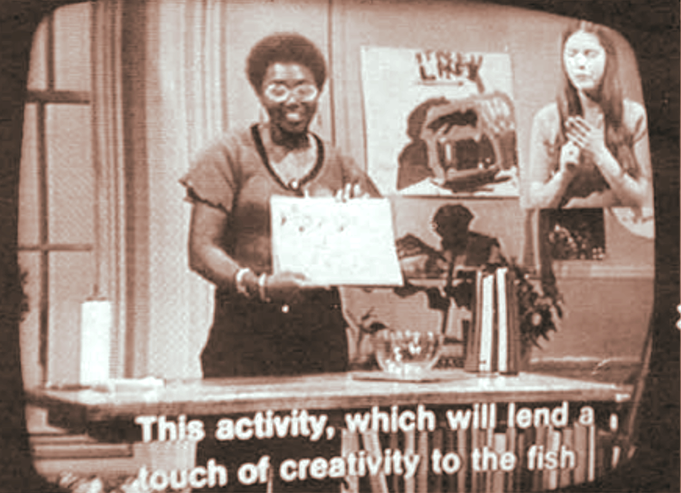
Actual broadcast of NBC’s “Watch Your Child/The Me Too Show.” Interpreter Maureen Collins appears in the right-hand corner of the TV screen throughout the program. Captions are broadcast at the beginning of each new activity. Source: UAD Bulletin, June 1972
On May 1, 2004, representatives from various Deaf organizations voted to dissolve the United Utah Organizations of the Deaf (UAD Bulletin, June 2004). Reflecting on the organization's history, Rodney W. Walker explained:
"It might be interesting to note that the original objective of the U.O. was to deal with captioned films and projection equipment for the organizations to use, but the purpose changed over time to focus on coordination and scheduling for various activities" (Walker, 2006).
Today, captions are widely available on television programming and most mainstream films. Advances in technology have also enabled Deaf filmmakers to create and distribute original works in American Sign Language. In Utah, pioneers of ASL filmmaking during the 2000s included Lance David Pickett of R.E.M. Films, Bobby Giles, Jim Harper, and Julio Diaz, Jr., of Eye-Sign Media.
In support of the growing ASL film industry, the Utah Association of the Deaf hosted ASL film screenings at the Robert G. Sanderson Community Center of the Deaf and Hard of Hearing, providing opportunities for Utah's Deaf community to enjoy films presented in ASL with captions.
Sources
Do You Remember the Events We Shared Long Long Ago, Long Ago? n.d.
Feldman, Shane. “Dr. Malcolm J. Norwood.” The Described and Captioned Media Program: Utah Association of the Deaf. Last modified September 2008. Accessed October 9, 2012. www.dcmp.org/caai/nadh87.pdf.
“Malcolm J. Norwood of Captioned Films Speaks in Utah.” UAD Bulletin, vol. 2, no. 9 (Spring 1963): 8.
“O.U.D. Is Dissolved.” UAD Bulletin, June 2004, p. 7.
Sanderson, Robert G. A Brief History of the Origins of the Robert G. Sanderson Community Center of the Deaf and Hard of Hearing. 2004.
“U.O. Movies.” UAD Bulletin, Fall 1960, p. 2.
Walker, Rodney Wilson. My Life Story. 2006.
Beehive Chapter of the
Gallaudet University Alumni Association
On June 27, 1889, during the third convention of the National Association of the Deaf in Washington, D.C., the Gallaudet University Alumni Association (GUAA), then known as the Gallaudet College Alumni Association, was established. Its principal objectives were "to preserve and increase the influence and prestige of the college, to broaden the sphere of its benefits among those for whom it was established, to oppose all influences tending to limit those benefits, and, secondarily, to perpetuate the friendships formed in the college and to promote relations between graduates of different generations" (Gannon & Pugin, Gallaudet Today, Fall 1994).
In 1972, Utah residents who had graduated from or attended classes at Gallaudet College founded the Beehive (Utah) Chapter of the Gallaudet College Alumni Association (BCGUAA). The chapter was established to strengthen connections among former students, recognize Gallaudet as their alma mater, and foster fellowship among alums.
In 1972, Utah residents who had graduated from or attended classes at Gallaudet College founded the Beehive (Utah) Chapter of the Gallaudet College Alumni Association (BCGUAA). The chapter was established to strengthen connections among former students, recognize Gallaudet as their alma mater, and foster fellowship among alums.

Members of the Gallaudet College Alumni Association in 1889. Source: Gallaudet Today, Fall 1994
Several years later, the national Gallaudet College Alumni Association invited the Utah chapter to become officially affiliated with the parent organization. The chapter subsequently drafted bylaws, which were approved by the national association. Over time, the Gallaudet University Alumni Association established chapters in several states, including Utah. The organization's primary goals are fellowship, fundraising, recognition, and celebration.
By 1987, the Utah chapter had grown to 65 members who had either graduated from or completed one or more semesters at Gallaudet University. While some members had passed away and others had relocated outside Utah, most remained active within the state.
By 1987, the Utah chapter had grown to 65 members who had either graduated from or completed one or more semesters at Gallaudet University. While some members had passed away and others had relocated outside Utah, most remained active within the state.
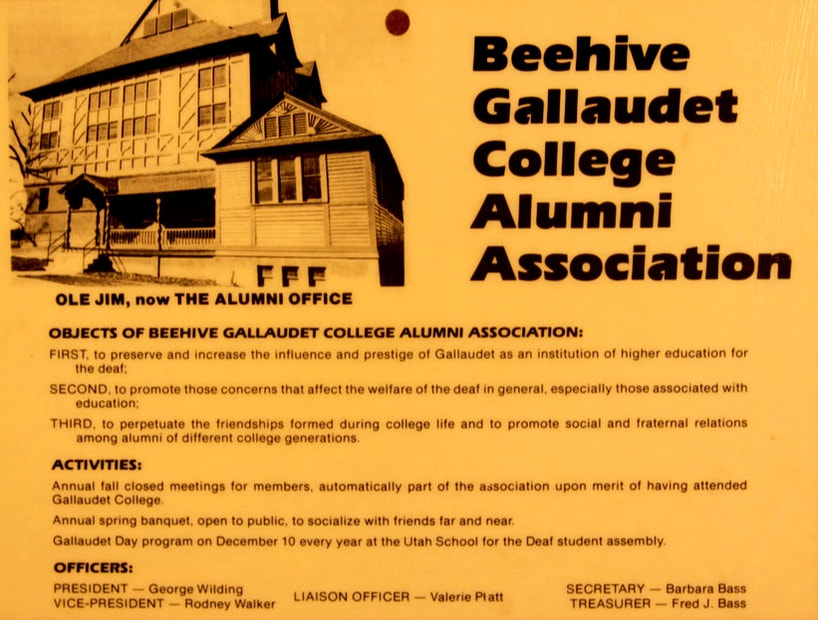
Beehive (Utah) Chapter of the Gallaudet College Alumni Association in the 1980s
Most chapter members lived in the Ogden and Salt Lake City areas. In the early years, members in Salt Lake City alternated hosting spring banquets or picnics, while Ogden members organized the fall gathering. After several years, the chapter determined that one annual event was sufficient. Thereafter, Salt Lake City and Ogden members alternated responsibility for organizing the yearly banquet, picnic, or social gathering.
At nearly every meeting, members voted to contribute $100 to the Gallaudet University Alumni Association. In addition, each chapter member paid annual dues of five dollars. These funds supported chapter activities as well as projects benefiting Gallaudet University and the broader Deaf community.
At nearly every meeting, members voted to contribute $100 to the Gallaudet University Alumni Association. In addition, each chapter member paid annual dues of five dollars. These funds supported chapter activities as well as projects benefiting Gallaudet University and the broader Deaf community.

Thomas Hopkins Gallaudet. Source: The Utah Eagle, December 1954
Sources
Gannon, Jack R., and Mary Anne Pugin. “A Brief History of the GUAA.” Gallaudet Today, vol. 25, no. 1 (Fall 1994): 10–13.
Walker, Rodney Wilson. My Life Story. 2006.
Walker, Rodney Wilson. My Life Story. 2006.
Ned C. Wheeler Scholarship
Foundation for the Deaf
The Utah Deaf community has long supported higher education through a scholarship program that evolved over time. Originally known as the Arthur Wenger Scholarship Fund, the organization later became the Utah Scholarship Foundation for the Deaf and eventually the Ned C. Wheeler Scholarship Foundation for the Deaf. The history of the foundation reflects the Utah Deaf community's enduring commitment to educational opportunity and academic achievement.
In October 1956, Dr. Robert G. Sanderson, a prominent Deaf leader in Utah, wrote in The Utah Eagle that Arthur W. Wenger, a 1913 graduate of the Utah School for the Deaf, athlete, and coach, had established the Arthur Wenger Athletic Association (AWAA) in 1919. Students raised money for the organization by selling candy on the school campus. The AWAA remained active until September 5, 1956, when representatives of the Utah School for the Deaf and the Utah Association of the Deaf voted to dissolve both the athletic association and the Park Literary Society (Sanderson, The Utah Eagle, October 1956).
In October 1956, Dr. Robert G. Sanderson, a prominent Deaf leader in Utah, wrote in The Utah Eagle that Arthur W. Wenger, a 1913 graduate of the Utah School for the Deaf, athlete, and coach, had established the Arthur Wenger Athletic Association (AWAA) in 1919. Students raised money for the organization by selling candy on the school campus. The AWAA remained active until September 5, 1956, when representatives of the Utah School for the Deaf and the Utah Association of the Deaf voted to dissolve both the athletic association and the Park Literary Society (Sanderson, The Utah Eagle, October 1956).

Robert G. Sanderson. Photo courtesy of Barry Sanderson
In 1956, Utah Association of the Deaf leaders Ned C. Wheeler and Robert G. Sanderson proposed that $1,000 from the Arthur Wenger Athletic Association's funds be set aside to establish a scholarship program. The purpose of the fund was to encourage students at the Utah School for the Deaf to pursue higher education and to provide financial assistance to deserving Deaf students with college aspirations. Representatives from the school and the student body supported the proposal. Members of the Utah Association of the Deaf and former students who had contributed to the athletic association believed that redirecting the funds toward education would benefit future generations of Deaf students (Sanderson, The Utah Eagle, October 1956).

Arthur W. Wenger. Source: FamilySearch.org
Officials of the Utah Association of the Deaf further proposed naming the new scholarship program the Arthur Wenger Scholarship Fund in honor of Arthur W. Wenger, founder of the former athletic association. The proposal was intended to recognize Wenger's dedication and lasting contributions to the welfare of Utah's Deaf community. The recommendation was unanimously approved (Sanderson, The Utah Eagle, October 1956).
The Utah Association of the Deaf later renamed the Arthur Wenger Scholarship Fund the Utah Scholarship Foundation for the Deaf. The organization initially managed the fund, which totaled slightly more than $1,000. In 1975, the foundation obtained its own Internal Revenue Service tax-exempt identification number, separated from the Utah Association of the Deaf, and became an independent nonprofit corporation incorporated under Utah law. By obtaining federal tax-exempt status, donations made to the foundation became tax-deductible. One of the foundation's primary goals was to promote access to higher education for Deaf and hard-of-hearing students throughout Utah. Following the death of prominent Utah Deaf leader Ned C. Wheeler in 1981, the organization renamed itself the Ned C. Wheeler Scholarship Foundation for the Deaf in recognition of his leadership and service to the Deaf community (Valerie G. Kinney, e-mail message to Jodi Christel Becker, October 3, 2012).
The Utah Association of the Deaf later renamed the Arthur Wenger Scholarship Fund the Utah Scholarship Foundation for the Deaf. The organization initially managed the fund, which totaled slightly more than $1,000. In 1975, the foundation obtained its own Internal Revenue Service tax-exempt identification number, separated from the Utah Association of the Deaf, and became an independent nonprofit corporation incorporated under Utah law. By obtaining federal tax-exempt status, donations made to the foundation became tax-deductible. One of the foundation's primary goals was to promote access to higher education for Deaf and hard-of-hearing students throughout Utah. Following the death of prominent Utah Deaf leader Ned C. Wheeler in 1981, the organization renamed itself the Ned C. Wheeler Scholarship Foundation for the Deaf in recognition of his leadership and service to the Deaf community (Valerie G. Kinney, e-mail message to Jodi Christel Becker, October 3, 2012).

Ned C. Wheeler. Photo courtesy of Edith Deininger Wheeler
Each year, the foundation awards scholarships to Deaf and hard-of-hearing students pursuing postsecondary education. Applicants must meet minimum academic requirements and demonstrate how the scholarship will help them achieve their educational goals. The scholarship program is administered by a board of directors composed of Deaf and hard-of-hearing individuals, parents of Deaf and hard-of-hearing students, and educators who have demonstrated an interest in Deaf education. Through careful management and community support, the foundation has operated successfully without requiring ongoing assistance from other organizations (Valerie G. Kinney, e-mail message to Jodi Christel Becker, October 3, 2012).

Valerie G. Kinney. Photo provided by Valerie G. Kinney
To ensure the fund's long-term sustainability, donations and contributions are invested to generate income. As a result, scholarship awards are based primarily on earnings generated from the principal balance rather than the principal itself. Over the years, the foundation has also benefited from numerous memorial contributions made in honor of members of Utah's Deaf community (Valerie G. Kinney, e-mail message to Jodi Christel Becker, October 3, 2012).

Kenneth L. Kinner. Photo courtesy of Kenneth and Ilene Kinner
Today, the Ned C. Wheeler Scholarship Foundation for the Deaf continues to support qualified Deaf and hard-of-hearing college students throughout Utah. Its mission remains consistent with the vision established in 1956: expanding educational opportunities and helping students achieve their academic and professional goals. Among its longest-serving board members are Valerie G. Kinney, who began serving in 1976, and Kenneth L. Kinner, who joined the foundation in 1978.
Personal Communication
Valerie G. Kinney, e-mail message to Jodi Christel Becker, October 3, 2012.
Source
Sanderson, Robert G. “Arthur Wenger Athletic Association.” The Utah Eagle, October 1956.
The Utah Deaf
Women’s Camp
One day in 1964, two Deaf women, Ilene Coles Kinner and Lois Williams, reminisced about their experiences camping as Girl Scouts and through the Women's Mutual Improvement Association of The Church of Jesus Christ of Latter-day Saints. Wanting to recreate those enjoyable memories, they organized a weekend camping trip for Deaf women interested in spending time outdoors together. After months of planning, approximately twenty to thirty women and their young children gathered at Tanner's Flat Campground in Little Cottonwood Canyon, Utah, in August 1964. They pitched their tents near the river and picnic areas, swam in the water, played games, shared meals, and enjoyed one another's company. The event was such a success that participants remembered it fondly for years afterward (Darlene Stewart Cochran and Ilene Coles Kinner, personal communication, 2009).

MIA Camp of the Ogden Deaf Branch in October 1955. Front L-R: Elaine Sprouse, Ilene Coles, Darlene Green, Joanne Burdett, _____. Second Row L-R: Afton Curtis Burdett, Dixie Lee Larson, Lois Williams, Carola Selzle. Back Row L-R: Betty Jo Alldredge, Lucille Simmons, Judith Jenkins. Photo courtesy of Kenneth and Ilene Kinner

The Utah Deaf Women's Camp at the Tanner’s Flat Campground in 1964. Photo courtesy of Kenneth and Ilene Kinner

The Utah Deaf Women's Camp at the Tanner’s Flat Campground in 1964. Photo courtesy of Kenneth and Ilene Kinner
However, the responsibilities of raising children, managing households, and participating in community service and other activities prevented the women from organizing another camp for fourteen years. During that time, many women fondly remembered the camping experience of 1964 and longed for an opportunity to gather again away from their daily responsibilities and family obligations.
In 1978, four determined Deaf women, Ilene Coles Kinner, Darlene Stewart Cochran, Dora Laramie, and Celia May Laramie Baldwin, decided to revive the tradition. Their goal was to establish a lasting camping experience that Deaf women throughout Utah could enjoy for years to come.
In 1978, four determined Deaf women, Ilene Coles Kinner, Darlene Stewart Cochran, Dora Laramie, and Celia May Laramie Baldwin, decided to revive the tradition. Their goal was to establish a lasting camping experience that Deaf women throughout Utah could enjoy for years to come.

Source: The Flyer of the 1978 Utah Deaf Women's Camp. Courtesy of Kenneth and Ilene Kinner
After searching for a suitable location, they found Camp Atoka Lodge in South Fork Canyon near Huntsville, Utah. The lodge, owned by the Ogden Stake of The Church of Jesus Christ of Latter-day Saints, was made available for their use. Resembling a rustic log cabin, the lodge offered a large open sleeping area, numerous bunk beds with mattresses, bathrooms, showers, and a kitchen. These accommodations provided a comfortable and welcoming setting for the revived Utah Deaf Women's Camp.

The Utah Deaf Women’s first official camp on June 17, 1978. Photo courtesy of Kenneth and Ilene Kinner
From June 15 to 17, 1978, women from across Utah gathered at Camp Atoka to enjoy fellowship, recreation, and relaxation. The success of the weekend established the foundation for a tradition that would continue for decades.
From then on, the Utah Deaf Women's Camp was held approximately every three years at Camp Atoka. The women reserved a beautiful camping area in South Fork Canyon, complete with a bridge crossing the river and access to outdoor recreation. The campground became the setting for countless happy memories. Participants enjoyed water fights, volleyball games, shared meals, campfires, craft projects, storytelling, skits, and group games.
One of the camp's most beloved traditions was preparing Dutch oven meals over an open fire. A Dutch oven is a thick-walled cast-iron cooking pot with a tight-fitting lid that can be used for baking, roasting, frying, and boiling. In Utah, Dutch oven cooking has deep historical roots connected to the Mormon pioneers who settled the Salt Lake Valley during the 19th century. Many Utah families continue to enjoy gathering around campfires to prepare and share meals cooked in Dutch ovens while preserving stories of their pioneer heritage.

Dorene is cooking Dutch oven meals at the Utah Deaf Women's Camp in 2008. Photograph by Duane Lee Kinner
Recognizing the importance of this tradition, the Utah State Legislature passed House Bill 203 in 1997, designating the Dutch oven as Utah's official state cooking pot. For the women attending camp, Dutch oven cooking became both a practical necessity and an enjoyable social activity that strengthened friendships and created lasting memories.
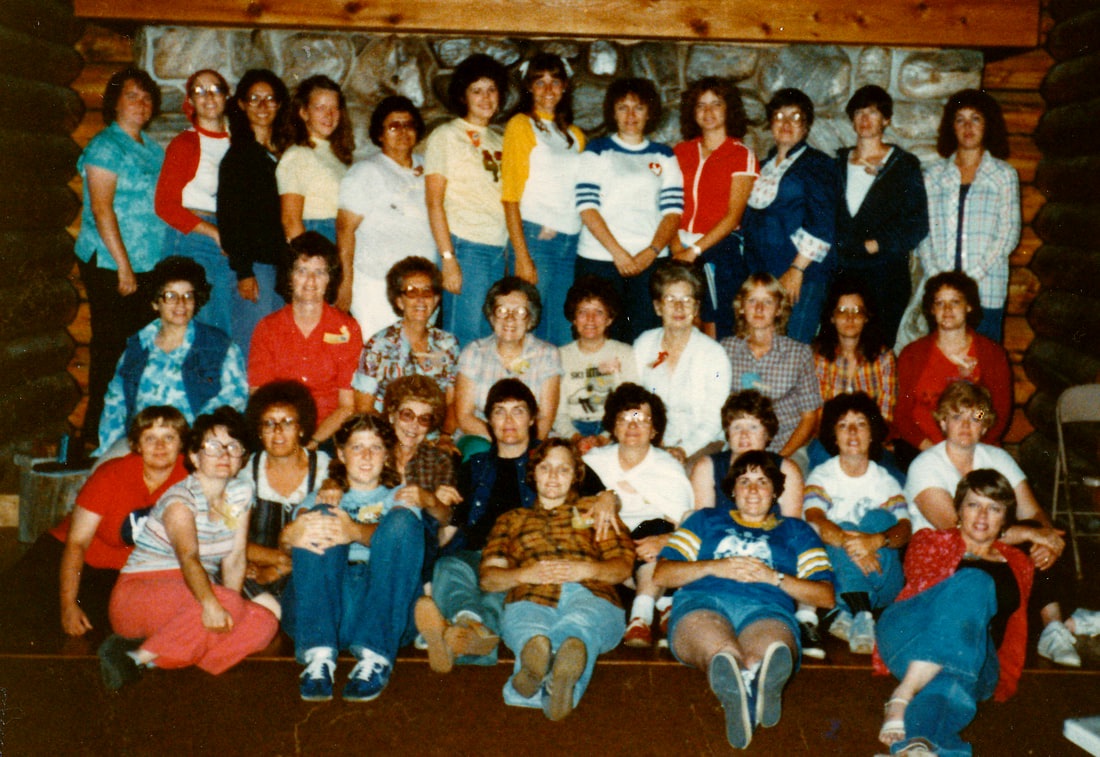
The Utah Deaf Women's Camp in 1981. Photo courtesy of Kenneth and Ilene Kinner
The camp was held at Camp Atoka six times before circumstances forced a change. When the Ogden Branch relocated from the Ogden Stake to South Ogden, the women lost access to their beloved campground. Although disappointed, they refused to abandon the tradition they had worked so hard to establish. The committee began searching for alternative locations that were affordable, accessible to older campers, close to restroom facilities, and situated in pleasant natural surroundings.
Eventually, they found suitable locations at Brighton Chalet, Monte Cristo, Camp Kiesel, YMCA Camp Roger, and Camp Wapiti, located at the Elks Lodge Camp in Tooele County, Utah (Cochran & Kinner, personal communication, 2009).
Finding a suitable lodge was not always easy. In 1992, the women were unable to secure indoor accommodations. Rather than cancel the event, they decided to return to the camping style of 1964 by pitching tents at Monte Cristo.
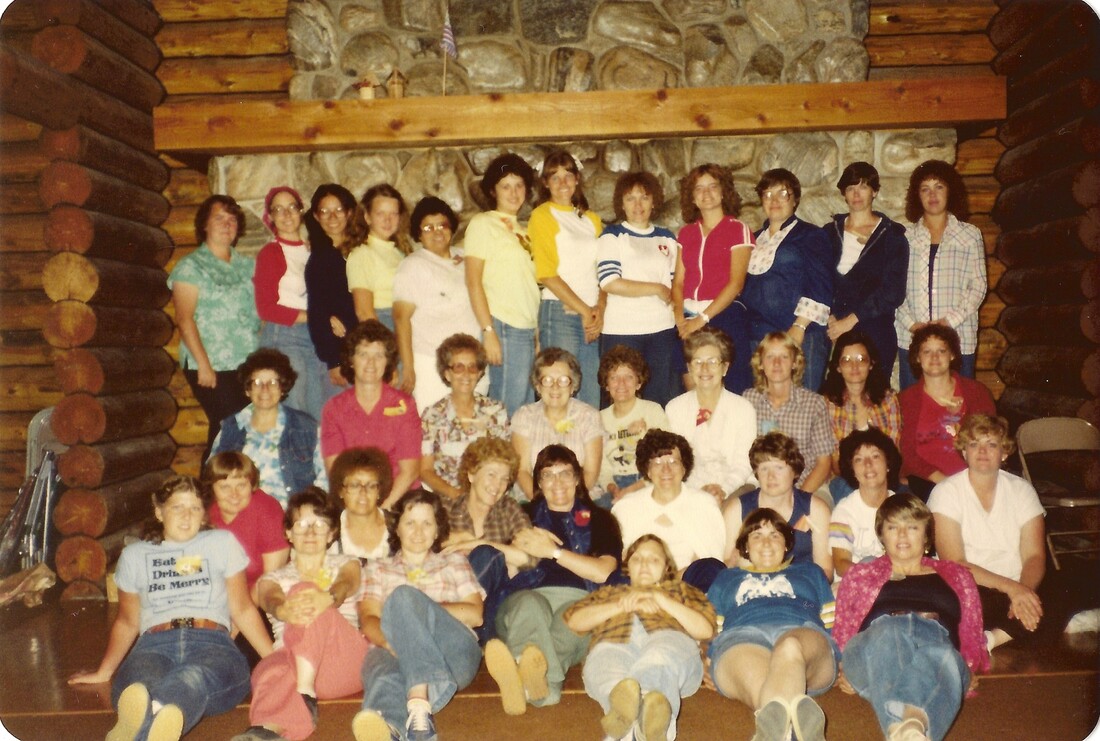
The Utah Deaf Women's Camp in 1984. Photo courtesy of Kenneth and Ilene Kinner
Although they encountered challenges, including swarms of flies around the eating areas, water faucets, and bathrooms, they made the best of the situation. A large tent served as a gathering area for meals, crafts, and games. Others enjoyed hiking, scavenger hunts, outdoor games, or simply relaxing in the mountain air. That evening, participants gathered around a large bonfire, shared stories, and enjoyed s'mores together. Many campers discovered that they enjoyed sleeping outdoors and appreciated the adventure of returning to a more traditional camping experience. Camp organizers even arranged for rangers to periodically check on the group during the night to ensure everyone's safety. The experience proved memorable and enjoyable for all involved.
Afterward, the Utah Deaf Women's Camp was generally held every two years, most often at locations with lodge accommodations.
Afterward, the Utah Deaf Women's Camp was generally held every two years, most often at locations with lodge accommodations.
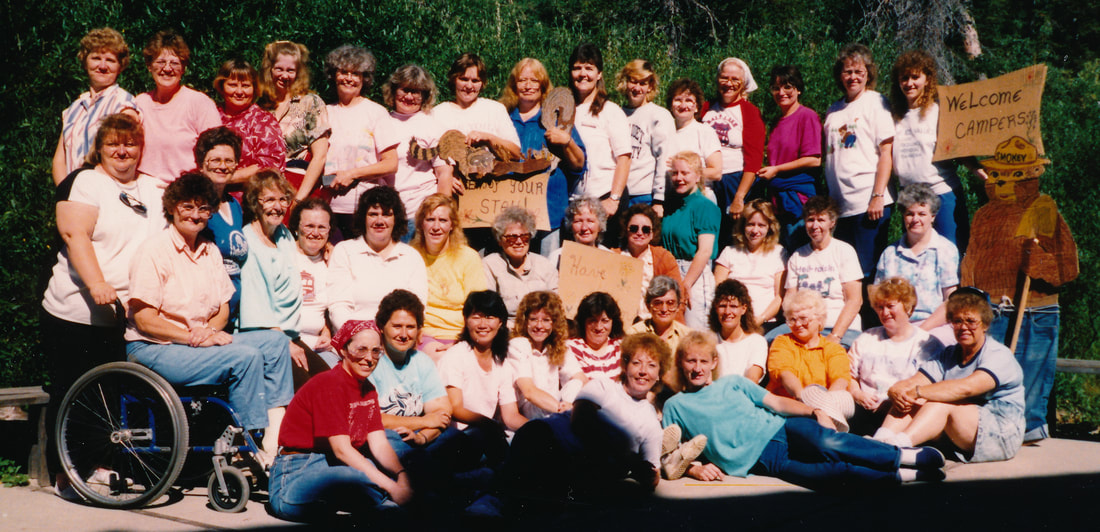
The Utah Deaf Women's Camp in 1990. Photo courtesy of Kenneth and Ilene Kinner
In 2000, the Utah Deaf Women's Camp Committee sought additional funding to support future camps. Members collaborated with family, friends, and neighbors to create A Treasury of Recipes, a cookbook containing more than 1,000 recipes. The cookbook was a tremendous success, with hundreds of copies sold. Combined with other fundraising activities, the project generated significant support for future camps and related activities.

'A Treasury of Recipes' cookbook created by the Utah Deaf Women's Camp in 2000
As the years passed, participants expressed interest in extending their camp experience. The committee responded by expanding the event to begin on Wednesday afternoon and continue through Saturday afternoon. The additional day allowed women more time to visit, participate in activities, and strengthen friendships.
Women aged eighteen and older were welcome to attend. Although most participants were between sixty and seventy years old, women traveled from Utah, Idaho, California, New York, Arizona, and Washington to take part. The oldest participant was seventy-five years old and thoroughly enjoyed the experience (Cochran & Kinner, personal communication, 2009).
Women aged eighteen and older were welcome to attend. Although most participants were between sixty and seventy years old, women traveled from Utah, Idaho, California, New York, Arizona, and Washington to take part. The oldest participant was seventy-five years old and thoroughly enjoyed the experience (Cochran & Kinner, personal communication, 2009).

The Utah Deaf Women's Camp in 2008. Top L-R: Dorene & Deanne. Bottom L-R: Ilene, Merla & Jessica. Photo courtesy of Kenneth and Ilene Kinner
Campers were organized into teams responsible for preparing meals, washing dishes, serving food, cleaning facilities, and completing other camp duties. Once the day's tasks were finished, many women stayed up late into the evening, playing games, sharing stories, and socializing with friends.

Team activities at the Utah Deaf Women's Camp in 1981. Photo courtesy of Kenneth and Ilene Kinner
Over time, the mission of the Utah Deaf Women's Camp expanded beyond recreation. The camp came to emphasize leadership, teamwork, self-esteem, community service, skill-building, friendship, and stress relief. Through shared experiences and mutual support, participants created a welcoming environment that enriched the lives of Deaf women throughout Utah and beyond.
In recognition of its many years of service, the Utah Association of the Deaf presented the Utah Deaf Women's Camp with a Presidential Award in 2002. Ilene Coles Kinner accepted the award on behalf of the organization. Since helping establish the first camp in 1964, she had never missed a campout. Fellow campers often remarked that her dedication, perseverance, and commitment were instrumental in ensuring the camp's continued success. Thanks to her efforts and those of many other dedicated women, generations of campers have enjoyed friendships and memories that continue to endure.
In recognition of its many years of service, the Utah Association of the Deaf presented the Utah Deaf Women's Camp with a Presidential Award in 2002. Ilene Coles Kinner accepted the award on behalf of the organization. Since helping establish the first camp in 1964, she had never missed a campout. Fellow campers often remarked that her dedication, perseverance, and commitment were instrumental in ensuring the camp's continued success. Thanks to her efforts and those of many other dedicated women, generations of campers have enjoyed friendships and memories that continue to endure.

The Utah Deaf Women's Camp at the Camp Wapiti. Photo courtesy of Kenneth and Ilene Kinner
Utah Deaf Women's Camp Locations and Dates
- Tanner's Flat, August 19, 1964
- Camp Atoka, June 15-17, 1978
- Camp Atoka, July 9-11, 1981
- Camp Atoka, August 9-11, 1984
- Brighton Chalet, July 18-20, 1990
- Monte Cristo, June 18-20, 1992
- Camp Atoka, June 15-18, 1994
- Camp Atoka, July 10-13, 1996
- Camp Atoka, July 29-August 1, 1998
- Camp Kiesel, August 16-19, 2000
- Camp Roger, August 14-17, 2002
- Camp Roger, August 4-7, 2004
- Camp Wapiti, August 13-16, 2008
- Camp Wapiti, July 7-10, 2010
- Camp Wapiti, August 7-10, 2012
This is one of the most engaging community-history sections you've shared because it captures not only organizational history but also friendship, tradition, leadership, and the experiences of Deaf women across generations.

The banner includes the dates of the Utah Deaf Women's Camp gatherings, 2008. Photo courtesy of Kenneth and Ilene Kinner
Personal Communication
Darlene Stewart Cochran & Ilene Coles Kinner, personal communication with the author, 2009.
Sources
“Dutch Oven.” Wikipedia: The Free Encyclopedia. Accessed October 2026. Dutch Oven Article.
“Utah State Cooking Pot: Dutch Oven.” Pioneer Utah Online Library. Utah State Cooking Pot.
“Utah State Cooking Pot: Dutch Oven.” Pioneer Utah Online Library. Utah State Cooking Pot.
Camp Liahona
For Deaf Children
When Roger Wilkins moved to Utah from Northern California in 1985, he noticed a lack of recreational and leadership opportunities for Deaf children. Having attended numerous Deaf camps as a child, he believed that Utah's Deaf youth deserved similar experiences and opportunities for personal growth (Roger Wilkins, Camp Director).

Roger Wilkins and Bobby Giles, the co-founders of Camp Liahona. Photo provided by Nan Hix
Roger partnered with Bobby Giles to establish a camp for Deaf children. While planning the camp, they struggled to find an appropriate name. One day, Bobby discussed possible names with George "Virl" Osmond and his then-wife, Chris Osmond. Virl was one of the two Deaf brothers in the well-known Osmond family. During their conversation, Chris suggested the name "Liahona." Bobby later shared the idea with Roger, who immediately felt it perfectly captured the camp's vision (Bobby Giles, personal communication, February 3, 2009).

Camp Liahona, 1989. Photo courtesy of Nan Hix
The word Liahona comes from the Book of Mormon and refers to a brass compass-like instrument of "curious workmanship" that guided Lehi and his family to the Promised Land. Roger and Bobby felt the name symbolized guidance, growth, and success. They wanted Deaf children to understand that they could achieve anything they set their minds to, despite the challenges associated with hearing loss. In 1986, Camp Liahona for Deaf Children officially opened (Bobby Giles, personal communication, February 3, 2009).
Camp Liahona represented a bright new opportunity for Deaf youth in Utah. One of its primary goals was to help children develop into future leaders. Camp organizers wanted participants to understand that they could accomplish anything except hear. Although relatively few prominent Deaf role models were visible at the time, camp leaders believed that with encouragement, mentoring, and opportunities, Deaf children could become successful community leaders, professionals, and advocates (Camp Liahona, 1988).
During its first year, Camp Liahona offered only day activities, including pizza parties and ice skating outings. Five children participated in the inaugural program (Roger Wilkins, Camp Director).
The second camp was held in September 1987 at the family cabin of camp leader Reid Simonsen in Big Cottonwood Canyon, Utah. During the three-day gathering, campers participated in skits, games, crafts, and hiking excursions (Roger Wilkins, Camp Director; Giles, 2009).
The third camp took place in August 1988 at a Boy Scout campsite in Payson Canyon, Utah. Eighteen children, counselors, and volunteers participated in the week-long program. Campers enjoyed activities such as archery, crafts, rifle shooting, swimming, canoeing, and outdoor recreation. More importantly, they formed friendships with other Deaf children from throughout the region (Roger Wilkins, Camp Director).

Camp Liahona, 1990. Photo courtesy of Nan Hix

Camp Liahona, 1991. Photo courtesy of Nan Hix
Did You Know?
In 1991, Roger Wilkins, Bobby Giles, Julio Diaz Jr., and Nan Hix discussed the need for American Sign Language immersion opportunities for hearing students studying ASL. They recognized that students had few places to practice their language skills while learning about Deaf culture.
As a result, they established an ASL Silent Weekend program. Held during the fall and winter semesters, the program welcomed ASL students from Utah State University, Salt Lake Community College, Utah Valley University, and Brigham Young University. Camp Liahona sponsored a 48-hour "Silent Weekend" at Camp Kostopulos in Emigration Canyon, where participants were expected to communicate entirely through sign language. Students who spoke verbally were fined twenty-five cents each time they violated the rule.
After two years, Brigham Young University assumed responsibility for the program under the leadership of Nan Hix, who directed it for nine years. Students and Deaf group leaders later met at Aspen Grove in Provo Canyon, near Sundance Ski Resort. Beginning in 2002, officers of the BYU ASL Club transitioned the program into a day camp held on the BYU campus (Nan Hix, e-mail message to Jodi Christel Becker, May 20, 2024).

Nan Hix, Lori Perrier (center), and Roger Wilkins at the ASL Silent Weekend Camp. Photo provided by Nan Hix

Camp Liahona, 1992. Photo courtesy of Nan Hix

Camp Liahona, 1992. Photo courtesy of Nan Hix
One memorable lesson taught at Camp Liahona involved educating children about the dangers of drugs and alcohol:
"They planned a dramatic play one night to highlight the importance of abstaining from drugs and alcohol. Roger hid a bottle of 'whiskey' in his coat, and Bobby hid 'pot' pipes and drugs that looked real in his pants. During an announcement, Jack Rose, a police officer who knew ASL and was in uniform, suddenly arrested Roger and Bobby. Afterward, Jack showed the children the items that had been confiscated. The arrest immediately captured their attention. Roger and Bobby then explained that the situation had been staged. Jack shared stories about actual arrests involving drug users and discussed the consequences of substance abuse. They hoped the experience would encourage the children to avoid drugs and alcohol in the future" (Camp Liahona, 1988).
"They planned a dramatic play one night to highlight the importance of abstaining from drugs and alcohol. Roger hid a bottle of 'whiskey' in his coat, and Bobby hid 'pot' pipes and drugs that looked real in his pants. During an announcement, Jack Rose, a police officer who knew ASL and was in uniform, suddenly arrested Roger and Bobby. Afterward, Jack showed the children the items that had been confiscated. The arrest immediately captured their attention. Roger and Bobby then explained that the situation had been staged. Jack shared stories about actual arrests involving drug users and discussed the consequences of substance abuse. They hoped the experience would encourage the children to avoid drugs and alcohol in the future" (Camp Liahona, 1988).

Camp Liahona, 1993. Photo courtesy of Nan Hix
Throughout the camp's five-day programs, Deaf guest speakers such as Curtis Pendleton, Jim Harper, and Virl Osmond visited the campers. On the final evening, family members joined campers for dinner and closing activities. Each child received a certificate of participation in recognition of their achievements and involvement (Camp Liahona, 1988).

Camp Liahona, 1994. Photo courtesy of Nan Hix

Camp Liahona, 1995. Photo courtesy of Nan Hix
Over the years, Camp Liahona utilized a variety of campgrounds throughout Utah. Campers participated in swimming, boating, arts and crafts, drama, horseback riding, hiking, rope-course challenges, and team games. In 1994, Camp Liahona finally found a permanent home at Camp Wapiti, located in Settlement Canyon near Tooele, Utah.
Staff members were thrilled when Vea Lynn Jarvis, mother of a hard-of-hearing daughter, Heather, and two Deaf sons, Jason and Micah, discovered the facility. Its mountain setting, convenient location, and proximity to shopping, community services, and medical facilities made it an ideal camp location (Camp Liahona Has Its Own Home, July 1994).
Staff members were thrilled when Vea Lynn Jarvis, mother of a hard-of-hearing daughter, Heather, and two Deaf sons, Jason and Micah, discovered the facility. Its mountain setting, convenient location, and proximity to shopping, community services, and medical facilities made it an ideal camp location (Camp Liahona Has Its Own Home, July 1994).

Camp Liahona, 1996. Photo courtesy of Nan Hix
Camp Wapiti offered sixteen sleeping cabins, each capable of housing up to ten campers. The main lodge included a full kitchen, second-floor sleeping quarters for staff members, and a small meeting room. Additional facilities included a recreation field, dispensary, and arts-and-crafts building. Tooele City also made its public swimming pool available to camp participants (Camp Liahona Has Its Own Home, July 1994).
Although many campers came from families affiliated with The Church of Jesus Christ of Latter-day Saints, Camp Liahona welcomed all Deaf children between the ages of eight and eighteen. Participants traveled not only from Utah but from across the United States and Canada. Many out-of-state campers were members of the Latter-day Saint faith who valued the unique opportunity to interact with Deaf peers and Deaf adult role models.
Although many campers came from families affiliated with The Church of Jesus Christ of Latter-day Saints, Camp Liahona welcomed all Deaf children between the ages of eight and eighteen. Participants traveled not only from Utah but from across the United States and Canada. Many out-of-state campers were members of the Latter-day Saint faith who valued the unique opportunity to interact with Deaf peers and Deaf adult role models.

Camp Liahona, 1998. Photo courtesy of Nan Hix

Camp Liahona, 1999. Photo courtesy of Nan Hix

Camp Liahona, 2000. Photo courtesy of Nan Hix

David Bair at Camp Liahona. Photo courtesy of Nan Hix
Over the years, many Deaf adults devoted countless hours to Camp Liahona's success by serving as presidents, vice presidents, camp directors, and assistant camp directors. Among those whose service deserves special recognition are:
- Roger Wilkins - 5 years
- David Bair - 10 years
- Bobby Giles - 12 years
- Nan Hix - 14 years

Nan Hix at Camp Liahona. Photo provided by Nan Hix

Camp Liahona, 2002. Photo courtesy of Nan Hix

Camp Liahona, 2003. Photo courtesy of Nan Hix

Camp Liahona, 2004. Photo courtesy of Nan Hix

Camp Liahona, 2005. Photo courtesy of Nan Hix
The goal of Camp Liahona was to provide Deaf children from across North America with opportunities to make new friends, interact with Deaf role models, learn American Sign Language and Deaf culture, and strengthen their self-esteem. Campers learned leadership skills, developed positive attitudes toward themselves and their future, and gained valuable life experiences through interaction with Deaf adults and successful community leaders.
Equally important, Camp Liahona provided children with a safe and welcoming environment where they could communicate freely, enjoy outdoor adventures, attend slumber parties, participate in recreational activities, and create lifelong memories. The camp's values, rooted in service, leadership, friendship, and faith, helped shape generations of Deaf youth.
After more than two decades of service, Camp Liahona closed in 2008 because of financial constraints, difficulties raising donations, and ongoing staff shortages (Bobby Giles, personal communication, October 2, 2012).

Camp Liahona, 2006. Photo courtesy of Nan Hix
Personal Communication
Bobby Giles, personal communication with the author, February 3, 2009.
Bobby Giles, personal communication with the author, October 2, 2012.
Nan Hix, e-mail message to Jodi Christel Becker, May 20, 2024.
Bobby Giles, personal communication with the author, October 2, 2012.
Nan Hix, e-mail message to Jodi Christel Becker, May 20, 2024.
Sources
“Camp Liahona Has Its Own Home.” UAD Bulletin, vol. 1, no. 2 (July 1994): 1.
“Camp Liahona.” Utah Valley Chapter Newsletter, vol. 1, no. 2 (March 1989): 1.
“Roger Wilkins, Camp Director.” Utah Valley Chapter Newsletter, vol. 1, no. 2 (March 1989): 1.
“Camp Liahona.” Utah Valley Chapter Newsletter, vol. 1, no. 2 (March 1989): 1.
“Roger Wilkins, Camp Director.” Utah Valley Chapter Newsletter, vol. 1, no. 2 (March 1989): 1.
Utah Deaf Genealogical Association
In the fall of 1999, chairperson Dulane Woodhouse, Elder Rex, Sister Sue Hatch, and missionaries serving in the Deaf Zone at the Family History Library began organizing the first Deaf genealogy workshop. Sister Hatch played a particularly important role in the development and success of the program. The first workshop was held at the Family History Library in the Joseph Smith Memorial Building on June 26-28, 2000. Approximately 30 Deaf participants attended the initial workshop and classes. Interest grew rapidly, and attendance increased the following year. In 2004, the program was renamed the Family History Deaf Workshop (Dulane Woodhouse, e-mail message to Jodi Christel Becker, November 11, 2008).
As the workshop's popularity expanded, it served an ever-growing number of Deaf participants interested in family history and genealogy research. Attendance reached 130 participants in 2004 and nearly 190 in 2006. Impressed by its continued growth and success, the Family History Library encouraged the Family History Deaf Workshop to become an independent organization. Organizers established bylaws, obtained tax-identification numbers and licenses, and completed the necessary organizational requirements. In 2007, these efforts resulted in the formation of the Utah Deaf Genealogical Association (UDGA). As an independent organization, the UDGA gained access to resources and opportunities comparable to those available to mainstream genealogical organizations (Dulane Woodhouse, e-mail message to Jodi Christel Becker, November 11, 2008).
At the time of its founding, W. David Samuelsen served as interim president, with Dulane Woodhouse as chairperson, Patty Kitchen as treasurer, and Susan Stokes as secretary. Roy Cochran and Darlene (Stewart) Cochran, who served as full-time Deaf missionaries at the Family History Library, also participated in the organization's weekly meetings.

W. David Samuelson. Photo provided by W. David Samuelson
The UDGA hosted its first conference from June 18 to 21, 2008, at the Radisson Hotel in Salt Lake City, Utah, located just west of the Family History Library. More than 230 people attended the conference. The event was highly successful and demonstrated the growing interest among Deaf individuals in genealogy and family history research.
The mission of the Utah Deaf Genealogical Association was to provide Deaf individuals with equal access to genealogy education and research opportunities. Its objectives included:
The ultimate goal of the UDGA was to ensure that Deaf individuals had equal access to advanced genealogy resources and research technology. Over time, however, the organization experienced increasing difficulty recruiting enough volunteers to support its conferences and activities. As participation declined, the remaining volunteers and administrators donated the organization's remaining funds to the Family History Library Deaf Zone (W. David Samuelson, e-mail message to Jodi Christel Becker, November 5, 2012).
The final UDGA event was held in 2018 before the organization gradually dissolved. The onset of the COVID-19 pandemic in 2020 further contributed to the suspension of large genealogy gatherings. According to W. David Samuelsen, organizers later restructured the program to provide a smaller and more manageable annual event featuring a limited number of classes (W. David Samuelsen, e-mail message to Jodi Christel Becker, December 19, 2023).
In 2024, David continued coordinating volunteers and helping organize the annual Deaf Week @ FamilySearch Library event. The event is promoted through Facebook and is typically announced nearly a year in advance to encourage participation from Deaf genealogists and family-history enthusiasts throughout the United States (W. David Samuelsen, e-mail message to Jodi Christel Becker, February 1, 2024).
The mission of the Utah Deaf Genealogical Association was to provide Deaf individuals with equal access to genealogy education and research opportunities. Its objectives included:
- Providing the Family History Deaf Workshop at the Family History Library for Deaf patrons.
- Offering genealogy classes taught by Deaf instructors.
- Providing access to computers and research tools.
- Referring patrons to tutoring provided by part-time Deaf Family History
- Library missionaries.
- Assisting patrons with genealogy and family history research
The ultimate goal of the UDGA was to ensure that Deaf individuals had equal access to advanced genealogy resources and research technology. Over time, however, the organization experienced increasing difficulty recruiting enough volunteers to support its conferences and activities. As participation declined, the remaining volunteers and administrators donated the organization's remaining funds to the Family History Library Deaf Zone (W. David Samuelson, e-mail message to Jodi Christel Becker, November 5, 2012).
The final UDGA event was held in 2018 before the organization gradually dissolved. The onset of the COVID-19 pandemic in 2020 further contributed to the suspension of large genealogy gatherings. According to W. David Samuelsen, organizers later restructured the program to provide a smaller and more manageable annual event featuring a limited number of classes (W. David Samuelsen, e-mail message to Jodi Christel Becker, December 19, 2023).
In 2024, David continued coordinating volunteers and helping organize the annual Deaf Week @ FamilySearch Library event. The event is promoted through Facebook and is typically announced nearly a year in advance to encourage participation from Deaf genealogists and family-history enthusiasts throughout the United States (W. David Samuelsen, e-mail message to Jodi Christel Becker, February 1, 2024).
Personal Communication
Dulane Woodhouse, e-mail message to Jodi Christel Becker, November 11, 2008.
W. David Samuelson, e-mail message to Jodi Christel Becker, November 5, 2012.
W. David Samuelsen, e-mail message to Jodi Christel Becker, December 19, 2023.
W. David Samuelsen, e-mail message to Jodi Christel Becker, February 1, 2024.
W. David Samuelson, e-mail message to Jodi Christel Becker, November 5, 2012.
W. David Samuelsen, e-mail message to Jodi Christel Becker, December 19, 2023.
W. David Samuelsen, e-mail message to Jodi Christel Becker, February 1, 2024.
Deaf Heritage and
Library Cultural Center
In 1993, a draft document was created outlining goals for a future Deaf Center in Utah County. The proposal reflected a growing desire among Deaf community members to establish resources that would preserve Deaf heritage while providing educational, cultural, and social opportunities. According to Caralee Crye, a Deaf member of the Deaf Heritage and Library Cultural Center (DHLCC), the organization "started out as a dream" in 1993 (Crye, 2003).
To turn that dream into reality, several Deaf residents of Utah County met at the home of Lee Shepherd in October 1995 to discuss the creation of a Deaf center and the preservation of Deaf heritage. Among those attending the first meeting were Reid Simonsen, Jim Harper, Gregg Scott, Lee Shepherd, Julio Diaz, Jr., and Tom Osmond (DHLCC Paper).
A second meeting was held at Gregg Scott's home, where participants formally organized a board of directors and elected officers. Reid Simonsen was elected chairperson, Jim Harper vice chairperson, and Gregg Scott treasurer. Board members included Minnie Mae Wilding-Diaz, Lee Shepherd, Bobby Giles, and Julio Diaz (DHLCC Paper).
Over the next several months, meetings were held in private homes, public libraries, and college classrooms. Participants discussed potential names for the organization, drafted bylaws, prepared articles of incorporation, and pursued 501(c)(3) nonprofit status. Although the process was challenging, the dedication of board members and supporters helped move the project forward (DHLCC Paper).
On May 29, 1997, after securing nonprofit status and completing the required legal documentation, the organization was formally established as the Deaf Heritage and Library Cultural Center (DHLCC).
The organization's mission included providing:
To accomplish these goals, the organization established several committees. The State of Utah eventually recognized the DHLCC as an official nonprofit organization.
At that time, the officers and board members were:
Members-at-large included Jim Harper, Nanette Hix, Lee Shepherd, Herb Royce, and Patty Kitchen (DHLCC Paper).
Committee leadership included:
Since its founding, the DHLCC accomplished a number of important goals, including:
Despite these accomplishments, the organization eventually struggled to maintain an active board and sufficient member participation. By 2002, the DHLCC had stopped holding meetings and formally dissolved. Its bank accounts were closed, and the remaining funds were donated to the Utah Association of the Deaf.
Following the wishes of the DHLCC, the UAD has continued to honor the memory and contributions of Dale Link and Herb Royce (Crye, 2003; DHLCC Paper).
To turn that dream into reality, several Deaf residents of Utah County met at the home of Lee Shepherd in October 1995 to discuss the creation of a Deaf center and the preservation of Deaf heritage. Among those attending the first meeting were Reid Simonsen, Jim Harper, Gregg Scott, Lee Shepherd, Julio Diaz, Jr., and Tom Osmond (DHLCC Paper).
A second meeting was held at Gregg Scott's home, where participants formally organized a board of directors and elected officers. Reid Simonsen was elected chairperson, Jim Harper vice chairperson, and Gregg Scott treasurer. Board members included Minnie Mae Wilding-Diaz, Lee Shepherd, Bobby Giles, and Julio Diaz (DHLCC Paper).
Over the next several months, meetings were held in private homes, public libraries, and college classrooms. Participants discussed potential names for the organization, drafted bylaws, prepared articles of incorporation, and pursued 501(c)(3) nonprofit status. Although the process was challenging, the dedication of board members and supporters helped move the project forward (DHLCC Paper).
On May 29, 1997, after securing nonprofit status and completing the required legal documentation, the organization was formally established as the Deaf Heritage and Library Cultural Center (DHLCC).
The organization's mission included providing:
- A Museum of Deaf Heritage
- A Library of Deafness
- Deaf Professional Services
- A Preschool for Deaf Children
- Social Activities
- A Deaf Community Bookstore
To accomplish these goals, the organization established several committees. The State of Utah eventually recognized the DHLCC as an official nonprofit organization.
At that time, the officers and board members were:
- Caralee Crye, President
- Dale Link, Vice President
- Jill Laing, Secretary
- Chris Wakeland, Correspondence Secretary
- Gregg Scott, Treasurer
- Bobby Giles, Assistant Treasurer
Members-at-large included Jim Harper, Nanette Hix, Lee Shepherd, Herb Royce, and Patty Kitchen (DHLCC Paper).
Committee leadership included:
- Library Committee: Chris Wakeland
- Museum Committee: Jim Harper, Kristi Mortensen, and Virginia Powers
- Preschool Committee: Jill Laing and Kelli Illi
- Services Committee: Caralee Crye
- Bookstore Committee: Gregg Scott
- Activities Committee: Nanette Hix and Patty Kitchen
- Fundraising Committee: Chris Wakeland and Brad Houck
- Media Services Committee: Doug Stringham
Since its founding, the DHLCC accomplished a number of important goals, including:
- Sending representatives to UCCD leadership seminars.
- Participating in the 1997 Deaf Festival in Salt Lake City and UCCD bazaars.
- Assisting efforts in 1996 and 1997 to preserve and renovate the historic Brigham Young Academy building rather than have it condemned.
- Conducting successful yard sales and fundraising activities.
- Developing strong partnerships with the Utah Association of the Deaf (UAD) and the Deaf and Hard of Hearing Advocacy Agency (DHAA).
- Renting a building in American Fork in 1999 through a loan from the UAD and proceeds from fundraising efforts.
- Helping establish the Deaf Users e-mail discussion group in 1997.
- Offering workshops and community activities in the American Fork facility, some in partnership with the DHAA.
- Working with the DHAA to bring open-captioned movies to Utah County theaters in April 1999. The first open-captioned film shown was October Sky.
- Collecting and preserving Deaf-related books, documents, and artifacts (Crye, 2003).
Despite these accomplishments, the organization eventually struggled to maintain an active board and sufficient member participation. By 2002, the DHLCC had stopped holding meetings and formally dissolved. Its bank accounts were closed, and the remaining funds were donated to the Utah Association of the Deaf.
Following the wishes of the DHLCC, the UAD has continued to honor the memory and contributions of Dale Link and Herb Royce (Crye, 2003; DHLCC Paper).
Sources
Crye, Caralee. “DHLCC Closure.” UAD Bulletin, vol. 26, no. 10 (March 2003): 5.
DHLCC Paper.
DHLCC Paper.
R.E.M. Film
David Lance Pickett, a Deaf native of Utah who is widely known as Lance, founded R.E.M. Films in Saratoga Springs, Utah, in January 2007. For many years, he studied the film industry and developed his skills in video production, storytelling, and visual media. His passion for filmmaking and his commitment to high-quality production laid the foundation for what would become one of the most recognized Deaf-owned media companies in Utah.
Lance began his career as an event videographer, filming weddings and special events. Over time, he expanded his expertise by producing a wide variety of projects, including corporate videos, commercials, documentaries, and feature productions. By combining creativity with emerging technology, he sought to deliver professional-quality productions while maintaining affordability and accessibility.
Lance began his career as an event videographer, filming weddings and special events. Over time, he expanded his expertise by producing a wide variety of projects, including corporate videos, commercials, documentaries, and feature productions. By combining creativity with emerging technology, he sought to deliver professional-quality productions while maintaining affordability and accessibility.

Lance David Pickett. Photo curtesy of the Sorenson Communications, Inc.
Under Lance's leadership, R.E.M. Films produced several popular online programs, including Wanna Bet?, Viral Signs, and DeafPod. The company also created numerous short films that received awards and recognition within the Deaf community and beyond. Among these productions were The Blue Box, S.O.D.A. That!, Deaf vs. Mafia, The Deaf Cow, Deaf and Addicted, and Business as Usual, as well as many other projects that showcased Deaf talent and Deaf-centered storytelling.
In addition to its original productions, R.E.M. Films served as the exclusive producer of video content and interviews for StreetLeveragefrom 2012 to 2019. Through its films, web series, interviews, and media productions, the company reached a combined audience of more than twenty million viewers.
In addition to its original productions, R.E.M. Films served as the exclusive producer of video content and interviews for StreetLeveragefrom 2012 to 2019. Through its films, web series, interviews, and media productions, the company reached a combined audience of more than twenty million viewers.
A logo of R.E.M. Films. Logo provided by David Lance Pickett
R.E.M. Films demonstrated that Deaf filmmakers could successfully create, direct, and produce professional media while sharing authentic Deaf experiences with both Deaf and hearing audiences. Through innovation, determination, and creativity, the company helped expand opportunities for Deaf artists, actors, filmmakers, and storytellers.
As Lance expressed:
"If you've ever wondered where dreams come from... just look around. This is where dreams come true."
For many Deaf individuals, R.E.M. Films became a place where those dreams could become reality through the power of filmmaking, storytelling, and visual media (David Lance Pickett, e-mail message to Jodi Christel Becker, February 14, 2024).

The Blue Box DVD produced by Lance David Pickett, 2008
Personal Communication
David Lance Pickett, e-mail message to Jodi Christel Becker, February 14, 2024.
Eye-Sign Media, LLC
Bobby Giles, a Deaf native of Utah, dreamed of making movies from an early age while attending the Utah School for the Deaf in Ogden, Utah. That childhood dream became a reality in 2004 when he and fellow Deaf filmmaker Jim Harper founded Eye-Sign Media, LLC. Both men shared a passion for filmmaking and a desire to create entertainment specifically for Deaf audiences.

Bobby Giles. Source: YouTube
Julio Diaz Jr., who also had a strong interest in Deaf film production, soon became involved in their efforts. Recognizing his talents and enthusiasm, Bobby and Jim invited him to join the company in 2005. Together, the three filmmakers combined their creativity and skills to produce films that reflected Deaf experiences, Deaf culture, and visual storytelling.
Soon after forming their partnership, Eye-Sign Media, LLC began producing films and video projects for the Deaf community. Their first film was Eyeth, which introduced audiences to the company's unique style of visual storytelling and Deaf-centered entertainment.
Soon after forming their partnership, Eye-Sign Media, LLC began producing films and video projects for the Deaf community. Their first film was Eyeth, which introduced audiences to the company's unique style of visual storytelling and Deaf-centered entertainment.

Jim Harper. Photo provided by Jim Harper

Julio Diaz, Jr.. Source: Facebook
In 2007, Eye-Sign Media, LLC released its first full-length feature film, VPMAN. The film premiered during the 2007 Winter Deaflympics in Salt Lake City, Utah, providing an opportunity for Deaf visitors from around the world to enjoy the production. Following its premiere, VPMAN was distributed and viewed by audiences throughout the United States (Jim Harper, e-mail message to Jodi Christel Becker, November 21, 2008).
The company continued producing original films and projects that showcased Deaf actors, Deaf culture, and stories told from a Deaf perspective. Their work helped provide greater representation for Deaf people in film and demonstrated that Deaf filmmakers could successfully create and distribute their own entertainment.
The company continued producing original films and projects that showcased Deaf actors, Deaf culture, and stories told from a Deaf perspective. Their work helped provide greater representation for Deaf people in film and demonstrated that Deaf filmmakers could successfully create and distribute their own entertainment.

The VPMAN DVD produced by Eye-Sign Media, LLC, 2008
One of Eye-Sign Media's most recognized productions was the black-and-white film Easy? No!. In the fall of 2014, the Robert G. Sanderson Community Center of the Deaf and Hard of Hearing in Taylorsville, Utah, hosted a screening of the film. Easy? No! was also shown in communities throughout the United States, helping to introduce broader audiences to Eye-Sign Media's work and its contributions to Deaf filmmaking.
Through their commitment to visual storytelling, Eye-Sign Media, LLC helped promote Deaf talent in film production and provided Deaf audiences with entertainment created by Deaf filmmakers. The company played an important role in the growth of Deaf media in Utah and contributed to the broader movement of Deaf-produced films across the nation.
Through their commitment to visual storytelling, Eye-Sign Media, LLC helped promote Deaf talent in film production and provided Deaf audiences with entertainment created by Deaf filmmakers. The company played an important role in the growth of Deaf media in Utah and contributed to the broader movement of Deaf-produced films across the nation.

Eye-Sign Media, LLC. produced a poster for the 2014 black-and-white film "Easy? No!" The main character of the movie, Christoper Palaia, is shown in this picture

Red Carpet flyer by Eye-Sign Media, LLC promoting the film "Easy? No!" at the Robert G. Sanderson Community Center, 2014
Personal Communication
Jim Harper, e-mail message to Jodi Christel Becker, November 21, 2008.
whatQGA
The organization whatQGA was founded in 2004 by Sarah and Preston Gudmunson in Provo, Utah. Its purpose was to empower Deaf and hard-of-hearing youth by helping them overcome challenges that hearing youth often do not encounter. Many of these challenges stem from communication barriers, which can affect education, family relationships, social interactions, and self-confidence. Through workshops, activities, and family-centered programs, whatQGA worked to help Deaf and hard-of-hearing youth develop the skills and confidence needed to succeed.
The name whatQGA originated from teletypewriter (TTY) communication. The phrase "GA" means "go ahead," and the expression "what Q GA" translates to "What did you say?" For Sarah Gudmunson, who is hard of hearing, the name symbolized the misunderstandings and communication barriers that often exist between Deaf, hard-of-hearing, and hearing individuals. The organization believed that learning and using American Sign Language (ASL) was an important step toward overcoming those barriers and strengthening communication within families and communities.
The name whatQGA originated from teletypewriter (TTY) communication. The phrase "GA" means "go ahead," and the expression "what Q GA" translates to "What did you say?" For Sarah Gudmunson, who is hard of hearing, the name symbolized the misunderstandings and communication barriers that often exist between Deaf, hard-of-hearing, and hearing individuals. The organization believed that learning and using American Sign Language (ASL) was an important step toward overcoming those barriers and strengthening communication within families and communities.
Sarah and Preston Gudmunson. Source: Facebook
Soon after its founding, whatQGA partnered with the Association for Deaf Children (ADC) to launch pilot programs for Deaf and hard-of-hearing youth and their families between 2004 and 2006. Through these programs, the organization provided educational workshops, recreational activities, and leadership opportunities designed to strengthen youth development and family involvement.
One of the organization's most successful events was the annual 5K/1-Mile Race for the Association for Deaf Children. The first race was held on May 12, 2007, in Park City, Utah. The second annual event took place in Draper, Utah, on May 17, 2008, followed by the third annual race on May 16, 2009. These events raised awareness and support for programs serving Deaf and hard-of-hearing children and their families.
In addition, whatQGA established Signing Youth Hanging Out (SYHO), a social and educational program for Deaf and hard-of-hearing youth. SYHO officially began on September 21, 2007, at the Robert G. Sanderson Community Center of the Deaf and Hard of Hearing and met on the first and third Fridays of each month. The program provided young people with opportunities to socialize, build friendships, and participate in activities within a supportive Deaf-centered environment.
On September 19, 2008, SYHO partnered with the Sego Lily Center for the Abused Deaf to provide monthly counseling services for participating youth. This collaboration expanded available resources and offered additional emotional support to Deaf and hard-of-hearing young people facing personal challenges.
whatQGA worked closely with the Association for Deaf Children (ADC), an organization established by Deborah and Joe Zeidner in Springville, Utah, in 1998. The Zeidners founded the organization to support their Deaf daughter, Jessica, and other Deaf children throughout Utah. When Jessica enrolled at the Jean Massieu School of the Deaf, the organization relocated its operations to Draper, Utah.
The Association for Deaf Children was originally created to support the education and development of Deaf children. Over time, its mission expanded to include older Deaf individuals and their families. The organization funded and supported a wide range of programs and services, including tutoring, Deaf education initiatives, Deaf sports, Deaf student foreign-exchange opportunities, American Sign Language workshops, Deaf youth groups, counseling services, family-support programs, and community-awareness activities. Through these efforts, the ADC served many Deaf and hard-of-hearing individuals and families throughout Utah.
As family responsibilities increased, Sarah and Preston Gudmunson found it increasingly difficult to continue operating whatQGA. The organization eventually dissolved. Likewise, the Association for Deaf Children ceased operations after Jessica graduated from high school and the organization's primary mission had been fulfilled (Sarah Gudmunson, e-mail message to Jodi Christel Becker, 2009).
Although both organizations were relatively short-lived, they made important contributions to Utah's Deaf community by supporting Deaf and hard-of-hearing youth, strengthening families, promoting American Sign Language, and creating opportunities for young people to develop confidence, leadership skills, and lasting friendships.
Personal Communication
Sarah Gudmunson, e-mail message to Jodi Christel Becker, 2009.
Utah Deaf Camper
COMING SOON!
SLIDESHOWS
We have carefully scanned and uploaded the following photographs into the slideshows for your enjoyment. We hope these images bring Utah Deaf history to life and preserve memories for future generations.
