The Utah School for the Deaf and the Growth of the Utah Deaf Community,
1880-Present
Compiled & Written by Jodi Christel Becker
Edited by Valerie G. Kinney
Published in 2015
Updated in 2026
Edited by Valerie G. Kinney
Published in 2015
Updated in 2026
Author's Note
I wish to express my heartfelt appreciation to Elaine Roberts for her exceptional master's thesis, The Early History of the Utah School for the Deaf and Its Influence on the Development of a Cohesive Deaf Society in Utah, c. 1884-1905 (1994). Her research provides invaluable insight into the early years of the Utah School for the Deaf and its profound influence on the development of Utah's Deaf community.
Elaine's meticulous scholarship documents pivotal events, educational developments, and social dynamics that helped shape Deaf identity and community life during this formative period. Her work remains an essential resource for anyone interested in the history of the Utah School for the Deaf and its relationship to the broader Deaf community.
I also extend my sincere gratitude to Doug Stringham and Anne Leahy for their unwavering dedication and significant contributions to this project. Their extensive research has greatly expanded our understanding of the history of Deaf Latter-day Saints and the early Utah Deaf community. Their publication, "Far Away, In the West: The Emergence of Utah's Deaf Community, 1885–1910," stands as an important resource for understanding the foundations of Utah's Deaf heritage.
This webpage explores the significant role of the Utah School for the Deaf, established in 1884, in fostering the growth of Deaf communities throughout Utah, particularly in Ogden and Salt Lake City. The school helped cultivate leadership, identity, and community among Deaf individuals. Many of its former students went on to become influential leaders, including Elizabeth DeLong, Kenneth C. Burdett, Dr. Robert G. Sanderson, W. David Mortensen, and Ned C. Wheeler. Through education, advocacy, and community engagement, the school has continued to foster pride, leadership, and a sense of belonging among its alums.
The 1960s marked a period of significant change with the rise of oral and mainstream educational approaches. These developments transformed Deaf education in Utah and led to ongoing debates regarding communication methods, educational philosophies, and the preservation of Deaf culture. While these changes created challenges for the Deaf community, they also inspired increased advocacy for sign language rights, educational access, and the continued preservation of the Utah School for the Deaf. These efforts laid the foundation for many of the advancements in Deaf education, accessibility, and cultural recognition that followed.
In my historical work, I use first names for everyone, including men, women, and LGBTQ+ individuals, to recognize their contributions and challenge the patriarchal tradition of identifying women primarily through their spouses' surnames. This approach acknowledges individual achievements while respecting personal identity. Using first names helps make each person feel valued and recognized while highlighting the important roles women and other underrepresented individuals have played in our community's history.
Furthermore, our organization was previously known as the Utah Association for the Deaf before changing its name to the Utah Association of the Deaf in 2012. Historically, the organization was known as the Utah Association of the Deaf from 1909 to 1962. In 1963, the name changed to the Utah Association for the Deaf, and in 2012 it returned to its original name. To accurately reflect each historical period, I use both "of" and "for" throughout this website when referring to the organization.
Thank you for your interest in this topic. I find this webpage intriguing because it provides information about the early history of the Utah School for the Deaf and the development of the Utah Deaf Community. Moreover, this community has played a significant role in advocating for the rights and education of individuals who are Deaf or hard-of-hearing. Exploring the origins of this community highlights the resilience and strength of its members throughout history.
Enjoy!
Jodi Christel Becker

Anne Leahy. Source: Registry of Interpreters for the Deaf, inc.
|

Doug Stringham. Source:Utah Valley University
|
Growth of the Deaf Population in Utah
The Deaf population in Utah began to grow in 1849. The 1860 United States Census recorded fourteen Deaf individuals living in Salt Lake, Davis, Utah, and Iron counties. By 1900, that number had increased to 343 Deaf individuals residing in Salt Lake, Davis, and Weber counties. However, by 1910, the population had declined to 236 Deaf individuals in those counties (Stringham & Leahy, 2013). Prior to the establishment of educational opportunities for Deaf children, Utah had no school for the Deaf, and little organized community development existed among Deaf residents.
Deaf Utahns Educated or Tutored At Home
Prior to the establishment of the Utah School for the Deaf in Salt Lake City in 1884, Deaf individuals in Utah primarily received their education at home. Historians Anne Leahy and Doug Stringham, specialists in the history of the Deaf Latter-day Saints community, note that several Deaf children were homeschooled during the territorial period. State educational agencies were not established in Utah until 1877, and the Salt Lake City Board of Education was not created until 1890. As a result, educational opportunities were limited for all children, particularly Deaf children (Anne Leahy, e-mail message to Jodi Christel Becker, June 7, 2011).
Between 1850 and 1880, Deaf children in Utah had few educational options. Parents often assumed responsibility for teaching and tutoring their Deaf children at home. One example was Laron Pratt, son of Apostle Orson Pratt of The Church of Jesus Christ of Latter-day Saints, commonly known as the Mormon Church. After becoming deaf at age 3, he was educated at home. Sarah Eckersley, who became Deaf at 18 months old, was taught by her mother after her family settled in Utah. Similarly, Mary Irene Foote, who was born in Fort Union in 1855, was educated at home by her father alongside her two Deaf sisters.
While some Deaf adults who migrated west had previously attended schools for the Deaf in the eastern United States, most Deaf children living in Utah Territory did not have access to such opportunities. Henry C. White, who later became a principal and teacher at the Utah School for the Deaf, was among those who had benefitted from Deaf education elsewhere. For most Deaf children in Utah, however, educational resources and support systems were scarce. This reality highlights the significant challenges faced by Deaf individuals and their families during the territorial period (Doug Stringham, e-mail message to Jodi Christel Becker, June 2, 2011).
The Founding of the
Utah School for the Deaf
The opening of the Utah School for the Deaf in Salt Lake City in 1884 marked a turning point in the history of Deaf education in Utah. For the first time, Deaf children in the territory had access to formal education designed to meet their unique needs. The school quickly became more than an educational institution; it also served as a social and cultural center where Deaf students formed lifelong friendships, developed leadership skills, and cultivated a sense of community.
As enrollment increased, the school's student body consisted primarily of younger students whose social interactions and community connections evolved over time. Through academic instruction, vocational training, and opportunities for personal development, students gained the skills necessary to work collaboratively, secure employment, and contribute meaningfully to society. The school's influence was reflected in the increasing number of Deaf marriages and the expansion of vocational opportunities available to Deaf adults (Roberts, 1994).
The Utah School for the Deaf also played a central role in shaping the Utah Deaf community. School leaders encouraged students to become active participants in civic, social, religious, educational, and vocational organizations. Many graduates later assumed leadership positions in local and statewide Deaf organizations, helping to strengthen community networks throughout Utah and beyond (Roberts, 1994).

The Utah School for the Deaf, part of the University of Deseret, was located at Professor Henry C. White's home in Salt Lake City, Utah, in 1886. Source: American School for the Deaf, 1817-1893
Before the school's establishment, individuals from families with hereditary deafness often had greater opportunities to interact with other Deaf people. Deaf parents, siblings, and relatives provided early exposure to sign language and Deaf culture, fostering a strong sense of identity and belonging. In contrast, Deaf individuals born into hearing families frequently experienced isolation and had fewer opportunities to connect with other Deaf people.
Some individuals who lost their hearing after acquiring spoken language, including John H. Clark (deaf at age 10), Elizabeth DeLong (deaf at age 5), Dr. Robert G. Sanderson (deaf at age 11), and Ned C. Wheeler (deaf at age 13), occupied a unique position within both the Deaf and hearing communities. Having learned to speak before becoming deaf, they often found it easier to communicate with hearing people while also participating actively in Deaf community life. This experience differed from that of many individuals born Deaf, whose primary means of communication developed through sign language (Roberts, 1994).
The founding of the Utah School for the Deaf in 1884 was one of the most significant events in the history of Utah's Deaf community. Laron Pratt, one of the community's earliest Deaf leaders, recognized the importance of this achievement. At age 37, he wrote an essay for the Deseret News entitled "Deaf Mutes: A Good Word in Behalf of the Unfortunates." In his article, Laron praised the legislature's efforts to provide educational opportunities for Deaf children in Utah Territory while also offering hearing readers an early and thoughtful perspective on Deaf culture and identity (Anne Leahy, e-mail message to Jodi Christel Becker, June 3, 2011).
More than a century later, Laron Pratt's words continue to resonate. His reflections illustrate the hopes, challenges, and aspirations of Utah's early Deaf community and remain relevant to ongoing discussions about Deaf education, accessibility, and community empowerment. The following section highlights Pratt's observations in his own words.
Deaf Mutes: A Good Word
in Behalf of the Unfortunates

Laron Pratt. Source: God Made Me Deaf Accounts from Deaf Latter-day Saints, 1836-1916
Salt Lake City, April 16, 1884,
Editor Deseret News:
It is with a degree of pleasure that I note the fact that the Legislature at its last session, made provision for the instruction and education of the unfortunate deaf and dumb of the Territory, in its primary branches, a much needed and long desired measure which cannot but be of benefit to them. Though the number of deaf mutes in our Territory are but few, it is a step in the right direction to aid them to become useful and self supporting citizens, that they may not be a charge thrown up the community.
I have had a varied experience of some thirty years among these unfortunate beings, and I will say that though this faculty—the faculty of hearing—has been denied them, it is nevertheless true that most if not all are capable of being educated to a better standard of excellence in intellectual and moral culture.
Doubtless it would be interesting to many who do not understand these beings, to give a short sketch upon their mode of life and peculiar way of making themselves understood by those with whom they come in contact.
These are different grades of deafness and dumbness, which may be classified as follows: Those who have been born deaf and dumb are naturally the hardest to bring to an understanding of even the most simple, every-day things. As they grow up and their faculties begin to expand, a vast amount of patience and perseverance will be required of those under whose charge they are placed to bring them to a comprehension of the plainest affair, that is in their uneducated state. Their brain possesses almost the same functions as that of other beings, but are very dormant and of slow growth, aptness not being a characteristic, and rather conspicuous for its absence. They are capable of being educated, but only by object lessons—always have an object to point to when trying to make them comprehend, such as a picture, etc.—they can learn most of the words in common use. Then you bring them to understand the meaning of words by persistently pointing at the object of the sentence; they will thus known what is meant, but they will not know the sound of the word, even of dog, cat, etc. When educating this class many difficulties are to be met with. It would be requisite not only to have a large share of patience, but a good facial expression, with the power to denote love, hate, sorrow, humor, etc., thereon. Deaf and dumb are able to understand facial expression and are quick to comprehend every variety and expression of the human countenance; it amount to an intuition; nothing escapes their notice. Another thing required will be an expressive gesture, not only of the arms, fingers and shrug of the shoulders, but a peculiar movement of the whole body, in imitation and illustration of the subject you may be speaking of. They have a peculiar gesture to denote father, mother, sister, brother, uncle, aunt, etc., and for all the numerous objects that surround them, and whole sentences can be brought to their understanding by a simple gesture of the arm and face. When made familiar with words and objects they will be soon able to connect sentences and learn to put them in proper shape. I have met many deaf mates of eastern cities who considered themselves as having a good education, still in their conversation, which they usually write on small slates carried about in the pocket for that purpose—they seem to have the greatest difficulty in joining sentences together, and they have a rather peculiar way of doing it. Their general mode of conversing among themselves is not only be gestures, but also by means of the deaf and dumb alphabet—single or double; with one hand or with both. In many cases they can spell the object but do not know the meaning, which is explained to them by gesture.
Another class are those who have lost their hearing and in some cases their speech by disease, such as scarlet ever or some great sickness. Some are made totally deaf through the auditory nerve of the ear being destroyed, and some through catarrh and various other diseases. The mental and intellectual faculties of this class are of a superior organization to those of the other, and may, by cultivation, be brought up to a much higher plain. In fact this class may be educated to any degree on a par with the most intelligent being—their reasoning powers and mental capacity to grasp at ideas being the same—with the exception of hearing, and may be taught the sciences, different languages, etc., but is it doubtful whether they can ever attain to a higher degree of perfection or even excellence. They are naturally very sensitive as well as suspicious and generally get very much embarrassed when trying to pronounce a word that they cannot accentuate properly. This grade also have a peculiar way of their won in speaking, being generally through the medium of signs, but more particularly by the formation of words shaped by the mouth. It must be understood that those who are of this latter class, namely—deaf through disease—will be able to talk aloud in most instances like any other person, if brought up to it. And while being able to express themselves understandingly are still in a measure mute—the loss of the hearing more or less affecting the glands of the throat, which are in sympathy with the auditory nerve of the ear, rendering the voice thick, and it cannot be made to harmonize with the variety of sounds produced in speaking. Still they are able to get along in that way without the aid of many signs. If you will converse with an intelligent person who is thus afflicted by writing on a piece of paper or a slate, he will be found to be equal in ideas, expression and refinement to the most intelligent beings, but it is difficult for a person not well acquainted with their habit of understanding the lips by the forming of words thereon without sound to converse really intelligently by that mode. These unfortunates, according to the degree of education they may secure, and according to their intellectual capacity, are able to obtain a fair share of pleasure therefrom. They can more or less enjoy sounds. Even music has its charms. They may all hear different sounds, by this mode:
When a piano or instrument is being played they either put their feet against it or their hand on it, and thus what a mute may say he “heard” is conveyed by the jar of the sound on the nervous system, which vibrates along the member touching the instrument and communicates through the whole body, producing a most delightful music and sensation, and giving a tolerable idea of what music is. A piece of elastic rubber, with one end in the mouth between the teeth and stretched, and with one finger striking it in the middle makes it vibrate. This will give a tolerably fair idea of the sensation of sound.
I would by all means encourage the parents and guardians of these unfortunates to send them to the Deseret University, for by not doing so they know not the pleasure they are depriving them of—the capacity to enjoy what few pleasures fall to them. If they are too poor to send them to the institution, then, in the name of common humanity, let those who profess to be their friends show by their actions and not words—by subscribing means to that end—their appreciation of the condition of their unfortunate fellow-creatures.
Respectfully,
Laron Pratt (Deseret News, Apr. 1884)
Anne Leahy, a researcher of Latter-day Saints history focusing on the Deaf Latter-day Saints community, observed that Laron was an elite Deaf individual with high social status. He recognized his position and decided to leverage his dual citizenship in both the Deaf and hearing communities to serve as an advocate and bridge between the two worlds. Although he was not involved in grassroots efforts, he consistently respected and acknowledged those who contributed to the community (Anne Leahy, e-mail message to Jodi Christel Becker, June 3, 2011).

Deaf female students of the Utah School for the Deaf in Ogden, Utah, in 1896. Photo courtesy of Jean Greenwood Thomas
Marriage of Deaf Students
In 1694, Jonathan Lambert, a Deaf resident of Martha's Vineyard off the coast of Massachusetts, became a significant figure in early American Deaf history. Because the island was geographically isolated, marriages within a relatively small population contributed to the transmission of hereditary deafness among Jonathan's descendants over several generations (Shapiro, 1994).
Similar patterns could be found in rural areas of Utah, particularly in isolated communities in southern Utah. Intermarriage among families and small population sizes contributed to hereditary deafness in some communities. In addition, several Deaf families married within established social networks, which contributed to the continuation of deafness across generations (Roberts, 1994).
Some families carrying hereditary deafness originally lived in West Virginia and joined The Church of Jesus Christ of Latter-day Saints during the 19th century. After migrating west with other church members, many settled in southern Utah at the encouragement of Brigham Young. Within these communities, marriages often occurred among interconnected families, and one or more Deaf individuals frequently appeared in successive generations. Many of these children later attended the Utah School for the Deaf. While a small number of Deaf individuals married, many remained at home and contributed to their family households (Roberts, 1994).
Intermarriage among families, including some polygamous family networks, also influenced the transmission of hereditary deafness in Utah. However, these marriage patterns began to change with the establishment of the Utah School for the Deaf. Unlike earlier generations whose social opportunities were largely limited to family and local communities, Deaf students now met other Deaf individuals from throughout Utah. The school created opportunities for new friendships and relationships, resulting in significant changes in Deaf marriage patterns (Roberts, 1994).
The expansion of the Utah School for the Deaf transformed social life for Deaf Utahns. Prior to the school's founding, Deaf individuals often married later than their hearing peers or remained unmarried. Many stayed with their families as adults, assisting with household responsibilities, while others married within their local communities. At the time, many educators and advocates discouraged marriages between Deaf individuals. Some believed Deaf people should marry hearing spouses in order to reduce the likelihood of hereditary deafness (Roberts, 1994).

Deaf female students at the Utah School for the Deaf in Ogden, Utah, in 1896-1897. Three women in arrows are left to right: Elizabeth DeLong, Clara Viola Eddy, and Pearl Ault. Photo courtesy of Jean Greenwood Thomas
According to Roberts (1994), more than one-third of Deaf individuals had never married before 1890 (p. 33). Several factors likely contributed to this pattern:
One of the most influential opponents of Deaf marriage was Alexander Graham Bell, commonly known as AGB. A prominent oral advocate and supporter of eugenics, Alexander feared that residential schools and the use of sign language would encourage the growth of Deaf communities throughout the United States. He opposed Deaf people socializing, marrying, and having children with one another (Lane, 1984; Lane, 1999). He even advocated for legislation that would prohibit Deaf individuals from marrying because he believed a so-called "Deaf race" would emerge (Bahan, 1989e).
- Many Deaf individuals grew up in isolated rural communities where opportunities for socialization were limited.
- Social environments had not yet developed to encourage or support Deaf marriage.
- Family members often adopted the beliefs of educators and advocates who viewed marriage as undesirable for Deaf individuals (Roberts, 1994, pp. 33-34).
One of the most influential opponents of Deaf marriage was Alexander Graham Bell, commonly known as AGB. A prominent oral advocate and supporter of eugenics, Alexander feared that residential schools and the use of sign language would encourage the growth of Deaf communities throughout the United States. He opposed Deaf people socializing, marrying, and having children with one another (Lane, 1984; Lane, 1999). He even advocated for legislation that would prohibit Deaf individuals from marrying because he believed a so-called "Deaf race" would emerge (Bahan, 1989e).

Students at the Utah School for the Deaf on May 20, 1927. An old truck with piles of students is parked behind the Annex Building and a fire escape cylinder. Seated on the bumper is Wayne Stewart. Standing to his right is Cyrus Freston. Kenneth Burdett is standing tall above the cab of the truck. The first two standing nearest in the bed of the truck are Joseph Burnett (left) and Verl Throup (right). Photo courtesy of Keith E. Stewart
In 1883, Alexander presented Memoir Upon the Formation of a Deaf Variety of the Human Race to the National Academy of Sciences. In this work, he argued that marriages between Deaf people were creating a separate and increasingly common "deaf variety" of humanity. He believed that residential schools encouraged Deaf individuals to meet, socialize, and marry each other, thereby increasing the number of Deaf children born in future generations (Lane, 1984).
To address what he perceived as a problem, Alexander proposed two solutions:
Alexander also advocated removing Deaf teachers from classrooms and replacing bilingual educational approaches with exclusive oral instruction. Although he proposed legislation to restrict marriages between Deaf individuals, his efforts ultimately failed because the scientific evidence supporting his claims was flawed (Lane, 1984; Lane, 1999).
To address what he perceived as a problem, Alexander proposed two solutions:
- A preventative method that would close residential schools for the Deaf and place Deaf children in public schools alongside hearing children.
- A repressive method that would legally prohibit congenitally Deaf individuals from marrying one another, despite evidence indicating that approximately 90 percent of Deaf children had hearing parents (Lane, 1984; Lane, Hoffmeister, & Bahan, 1996).
Alexander also advocated removing Deaf teachers from classrooms and replacing bilingual educational approaches with exclusive oral instruction. Although he proposed legislation to restrict marriages between Deaf individuals, his efforts ultimately failed because the scientific evidence supporting his claims was flawed (Lane, 1984; Lane, 1999).

Alexander Graham Bell. Source: Wikipedia
One of Alexander's strongest critics was Edward Allen Fay, a teacher, publisher, and researcher in Deaf education. In 1893, Edward published a comprehensive study examining Deaf marriages and heredity. His findings demonstrated that most Deaf couples had hearing children, directly contradicting Alexander's claims. Edward's research helped dispel misconceptions about Deaf marriage and the inheritance of deafness (Roberts, 1994).

Edward Allen Fay. Source: The American Annuals of the Deaf, Vol. 68, No. 4, September 1923
During the early years of the Utah School for the Deaf, a number of marriages occurred among students, staff members, and the children of staff. For example, Elizabeth DeLong, a Deaf teacher, married her former student, Thomas Loran Savage. Because students and staff lived and interacted closely in a residential setting, friendships and romantic relationships often developed naturally. These relationships contributed to the growth of the Utah Deaf community and the increasing number of Deaf marriages (Roberts, 1994).
As the school expanded, marriages among Deaf students became increasingly common. Within the first 20 years of the school's operation, nearly two-thirds of former students married. Most chose spouses whom they had met through the school. The education they received equipped them with the social, vocational, and practical skills necessary to establish independent households and support their families (Roberts, 1994, p. 37).
As the school expanded, marriages among Deaf students became increasingly common. Within the first 20 years of the school's operation, nearly two-thirds of former students married. Most chose spouses whom they had met through the school. The education they received equipped them with the social, vocational, and practical skills necessary to establish independent households and support their families (Roberts, 1994, p. 37).

Elizabeth DeLong and Thomas Loran Savage. Source: The DeLong Family Saga
The Utah School for the Deaf also connected students from different communities and regions, helping break patterns of localized intermarriage. Students who might otherwise never have met were able to establish lifelong relationships. Examples include:
Since its founding, the Utah School for the Deaf has profoundly influenced the social structure of Utah's Deaf community. By creating opportunities for education, socialization, leadership, and marriage, the school fostered a strong and interconnected community. Graduates went on to contribute to their families, professions, churches, educational institutions, and communities throughout Utah and beyond (Roberts, 1994).
- Joseph Olorenshaw, whose family immigrated from England and settled in Salt Lake City, married Helmar Michelson of Largo, Idaho.
- John McMills of Summit County married Pearl Ault of Cedar Fort, Utah.
- Ole Pettit of Salt Lake City married Jenine Jensen of Salina, Utah (Roberts, 1994, p. 38).
Since its founding, the Utah School for the Deaf has profoundly influenced the social structure of Utah's Deaf community. By creating opportunities for education, socialization, leadership, and marriage, the school fostered a strong and interconnected community. Graduates went on to contribute to their families, professions, churches, educational institutions, and communities throughout Utah and beyond (Roberts, 1994).

John Wallace McMills and Pearl Ault on a wedding day on June 15 1910 in Utah. Photo courtesy of Keith E. Stewart
Students from the Same Families
According to Roberts (1994), many students who attended the Utah School for the Deaf during its first 25 years came from the same families. Numerous Deaf relatives enrolled at the school, and over time, some of their nieces, nephews, and cousins married one another and maintained close ties to the institution. Although the children of these couples did not necessarily attend the school, many members of their extended families did (Roberts, 1994).
It was common for multiple members of the same family to be enrolled simultaneously. For example, cousins Elizabeth DeLong and John H. Clark both attended the school. Several sibling groups were also enrolled together, including members of the Beck, Bernard, and Thompson families (First Reunion of the Utah School for the Deaf Alumni, 1976; Roberts, 1994).
It was common for multiple members of the same family to be enrolled simultaneously. For example, cousins Elizabeth DeLong and John H. Clark both attended the school. Several sibling groups were also enrolled together, including members of the Beck, Bernard, and Thompson families (First Reunion of the Utah School for the Deaf Alumni, 1976; Roberts, 1994).

Elizabeth DeLong. Source: FamilySearch.org
During their years at the Utah School for the Deaf, students were encouraged to maintain strong connections with their families. While most Utah families were members of The Church of Jesus Christ of Latter-day Saints, many out-of-state families were not. Utah parents generally preferred to keep their children enrolled in a nearby school, whereas parents from other states often transferred their children to schools closer to home once those options became available. Regardless of distance, families frequently visited campus and participated in school events and activities (Roberts, 1994).
The social environment of the Utah School for the Deaf helped strengthen and expand Utah's Deaf community. Through friendships, shared experiences, and community involvement, students developed lasting connections that extended beyond their school years. As graduates established homes, careers, and families, Deaf communities grew in both Ogden and Salt Lake City. The relationships fostered at the school contributed significantly to the development of vibrant and interconnected Deaf communities throughout Utah (Roberts, 1994).
The social environment of the Utah School for the Deaf helped strengthen and expand Utah's Deaf community. Through friendships, shared experiences, and community involvement, students developed lasting connections that extended beyond their school years. As graduates established homes, careers, and families, Deaf communities grew in both Ogden and Salt Lake City. The relationships fostered at the school contributed significantly to the development of vibrant and interconnected Deaf communities throughout Utah (Roberts, 1994).

John H. Clark. Source: FamilySearch.org
Social Development within
the Utah Deaf Community
The Utah Deaf community had limited opportunities for social interaction until the opening of the Utah School for the Deaf in 1884. For the first time, Deaf children from throughout Utah gathered in one place, allowing them to socialize, form friendships, and develop a strong sense of community. The school became more than an educational institution; it became a social and cultural center for Deaf Utahns.

Students of Utah School for the Deaf, 1928-1930. Back L-R: Wayne Stewart, William Woodward, Alton Fisher, John (Jack) White, Joseph Burnett, possible Leon Edwards, Arvel Christensen, Virgil Greenwood, ____ Front L-R: J. Sherwood Messerly, Rodney Walker, Melvin Penman, Wesley Perry, Verl Throup, _____. Photo courtesy of Keith E. Stewart
Life on campus, however, was not always easy. Many students were living away from home for the first time and had to adjust to sharing dormitories and interacting closely with unfamiliar peers. To help students develop social and emotional skills, teachers and staff organized a variety of social and recreational activities. Through these experiences, students learned how to cooperate with others, develop independence, build friendships, and navigate social relationships. These opportunities helped prepare them to become productive members of society and to lead fulfilling lives within their communities (Roberts, 1994).
The Utah School for the Deaf offered a wide range of activities for students, their families, and members of the Deaf community. These social events encouraged personal growth, strengthened interpersonal relationships, and provided opportunities for meaningful interaction. Through participation in school activities, students developed confidence, leadership skills, and lifelong friendships while gaining valuable experiences that prepared them for life beyond the school campus (Roberts, 1994).
The Utah School for the Deaf offered a wide range of activities for students, their families, and members of the Deaf community. These social events encouraged personal growth, strengthened interpersonal relationships, and provided opportunities for meaningful interaction. Through participation in school activities, students developed confidence, leadership skills, and lifelong friendships while gaining valuable experiences that prepared them for life beyond the school campus (Roberts, 1994).
The First Deaf Student from Deaf Parents
One notable milestone in the school's history occurred in 1906 when Hyrum Hatch Beck enrolled at the Utah School for the Deaf. Hyrum was the six-year-old son of Joseph Beck, Jr., a former student of the school. According to The Utah Eagle on June 6, 1906, Hyrum was the first Deaf student known to have Deaf parents enrolled at the Utah School for the Deaf.
Hyrum's grandfather, John Beck, was one of the co-founders of the Utah School for the Deaf in 1884. The enrollment of Hyrum represented an important moment in the development of Utah's Deaf community, demonstrating the emergence of multiple generations of Deaf families connected to the school.
Hyrum's grandfather, John Beck, was one of the co-founders of the Utah School for the Deaf in 1884. The enrollment of Hyrum represented an important moment in the development of Utah's Deaf community, demonstrating the emergence of multiple generations of Deaf families connected to the school.

Students of the Utah School for the Deaf: Between 1914 & 1919. Top L-R: George Laramie, Frank Fuller, _____, Lee Hunter. 2nd Row: ___________, ________, ____________. Front Row: L-R: __________, ________, Wayne Stewart. Photo courtesy of Keith E. Stewart
Social Interests Among Boys and Girls
In 1921, the Utah School for the Deaf enrolled 126 students. Forty-two students lived in Primary Hall, while eighty-four students resided in the Main Building (Wenger, The Silent Worker, January 1921).
School life extended far beyond academics. Students filled their free time with a wide variety of recreational activities that reflected their interests, creativity, and imagination.
Many boys became fascinated with military activities and mock battles. Several staff members were military veterans whose war stories captivated the students. Inspired by these stories, boys organized themselves into opposing armies and staged elaborate mock wars. Arthur W. Wenger, a 1913 graduate of the Utah School for the Deaf and frequent campus visitor, observed one student who became particularly invested in these imaginary battles. Arthur humorously described him as a "defeated general" who worried about the fate of his troops whenever victory seemed uncertain (Wenger, The Silent Worker, January 1921).

Arthur W. Wenger. Source: FamilySearch.org
The boys often staged mock battles along the banks of the Ogden River, complete with trenches, improvised weapons, and helmets fashioned from household utensils. Their games became so animated that they frequently scattered dirt, corks, and other harmless projectiles while reenacting military conflicts. On one occasion, however, younger students who were playing baseball were drafted into the ongoing "war." Older students quickly objected and demanded that the baseball players be allowed to return to their game. Faced with this opposition, the generals agreed to disband their armies, ending the conflict and allowing the younger boys to resume their baseball game (Wenger, The Silent Worker, January 1921).
While many boys preferred organized and structured activities, girls often participated in more spontaneous recreational pursuits. Some enjoyed dancing, spinning in circles, and engaging in imaginative games. Arthur also noted the presence of gifted storytellers among the girls. One student, affectionately nicknamed "Peter Pan," was often at the center of lively gatherings, while another student known as "Princess" delighted her peers with imaginative stories. One particularly talented girl earned recognition for her natural leadership abilities and enthusiasm for organizing activities (Wenger, The Silent Worker, January 1921).
While many boys preferred organized and structured activities, girls often participated in more spontaneous recreational pursuits. Some enjoyed dancing, spinning in circles, and engaging in imaginative games. Arthur also noted the presence of gifted storytellers among the girls. One student, affectionately nicknamed "Peter Pan," was often at the center of lively gatherings, while another student known as "Princess" delighted her peers with imaginative stories. One particularly talented girl earned recognition for her natural leadership abilities and enthusiasm for organizing activities (Wenger, The Silent Worker, January 1921).

Students of the Utah School for the Deaf, 1917-1918. 1st Top Row (L-R): Waldron Robinson, Arthur Hutcheson, Lee Hunter, George Roth, Marvin Stanly or possible Stanley, Nat Underwood, & Allen Fowler. 2nd Row (L-R): Albert Price, Lorn Alsof (maybe Joe Brandberg), Kenneth Burdett, Virgil Greenwood, & George Laramie. 3rd Bottom Row (L-R): Wayne Stewart & Oliver Woodard. Photo courtesy of Keith E. Stewart
Swimming Pool Enjoyment
One of the most popular recreational opportunities at the Utah School for the Deaf was the campus swimming pool. Each week, the pool was filled with fresh water and made available to students according to a scheduled rotation.
Swimming sessions brought excitement and joy to both boys and girls. Students were free to splash, play, and express themselves enthusiastically while enjoying time with their friends. Arthur believed these swimming activities provided an important emotional outlet, allowing students to release energy, reduce stress, and strengthen friendships. He viewed recreation as an important part of students' social and emotional development (Wenger, The Silent Worker, January 1921).
Swimming sessions brought excitement and joy to both boys and girls. Students were free to splash, play, and express themselves enthusiastically while enjoying time with their friends. Arthur believed these swimming activities provided an important emotional outlet, allowing students to release energy, reduce stress, and strengthen friendships. He viewed recreation as an important part of students' social and emotional development (Wenger, The Silent Worker, January 1921).
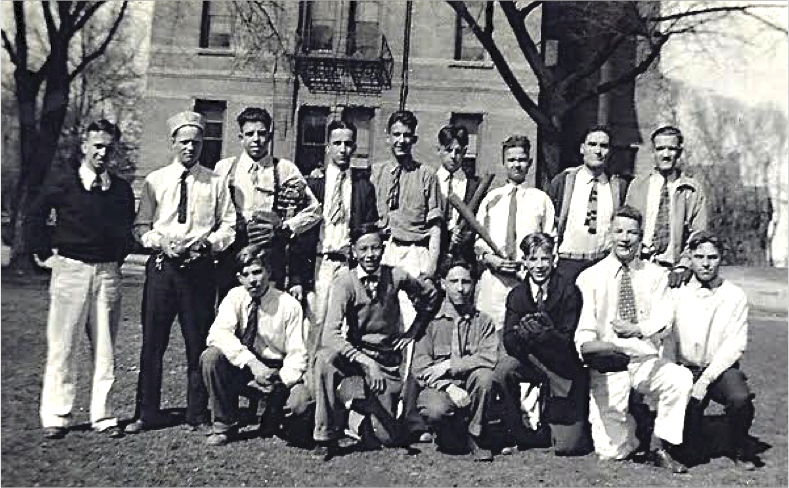
Students at the Utah School for the Deaf, 1928-1930. Back L-R: Wayne Stewart, William Woodward, Alton Fisher, John (Jack) White, Joseph Burnett, possible Leon Edwards, Arvel Christensen, Virgil Greenwood, ____ Front L-R: J. Sherwood Messerly, Rodney Walker, Melvin Penman, Wesley Perry, Verl Throup, _____. Photo courtesy of Keith E. Stewart
Extracurricular Activities
at the Utah School for the Deaf
In addition to their academic studies, students at the Utah School for the Deaf participated in a wide variety of extracurricular activities. According to the 1976 and 1984 alumni reunion booklets, these activities included the Park Literary Society, Arthur Wenger Athletic Association, Drama Club, Spur Club, Ski Club, Student Body Government, Junior National Association of the Deaf (Junior NAD), Student Council, athletic programs, Boy Scouts, and Girl Scouts (First Reunion of the Utah School for the Deaf Alumni Booklet, 1976; A Century of Memories: Utah School for the Deaf 100th Year Anniversary Alumni Reunion Booklet, 1984).
These organizations provided opportunities for students to develop leadership skills, build friendships, and participate in school life beyond the classroom. Through these activities, students learned responsibility, teamwork, and public service while strengthening their connections to the broader Deaf community.
Most students were members of The Church of Jesus Christ of Latter-day Saints and regularly attended services at the Ogden Branch for the Deaf on Sundays and Tuesday evenings. Students from other religious backgrounds attended Protestant chapel services. Religious activities provided additional opportunities for fellowship and community involvement (First Reunion of the Utah School for the Deaf Alumni Booklet, 1976; A Century of Memories: Utah School for the Deaf 100th Year Anniversary Alumni Reunion Booklet, 1984).
Among the many student organizations on campus, the Park Literary Society, the Arthur Wenger Athletic Association, and the Spur Club emerged as the three most influential clubs, playing an important role in shaping student leadership, social interaction, and community engagement at the Utah School for the Deaf.

The three most prominent clubs at the Utah School for the Deaf were the Park Literary Society, the Arthur Wenger Athletic Association, and the Spur Club. Courtesy of the Kenneth C. Burdett Bulletin Board
The Park Literary Society
In 1897, one year after the Utah School for the Deaf relocated from Salt Lake City to Ogden, students established the Park Literary Society in honor of Dr. John R. Park, president of the University of Deseret (now the University of Utah). Deaf students held John in high regard for his support of Deaf education and the Utah School for the Deaf.
The Park Literary Society was the school's first organized club. Its members, generally between the ages of 14 and 17, met every two weeks throughout the school year to develop their skills in creative writing, acting, public speaking, and literary appreciation. The society also provided an opportunity for students to participate in debates on a variety of topics. Students were expected to prepare presentations, stories, plays, and debate arguments independently, without assistance from teachers (Roberts, 1994).
The Park Literary Society was the school's first organized club. Its members, generally between the ages of 14 and 17, met every two weeks throughout the school year to develop their skills in creative writing, acting, public speaking, and literary appreciation. The society also provided an opportunity for students to participate in debates on a variety of topics. Students were expected to prepare presentations, stories, plays, and debate arguments independently, without assistance from teachers (Roberts, 1994).
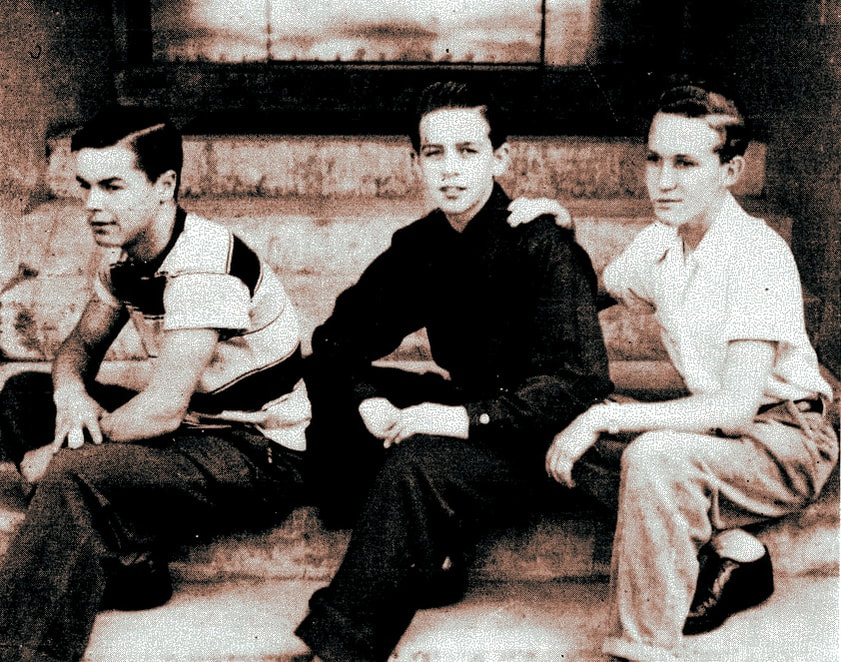
The Park Literary Society at the Utah School for the Deaf in 1949. Left to right: Secretary Peter Green, Vice-President, Jerry Westburg, President W. David Mortensen. Source: The 1949 Utahn
The school magazine, Eaglets, documented many of the society's debates. Topics included whether Abraham Lincoln was a greater leader than George Washington, whether the United States should recognize the independence of Cuba, and whether boys had more fun than girls. Judges selected from among faculty members and the Utah Deaf community determined the winners. These debates helped students strengthen their communication, public speaking, teamwork, organizational, and research skills while broadening their understanding of current events and history (Roberts, 1994; First Reunion of the Utah School for the Deaf Alumni Booklet, 1976; A Century of Memories: Utah School for the Deaf 100th Year Anniversary Alumni Reunion Booklet, 1984).
Participating in the Park Literary Society helped students develop confidence and leadership skills that would benefit them throughout their lives. The society's emphasis on independent thinking and effective communication made it one of the most influential student organizations in the history of the Utah School for the Deaf.
Participating in the Park Literary Society helped students develop confidence and leadership skills that would benefit them throughout their lives. The society's emphasis on independent thinking and effective communication made it one of the most influential student organizations in the history of the Utah School for the Deaf.

The Park Literary Society at the Utah School for the Deaf in 1944. Courtesy of the Kenneth C. Burdett Bulletin Board

The Park Literary Society at the Utah School for the Deaf in 1954. Courtesy of the Kenneth C. Burdett Bulletin Board

The Park Literary Society at the Utah School for the Deaf in 1955. Courtesy of the Kenneth C. Burdett Bulletin Board
The Park Literary Society Produced
The House of Rimmon
In 1921, the Park Literary Society demonstrated the creativity and talent of Deaf individuals through its production of The House of Rimmon. Arthur W. Wenger, a Deaf graduate of the Utah School for the Deaf's Class of 1913, directed the biblical drama with assistance from Elsie Christiansen, a Deaf graduate from the Class of 1907.
The play's initial performance in the school chapel was highly successful and generated such enthusiasm that a second performance was scheduled at East High School in Salt Lake City. Admission was free, and audience members responded enthusiastically, giving the cast a standing ovation. The production showcased the abilities of Deaf performers while helping educate the public about the talents and potential of Deaf individuals (White, The Silent Worker, June 1920; Wenger, The Silent Worker, January 1921; UAD Bulletin, Summer 1964).
On September 5, 1956, representatives of the Utah Association of the Deaf and the Utah School for the Deaf met and decided to discontinue the Park Literary Society (Sanderson, The Utah Eagle, October 1956). Unfortunately, the reason for the society's closure remains unknown.

The “The House of Rimmon” Play at the Utah School for the Deaf in 1920.
Source: The UAD Bulletin, Summer 1964

Scene from the House of Rimmon Play. Source: The Silent Worker, January 1921
Did You Know?
Dr. John R. Park played a pivotal role in the establishment and development of Deaf education in Utah. In 1884, John Beck and William Wood, both fathers of Deaf children, petitioned the Utah Territorial Legislature to create a school for Deaf students. The legislature approved their request and assigned John, then president of the University of Deseret, to oversee the initiative.
John arranged for the university to establish a class for Deaf students and hired Henry C. White, a Deaf educator from Boston, to lead the program. Throughout his life, John remained deeply committed to the success of Deaf education in Utah. For eight years, he supervised the Utah School for the Deaf and recognized the need for the school to become independent from the university. Using his influence, he helped make that transition possible.
When the school eventually became independent and relocated to Ogden, John was delighted by its success. During visits to the campus, students warmly remembered and welcomed him. Even in the final years of his life, he maintained a strong interest in the school's welfare. Utah School for the Deaf employees who visited his Salt Lake City office observed the same dedication and enthusiasm that had characterized his involvement from the beginning.
John served as president of the university during both the territorial and early statehood periods of Utah for nearly 25 years. He was born on September 30, 1835, and died on September 30, 1900, on his 65th birthday (Metcalf, The Utah Eagle, October 15, 1900; The Utah Eagle, October 15, 1900).

John R. Park Source: Wikipedia
The Arthur Wenger Athletic Association
The Arthur Wenger Athletic Association (AWAA) was a club for older boys at the Utah School for the Deaf. Founded in 1919, the organization was named in honor of Arthur W. Wenger, a graduate of the Utah School for the Deaf and one of its most active alumni leaders. The club's primary purpose was to promote fellowship, leadership, and social development through athletic and recreational activities (Roberts, 1994).
Members raised funds by selling candy on campus under the sponsorship of the AWAA. These fundraising activities helped support the club's programs and provided students with opportunities to develop responsibility and organizational skills.
On September 5, 1956, representatives of the Utah Association of the Deaf and the Utah School for the Deaf met and voted to discontinue the Arthur Wenger Athletic Association. At the time of its closure, the club had accumulated approximately $1,000. Rather than disbanding without a legacy, the AWAA donated its remaining funds to create a scholarship program through the Utah Association of the Deaf Scholarship Fund. This program later evolved into the Utah Scholarship Foundation for the Deaf and eventually the Ned C. Wheeler Scholarship Foundation for the Deaf (Sanderson, The Utah Eagle, October 1956).

The Arthur Wenger Athletic Association at the Utah School for the Deaf in 1944. L-R: Sam Judd, Merrill Bauer, Melwin Sorensen, Lod Perkins and Paul Loveland. Courtesy of the Kenneth C. Burdett Bulletin Board

The Arthur Wenger Athletic Association at the Utah School for the Deaf in 1955. Courtesy of the Kenneth C. Burdett Bulletin Board

The Arthur Wenger Athletic Association at the Utah School for the Deaf in 1956. Courtesy of the Kenneth C. Burdett Bulletin Board
The Spur Club
The Spur Club was organized in 1943 for high school girls attending the Utah School for the Deaf. Its mission was to support school activities while promoting school spirit, leadership, and community service.
The name "Spur" reflected the club's goal of encouraging enthusiasm, strengthening morale, and fostering good sportsmanship. Members were expected to serve as role models for younger students and uphold high standards of behavior that reflected positively on both themselves and the school. Through service projects and sponsorship of school activities, the Spur Club provided young women with opportunities to develop leadership skills and contribute to campus life (The Utah Eagle, November 1943).
The name "Spur" reflected the club's goal of encouraging enthusiasm, strengthening morale, and fostering good sportsmanship. Members were expected to serve as role models for younger students and uphold high standards of behavior that reflected positively on both themselves and the school. Through service projects and sponsorship of school activities, the Spur Club provided young women with opportunities to develop leadership skills and contribute to campus life (The Utah Eagle, November 1943).

The four leaders in the new Spur Club at the Utah School for the Deaf: L-R: Irene Liddell, Mary Antonietti, Ruby Anderson, and Lorraine Whitesides. Source: The Utah Eagle, November 1943
Extracurricular organizations such as the Spur Club played an important role in helping students develop social skills, confidence, and lasting friendships. These experiences contributed to the growth of Deaf communities throughout Utah and Idaho, as students carried their leadership abilities and social connections into adulthood (Roberts, 1994).
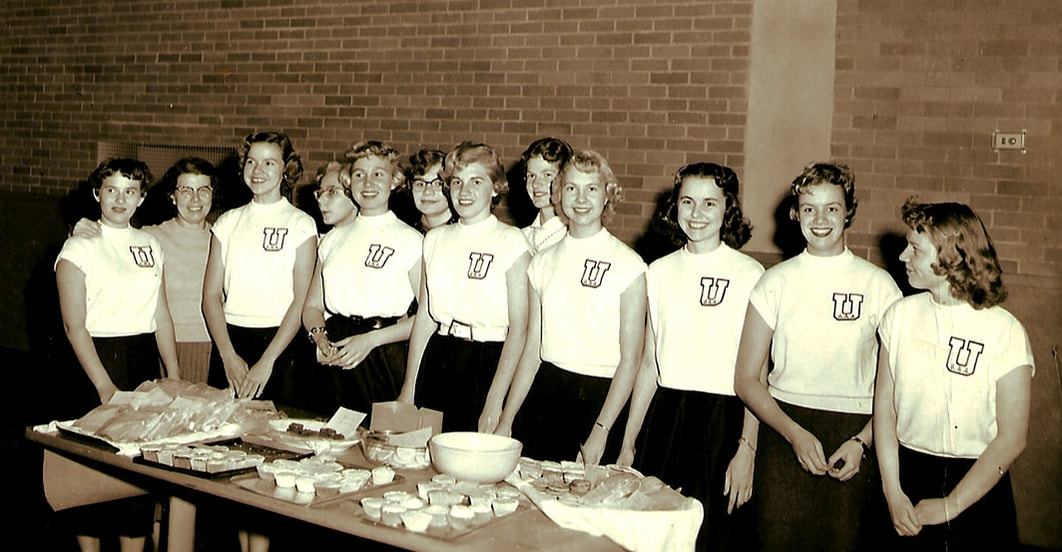
The Spur Club at the Utah School for the Deaf in Ogden, Utah, in 1955-56. Front L-R: Gayla Marlow, Afton Curtis Burdett, Lois Williams, Darlene Green, Lucille Simmons, Virginia Brown, Ilene Coles, Elaine Sprouse, Betty Jo Alldredge. Back L-R: Judith Jenkins, Carola Selzle, Lucille Simmons. Photo courtesy of Kenneth and Ilene Kinner
Beyond clubs, the Utah School for the Deaf hosted an annual formal banquet to recognize students who demonstrated outstanding service and achievement. Boy Scout and Girl Scout troops also participated in a variety of educational and recreational programs, further enriching student life and encouraging community involvement (Roberts, 1994).

The students at the Utah School for the Deaf between 1933 and 1936. Front Row L-R: Robert G. Sanderson, _____, Frank Orlando, _______ Back Row L-R: _____, Lloyd Jones, _____, and Oliver I. Langworthy. Photo courtesy of Keith E. Stewart
The Annual May Festival
of the Utah School for the Deaf
The Utah School for the Deaf held its first May Festival in 1909 and continued the tradition annually until 1936. The festival became one of the school's most popular and celebrated events, showcasing students' talents through dance, music, pageantry, and dramatic performances. The performances attracted large audiences from both the Deaf and hearing communities. One festival reportedly drew an audience of approximately 5,000 spectators (Pace, 1946).
The most successful festival was the ninth annual pageant, held in May 1920, entitled "The Story of the Deaf." The production was first performed on the school campus in Ogden and later presented on the lawn of Liberty Park in Salt Lake City. Students wore costumes representing various nations and dramatized the Deaf community's struggle against prejudice, exclusion, and misunderstanding. The pageant conveyed the message that education empowers Deaf individuals to overcome barriers and achieve success, happiness, and full participation in society (Wenger, The Silent Worker, January 1921).
The most successful festival was the ninth annual pageant, held in May 1920, entitled "The Story of the Deaf." The production was first performed on the school campus in Ogden and later presented on the lawn of Liberty Park in Salt Lake City. Students wore costumes representing various nations and dramatized the Deaf community's struggle against prejudice, exclusion, and misunderstanding. The pageant conveyed the message that education empowers Deaf individuals to overcome barriers and achieve success, happiness, and full participation in society (Wenger, The Silent Worker, January 1921).
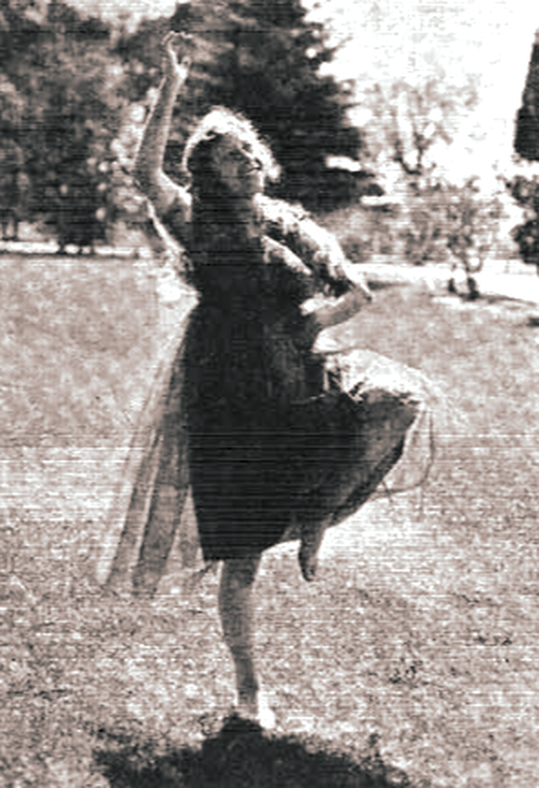
Edna Wright in the role of “The
Maiden.” Source: Silent Worker, January 1921

The front cover of The Silent Worker, vol. 33, no. 4, January 1921
Among the featured performers were Mona Leckliter, Vida Crawford, Elsie Lamb, Gladys Jones, and Coraline Wood, who appeared as soloists. Arthur W. Wenger, a graduate of the Utah School for the Deaf's Class of 1913, praised their performance, noting that they represented the five senses: sight, taste, touch, smell, and hearing. The dancers gracefully portrayed these senses while a group of young women entered seeking their blessings. Together, they celebrated the gifts and opportunities represented by the five senses.

The Annual May Festival
of the Utah School for the Deaf. Source: The Silent Worker, January 1921
The pageant took an emotional turn when the young women lost the sense of hearing. Edna Wright portrayed the central character, the "Maiden," who represented a Deaf individual struggling to understand her new reality. Heartbroken by the loss of hearing, the Maiden sought comfort and guidance. Although hearing could not be restored, the remaining senses offered their support. Knowledge, represented as a powerful force for empowerment, called upon nature in the form of butterflies, birds, and flowers to encourage and uplift the Maiden. Through education, friendship, and self-discovery, she found hope and renewed confidence.
The pageant ultimately illustrated the Deaf community's long struggle for equality, acceptance, and recognition. As the performance concluded, dancers representing various nations appeared on stage. According to Arthur, each figure symbolized a different society or culture until the appearance of the "Maiden" of the Stars and Stripes, who emerged from the folds of the American flag. Arthur described her as representing "liberty, equity, and prosperity to all." He wrote that her graceful dancing and expressive performance captivated the audience and inspired admiration from all who witnessed the production (Wenger, The Silent Worker, January 1921, p. 113).
The May Festival became one of the Utah School for the Deaf's most distinctive traditions. Through pageantry, storytelling, and artistic expression, students celebrated Deaf identity while demonstrating their talents and abilities to both Deaf and hearing audiences. The festival served as a powerful reminder that Deaf individuals could achieve success, contribute to society, and take pride in their culture and community.

Dressed in flowing chiffon gowns for their role in one of the
USD’s famous May Festivals in 1920 are, left to right, front,
Corline Wood, Ellen Lusk, Gladys Jones; center, Verda
Williams, Vida Crawford, Catherine Crawford, Eda Wright,
Irene Linderman; back, Mary Erying, Lona Thompson, Mona
Leckliter, Florence Funk, and Violet Taylor. Source: The UAD Bulletin, Summer 1963
The May Festival was held on the
Utah School for the Deaf campus in 1910

The May Festival was held on the Utah School for the Deaf campus in 1910. Merrill Funk took the picture from the 4th floor of the old Main Building.
Photo courtesy of the Kenneth C. Burdett Bulletin Board
Helen Keller’s Visit to the
Utah Schools for the Deaf and the Blind
On March 14, 1941, Helen Keller, the renowned DeafBlind advocate, visited the Utah Schools for the Deaf and the Blind (USDB) accompanied by her interpreter, Polly Thompson, and business manager, Ida Hirst-Gifford. Prior to her visit to the school, Helen traveled to Utah on behalf of the American Foundation for the Blind, where she appeared before the Utah Legislature to advocate for blind adults. She also addressed a crowd of approximately 5,000 people at the Mormon Tabernacle.
During her visit to the USDB, Helen spoke to students assembled in the chapel of the Main Building. Superintendent Frank Driggs assisted with the interpretation, while Polly communicated with Helen through speech and the manual alphabet. During a question-and-answer session, a student spelled into Helen's hand, asking, "What is the most outstanding thing you have found on your visit to Utah?" Helen immediately replied, "The good will toward the adult blind" (The Utah Eagle, March 1941, p. 11).
During her visit to the USDB, Helen spoke to students assembled in the chapel of the Main Building. Superintendent Frank Driggs assisted with the interpretation, while Polly communicated with Helen through speech and the manual alphabet. During a question-and-answer session, a student spelled into Helen's hand, asking, "What is the most outstanding thing you have found on your visit to Utah?" Helen immediately replied, "The good will toward the adult blind" (The Utah Eagle, March 1941, p. 11).

Helen Keller. Source: Bio.com
One student who vividly remembered the visit was Kleda Barker Quigley. Reflecting on the experience years later, Kleda recalled watching Helen and Polly enter the assembly chapel and address the Deaf and blind students. She was amazed by Helen's intelligence, determination, and ability to communicate despite being both Deaf and blind. Kleda was particularly impressed by the speed and skill with which Helen and Polly communicated.
In 2014, Kleda discussed Helen's visit during a videophone conversation with several Utah School for the Deaf alums, including Fred Richins, G. Leon Curtis, Jay A. Barker, Winona Anderson, Gerry Shepard, and others. During the discussion, Leon recalled asking Helen whether she would rather be Deaf or blind. According to Kleda, Helen responded that she would choose to be blind. Kleda noted that most Deaf people she knew would prefer to be Deaf rather than blind. Regardless, Helen's visit left a lasting impression on her, and she remained grateful for the opportunity to have met such an inspirational figure (Kleda Quigley, e-mail message to Jodi Christel Becker, April 15, 2015).
In 2014, Kleda discussed Helen's visit during a videophone conversation with several Utah School for the Deaf alums, including Fred Richins, G. Leon Curtis, Jay A. Barker, Winona Anderson, Gerry Shepard, and others. During the discussion, Leon recalled asking Helen whether she would rather be Deaf or blind. According to Kleda, Helen responded that she would choose to be blind. Kleda noted that most Deaf people she knew would prefer to be Deaf rather than blind. Regardless, Helen's visit left a lasting impression on her, and she remained grateful for the opportunity to have met such an inspirational figure (Kleda Quigley, e-mail message to Jodi Christel Becker, April 15, 2015).

Kleda Barker Quigley. Source: Jenkins-Soffe Utah Funeral Homes
The Burdett’s Picnic and Boating Party
In 1953, Kenneth C. Burdett, affectionately known as "KB," a Deaf teacher at the Utah School for the Deaf, organized a summer picnic and boating party for high school students. Eleanor Kay Kinner, a member of the Class of 1954, later wrote an article entitled "Burdett's Picnic and Boating Party" for The Utah Eagle, describing the event and expressing her admiration for KB as both a teacher and youth leader.
During the summer of 1953, Utah experienced unusually hot and dry weather. Students sought relief by enjoying cold drinks, swimming, and outdoor recreation. Despite occasional nighttime showers, the dry conditions made it difficult to maintain lawns, flowers, and gardens throughout the community.
On August 2, students received an invitation from KB and his wife, Afton to attend a boating and picnic outing at Pineview Reservoir. Excitement quickly spread among the students. The invitation included several boys and girls who lived outside the Ogden area, and many traveled to Ogden so they could participate. The outing took place the Sunday following the wedding of Peter and Sally Green and became a memorable summer event for those who attended.
The picnic and boating party reflected KB's commitment to providing meaningful social opportunities for Deaf youth. Events such as these allowed students to strengthen friendships, enjoy recreational activities, and build a sense of community beyond the classroom.

Eleanor Kay Kinner. Photo courtesy of Kenneth and Ilene Kinner
"The day began cold and rainy and they thought that they might not be able to go there. While they stayed at the Burdett home, they waited and waited for the rain to stop. Suddenly, the rain stopped, and the sun shone very brightly about noon. They thought the weather was queer. When the sun shone through the window onto the floor, they were ready, and started for Pine View Lake.
Some of them went water-skiing and surf boarding. Some of the girls and boys went riding in the boat with Kenneth Burdett. Kenneth Kinner held onto the rope and went water skiing. They were nonplussed that Max Hardy could water ski and ride a surfboard. He just held onto the rope and rode the waves, then went water skiing at once. He was successful although that was his first time. Von Jones, Dona Mae Dekker, Lawana Simmons, and Bruce Harvey tried to learn how to control themselves while water skiing. Some fell down all the time, but some were successful. Dixie Lee Larsen and Kay Kinner water-skied well because they had done this before at Bear Lake. They had fun going water skiing and surf riding.
At the beach, they rested and the Burdetts treated them to cold drinks. They took sunbaths for a while. They had fun going water skiing and surf riding. They fell and tried to manage themselves.
In the evening, the students went to the Burdetts’ for a barbecue in their yard. It was delicious and they did enjoy going to the picnic and boating party. It was all very interesting for them. Marion Brown and her boyfriend were with them” – Kay Kinner (Kinner, The Utah Eagle, October 1953).

Students went boating with Kenneth and Afton Burdett, Deaf teachers at
Pineview Reservoir, 1953. Standing L-R: Kay Kinner, Marion Brown,
Bruce Harvey, Dixie Lee Larsen, Afton Burdett, Kenneth Burdett, Max
Hardy, Donna Mae Dekker, Leon Curtis, Von Jones, Lawana Simmons.
Sitting L-R: Kenneth Kinner and Ronald Burdett. Photo courtesy of Kenneth and Ilene Kinner

'Summer Fun at Pineview Reservoir.' Source: The Utah Eagle, October 1953
KB devoted his life to the Utah School for the Deaf and to the success of Deaf students. Between 1934 and 1974, he served the school in numerous capacities, including boys' supervisor, head basketball coach, athletic director, teacher, printing instructor, and curriculum coordinator. His four decades of service left a lasting impact on generations of students (The Ogden Standard-Examiner, May 23, 1974).
Beyond his work at the school, KB was an active member of the Utah Association of the Deaf, the National Fraternal Society of the Deaf, and the Golden Spike Athletic Club of the Deaf. He believed strongly in the value of athletics, leadership development, and community involvement.
KB earned widespread respect for his dedication to student success, his encouragement of athletic participation, and his genuine concern for the well-being of his students. His enthusiasm, leadership, and ability to inspire young people made him one of the most admired educators in the history of the Utah School for the Deaf. Former students remembered him not only as an excellent teacher and coach but also as a mentor who encouraged them to achieve their fullest potential (Dr. Robert G. Sanderson and Valerie G. Kinney, e-mail message to Jodi Christel Becker, July 8, 2011).

Kenneth C. Burdett. Photo courtesy of Ronald C. Burdett
Holiday Celebrations at
the Utah School for the Deaf
Holidays were important social occasions during the early years of the Utah School for the Deaf. Because many students lived on campus throughout the school year, holiday celebrations provided opportunities for recreation, fellowship, and a sense of family. Students typically remained at school during Thanksgiving and were entertained with special meals and activities. Most students returned home only during the Christmas holidays (Roberts, 1994; Evans, 1999). By 1913, students who lived nearby were permitted to return home for the Thanksgiving holiday weekend (Evans, 1999).
The school also celebrated Arbor Day, Valentine's Day, Easter, and other seasonal holidays. Teachers organized many of these events, including Arbor Day programs, Valentine's socials, and other holiday gatherings. While the school was located in Salt Lake City, Superintendent Frank Metcalf and members of the faculty sponsored masquerade dances and various social events throughout the year. Spring and autumn gatherings were especially popular, allowing teachers and older students to socialize together. Many lifelong friendships were formed at these events, and several eventually led to marriages (Roberts, 1994).
Because most students lived away from home, birthday celebrations held special significance. The school regularly organized birthday parties for both students and teachers, helping cultivate a warm and supportive atmosphere. The Metcalf children frequently invited Deaf students to their own birthday celebrations, further strengthening the sense of belonging and family at the school (Roberts, 1994).

Students of the Utah School for the Deaf, spring 1945. They were going on the annual spring hike. Photo courtesy of Kenneth and Ilene Kinner
School Events and Trips
Students at the Utah School for the Deaf participated in a variety of recreational outings, educational excursions, and seasonal activities. These experiences provided opportunities for socialization, recreation, and learning outside the classroom.
Before and after the school's relocation from Salt Lake City to Ogden, students often attended circus performances. Winter activities were especially popular. While the school was located in Salt Lake City, students enjoyed sledding on the hills between the campus and the future site of the Utah State Capitol. After the move to Ogden, the school gardener maintained an ice-skating rink on campus for many years, allowing students to enjoy skating throughout the winter season (Roberts, 1994).
John Beck, one of the founders of the Utah School for the Deaf, owned Beck's Hot Springs north of Salt Lake City. Before the school's move to Ogden, John's sons, Joseph, John A., and Jacob, along with other older boys, often visited the resort and enjoyed its recreational opportunities (Roberts, 1994).

John Beck. Source: The National Cyclopedia of American Biography

Beck’s Hot Springs, 1908. Source: 2001 Utah State Historical Society

Jacob Beck, 1921. Photo courtesy of the Salt Lake City Division No. 56
As transportation improved and family travel became easier, many students returned home during major holidays such as Thanksgiving, Christmas, and Easter (Roberts, 1994).
The school also organized nature walks, sightseeing excursions, and shopping trips. These activities provided educational experiences while offering students a welcome change from daily campus routines. Such outings encouraged social interaction and allowed students to explore their surrounding communities (Roberts, 1994).
During one excursion, students met Dr. James E. Talmage, a professor at the University of Utah and a noted geologist. James was already familiar with the school because his blind brother, Albert Talmage, attended the Utah School for the Blind. The students encountered James while visiting Ogden Canyon around 1900 or 1901.

Dr. James Talmage. Source deseretnews.com
According to The Utah Eagle:
"Some of the large boys went up to the mouth of Ogden Canyon with Mr. Crandall the other day. They wanted to look at the bridge which was recently destroyed by a rock falling from the immense cliff at the mouth of the canyon. They met Dr. Talmage, formerly president of the University of Utah. He was to examine the tunnel, the cliff, the fissure and the water pipe and report to the electric Power Plant Company regarding the cause of the break and the proper course to pursue to repair the damage done. Dr. Talmage is a learned geologist and a very prominent scientist" (The Utah Eagle, p. 70).
Several influential figures also visited the Utah School for the Deaf and developed meaningful relationships with students. One notable visitor was David O. McKay, who visited while teaching at Weber Stake Academy and serving in the Utah State Legislature. He later became President of The Church of Jesus Christ of Latter-day Saints (Roberts, 1994).

David O. McKay. Source: eligion.fandom.com
Another important supporter was Maud May Babcock, the University of Utah's first female faculty member and founder of the university's Departments of Speech, Physical Education, and University Theater. Maud served on the Board of Trustees of the Utah School for the Deaf and the Blind for 22 years, including 12 as board president. Her remarkable career at the University of Utah spanned 46 years, and she also became the first woman to serve as a Senate chaplain in Utah (Toone, Deseret News, May 7, 2014).
Maud was a dedicated advocate for Deaf education. While serving on the Board of Trustees, she traveled to eastern schools for the Deaf in 1904 to study their instructional methods. Following her research, she successfully advocated for additional funding and educational opportunities at the Utah School for the Deaf. She frequently visited students to share her experiences and encourage their academic growth (Roberts, 1994). At the Utah Association of the Deaf Convention in 1915, she shared observations from her visits to Deaf schools in France and Germany, providing Utah Deaf community members with an international perspective on Deaf education (The UAD Bulletin, Summer 1963).
Maud was a dedicated advocate for Deaf education. While serving on the Board of Trustees, she traveled to eastern schools for the Deaf in 1904 to study their instructional methods. Following her research, she successfully advocated for additional funding and educational opportunities at the Utah School for the Deaf. She frequently visited students to share her experiences and encourage their academic growth (Roberts, 1994). At the Utah Association of the Deaf Convention in 1915, she shared observations from her visits to Deaf schools in France and Germany, providing Utah Deaf community members with an international perspective on Deaf education (The UAD Bulletin, Summer 1963).

Maud May Babcock. Source: utahwomenshistory.org
Another influential supporter was Edwin A. Stratford, who served for several years as chairman of the Board of Trustees for the Utah School for the Deaf. He continued his leadership following the school's separation from the University of Utah and its relocation to Ogden. In 1896, Edwin also served as superintendent of the students' Sunday School program for The Church of Jesus Christ of Latter-day Saints at the school.
Together, individuals such as Frank Metcalf, James Talmage, David O. McKay, Maud May Babcock, Edwin Stratford, and many others helped strengthen the Utah School for the Deaf during its formative years. Through their advocacy, leadership, and personal involvement, they increased public awareness of Deaf education and helped secure support for the school's continued growth and success (Roberts, 1994).
Together, individuals such as Frank Metcalf, James Talmage, David O. McKay, Maud May Babcock, Edwin Stratford, and many others helped strengthen the Utah School for the Deaf during its formative years. Through their advocacy, leadership, and personal involvement, they increased public awareness of Deaf education and helped secure support for the school's continued growth and success (Roberts, 1994).

Edwin A. Stratford. Source: Black’s Family History
Legislative Leadership Opportunity
During Utah's territorial period, students at the Utah School for the Deaf were given unique opportunities to develop leadership and civic engagement skills. School administrators and teachers encouraged students to advocate for their educational needs by communicating directly with legislators and requesting funding for the school. Even after Utah achieved statehood in 1896, students continued working with lawmakers to secure financial support for the Utah School for the Deaf and its programs (Roberts, 1994).
Each year, the school organized an "exhibition" on campus that showcased students' academic achievements and talents. Legislators and other community leaders were invited to attend and observe students demonstrating their educational progress through presentations, performances, and classroom activities. These exhibitions allowed students to interact directly with policymakers, explain the value of Deaf education, and demonstrate the importance of continued state support. The experience not only educated legislators but also strengthened students' confidence, communication skills, and sense of civic responsibility (Roberts, 1994).
In January 1896, students participated in a special legislative exhibition that highlighted their educational accomplishments. During the event, they performed songs, recited poetry, and presented readings that demonstrated the quality of instruction they received. They also toured the Utah State Capitol and met with government officials, gaining firsthand knowledge of how government operates.
Through these experiences, students learned about the functions of the three branches of government: the legislative branch, consisting of the House and Senate; the executive branch, headed by the governor; and the judicial branch, which interprets and applies the law through the courts. The visit exposed students to concepts and experiences that few young people of the time had the opportunity to encounter. In many cases, students gained a greater understanding of state government than their own parents possessed (Roberts, 1994).
The leadership skills developed through these legislative experiences had a lasting impact. Many graduates later assumed leadership roles within Utah's Deaf community and became active advocates for social change. They carried these skills into organizations such as the Utah Association of the Deaf, where they worked to address issues affecting Deaf individuals throughout the state.
Over the years, Deaf leaders advocated for improvements in auto insurance accessibility, traffic safety, protection from fraudulent peddlers, Deaf education, early intervention services, employment opportunities, vocational rehabilitation, interpreting services, health care access, telecommunications, assistive technology, youth leadership development, and numerous other issues affecting the Deaf community. The Utah School for the Deaf's emphasis on civic engagement and advocacy helped prepare generations of Deaf Utahns to become effective leaders, organizers, and champions for equal access and opportunity (Roberts, 1994).
This tradition of advocacy became one of the school's most enduring legacies, empowering Deaf individuals to influence public policy and strengthen the Utah Deaf community for generations.
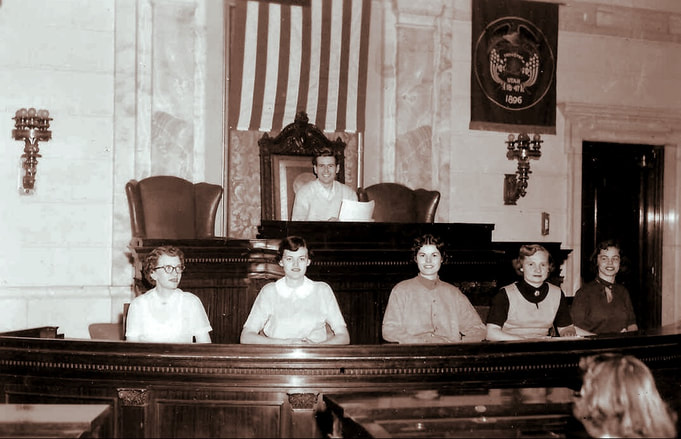
The Utah School for the Deaf Senior trip to the Utah State Capitol in 1954
Top: Kenneth Kinner. L-R: Shanna Christiansen, Donna Mae Dekker,
Eleanor Kay Kinner, Clara Bosshardt and Carol MacTee. Photo courtesy of Kenneth and Ilene Kinner
The Formation of the
Utah Association of the Deaf

Elizabeth DeLong. Source: The UAD Bulletin, Summer 1963
Elizabeth DeLong, First Female President
of the Utah Association of the Deaf
Elizabeth DeLong, affectionately known as "Libbie," was one of the most influential figures in Utah Deaf history. After graduating from the Utah School for the Deaf in 1897, she became the first Utah School for the Deaf graduate to earn a degree from Gallaudet College in 1902. She then returned to Utah and became the first Deaf teacher with a college degree to teach at her alma mater. Her achievements opened doors for future generations of Deaf students and educators throughout the state.
Libbie's leadership extended beyond education. Inspired by the formation of the National Association of the Deaf (NAD) in 1880, Deaf leaders across the nation began establishing state organizations to advocate for the interests and welfare of Deaf individuals. Libbie played a central role in co-founding the Utah Association of the Deaf (UAD) on June 10, 1909. Her commitment to community service, education, and social welfare quickly established her as one of Utah's most respected Deaf leaders (Evans, 1999).
The day after the UAD was established, members elected officers for the new organization. In a historic election on June 11, 1909, Libbie defeated two male candidates and became the first female president of the Utah Association of the Deaf. Her election was groundbreaking not only for Utah but also nationally, as she became the first woman to serve as president of any state association affiliated with the National Association of the Deaf. At a time when women faced widespread discrimination and had limited political rights, her victory demonstrated the confidence that Utah's Deaf community placed in her leadership.
Libbie's success reflected years of preparation and advocacy. While attending Gallaudet College, she joined a secret support organization for women known as O.W.L.S., now Phi Kappa Zeta. Established to address the challenges faced by Deaf women in the predominantly male environment of Gallaudet College, the organization encouraged leadership, mutual support, and advocacy. Libbie's fellow members recognized her abilities by electing her president in 1901 (The Buff and Blue, October 1901; This Week in 19th Amendment History: Agatha Tiegel Hanson, October 17, 1959).
The experiences Libbie gained through O.W.L.S. strengthened her commitment to women's rights and equality. During this era, Deaf women faced barriers related to both gender and hearing loss. Although hearing women in Utah had gained the right to vote in 1870 through territorial legislation, women throughout the nation continued to fight for equal political representation. Within Deaf organizations, opportunities for women were also limited. Notably, Deaf women were not permitted to vote in National Association of the NAD elections until 1964. Libbie's achievements demonstrated that Deaf women could serve as effective leaders despite these restrictions.
Growing up in Utah's progressive suffrage environment helped shape Libbie's outlook. She developed a strong belief in civic participation, education, and equal opportunity. These values guided her work as an educator, advocate, and organizational leader. Throughout her career, she promoted educational advancement, employment opportunities, and greater social inclusion for Deaf individuals.
As president of the Utah Association of the Deaf from 1909 to 1915, Libbie championed initiatives that strengthened Utah's Deaf community. At the conclusion of her second term in 1915, she delivered a memorable address at the UAD convention (The Ogden Daily Standard, June 9, 1915; The UAD Bulletin, Summer 1963). In her speech, she emphasized the importance of women's suffrage and encouraged greater civic engagement among Deaf citizens. Her ability to connect Deaf rights with broader social movements reflected her forward-thinking leadership.
Libbie's influence extended far beyond her presidency. Through her advocacy, she helped improve opportunities for Deaf people in education, employment, and community life. She also served as an important role model for Deaf women, demonstrating that leadership positions were attainable despite social barriers. Her accomplishments contributed to a more inclusive and representative Deaf community in Utah.
Today, Libbie is remembered as a pioneer whose achievements transformed Utah Deaf history. Her record of historic firsts includes becoming the first Utah School for the Deaf graduate to earn a degree from Gallaudet College, the first Deaf teacher with a college degree at the Utah School for the Deaf, a co-founder of the Utah Association of the Deaf, and the first female president of both the UAD and any state association affiliated with the National Association of the Deaf.
Her legacy continues through the Elizabeth DeLong School of the Deaf, one of Utah's ASL/English bilingual schools, which proudly bears her name. By honoring her contributions, the school preserves the memory of a remarkable leader whose dedication to education, equality, and community empowerment continues to inspire new generations of Deaf students, educators, and advocates.
The Better Days 2020 project also features Elizabeth DeLong's biography alongside other trailblazing Utah women whose contributions helped shape the state's history. Their stories remind us that meaningful progress is often achieved through perseverance, leadership, and a commitment to expanding opportunities for others.

The 1909 Utah Association of the Deaf Officers. Photo courtesy of the Special Collections at the J. Willard Marriott Library, University of Utah
The Advocacy of the
Utah Association of the Deaf
The Utah Association of the Deaf (UAD), founded in 1909, is one of the oldest organizations representing Deaf individuals in Utah and the United States. Since its founding, UAD has worked to protect and promote the human, civil, educational, linguistic, social, accessibility, and economic rights of Deaf people, making it a cornerstone of Deaf advocacy in Utah.
Throughout its history, UAD has advocated for improved access to education, employment, telecommunications, interpreting services, rehabilitation services, traffic safety, and other programs affecting the Deaf community. Its efforts have helped advance awareness, equality, and opportunities for Deaf Utahns.
Among its many accomplishments, UAD helped establish the Robert G. Sanderson Community Center of the Deaf and Hard of Hearing, which serves as an important hub for community programs and services. The organization has also been a strong supporter of the Jean Massieu School of the Deaf, promoting ASL/English bilingual education and educational opportunities for Deaf children.
UAD has also played a significant role in legislative advocacy. Notable achievements include support for Senate Bill 41, which established interpreter certification requirements, and Senate Bill 42, which recognized American Sign Language (ASL) as a foreign language in 1994. These measures expanded access to qualified interpreting services and increased recognition of ASL throughout Utah.
For decades, UAD has advocated for accessible communication technologies, including telecommunications, closed captioning, and video relay services. The organization has also supported sign language education at the Utah School for the Deaf, particularly during periods when oral and mainstream educational approaches became more common. These efforts helped preserve language access and Deaf cultural identity for future generations.
In 1985, UAD played an important role in establishing the Deaf Education Program at Utah State University. The program initially followed a Total Communication philosophy and later transitioned to a bilingual model in 1991. Although the bilingual program ended in 2025 because of budget reductions, UAD continues to advocate for accessible, high-quality Deaf education throughout Utah.
Today, UAD remains actively involved in promoting communication access, inclusive education, community leadership, and civil rights. The organization collaborates with partners such as the Utah School for the Deaf, the Robert G. Sanderson Community Center of the Deaf and Hard of Hearing, and the Sego Lily Center for the Abused Deaf to support Deaf individuals across Utah.
UAD serves a diverse community that includes Deaf, Hard of Hearing, DeafBlind, DeafDisabled, Late-Deafened, Deaf LGBTQ+ individuals, Deaf people of color, and women. Through advocacy, education, leadership development, and community engagement, UAD continues to build upon more than a century of service to Utah's Deaf community.
The Effect of the Oral and Mainstreaming
Movements on the Utah School for the Deaf
For many decades, Deaf students from across Utah attended the Utah School for the Deaf in Ogden, where they lived, learned, and socialized with one another. Beginning in the 1960s, however, Deaf education in Utah shifted significantly under the leadership of Dr. Grant B. Bitter, a prominent advocate of oral and mainstream education. Because of his extensive efforts to place Deaf students in neighborhood public schools rather than residential schools for the deaf, Grant became widely known as the "Father of Mainstreaming" in Utah.

Dr. Grant B. Bitter. Source: The Utah Eagle, October 1962
This movement stood in sharp contrast to the earlier vision of Dr. Martha Hughes Cannon, a member of the Board of Trustees of the Utah School for the Deaf and the Blind and the first female state senator in the United States. In 1896, Martha sponsored legislation requiring the education of Deaf, blind, and mute children in Utah. Her efforts helped establish the Utah School for the Deaf and the Blind as the state's primary educational institution for Deaf and blind students (Martha Hughes Cannon, Wikipedia, April 20, 2024). She believed Deaf children deserved access to a comprehensive education in an environment that accommodated their communication needs and fostered a strong sense of community.
By contrast, Grant strongly believed Deaf children should learn spoken language and, whenever possible, attend local public schools alongside hearing peers. His advocacy helped gradually expand mainstream educational opportunities throughout Utah. These changes mirrored broader national trends and gained additional momentum following the passage of Public Law 94-142 in 1975, now known as the Individuals with Disabilities Education Act (IDEA). The law guaranteed students with disabilities access to a free and appropriate public education in the least restrictive environment and significantly influenced educational practices across the United States.
By contrast, Grant strongly believed Deaf children should learn spoken language and, whenever possible, attend local public schools alongside hearing peers. His advocacy helped gradually expand mainstream educational opportunities throughout Utah. These changes mirrored broader national trends and gained additional momentum following the passage of Public Law 94-142 in 1975, now known as the Individuals with Disabilities Education Act (IDEA). The law guaranteed students with disabilities access to a free and appropriate public education in the least restrictive environment and significantly influenced educational practices across the United States.

Martha Hughes Cannon. Source: Utah State Historical Society, Deseret News Archives
Dr. Grant B. Bitter's Influence
Grant's commitment to Deaf education was deeply personal. His daughter, Colleen, was born deaf in 1954, and her experiences profoundly influenced his educational philosophy. During his professional training at the Lexington School for the Deaf, Grant became troubled by the practice of separating young Deaf children from their families for extended periods of time. These experiences strengthened his belief that Deaf children should remain at home and, whenever possible, be educated within their local communities (Bluhm, 1987).
Grant had an extensive career in teaching and curriculum development. He began his professional career in the Extension Division of the Utah School for the Deaf in Salt Lake City, where he served as a teacher and curriculum coordinator. His dedication to Deaf education eventually led him to the University of Utah, where he became a professor and director of the Teacher Preparation Program within the Department of Special Education. There, he focused primarily on oral education and the preparation of future teachers of Deaf and hard-of-hearing students. Grant also served as coordinator of the Deaf Seminary Program for The Church of Jesus Christ of Latter-day Saints in Utah.
Throughout his career, Grant remained firmly committed to oralism, the philosophy that Deaf individuals should learn to communicate through speech and listening skills. His belief in oral education shaped his work as an educator and influenced the curriculum he helped develop at the University of Utah. To further promote oral Deaf education, he founded the Oral Deaf Association of Utah (ODAU) in 1970 and later helped establish the Utah Registry of Oral Interpreters in 1981 (Bitter, April 15, 1985; Bitter, October 22, 1986).

Colleen Bitter Addie. Source: The Salt Lake Tribune Obituary, July 24, 2003
In the 1970s, Stephen C. Baldwin, a Deaf educator and Curriculum Coordinator of the Total Communication Division at the Utah School for the Deaf, reflected on Grant's influence. Stephen described Grant as one of the nation's strongest advocates of oral education and characterized him as a "hard-core oralist." He further noted that few individuals worked as tirelessly to promote oral and mainstream educational approaches (Baldwin, 1990).
According to Stephen, Grant believed that sign language limited the development of speech and listening skills. He argued that oral education would better prepare Deaf individuals to participate in mainstream society. As a result, he favored programs that emphasized spoken language and supported policies that reduced reliance on sign language in residential educational settings (Baldwin, 1990).
According to Stephen, Grant believed that sign language limited the development of speech and listening skills. He argued that oral education would better prepare Deaf individuals to participate in mainstream society. As a result, he favored programs that emphasized spoken language and supported policies that reduced reliance on sign language in residential educational settings (Baldwin, 1990).

Dr. Stephen C. Baldwin. Source: The Utah Eagle, April 1975
A Philosophical Divide
The debate between Grant Bitter and supporters of residential Deaf education reflected a much larger philosophical disagreement within the Deaf community.
Grant believed Deaf students would benefit most from learning spoken language and attending neighborhood schools. In contrast, many Deaf community leaders believed Deaf children should have access to sign language and opportunities to interact with other Deaf students in a culturally and linguistically accessible environment.
Among the most prominent advocates of sign language and residential Deaf education was Dr. Robert G. "Bob" Sanderson. Having become deaf at age eleven, Bob strongly supported educational programs that preserved sign language and Deaf culture. Through his leadership in the Utah Association for the Deaf (UAD), he worked to ensure that Deaf children had access to sign-language-based educational opportunities. Grant's promotion of oral communication and mainstream education also sparked a longstanding conflict with the UAD (Becker, 2026).
The rivalry between these two giant figures—Grant Bitter and Bob Sanderson—stemmed from their ongoing disagreement over the use of oral and sign language approaches in Utah's Deaf education system. This conflict was not merely a matter of personal preference; it represented a fundamental disagreement over the most effective methods for educating Deaf children. Each side sought to influence policy and practice in a rapidly changing educational landscape, like a chess match, which heightened tensions. As the conflict intensified, both groups rallied supporters to advocate for their views and influence public opinion and policymakers (Becker, 2026). The outcome of this debate would help shape the future of Deaf education in Utah and influence similar discussions across the nation.
Over time, the differences between Grant and Bob became one of the most influential debates in Utah Deaf history. Their disagreement centered not only on communication methods but also on broader questions involving language, identity, culture, educational access, and the best way to prepare Deaf children for adulthood.

Dr. Robert G. Sanderson. Courtesy of Gallaudet University Archives
Understanding ASL and
Listening and Spoken Language
To better understand this controversy, it is important to recognize that American Sign Language (ASL) and Listening and Spoken Language (LSL) represent different approaches to communication and education.
ASL provides Deaf individuals with direct visual access to language and supports identity development, cognitive growth, and participation in Deaf culture. However, because relatively few hearing people know ASL, Deaf individuals may encounter communication barriers in everyday settings and often rely on interpreters for full access.
LSL focuses on developing listening and spoken communication skills. This approach can support participation in spoken-language environments and neighborhood schools. However, its success often depends on early intervention, consistent therapy, advanced hearing technology, and ongoing support. Listening and lipreading can also be physically and mentally demanding. When spoken-language approaches do not provide full language access and sign language is not introduced, children may be at risk of language deprivation.
Today, many families view ASL and LSL as complementary rather than competing approaches and often combine elements of both to meet the individual needs of their children (Becker, 2026).
Conflict Between Oral and Sign-Language Advocates
Grant Bitter helped shape policies that favored oral and mainstream educational approaches in Utah. During his graduate training, he was troubled by seeing Deaf children attend residential schools and live away from their families. This experience reinforced his belief in mainstreaming and local educational placement (Bluhm, March 17, 1987).
In contrast, Bob, supported by the UAD, actively participated in ongoing debates regarding sign language and oral communication. He and the UAD emphasized the importance of accessible sign-language education at the Utah School for the Deaf. The disagreement became increasingly heated and played out through oral demonstration panels, picket protests, committee meetings, board discussions, and legislative hearings (Bluhm, March 17, 1987).
During the intense controversy over oral versus sign language education, Grant formally demanded the termination of Bob Sanderson and Dr. Jay J. Campbell, both respected advocates for sign language, at a meeting of the USBE. He argued that their actions were obstructing his mission to promote oral and mainstream education. Moreover, he requested the resignation of Della L. Loveridge, a Utah legislator and the respected chairperson of the committee. He criticized her decision to invite representatives from the UAD, including Bob, viewing this invitation as a deviation from the committee's purpose and focus (Bluhm, March 17, 1987).
Grant's objections extended beyond committee proceedings. He also criticized Beth Ann Stewart Campbell's televised news interpretations in American Sign Language, claiming they conflicted with his oral educational philosophy and urging that the interpreted news segment be discontinued. Furthermore, he called for Bob's dismissal from his position with the Utah State Office of Rehabilitation because Bob had assigned Beth Ann to provide the interpreted broadcasts (Robert G. Sanderson, personal communication, October 21, 2006; Stewart, DSDHH Newsletter, April 2012).
Lasting Impact
The UAD, led by Bob, played a vital role in raising concerns about oral education and mainstreaming policies, while Grant continued to advocate for those approaches. As a representative of the Deaf community, Bob provided significant insight into the challenges Deaf individuals faced in Utah.
Because most Deaf children are born to hearing parents, advocates such as Grant often held considerable influence in shaping educational policy. With support from parents who favored oral education, Grant successfully promoted oral and mainstream programs throughout Utah. Despite the substantial influence of Grant and other oralists, the UAD and its supporters remained steadfast in advocating for sign language, communication access, and the rights of Deaf children.
Their efforts helped preserve educational options for Deaf students and contributed to continuing discussions about language, identity, educational choice, accessibility, and Deaf culture. The debate between oralism and sign-language education remains one of the most significant chapters in Utah Deaf history. Understanding both perspectives provides valuable insight into the evolution of Deaf education and the ongoing efforts to ensure that Deaf children have meaningful access to language, education, and opportunity.
The Introduction of the Dual-Track Program
In the fall of 1962, Utah's Deaf community was surprised by major educational reforms at the Utah School for the Deaf with the implementation of the dual-track program, commonly known as the "Y" system. The new policy profoundly affected the education of Deaf children and quickly became one of the most controversial developments in Utah Deaf history.
The Utah Association of the Deaf (UAD), which supported sign language and residential Deaf education, was unaware that the Utah Council for the Deaf had played a major role in promoting the change. The council advocated for speech-based instruction and successfully pushed for its implementation at the Utah School for the Deaf in Ogden (The UAD Bulletin, Fall-Winter 1962). It is believed that Grant was a member of this council.
The dual-track program established two separate educational pathways: an oral department and a simultaneous communication department, which was later replaced by a combined communication system. Under the policy, however, all Deaf children were initially required to enroll in the oral department, regardless of their individual communication needs (The Utah Eagle, February 1968; Gannon, 1981). On June 14, 1962, the Utah State Board of Education approved the plan with the support of the Special Study Committee on Deaf Education (The Ogden Standard-Examiner, June 14, 1962; Wight, The Ogden Standard-Examiner, October 19, 1970). After an initial placement period, students could transfer to either the oral or sign language track (Smiley, The Salt Lake Tribune, June 14, 1962; The Ogden Standard-Examiner, June 14, 1962).
Newly appointed superintendent Robert W. Tegeder accepted recommendations from parents who favored oral education and initiated significant changes within the school system (The UAD Bulletin, Fall-Winter 1962; Bluhm, March 17, 1987). These reforms affected not only Deaf children but also their families and the broader Utah Deaf community.

Robert W. Tegeder. Source: The Utah Eagle, October 1959
The "Y" System
The "Y" system imposed significant restrictions on students and their families by separating instruction into two distinct educational tracks. The oral department emphasized speech, lipreading, amplified sound, and reading, while the simultaneous communication department utilized signs, the manual alphabet, speech, and reading (The Utah Eagle, February 1968).
Under this policy, all Deaf children were initially required to enroll in the oral department for the first six years of their education. At the end of that period, a committee evaluated each student's progress and determined whether the student would remain in the oral department or transfer to the simultaneous communication department (The Utah Eagle, February 1968).
Because the oral department served as the default placement, many Deaf community members believed the system favored oral education over sign language. Parents and students had little choice in educational placement until approximately the 6th or 7th grade, when students could continue in the oral department or transfer to the simultaneous communication department (The Utah Eagle, February 1968; Dr. Grant B. Bitter's Paper, 1970s; Deanne Kinner Montgomery, personal communication with the author, May 4, 2024).
Students who transferred from the oral department to the signing program were often labeled "oral failures," a term that created stigma and frustration for many families (The UAD Bulletin, Spring 1965).
Historical sources differ slightly regarding the age or grade level at which students became eligible to transfer. The First Reunion of the Utah School for the Deaf Alumni Program Book (1976) indicates that students generally transferred between the ages of 10 and 12, while The Utah Eagle (February 1968) stated that students remained in the oral department for their first six years of schooling. For this reason, it is most accurate to describe transfer eligibility as occurring around the 6th or 7th grade, depending on each student's individual educational progress.
Changes to the School Environment
The implementation of the dual-track program required major organizational changes at the Utah School for the Deaf. Additional oral teachers were hired, and speech became the primary mode of instruction for younger students. All elementary-aged students entered the oral department, and only those who experienced difficulty progressing within that program were transferred to the simultaneous communication department.
School administrators believed that oral language skills should be developed first and that sign language should play a secondary role in the educational process. As a result, the school's culture and instructional environment changed dramatically. The increased emphasis on oral education altered daily classroom experiences, staffing patterns, and communication practices throughout the campus (The Utah Eagle, February 1968; Deanne Kinner Montgomery, personal communication with the author, May 4, 2024).
The dual-track program also influenced teacher preparation. Training increasingly emphasized oral methods rather than sign language, and school administrators promoted what they described as a "pure oral mindset" among educators. In 1968, the Utah School for the Deaf was one of the few residential schools in the nation to provide a completely oral elementary program (The Utah Eagle, February 1968). By 1973, school officials promoted the dual-track system as unique because it offered both oral and simultaneous communication options within the same institution (Laflamme, The Ogden Standard-Examiner, September 5, 1973).
Segregation on Campus
Following approval of the dual-track program on June 14, 1962, the Ogden campus underwent dramatic physical changes during the summer break (The Ogden Standard-Examiner, June 14, 1962).
The residential campus was divided into separate oral and simultaneous communication departments. Each department maintained its own classrooms, dormitories, dining facilities, recess schedules, and extracurricular activities. Interaction between students in the two programs was discouraged or prohibited in an effort to maintain separate communication environments (The Utah Eagle, February 1968; Wight, The Ogden Standard-Examiner, October 19, 1970).
Athletics provided one of the few exceptions. Because there were not enough students in either department to support separate sports programs, athletic teams combined students from both tracks. Coaches representing both communication approaches worked together to communicate with their respective athletes (The Utah Eagle, February 1968).
This unique arrangement illustrated the practical difficulties and social tensions created by the dual-track system.
Student Reactions to the Dual-Track Program
During the 1962-63 school year, significant changes were implemented at the Utah School for the Deaf without prior notice to Deaf students. When students arrived on campus in August 1962, many were shocked to discover the new policies and divisions within the school. The changes generated considerable frustration among older students and led to disagreements among veteran teachers, administrators, and members of the Utah Deaf community (Diane Quinn Williams, personal communication with the author, 2007).
Barbara Schell Bass, a longtime Deaf teacher at the Utah School for the Deaf, later recalled that the physical and educational separation of students had painful consequences. According to Barbara, philosophical disagreements strained friendships among teachers, classmates became socially divided, and administrators struggled to balance competing loyalties (Bass, 1982).
Barbara Schell Bass, a longtime Deaf teacher at the Utah School for the Deaf, later recalled that the physical and educational separation of students had painful consequences. According to Barbara, philosophical disagreements strained friendships among teachers, classmates became socially divided, and administrators struggled to balance competing loyalties (Bass, 1982).
The 1962 Student Protest
The student protests of 1962 and 1969 were fueled by dissatisfaction with the dual-track program's "Y" segregation system, the separation of oral and signing students, and the administration's perceived dismissal of student concerns (Ogden Standard-Examiner, September 14, 1962; Ogden Standard-Examiner, September 15, 1962; Manuelita "Nellie" Sausedo, personal communication with the author, 2007; Ronald C. Burdett, personal communication with the author, 2007; Celia May Laramie Baldwin, e-mail message to Jodi Christel Becker, April 1, 2024).
Following the 1962 protest against social segregation on the Ogden residential campus, Dr. Grant B. Bitter and other supporters of oral education suspected that the Utah Association for the Deaf had organized the student strike. The Utah State Board of Education investigated the allegations but found no evidence connecting the students' actions to the Utah Association for the Deaf (Sanderson, The UAD Bulletin, Summer 1963; Kenneth L. Kinner, personal communication, May 14, 2011).
Students in the simultaneous communication department organized their own demonstrations in response to the segregation policies. Their actions reflected growing frustration with restrictions that limited interactions between oral and signing students.
Dr. Robert G. Sanderson, who served as president of the Utah Association for the Deaf from 1960 to 1963, denied any involvement in the strike. He maintained that the protest was a spontaneous response by students who felt that conditions at the Utah School for the Deaf had become intolerable (Sanderson, The UAD Bulletin, Summer 1963).
In its Fall-Winter 1962 issue of the UAD Bulletin, the Utah Association of the Deaf expressed support for testing the dual-track program in the classroom. However, the organization strongly opposed complete social isolation, interference with religious activities, damage to the athletic program, and pressure placed on oral students to comply with the "no signing" policy (UAD Bulletin, Fall-Winter 1962, p. 2).
For many members of Utah's Deaf community, the implementation of the dual-track program marked one of the most controversial chapters in the history of Deaf education in Utah.

Dr. Robert G. Sanderson. Source: The UAD Bulletin, Winter 1965
The 1969 Walkout
The 1969 walkout represented another significant act of student resistance and echoed the concerns raised during the 1962 protest (Dale R. Cook, Paul Arthur, and Linda Snodgrass James, personal communication with the author, May 29, 2011). Although students did not achieve all of their goals, they continued seeking ways to express dissatisfaction with the continuing social segregation imposed by the "Y" system.
Some signing students deliberately crossed into hallways designated for oral students, while others entered areas reserved for the simultaneous communication department. These actions violated school rules that designated certain spaces as off-limits in an effort to maintain what administrators viewed as separate communication environments. Some students openly challenged oral teachers, accusing them of exercising excessive control and authority over Deaf students (Raymond Monson, e-mail message to Jodi Christel Becker, November 9, 2010).
For nearly a decade, the Utah Association for the Deaf and the Parent-Teacher-Student Association worked together to oppose the "Y" system. Supported by parents who favored sign language, these organizations continually challenged the dual-track system despite repeated setbacks and opposition.
Creation of the Two-Track Program
Faced with continuing controversy, Superintendent Robert W. Tegeder sought assistance from Dr. Jay J. Campbell, Deputy Superintendent of the Utah State Office of Education and a strong ally of Utah's Deaf community. Concerned about the welfare of Deaf children and the growing conflict surrounding the "Y" system, Jay worked to develop a new educational framework intended to replace the segregated structure then in place (First Reunion of the Utah School for the Deaf Alumni, 1976; Campbell, 1977; Dr. Jay J. Campbell, personal communication with the author, July 1, 2007).

Dr. Jay J. Campbell. Source: UAD Bulletin, June 1973
Ned C. Wheeler, a 1933 graduate of the Utah School for the Deaf and chair of the USDB Governor's Advisory Council, played a significant role in the effort to reform the existing system. Influenced by Jay's proposals, the student protests of 1962 and 1969, and ongoing opposition from the Parent-Teacher-Student Association, Ned proposed a revised two-track system that would provide parents with educational choices.

Ned C. Wheeler. Photo courtesy of Edith Deininger Wheeler
On December 28, 1970, the Utah State Board of Education approved a new policy that eliminated the "Y" system. The new policy allowed parents to choose between oral and total communication approaches for Deaf children between the ages of 2½ and 21 (Kenneth L. Kinner, personal communication with the author, May 14, 2011; Recommendations on Policy for the Utah School for the Deaf, 1970; Deseret News, December 29, 1970).
However, while supervising the Utah School for the Deaf, Jay observed that many parents were not fully informed about the educational and communication options available to their Deaf children (Campbell, 1977). Although the Utah State Board of Education adopted policies in 1970, 1977, and 1998, the Utah School for the Deaf's Communication Guidelines did not consistently provide parents with a broad range of educational choices. As a result, placement practices were often influenced by a prevailing oral bias, limiting informed decision-making by families.
On April 14, 1977, Jay presented a comprehensive 202-page study of the Utah School for the Deaf to the Utah State Board of Education. His report proposed improvements to the school's educational system through more equitable evaluation and placement procedures. Grant, then a professor at the University of Utah, strongly opposed Jay's findings. He argued that the report contained inaccuracies and drew unsupported conclusions regarding the University of Utah's Oral Teacher Training Program and Deaf education programs throughout the state (G.B. Bitter, March 6, 1978).
The presentation generated intense debate. More than 300 parents attended the meeting, many of whom supported the oral method and applauded Dr. Bitter and Peter Viahos, an Ogden attorney and father of a Deaf daughter, as they presented arguments against Jay's recommendations (The Ogden Standard-Examiner, April 15, 1977).
A group of parents aligned with Grant petitioned the Utah State Board of Education to suspend Jay's study, arguing that its findings were inconclusive. Dissatisfied with his conclusions, they also called for his dismissal (Dr. Jay J. Campbell, personal communication with the author, July 1, 2007). The meeting drew approximately 300 parents and between 50 and 60 Deaf community members, including Ned C. Wheeler, W. David Mortensen, Lloyd L. Perkins, Dennis R. Platt, and Kenneth L. Kinner.
As a spokesperson for oral advocates, Grant presented Jay's supervisor, Dr. Walter D. Talbot, State Superintendent of Public Instruction, with three proposed courses of action:
Dr. Talbot's response intensified tensions within the meeting. Members of the Deaf community strongly opposed the State Board's decision to reassign Jay within the Utah State Office of Education. Their dissatisfaction was evident as they expressed their frustration by stomping on the floor in protest. In his 1987 oral history interview, Grant described the atmosphere as highly emotional and chaotic, stating that he considered leaving the room. Concerned about the escalating conflict, Dr. Talbot ultimately asked Deaf community members to leave the meeting (Bluhm, March 17, 1987). Accounts of the incident vary, and differing interpretations of what occurred remain a subject of disagreement.
However, while supervising the Utah School for the Deaf, Jay observed that many parents were not fully informed about the educational and communication options available to their Deaf children (Campbell, 1977). Although the Utah State Board of Education adopted policies in 1970, 1977, and 1998, the Utah School for the Deaf's Communication Guidelines did not consistently provide parents with a broad range of educational choices. As a result, placement practices were often influenced by a prevailing oral bias, limiting informed decision-making by families.
On April 14, 1977, Jay presented a comprehensive 202-page study of the Utah School for the Deaf to the Utah State Board of Education. His report proposed improvements to the school's educational system through more equitable evaluation and placement procedures. Grant, then a professor at the University of Utah, strongly opposed Jay's findings. He argued that the report contained inaccuracies and drew unsupported conclusions regarding the University of Utah's Oral Teacher Training Program and Deaf education programs throughout the state (G.B. Bitter, March 6, 1978).
The presentation generated intense debate. More than 300 parents attended the meeting, many of whom supported the oral method and applauded Dr. Bitter and Peter Viahos, an Ogden attorney and father of a Deaf daughter, as they presented arguments against Jay's recommendations (The Ogden Standard-Examiner, April 15, 1977).
A group of parents aligned with Grant petitioned the Utah State Board of Education to suspend Jay's study, arguing that its findings were inconclusive. Dissatisfied with his conclusions, they also called for his dismissal (Dr. Jay J. Campbell, personal communication with the author, July 1, 2007). The meeting drew approximately 300 parents and between 50 and 60 Deaf community members, including Ned C. Wheeler, W. David Mortensen, Lloyd L. Perkins, Dennis R. Platt, and Kenneth L. Kinner.
As a spokesperson for oral advocates, Grant presented Jay's supervisor, Dr. Walter D. Talbot, State Superintendent of Public Instruction, with three proposed courses of action:
- Remove Dr. Campbell from his position;
- Reassign him to another position; or
- Request a grand jury investigation into allegations that oral Deaf individuals had been intimidated by certain state programs (Bluhm, March 17, 1987).
Dr. Talbot's response intensified tensions within the meeting. Members of the Deaf community strongly opposed the State Board's decision to reassign Jay within the Utah State Office of Education. Their dissatisfaction was evident as they expressed their frustration by stomping on the floor in protest. In his 1987 oral history interview, Grant described the atmosphere as highly emotional and chaotic, stating that he considered leaving the room. Concerned about the escalating conflict, Dr. Talbot ultimately asked Deaf community members to leave the meeting (Bluhm, March 17, 1987). Accounts of the incident vary, and differing interpretations of what occurred remain a subject of disagreement.

Dr. Walter D. Talbot. Source: The Utah Eagle, April 1970
Although the Utah State Board of Education accepted Jay's report and supporting documentation, it rejected all of his recommendations despite the report's inclusion of data from independent researchers (The Ogden Standard-Examiner, April 15, 1977). As a result, Jay's proposed reforms, including a two-year study designed to improve educational assessment and placement procedures, were never implemented. According to Jay, the plan was effectively shelved and eventually forgotten (Dr. Jay J. Campbell, personal communication with the author, July 1, 2007).
The legacy of the "Y" system and the oral bias embedded within the dual-track program continued to influence parental choice and educational placement for many years. During the 1970s, Jay sought to provide parents with more balanced information through the Parent Infant Program Orientation. Grant opposed these efforts, arguing that total communication lacked a meaningful relationship between sign language and spoken language and characterizing it primarily as a gestural system. He also questioned the validity of the research supporting total communication (Campbell, 1977; Cummins, The Salt Lake Tribune, August 20, 1977; Bluhm, March 17, 1987).
For many years, the Parent Infant Program at the Utah School for the Deaf strongly favored oral approaches and did not consistently provide balanced information about the full range of educational and communication options available to Deaf children. The Utah Deaf Education Core Group, a leading advocate for ASL-English bilingual education, criticized this imbalance and called for parents to receive objective and comprehensive information.
In 2010, Superintendent Steven W. Noyce of the Utah Schools for the Deaf and the Blind developed a revised Parent Infant Program Orientation intended to provide parents with more balanced information. Noyce, a longtime educator, school director, oral advocate, and former student of Dr. Bitter, sought to ensure that families understood the available educational options. Nevertheless, many parents still faced what some viewed as an "either-or" decision between ASL-English bilingual education, which replaced total communication, and Listening and Spoken Language, which replaced the oral program. As a result, the Listening and Spoken Language program continued to expand.

Steven W. Noyce. Source: Twitter
The Utah Association of the Deaf has worked for decades to protect sign language and support Deaf education in Utah. At the same time, Dr. Grant B. Bitter remained one of the most influential advocates of oral and mainstream education in the state. Drawing upon both his personal experiences as a parent and his professional career in Deaf education, Grant significantly shaped educational policy from the 1960s onward.
His advocacy contributed to increased mainstream placement and a corresponding decline in residential school enrollment in Ogden. Many Deaf alums believed these changes weakened the educational and social environment that had long provided language access, cultural identity, and community connections for Deaf students. Following the closure of the Teacher Training Program in the Department of Special Education at the University of Utah in 1986, Grant retired in 1987 (Bitter, March 15, 1985).
Today, the University of Utah's Department of Special Education continues to offer a Deaf and Hard of Hearing specialization. Although the program includes coursework in American Sign Language, it places substantial emphasis on Listening and Spoken Language approaches. This continuing emphasis reflects the lasting influence that Grant, who passed away in 2000, had on Deaf education in Utah. His impact, along with the continuing advocacy of the Utah Deaf community, remains evident in ongoing discussions about language, educational placement, parental choice, and access to communication for Deaf children.

Students at the Utah School for the Deaf, Ogden, Utah, in the 1940s. Photo courtesy of Kenneth and Ilene Kinner
Accreditation Visiting Team Report on the
Utah Schools for the Deaf and the Blind and
Its Impact on the Residential Campus
In 2010, the Utah Schools for the Deaf and the Blind (USDB) underwent an evaluation of its services conducted by an Accreditation Visiting Team during the administration of Superintendent Steven W. Noyce. The Accreditation Visiting Team Report noted that some students living in the dormitory and cottage facilities reported feelings of loneliness despite efforts to create a home-like environment. The report also indicated that many Utah families were reluctant to enroll their children in residential programs, creating challenges for sustaining and expanding residential services (Utah Schools for the Deaf and the Blind Accreditation Visiting Team Report, 2010).
These concerns reflected broader educational trends that had been developing for several decades. During the special education reforms of the 1970s, national educational policies underwent significant changes. The passage of Public Law 94-142, the Education for All Handicapped Children Act of 1975, expanded educational opportunities for students with disabilities and enabled many families to access services closer to home. As a result, residential schools across the United States experienced declining enrollments as increasing numbers of students were educated in their local communities.
At the same time, many alums of the Utah School for the Deaf shared experiences that differed from the perspectives expressed in the Accreditation Visiting Team Report. In the First Reunion of the Utah School for the Deaf Alumni Booklet (1976) and A Century of Memories: Utah School for the Deaf 100th Year Anniversary Alumni Reunion Booklet (1984), former students described positive experiences and successful adjustments to life at the residential campus in Ogden. They recalled lifelong friendships, extracurricular activities, athletic participation, leadership opportunities, and a strong sense of belonging within the Deaf community (First Reunion of the Utah School for the Deaf Alumni Booklet, 1976; A Century of Memories: Utah School for the Deaf 100th Year Anniversary Alumni Reunion Booklet, 1984).
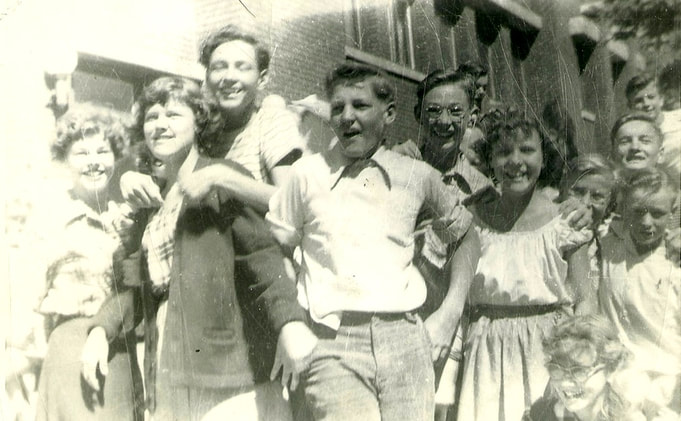
Deaf students at the Utah School for the Deaf in Ogden, Utah, Fall 1949. Top row L-R: Carol McTee, Renea Nelson, Arthur Valdez, Bruce Harvey, Max Hardy, and Carol Nelson. Lower row: Rollin Jones, La Vell Olson, Doyle Fergus. Upper row: Alden Broomhead, and a girl at the bottom whose name is unknown. Photo courtesy of Kenneth and Ilene Kinner
Similar themes are reflected in the book "A Journey Into the Deaf-World," in which the authors describe how residential schools often provided Deaf children with opportunities to interact with Deaf role models, educators, older students, and alums. These interactions helped foster personal identity, cultural awareness, community connection, and self-confidence. For many Deaf individuals, residential schools served not only as educational institutions but also as important centers of social and cultural development.
Questions have also been raised regarding the perspectives represented in the Accreditation Visiting Team Report. Steven Noyce was a former student of Dr. Grant B. Bitter's Oral Training Program at the University of Utah during the early 1970s and later supported the integration of Deaf and hard-of-hearing students into general education settings. Some members of the Deaf community have questioned whether these experiences and educational philosophies may have influenced the report's interpretation of residential education. Historical records indicate that alums were not formally consulted during the accreditation review process, leaving their perspectives absent from the final report.
Additional insight into residential life is preserved through historical film and photographic collections. In 1989, the Utah Association of the Deaf presented a 16-mm film, "A History of the Utah School for the Deaf: 1940–1965 during its 33rd Biennial Convention. Along with the extensive film collection created by Kenneth C. Burdett, a 1929 graduate and later teacher at the Utah School for the Deaf, these materials preserve valuable visual documentation of student life, including classroom activities, social events, athletics, field trips, and graduation ceremonies (Mortensen, UAD Bulletin, June 1989).

W. David Mortensen. Photo courtesy of W. David and Shanna Mortensen
In June 1990, W. David "Dave" Mortensen, then president of the Utah Association of the Deaf and a graduate of the Utah School for the Deaf, reflected on his experiences at the residential campus in the UAD Bulletin. He described his years at the school as "very, very happy times," emphasizing the educational opportunities, friendships, leadership experiences, and extracurricular activities that shaped his life. Mortensen credited the residential environment with fostering personal growth and helping students develop lasting connections within the Deaf community.
At the same time, Dave acknowledged that educational practices had changed and raised important questions about the long-term effects of mainstreaming. Rather than dismissing alternative educational models, he encouraged educators and families to consider the experiences of residential school alums when evaluating educational options for Deaf children. His reflections emphasized the importance of examining multiple viewpoints and recognizing that educational experiences can vary among individuals and across generations (Mortensen, UAD Bulletin, June 1990, p. 1).
At the same time, Dave acknowledged that educational practices had changed and raised important questions about the long-term effects of mainstreaming. Rather than dismissing alternative educational models, he encouraged educators and families to consider the experiences of residential school alums when evaluating educational options for Deaf children. His reflections emphasized the importance of examining multiple viewpoints and recognizing that educational experiences can vary among individuals and across generations (Mortensen, UAD Bulletin, June 1990, p. 1).

Utah Association for the Deaf President W. David Mortensen's President's Message. Source: UAD Bulletin, June 1990, p. 1
The Implementation of the Hybrid Program
at the Utah School for the Deaf
After more than five decades of oral advocacy influence at the Utah School for the Deaf following the implementation of the dual-track system in 1962, an important milestone was reached in 2016. Under the leadership of Michelle Tanner, Associate Superintendent of the Utah School for the Deaf, and with the support of Joel Coleman, Superintendent of the Utah Schools for the Deaf and the Blind, the hybrid program was introduced.
The hybrid program allows the ASL/English bilingual program and the Listening and Spoken Language (LSL) program to work collaboratively without favoring one approach over the other. Its goal is to provide Deaf students with educational placements that best meet their individual language, communication, and learning needs. The program also eliminates the need for parents to make an "either-or" choice between the two approaches, representing an important step toward providing families with more balanced information and greater educational flexibility (Michelle Tanner, e-email message to Jodi Christel Becker, October 17, 2021).
The hybrid program allows the ASL/English bilingual program and the Listening and Spoken Language (LSL) program to work collaboratively without favoring one approach over the other. Its goal is to provide Deaf students with educational placements that best meet their individual language, communication, and learning needs. The program also eliminates the need for parents to make an "either-or" choice between the two approaches, representing an important step toward providing families with more balanced information and greater educational flexibility (Michelle Tanner, e-email message to Jodi Christel Becker, October 17, 2021).
Michelle Tanner, USD Assoc. Supt; Joel Coleman, USDB Superintendent; Carolyn Lasater, USB Assoc. Supt. Source: Twitter
The Establishment of ASL/English Bilingual
Schools and the Impact of Listening
& Spoken Language on Deaf Education
In 1999, the Jean Massieu School of the Deaf (JMS) was established in Salt Lake City as a public charter school. The school's creation stemmed from concerns regarding the educational performance and structure of the Utah School for the Deaf. JMS was founded to provide Deaf students with a stronger cultural, social, and linguistic environment centered on Deaf culture and ASL/English bilingual education. The school was named after Jean Massieu, a renowned Deaf French educator whose accomplishments continue to inspire Deaf education worldwide.
Since its establishment, JMS has made significant contributions to Deaf education in Utah. The school successfully integrated Deaf culture, language, and identity into its educational program while maintaining high academic expectations. JMS also promotes student development through extracurricular opportunities, including athletics, drama, student government, and participation in the Junior National Association of the Deaf. These activities help students develop leadership, teamwork, and advocacy skills that benefit both the students and the broader Utah Deaf community.
In addition, the Utah School for the Deaf expanded its educational offerings through the establishment of two ASL/English bilingual schools: the Kenneth C. Burdett School of the Deaf in Ogden and the Elizabeth DeLong School of the Deaf in Springville. These schools provide families with additional educational options and continue the tradition of accessible language-rich environments for Deaf students.
The Utah Deaf community has demonstrated remarkable resilience throughout periods of educational change. While mainstreaming, cochlear implant technology, and the growth of Listening and Spoken Language programs have altered the educational landscape, organizations such as the Utah Association of the Deaf, the Jean Massieu School of the Deaf, the Kenneth C. Burdett School of the Deaf, and the Elizabeth DeLong School of the Deaf continue to advocate for Deaf children and support their educational success.
As educational philosophies and communication approaches continue to evolve, the Utah Deaf community remains committed to preserving Deaf culture, promoting language accessibility, and ensuring that Deaf children receive an education that meets their individual needs. Their ongoing advocacy reflects a long history of perseverance, adaptability, and dedication to future generations.
Conclusion
Utah is home to a vibrant and enduring Deaf community whose development has been profoundly influenced by the Utah School for the Deaf. Since its founding in 1884, the school has played a central role in shaping Deaf life throughout the state and fostering the growth of Deaf communities in Ogden, Salt Lake City, and beyond. Many graduates went on to become leaders, educators, advocates, and community builders, demonstrating the school's lasting impact on Utah Deaf history.
Graduates of the Utah School for the Deaf helped strengthen organizations such as the Utah Association of the Deaf, which became a leading advocate for civil rights, accessibility, and equal opportunities for Deaf individuals. Through its efforts, the organization addressed issues involving education, interpreting services, telecommunications, employment, technology, and public accessibility.
Today, the legacy of the Utah School for the Deaf lives on through the continued advocacy, leadership, and achievements of Utah's Deaf community. Their efforts have helped create greater opportunities for Deaf individuals while preserving the language, culture, and history that bind the community together. As Utah Deaf history continues to unfold, the community remains committed to ensuring that future generations of Deaf children have access to language, education, equality, and the opportunity to thrive.
Personal Communication
Anne Leahy, e-mail message to Jodi Christel Becker, June 3, 2011.
Anne Leahy, e-mail message to Jodi Christel Becker, June 7, 2011.
Celia May Laramie Baldwin, e-mail message to Jodi Christel Becker, April 1, 2024.
Dale R. Cook, Paul Arthur, and Linda Snodgrass James, personal communication with the author, May 29, 2011.
Deanne Kinner Montgomery, personal communication with the author, May 4, 2024.
Diane Quinn Williams, personal communication with the author, 2007.
Doug Stringham, e-mail message to Jodi Christel Becker, June 2, 2011.
Kenneth L. Kinner, personal communication with the author, May 14, 2011.
Kleda Quigley, e-mail message to Jodi Christel Becker, April 15, 2015.
Manuelita "Nellie" Sausedo, personal communication with the author, 2007
Michelle Tanner, e-email message to Jodi Christel Becker, October 17, 2021
Robert G. Sanderson and Valerie G. Kinney, e-mail message to Jodi Christel Becker, July 8, 2011.
Ronald C. Burdett, personal communication with the author, 2007.
Sources
A Century of Memories: Utah School for the Deaf 100th Year Anniversary Alumni Reunion. Booklet, 1984.
Baldwin, Stephen C. “Mainstreaming in Retrospect: A Deaf Perception.” National Association of the Deaf, 1990, pp. 14-16.
Bass, Barbara. "Profile: Teacher Dora Laramie." Perspectives for Teachers of the Hearing-Impaired, vol. 1, no. 1, September 1982.
Bahan, Ben. “What If... Alexander Graham Bell Had Gotten His Way?” In American Deaf Culture: An Anthology, edited by Sherman Wilcox, pp. 83-87. Silver Spring, MD: Linstok Press, 1989.
Becker, Jodi Christel. “Robert G. Sanderson: Utah's Deaf Community Advocate.” Scholarly Publishing Collection, vol. 94, no. 3, July 1, 2026, pp. 221-236.
Bitter, Grant B. Letter to Edward W. Clyde, March 6, 1978. Grant B. Bitter Papers, Accn. #1072, Manuscripts Division, J. Willard Marriott Library, University of Utah, Salt Lake City, Utah.
Bitter, Grant B. A Summary Report for Tenure. Grant B. Bitter Papers, Accn. #1072, Manuscripts Division, J. Willard Marriott Library, University of Utah, Salt Lake City, Utah, March 15, 1985.
Bitter, Grant B. "Utah's Hearing Impaired Children...At High Risk." Grant B. Bitter Papers, Accn. #1072, Manuscripts Division, J. Willard Marriott Library, University of Utah, Salt Lake City, Utah, October 22, 1986.
Bluhm, H. P. Grant Bitter: Everett L. Cooley Oral History Project. J. Willard Marriott Library, University of Utah, Salt Lake City, Utah, March 17, 1987.
Campbell, Jay J. Education of the Deaf in Utah: A Comprehensive Study. Utah State Board of Education, Office of Administration and Institution Services, February 15, 1977.
Cummins, John. “Board to Study Methods of Teaching Deaf.” The Salt Lake Tribune, August 20, 1977.
Cummins, John. “Deaf Education Methods Best Served by ‘Re-Channeling Energy.’” The Salt Lake Tribune, April 15, 1977.
“Deaf People of Two States Will Hold Reunion.” The Ogden Daily Standard, June 9, 1915.
“Dissatisfied Students of the Utah School for the Deaf Ended the Strike.” Ogden Standard-Examiner, September 15, 1962.
“Education Board Splits Teaching Methods for Deaf.” Ogden Standard-Examiner, December 29, 1970.
Evans, David S. A Silent World in the Intermountain West: Records from the Utah School for the Deaf and Blind, 1884-1941. Master's thesis, Utah State University, 1999.
First Reunion of the Utah School for the Deaf Alumni. Booklet, 1976.
“From the Minutes.” The UAD Bulletin, vol. 2, no. 10 (Summer 1963): 4-5.
Gannon, Jack R. Deaf Heritage: A Narrative History of Deaf America. Silver Spring, Maryland: National Association of the Deaf, 1981.
“History of the Deaf.” The Utah Eagle, vol. 16, no. 9 (June 6, 1906): 137.
“Helen Keller.” The Utah Eagle (March 1941): 7, 11.
Kinner, Eleanor Kay. “The Burdett's Picnic and Boating Party.” The Utah Eagle, vol. 65, no. 1 (October 1953): 13-14.
Lane, Harlan. When the Mind Hears: A History of the Deaf. New York: Random House, 1984.
Lane, Harlan. The Mask of Benevolence: Disabling the Deaf Community. San Diego, CA: DawnSignPress, 1999.
Lane, Harlan, Robert Hoffmeister, and Ben Bahan. A Journey into the Deaf-World. San Diego, CA: DawnSignPress, 1996.
“Locals.” The Buff and Blue, vol. 10, no. 1 (October 1901): 29.
“Martha Hughes Cannon.” Wikipedia. Retrieved January 22, 2019.
“Maud Babcock.” Wikipedia. Retrieved December 28, 2018.
“Meet to Examine Help for the Deaf.” Deseret News, December 29, 1970.
Metcalf, Frank. “Dr. John R. Park.” The Utah Eagle, vol. 12, no. 2 (October 15, 1900): 12.
Mortensen, W. David. “President's Message.” The UAD Bulletin, vol. 13, no. 3 (June 1990): 1.
“NAD History.” National Association of the Deaf.
“New Developments in Utah's Educational Programs for the Deaf.” The Utah Eagle, vol. 79, no. 5 (February 1968): 13-15.
“Ninth Annual May Festival: ‘The Story of the Deaf.’” The Silent Worker, vol. 33, no. 4 (January 1921): 114-115.
Pace, Irma Acord. “A History of the Utah School for the Deaf.” The Utah Eagle, vol. 58, no. 1 (October 1946): 1-33.
Pratt, Laron. “A Good Word in Behalf of the Unfortunates.” Deseret News, April 1884.
“Reception Will Honor Retiring Deaf Teacher.” Ogden Standard-Examiner, May 23, 1974, p. 11B.
Roberts, Elaine M. The Early History of the Utah School for the Deaf and Its Influence in the Development of a Cohesive Deaf Society in Utah, Circa 1884-1905. Master's thesis, Brigham Young University, August 1994.
Sanderson, Robert G. “Arthur Wenger Scholarship Fund.” The Utah Eagle, vol. 68, no. 1 (October 1956): 4-5.
Sanderson, Robert G. “The President's Corner.” The UAD Bulletin, vol. 2, no. 10 (Summer 1963): 2, 14.
Smiley, William F. "State Okeys 2-Way Plan For Teaching of Deaf." Salt Lake Tribune, June 14, 1962, 1B-2B.
Stringham, Doug, and Anne Leahy. ‘Far Away, in the West’: The Emergence of Utah's Deaf Community, 1850-1910. January 2013.
"Students of the Utah School for the Deaf on Strike." Ogden Standard-Examiner, September 14, 1962.
"Subcommittee #4 Recommendations." Grant B. Bitter Papers, Accn. #1072, Manuscripts Division, J. Willard Marriott Library, University of Utah, Salt Lake City, Utah, 1970.
The Ogden Standard-Examiner, April 15, 1977, p. 15.
“The Spur Club.” The Utah Eagle (November 1943): 3-4.
The Utah Schools for the Deaf and the Blind Accreditation Visiting Team Report. Utah State Office of Education, May 10-11, 2010.
“This Week in 19th Amendment History: Agatha Tiegel Hanson.” Arlington Public Library, October 14, 2019.
“Those Were the Days...” The UAD Bulletin, vol. 3, no. 4 (Summer 1964): 5.
Toone, Trent. “10 Remarkable Women in LDS Church History.” Deseret News, May 7, 2014.
“Two-Way Program to Be Instituted This Fall at Utah School for the Deaf.” Ogden Standard-Examiner, June 14, 1962.
“USDB Had Begun the Move to New Campus.” The UAD Bulletin, vol. 17, no. 12 (May 1993): 7.
“‘W’ in the Deseret News. Dr. John R. Park: His Life and Work.” The Utah Eagle, vol. 12, no. 2 (October 15, 1900): 9-10.
Wenger, Arthur W. “Distinctive Features of Schools for the Deaf; No. 11: The Inspirational Side of the Utah School.” The Silent Worker, vol. 33, no. 4 (January 1921): 111-113.
Wight, R. “Deaf Teaching Methods Debated.” Ogden Standard-Examiner, October 19, 1970.
White, Bob. “Notes and Comment from the Land of the Mormons.” The Silent Worker, vol. 32, no. 9 (June 1920): 243.
“Who's for the Deaf?” The UAD Bulletin, vol. 2, no. 8 (Fall-Winter 1962): 2-3.
