Why the Website?
I had intended to write a book about Utah Deaf History and Culture, but I opted instead to develop a digital library website for accessibility reasons. Several considerations affected the choice to create a website, which are as follows:
Publishing the book is expensive and may not be a good investment. The project's primary objective was to keep Utah Deaf history alive by creating an accessible digital library website. We will keep the website updated and provide historical information about events that shaped the Utah Deaf community. So, instead of leaving the book to collect dust on the shelf, anyone interested in learning more about Utah Deaf History and Culture can visit the website.
- The impact of residential school in Ogden, Utah, decreased over time, and oral education and mainstreaming became more prevalent at the Utah School for the Deaf in the 1950s and 1960s. Consequently, the number of Utah Deaf community members decreased, and fewer graduates purchased the book.
- Due to the significant reduction in the number of people who graduated from the Utah School for the Deaf, many of the older generations of graduates who valued language, heritage, and culture may not be around to buy the book.
- There is a slim chance that younger people who have graduated from mainstream settings will buy it.
Publishing the book is expensive and may not be a good investment. The project's primary objective was to keep Utah Deaf history alive by creating an accessible digital library website. We will keep the website updated and provide historical information about events that shaped the Utah Deaf community. So, instead of leaving the book to collect dust on the shelf, anyone interested in learning more about Utah Deaf History and Culture can visit the website.
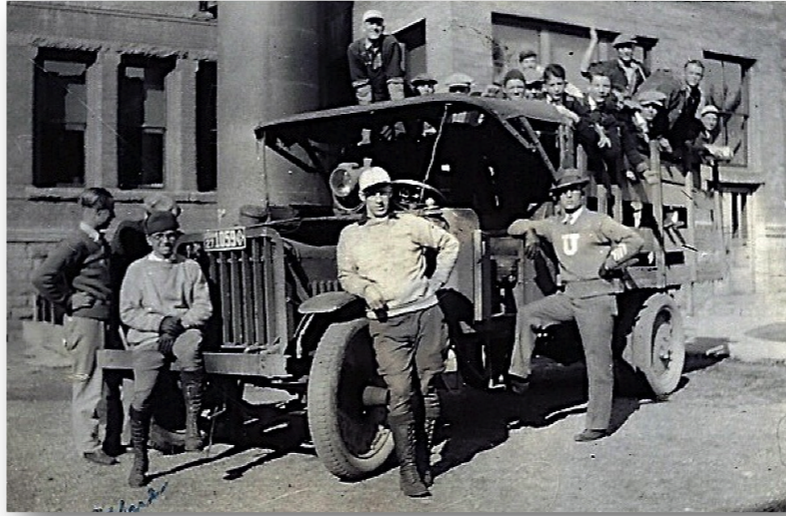
Students of the Utah School for the Deaf, May 20, 1927. An old truck with piles of USD students behind the Annex Building & fire escape cylinder. Seated on the bumper is Wayne Stewart. Standing to his right is Cyrus Freston. Kenneth Burdett is standing tall above the cab of the truck. The first two standing nearest in the bed of the truck are Joseph Burnett (left) and Verl Throup (right)
The majority of the Deaf community had positive memories of their residential school, where they shared a common language, culture, and identity. They called it "home." To convey the history of the school and the impact of the oral and mainstreaming of Ogden's Residential School, I'll use the terms "institution," "Ogden's Residential School," or "state school" on this webpage.
This website is a platform to educate the public about the efforts of Utah's Deaf leaders to safeguard their language, heritage, and culture. It's important to note that this website does not seek to criticize or disparage any individual or group. Please do not publish, distribute, or replicate the information, content, or materials on this website for any purpose other than education.
If you notice any inaccuracies or have additional information or materials to provide regarding Utah Deaf history, your input is invaluable. Please do not hesitate to contact me at [email protected]. I am committed to ensuring accuracy and completeness in my work and greatly appreciate your feedback or contributions.
Thank you for visiting the site, and I hope you find it entertaining, educational, and informative!
Enjoy!
Jodi Becker Kinner
This website is a platform to educate the public about the efforts of Utah's Deaf leaders to safeguard their language, heritage, and culture. It's important to note that this website does not seek to criticize or disparage any individual or group. Please do not publish, distribute, or replicate the information, content, or materials on this website for any purpose other than education.
If you notice any inaccuracies or have additional information or materials to provide regarding Utah Deaf history, your input is invaluable. Please do not hesitate to contact me at [email protected]. I am committed to ensuring accuracy and completeness in my work and greatly appreciate your feedback or contributions.
Thank you for visiting the site, and I hope you find it entertaining, educational, and informative!
Enjoy!
Jodi Becker Kinner
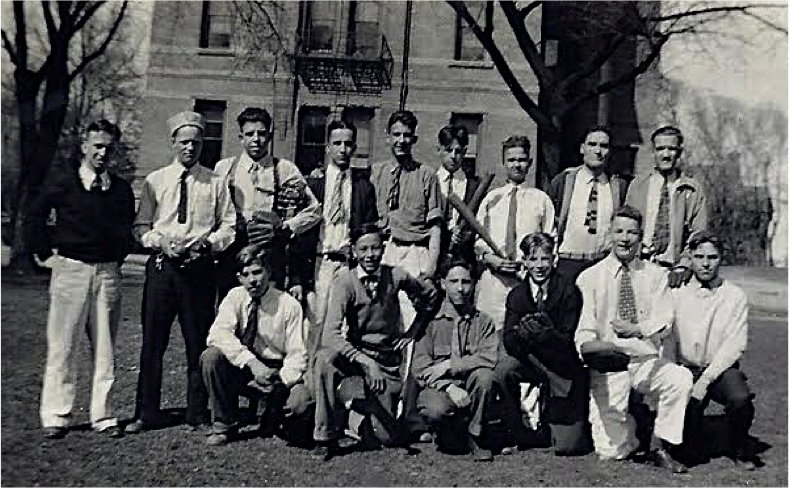
Students of Utah School for the Deaf, 1928-1930. Back L-R: Wayne Stewart, William Woodward, Alton Fisher, John (Jack) White, Joseph Burnett, possible Leon Edwards, Arvel Christensen, Virgil Greenwood, ____
Front L-R: J. Sherwood Messerly, Rodney Walker, Melvin Penman, Wesley Perry, Verl Throup, _____
"The ideology of Dr. Grant B. Bitter has had
a profound impact on the Utah Deaf community,
both in oral and mainstream settings."
~Jodi Becker Kinner~
a profound impact on the Utah Deaf community,
both in oral and mainstream settings."
~Jodi Becker Kinner~
